The Bridge of Arta: History, Legend and Architecture
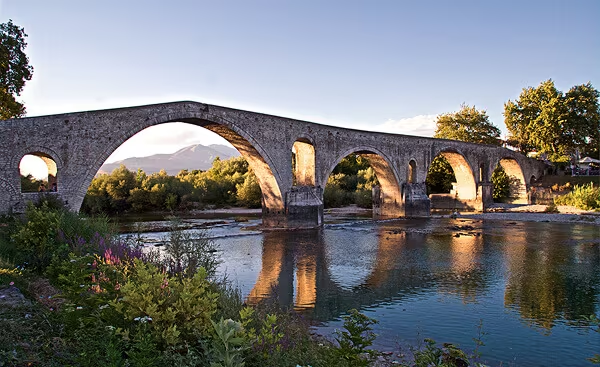
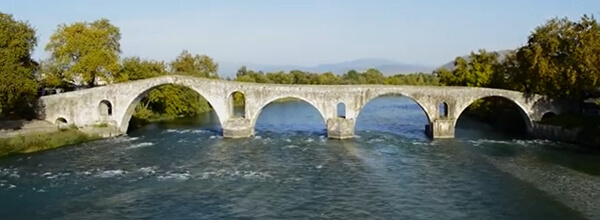
The Bridge of Arta is the most famous stone bridge in Greece. Spanning the river Arachthos on the western edge of the city, it is admired for its distinctive, asymmetrical arches and known across the Balkans through a haunting folk legend — that of the master builder who walled his own wife into the foundations to stop the bridge from collapsing. Behind the legend lies a real monument of layered history, raised and rebuilt across the Roman, Byzantine and Ottoman centuries.
Bridge of Arta — in brief
Location:
Arta, Epirus, Greece — over the river Arachthos
Length: about 142 m ·
Width: about 4 m (cobbled path 3.75 m) ·
Height: about 12 m
Structure:
four large arches on five piers, with smaller relief openings
Building phases:
possible Roman/ancient core · Despotate of Epirus · Ottoman
Present form:
early 17th century (the high arch rebuilt after its collapse in 1612)
Famous for:
the folk ballad of the master builder’s walled-up wife
Why was the bridge built here?
A permanent crossing of the Arachthos was not a luxury but a necessity. The river is wide and notoriously violent — the catastrophic flood of 1215 swamped much of Byzantine Arta — yet it was also the city’s lifeline. Medieval Arta was the thriving capital of the Despotate of Epirus and one of the busiest trade hubs of the region, frequented by Venetian and Ragusan merchants. The Arachthos was navigable up to the city, linking it through the port of Kopraina to the Ambracian Gulf and the sea routes toward Italy, the Adriatic and the Balkans.
The bridge was the land half of that network. It carried the produce of Arta’s fertile hinterland — grain, livestock, fish, dried meat, furs — across the river and into the city, where an organised market stretched along the road climbing to the main gate of the Castle of Arta, the seat of the despots. A reliable crossing therefore meant control of trade, communications and revenue, which is why successive rulers — Byzantine and Ottoman alike — kept rebuilding it after every flood and collapse. For the despots, a monumental bridge was also a statement of prestige, a visible sign of the wealth and ambition of their capital.
Standing watch beside the crossing is one of the oldest churches in the city, the little Church of Saint Basil of the Bridge (Agios Vasileios tis Gefyras), whose very name records how closely the life of medieval Arta was bound to its river crossing.
History and dating
The bridge has been rebuilt many times, and scholars still disagree on its origins. According to the Epirote chronicler Panayiotis Aravantinos, a bridge first stood here under the Roman Empire, and archaeologists have noted that the lowest visible piers share features with the ancient fortifications of Arta — raising the possibility of an even older core going back to the city of Ambrakia. Recent studies, however, caution that the course of the Arachthos was probably different in antiquity, which complicates any claim of a continuous ancient structure.
A strong tradition links the bridge to Arta’s golden age as capital of the Despotate of Epirus, when the despots invested heavily in the city’s infrastructure. Most scholars accept a Byzantine contribution and attribute a major phase of the masonry — up to the springing of the arches — to the 13th century, possibly under Michael II Komnenos Doukas (r. c. 1230–1266/68).
Building across the wide, flood-prone Arachthos was never easy. Sources record that between 1215 and 1222 several bridges on the river — both timber and stone — were swept away, and the catastrophic flood of 1215 is said to have inundated much of Arta and driven many inhabitants to leave. Later tradition credits the despot Nikephoros I Komnenos Doukas and his wife Anna Palaiologina Kantakouzene with commissioning both the great church of the Panagia Paregoritissa and a new bridge to restore the morale of the city.
Whatever its medieval form, the bridge as it stands today is essentially an Ottoman work. It was repaired after the Ottoman conquest of Arta in 1449 — the traveller Evliya Çelebi attributes a rebuilding to the conqueror Faik Pasha — but most scholars read this as repair of an older structure rather than a wholly new bridge. The decisive moment came in 1612, when the main high arch collapsed (or was demolished) and had to be rebuilt over roughly three years. Following Theocharis Tsoutsinos, the prevailing view dates the bridge’s final form to this early-17th-century campaign, with the great arch raised higher than before — a difference still visible in the masonry, which is uniform across the bridge except on that central span.
Architecture and construction
The Bridge of Arta carries a cobbled pedestrian path roughly 3.75 metres wide and rises asymmetrically to a height of about 12 metres. Its silhouette is unmistakable: four large semicircular arches of unequal span, carried on five piers set in the riverbed, give the bridge its characteristically uneven, almost playful profile. Between and above them are smaller arched openings, which served a practical purpose — channelling floodwater and relieving pressure on the structure during the violent rises of the Arachthos.
The builders worked in slate, bound with a remarkably elaborate mortar: a mixture of ground tile, lime, pumice, soil, water and dried grass, to which egg whites and goat hair were added for extra strength and elasticity. It is partly to this binding that the bridge owes its survival.
A popular reading sees Christian symbolism in the design, counting the arches and openings together as twelve — taken to represent the Twelve Apostles, with the four great arches standing for the four principal Apostles and a single off-axis opening for Judas the betrayer. This interpretation is symbolic rather than structural: as an engineering matter the bridge rests on four main arches and five piers, and the smaller openings are flood-relief vents. But the symbolic reading is old, and it hints that a Byzantine design sensibility may lie beneath the Ottoman fabric.
The legends about the Bridge of Arta
The famous folk ballad
More than its stones, it is a song that has made the bridge immortal. Tis Artas to Gefyri (“The Bridge of Arta”) is one of the most famous folk ballads in the Greek world, an acritic demotic song preserved in more than three hundred recorded variants.
The ballad tells how forty-five master masons and sixty apprentices laboured to raise the bridge, “all day they were building it, and in the night it would collapse.” At last a bird with a human voice revealed the terrible price: the structure would never stand unless the head builder sacrificed his own wife, walling her alive into the foundations. The belief beneath the story is ancient — that a great building must be secured by a living soul, whose spirit then becomes the guardian of the work.
As she is immured, the wife first curses the bridge, that it should tremble like a leaf and its travellers fall like leaves. Then, reminded that her own brother is abroad and might one day cross it, she softens her words into a blessing: as the mountains stand firm, so shall the bridge stand firm, and so shall those who pass over it. The motif of the “walled-up wife” is shared across the Balkans — the Serbian Building of Skadar and the Romanian Meșterul Manole (the Argeș Monastery) tell strikingly similar tales — and even echoes Western legends such as that of Vortigern’s collapsing tower in the Merlin cycle. The ballad has given modern Greek a proverbial phrase for any project plagued by endless delays: “like the Bridge of Arta.”
The legend of the “Cat-eater”
A second, gentler legend attaches to the bridge’s last great rebuilding. The reconstruction of the collapsed arch after 1612 is said to have been financed entirely by a humble Arta grocer named Ziannis Thiakogiannis, nicknamed Gatofagos (“the cat-eater”), who is supposed to have paid for the whole costly undertaking out of his own pocket — thanks, the story goes, to a hidden treasure he had found. Like the ballad, the tale grew up around a real event: the long, expensive repair of the bridge’s central span in the early 17th century.
A bridge on the border
The bridge also had a place in modern history. From the annexation of Arta to the Kingdom of Greece in 1881 until the outbreak of the First Balkan War in 1912, the highest point of the Bridge of Arta marked the actual frontier between the Ottoman Empire and the Greek state — travellers crossing its crown passed from one country into another. Today the bridge is a protected monument under the Hellenic Ministry of Culture and one of the enduring symbols of Arta and of Epirus.
FAQ
Why is the Bridge of Arta famous?
For its distinctive asymmetrical stone arches and, above all, the folk legend of the master builder who walled his wife into the foundations to stop the bridge from collapsing — one of the best-known stories in Greek folklore.
Who built the Bridge of Arta?
It has a layered history: a possible Roman or ancient core, a Byzantine phase under the Despotate of Epirus, and major Ottoman reconstruction. Its present form dates to the early 17th century.
How old is the Bridge of Arta?
The current bridge took shape around 1600–1613, after the central arch collapsed in 1612 and was rebuilt, but earlier bridges stood on the site and some piers may be far older.
What is the legend of the Bridge of Arta?
A folk ballad in which builders’ work collapses every night until a bird tells the head mason he must sacrifice his wife. She is immured in the foundations, and her dying curse turns to a blessing so the bridge will stand.
Sources & further reading
- Bridge of Arta — Wikipedia
- Historical Bridge of Arta — DiscoverArta (Municipality of Arta)
- Tis Artas to Gefyri — The Bridge of Arta in Greek folk song (Boston Lykeion Ellinidon)
- Pirates from Algiers, the “Cat-eater” and the Bridge of Arta — Archaeology Wiki
- Artemis Leontis, “The Bridge between the Classical and the Balkan,” The South Atlantic Quarterly 98:4 (1999), 625–631.
- Theocharis Tsoutsinos and A. Schismenos (2000), on the dating and reconstruction phases.