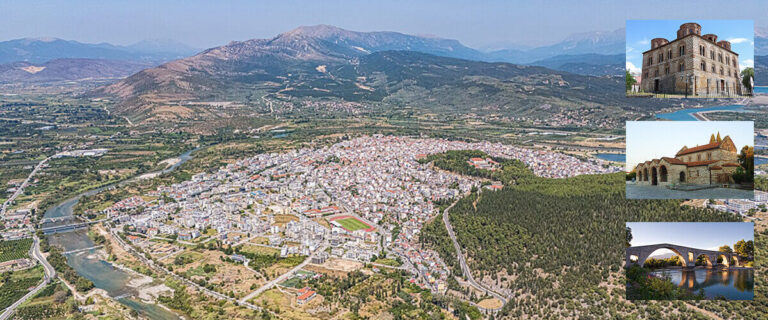
Epirus in Byzantine history: From periphery to political center
Epirus is a mountainous region of northwest Greece, stretching between the Pindos range and the Ionian Sea. For much of its history, it formed a frontier zone of the Byzantine Empire, valued for its coastal routes and its position between the Greek mainland and the western Adriatic world. Its rugged landscape favored defense, and Epirus often served as a buffer against foreign incursions. Over time, local elites strengthened their authority, and the region gained political and cultural significance. After the Fourth Crusade in 1204, Epirus emerged as an independent center of power, with Arta as its capital. The Despotate of Epirus developed into a lasting regional state, flourishing in art, culture, and diplomacy. Although its territory fragmented and shrank over time, and foreign influence continued to grow, Epirus remained an independent power well into the 15th century, with its last territories falling to the Ottomans only in 1479.
History of Epirus from late Antiquity to 1204.
Epirus had a long pre-Byzantine history, with its most famous ruler being Pyrrhus in the 3rd century BCE. Under Roman rule, the region was organized around the colony of Nicopolis. Probably under Diocletian, Epirus was administratively separated from Achaia. By the early 4th century, it was divided into Epirus Vetus (Old Epirus) in the south and Epirus Nova (New Epirus) in the north. Both provinces belonged first to the Diocese of Moesia and later to that of Macedonia.
Epirus during the Early Byzantine period.
In Late Antiquity, the region suffered from several raids, especially by the Vandals in the 5th century. Justinian reinforced urban defenses, and according to Hierokles, a contemporary writer, the province of Old Epirus counted twelve cities, with Nicopolis as its capital, while Epirus Nova had nine cities and Dyrrachion as its capital.
However, from the late 6th to the 7th centuries, Slavic groups advanced into Epirus. They settled mainly in the mountainous interior, leading to the decline or even disappearance of many older cities – though they were often replaced by new settlements. Numerous Slavic place names bear witness to their presence, and in these regions they constituted a significant part of the local population for a long time. The coastal zones of Epirus, however, remained predominantly Greek.
Until around 800, the main ecclesiastical center remained Nicopolis. Archaeology shows many early Christian basilicas along the coast, for instance in Butrint or Saranda. Later monuments, however, appear more inland, especially around the area of Arta. This shift suggests a movement of population from the coast toward more protected interior zones.
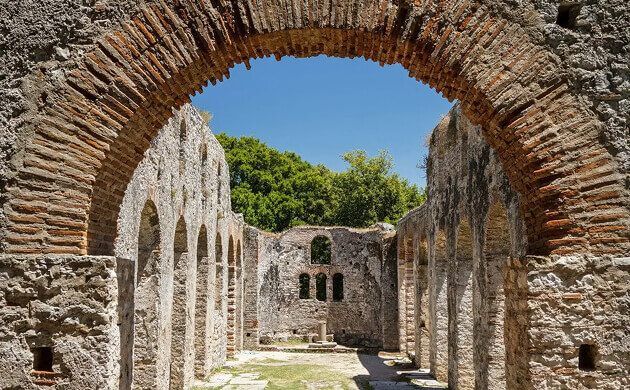
Ruins of the Early Byzantine Great Basilica of Butrint, Epirus 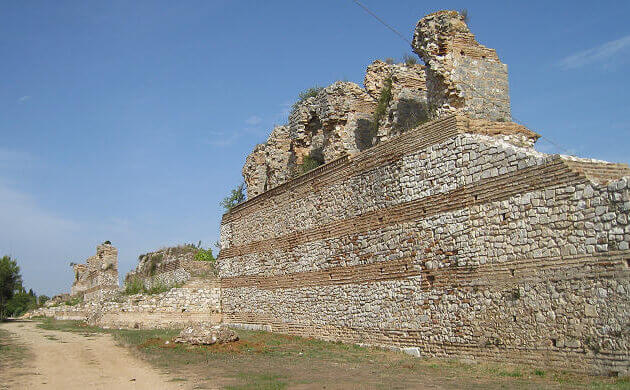
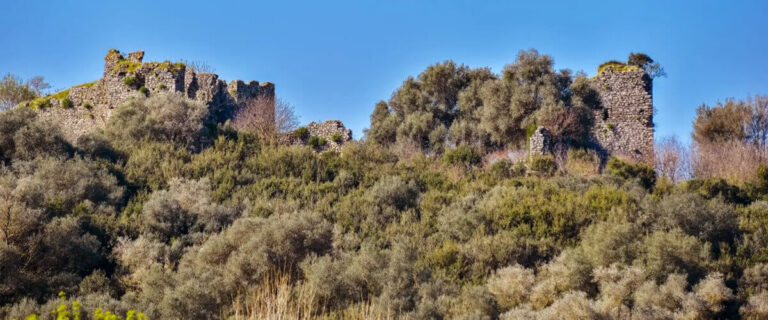
Ruins of the Byzantine walls of Nicopolis, in Epirus, erected by Emperor Justinian
Epirus in the Middle Byzantine period.
Byzantine control was gradually restored from the 8th century onward, largely through maritime routes. To defend the Balkans, the Byzantines implemented the theme organization, and the themes of Dyrrachion and Nikopolis were created in the 9th century. Nevertheless, the Bulgars took control of the region, following the Battle of Bulgarophylon in 896. Their rule lasted several decades, and they even managed to maintain domination on some areas until Emperor Basil II crushed the first Bulgarian Empire in 1018. The Bulgarian rule strengthened the Slavic element in the Epirote population.
In the 9th century, ecclesiastical authority moved from Nicopolis to Naupaktos, whose bishopric oversaw several important suffragan sees in the 10th century, including Bounditza, Aetos, Acheloos, Rogoi (or Arta), Ioannina, Drynoupolis, Photike (or Bella), and Bouthroton. The building of new churches, especially between the late 9th and 11th centuries, suggests that the region experienced some prosperity at that time.
Between 1081 and 1108, Epirus suffered repeated attacks from the southern Italian Normans under Robert Guiscard and his son Bohemond of Taranto. In 1085, the Normans even succeeded in capturing Ioannina. Pursued by Emperor Alexios I, Bohemond fortified the city but was ultimately defeated at Durazzo and was compelled to accept the Treaty of Devol.
By the late 12th century, the region was organised in several smaller administrative and fiscal units. A chrysobull of 1198 lists the provinces of Dyrrachion: Jericho, Ioannina, Drynoupolis, and Nikopolis, as well as privately managed land units (episkepseis) such as Arta and Acheloos.
The Late Byzantine Period: The Despotate of Epirus.
The Despotate of Epirus emerged after the fall of Constantinople in 1204. Alongside the empires of Nicaea and Trebizond, it claimed continuity with Byzantine imperial legitimacy. The term “Despotate” itself first appeared officially only in 1342. The ruling dynasty descended from the Angelos line, but adopted the prestigious names Komnenos and Doukas, to whom they were also related, though more distantly.
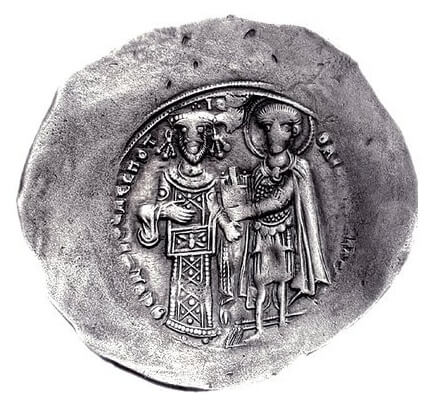
Michael I Komnenos Doukas founded the state, asserting his control over the entire northwestern coast of Greece and much of Thessaly. He established Arta as his political center. His brother Theodore expanded into Macedonia and captured Ohrid in 1216 and Thessaloniki from the Latins in 1224. There, he was crowned emperor in rivalry with Nicaea. He even besieged Constantinople, which he hoped to recover.
However, his ambitions came to an end after a major defeat by the Bulgars at the Battle of Klokotnitsa in 1230, which definitively shattered the wider political aspirations of Epirus. Theodore’s son, John, was compelled by John III Vatatzes to exchange the title of “emperor” for that of “despot” in 1242. In 1246, Nicaea annexed Thessaloniki, and most of Theodore’s gains were lost. At the beginning of the reign of Michael II Komnenos Doukas, and following the defeat at Pelagonia in 1259, Epirus was even invaded and occupied for a time by Nicaean forces.
However, they encountered strong resistance, and independence was restored in 1264. The reign of Michael II Komnenos Doukas and his successors — who maintained their rule until 1318 — marked a period of artistic and architectural flourishing, with the construction of numerous civil, military, and religious buildings, particularly in and around the capital, Arta.
Due to its geographical isolation and the barrier of the Pindos mountain range, it managed to remain separated from the Byzantine Empire most of the time. Yet, the Byzantine emperors always regarded the rulers of Epirus as rebels or vassals and maintained the right to confer the title of despotes. The same geography made Epirus more open to Western influences than other Greek states, both culturally and politically. Its rulers had to repel the ambitions of surrounding Latin states: Achaia in the south, the Angevins in Naples, and the Orsini, counts of Zakynthos and Cephalonia. The latter family managed to take control of the Despotate in 1318, through the murder of the despot Thomas by his nephew Nicholas Orsini.
Foreign Influence and Ottoman Conquest
The Orsini held Epirus until 1347. A short Greek restoration followed, but soon the Serbian state of Stefan Dušan occupied the region. Their rule was unpopular and fragile. In the later 14th century, Albanian clans, notably the Spatas, controlled Arta. The Serbs retained Ioannina from 1366 to 1384, before it passed under the control of Italian lords, first Esau Buondelmonti and later the Tocco family, who also seized Arta in 1416, ending the Albanian rule over the region.
However, at the same period, the Ottomans presence was strengthening in Greece. Ioannina fell in their hands in 1430, and Arta in 1449, Angelokastro (in Aetolia). The shrinking Despotate of Epirus disapperead finally with the fall of Vonitsa in 1479.
Society in Byzantine Epirus
Due to its history and geographical position, the population of Epirus was never homogenous. In the 13th century, it was inhabited primarily by Greeks, alongside Slavs (referred to in the sources as Macedonians, Bulgarians, or Drougobites), Albanians, Vlachs, Jews, Turks, Armenians, and Latins. The surviving documents of the period depict a society largely composed of free peasants, who lived in communities and enjoyed the right of protimesis. In the towns, there existed a strong landowning class, which was also mostly made up of free peasants. Dependent peasants were comparatively rare, a situation that contrasts with the broader trend within the Byzantine Empire, where from the Middle Byzantine period onward the free peasantry had been increasingly replaced by dependent peasants under the authority of the dynatoi.
Administratively, the region was divided into several themes (such as Bagenetia, Acheloos, Skopje, and Drama), each typically comprising a single town and its surrounding territory. The governor of a theme was most commonly known as the doux, though the titles kephale or energon are also attested. The most important cities of Epirus were Nikopolis, Butrint during the Early Byzantine times, and later Ioannina and Arta – which was the capital of the Despotate in the 13th century.
Hellenization or Albanization of the Epirote Slavs has been a long lasting process, already ongoing during Byzantine times, but which was only completed in the 17th century under the Ottomans.
Surviving Monuments and Byzantine Artistic Legacy in Epirus.
While Epirus has preserved some Early and Middle Byzantine monuments, especially in cities such as Butrint, Nikopolis, and Arta, its main artistic and architectural flourishing took place at the height of its power in the 13th century.