The Rotunda of Thessaloniki: From Roman Mausoleum to one of the world’s oldest churches
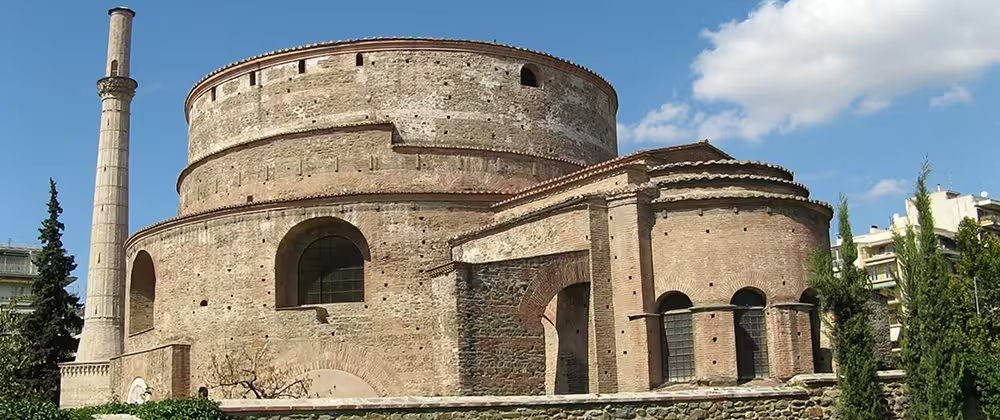
In the heart of Thessaloniki stands a building that has served three faiths across seventeen centuries. The Rotunda was raised around 300 CE by the Roman emperor Galerius — as his mausoleum, or perhaps a temple — converted into a church within a century, perhaps two, of its construction, and later served the city as a mosque. It is quite possibly the oldest building in the world still in use, at least occasionally, as a Christian church. And high in its dome survives one of the supreme achievements of early Christian art: a vast golden mosaic of martyrs standing before dreamlike heavenly palaces, created when the mosaic tradition of Byzantium was just being born.
Visiting Thessaloniki? The Rotunda is the first stop in our complete guide to the city’s Byzantine monuments.
Quick facts
Built
c. 300 CE under Emperor Galerius, as part of his palace complex
Original purpose
Debated — mausoleum for Galerius or a temple (he was ultimately buried in present-day Serbia)
Became a church
Late 4th century (most likely under Theodosius I, 379–395); dedicated probably to the Asomatoi (Archangels)
Dimensions
Interior diameter c. 24.5 m; height to the crown of the dome 29.8 m
Famous for
The dome mosaics — among the earliest surviving wall mosaics of the Christian world
Ottoman era
Mosque from 1590–91; its minaret still stands
UNESCO
World Heritage Site since 1988 (Paleochristian & Byzantine Monuments of Thessaloniki)
Visiting
Roughly 8:00–20:00 in summer, 8:30–15:30 in winter; entry €10 (reduced €5) — check locally
An emperor’s monument without an emperor
The Rotunda was built as part of the great imperial quarter that the tetrarch Galerius laid out in Thessaloniki around 300 CE — a complex that included his palace, the hippodrome, and the triumphal arch (the Kamara) that still spans the old Via Egnatia a few hundred metres to the south. A colonnaded processional way connected arch and Rotunda in a single ceremonial axis; walking between them today, you are following the route Galerius intended.
What the building was for is one of the oldest puzzles in Roman architecture. Its cylindrical form — unique in Greece, and inevitably compared to the Pantheon in Rome — matches the great imperial mausoleums of the tetrarchic age, and the mausoleum idea is the most widely repeated theory. But there is a problem: Galerius died in 311 and was buried at Felix Romuliana, in present-day Serbia, not in Thessaloniki. His rotunda, if it was a tomb, never received its occupant. Other scholars have argued it was a temple, perhaps of Zeus — patron god of Galerius and his senior emperor Diocletian — or of the Kabeiroi, the mystery deities of the region. A minority of researchers has even proposed a third candidate: a mausoleum intended for Constantine the Great, around 322–323, when he was considering making Thessaloniki his capital — a hypothesis the city’s own tourism guide repeats, though it remains far from consensus.
There is a final irony in the founder’s story. Galerius was the chief instigator of the empire’s last and fiercest persecution of Christians — yet he revoked it himself. His Edict of Toleration, issued from his sickbed on 30 April 311, legalized Christianity just days before his death. Within a century, his own rotunda was a church.
The structure itself is Roman engineering at full confidence: a brick dome nearly 25 metres across resting on rubble-and-brick walls of enormous thickness, hollowed at ground level by eight barrel-vaulted recesses, with a ring of windows above and originally an opaion — an open oculus, like the Pantheon’s — at the crown.
The conversion: one of the oldest churches in the world
Within a few generations, the empty pagan monument found its permanent purpose. At some point between the late 4th and early 6th century — most probably during the reign of Theodosius I (379–395), who resided in Thessaloniki for long periods — the Rotunda was converted into a Christian church, probably dedicated to the Asomatoi, the Archangels. If the earlier dating is right, the building has now served Christian worship, with interruptions, for over 1,600 years — a claim very few standing structures on earth can match. It is certainly the oldest of Thessaloniki’s churches, in a city that has the densest concentration of early churches in Greece.
The conversion was radical. The east recess was cut open to create a sanctuary with an apse; an ambulatory eight metres wide was wrapped around the Roman core, nearly doubling the building’s area (it collapsed, probably in the earthquakes of the early 7th century, and was never rebuilt); a narthex was added at the west; and the south entrance — the one facing the palace — received a monumental porch flanked by two chapels. That emphasis on the palace axis has led some scholars to see the converted Rotunda as an imperial church, the emperor’s own.
One furnishing of the great church survives — in exile. The Rotunda’s monumental marble ambo, a fan-shaped pulpit of the early 6th century carved with the Adoration of the Magi, was carried off to Constantinople in the late Ottoman period and stands today in the Istanbul Archaeological Museum; only its base remains in Thessaloniki.
The dome mosaics: heaven rendered in gold
The reason the Rotunda matters to the history of art is overhead. Its dome and vaults preserve mosaics that are among the earliest wall mosaics to survive anywhere in the Christian world — the work, remarkably, of a local Thessalonian workshop, created most likely in the decades around 400.
Their precise dating, like the conversion itself, is one of the longest-running arguments in Byzantine studies, and the stakes are real: the Norwegian scholar Hjalmar Torp, who studied the building for over sixty years, argued that the Rotunda was rebuilt as the palace church of Theodosius I around 380–390, while others — following W. E. Kleinbauer — place the mosaics in the mid-5th century, and some as late as c. 500. A century of scholarly argument over brick-stamps, sculpture and style is summed up in Torp and Bente Kiilerich’s monumental 2017 study.
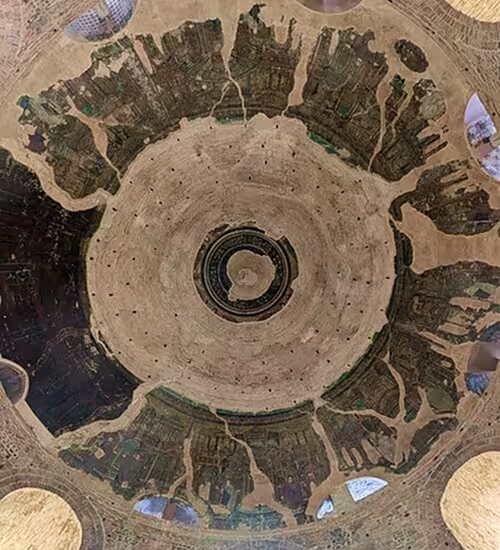
The programme rises through three zones, from earth toward heaven:
The martyrs’ zone. The lowest and best-preserved band is divided into eight great panels. Against a shimmering gold ground rise fantastic two-storey architectural facades — colonnades, domes, screens, hanging lamps, gospel books on altars — studded with pearls and jewels, their ancestry reaching back to Roman stage-fronts and the rock-cut tombs of Petra. This is not earthly architecture but the heavenly church. Before these buildings stand fifteen surviving martyrs in the orant pose of prayer, each labelled with his name, his role and the month of his feast — soldiers, bishops, physicians, a courtier — an illustrated calendar of saints whose faces are executed with the precision of true portraits. You can still read the inscriptions: “Damianos, physician — month of September”; “Philippos, bishop — month of October”; the young soldiers Onesiphoros and Porphyrios share the month of August. One panel, destroyed when part of the dome fell, was replaced in 1889 by a painted imitation by the restorer Rossi.
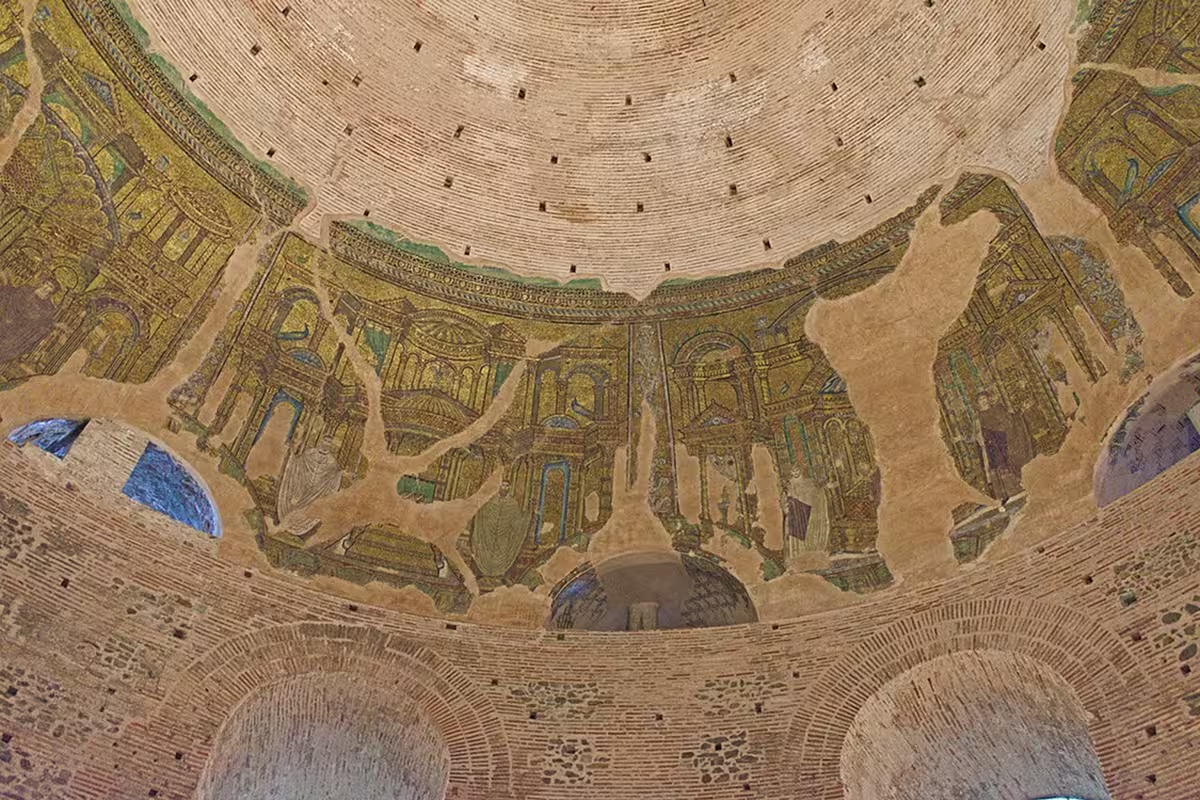
The middle zone. Almost nothing survives except rows of sandalled feet standing on grass and traces of white, wind-stirred drapery — enough to show a procession of vigorously moving figures, apostles or angels; scholars still argue which.
The summit. At the crown of the dome, three angel heads (of an original four) and a phoenix — ancient symbol of immortality — support a “glory” of stars, wreath and rainbow. Inside it stood Christ triumphant, holding a cross-staff. The figure itself is lost, but its preparatory sketch, drawn in charcoal directly on the Roman brickwork, is still visible — the ghost of the image, seventeen centuries old, showing exactly where heaven’s king once stood.
The vaults of the recesses below carry superb non-figural mosaics — octagons with birds and fruit, a silver-ground “carpet” spread around a golden cross, interlocking circles — whose colour palettes were deliberately tuned to the different light of each space.
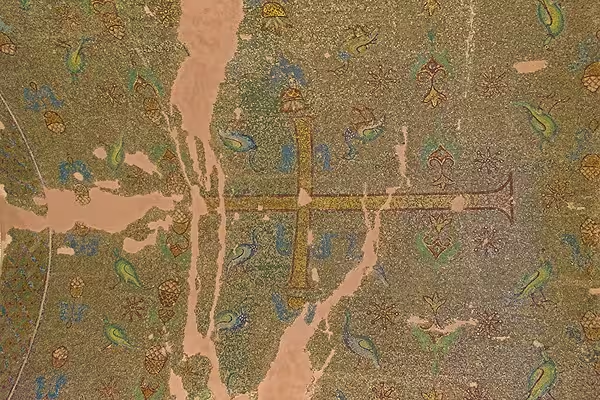
Cross, birds and vegetals. © Ymblanter, CC-by-SA 4.0 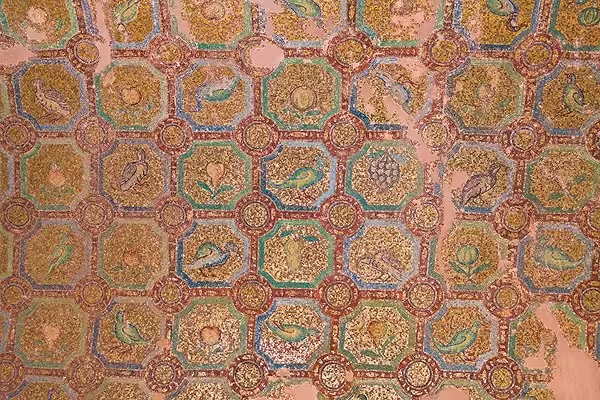
Birds and flowers in octogons. © Ymblanter, CC-by-SA 4.0 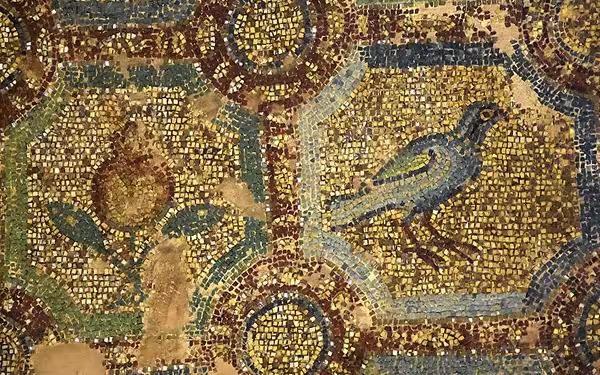
Bird and flower, detail. © Phryrexian, CC-by-SA 4.0
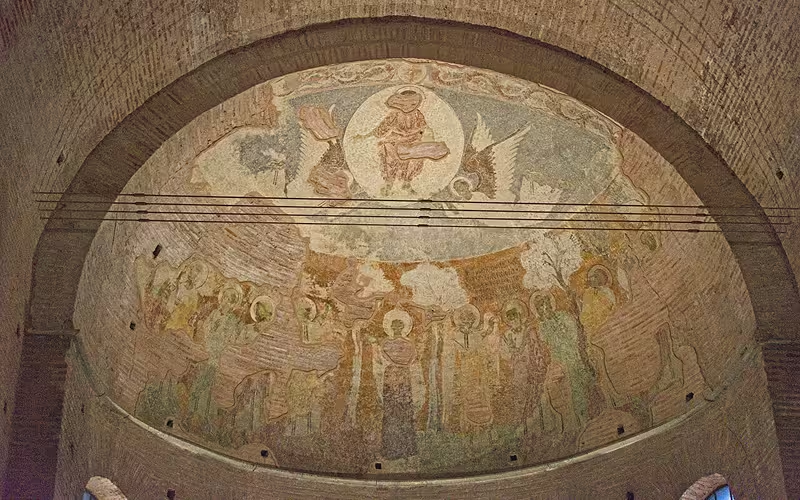
In the apse, a fresco of the Ascension was added in the late 9th century, echoing the composition then being created in the dome of the city’s Hagia Sophia — possibly by the same workshop.
Metropolis, mosque, museum
The Rotunda served Thessaloniki’s Christians for over a millennium. After the Ottomans converted the city’s Hagia Sophia into a mosque, the Rotunda even became the metropolitan church of Thessaloniki (1523/24–1590/91) — the seat of its archbishop. Then, in 1590–91, it too was converted into a mosque. The elegant minaret that still stands beside it — the only one left in Thessaloniki — dates from this period, built over the ruins of the early Christian ambulatory, along with the fountain to the west and the Ottoman tombs east of the sanctuary. Travellers of the period knew the building as the Old Metropolis (Eski Metropol); the name Agios Georgios, still in use today, comes from the small church of Saint George that faces the Rotunda’s west gate.
After Thessaloniki returned to Greece in 1912, the building briefly resumed Christian worship before archaeological excavation began in 1914; in 1917 it was designated a museum. During the First World War, when Allied armies filled the city, the archaeological service of the French Armée d’Orient studied and photographed the arch and the Rotunda — work published in 1920 by the architect Ernest Hébrard, the same man who redesigned Thessaloniki after the great fire of 1917.
The earthquake of 1978 — striking weaknesses created by the ancient conversion itself, where the Roman wall had been cut open for the sanctuary — caused serious damage and set off one of the longest restorations in Greek history. For nearly four decades, visitors saw the dome through a forest of internal scaffolding; it finally came down in December 2015, when the restored monument reopened with new lighting — the first unobstructed view of the mosaics in a generation. Since 1988 the Rotunda has been a UNESCO World Heritage Site, and today it functions as a monument under the Ministry of Culture, with Orthodox liturgy celebrated on certain feast days — meaning a building begun under a persecutor of Christians still, occasionally, hosts the Christian rite 1,700 years later. Scholars of heritage regularly pair it with Istanbul’s Hagia Sophia as the two great case studies of a building contested between faith and museum — a monument whose ownership has been argued over, in one form or another, for seventeen centuries.
Visiting the Rotunda
The Rotunda stands just north of the Arch of Galerius (Kamara), five minutes’ walk from the Kamara bus stops and about fifteen minutes on foot from Aristotelous Square. Visit the two together — they were built as one ensemble. Opening hours are roughly 8:00–20:00 in summer and 8:30–15:30 in winter; entry is €10, reduced €5 (some sources report a Tuesday closure — hours and prices change, so check locally before you go). Bring binoculars or a good zoom lens if you can: the martyrs’ portraits are 30 metres above the floor, and the detail rewards magnification. Morning light through the southern windows is best for seeing the gold ground come alive.
From here, our guide to Byzantine Thessaloniki continues to Saint Demetrios, Osios David and the churches of Ano Poli — and the mosaics of Saint Demetrios, a short walk north, make the natural next stop.
Frequently asked questions
Is the Rotunda the oldest church in the world?
It is one of the oldest buildings in the world still used for Christian worship. The structure dates to c. 300 AD and probably became a church in the late 4th century. A few purpose-built churches elsewhere are older as churches, but very few standing buildings anywhere have housed Christian worship for so long.
Was the Rotunda built as Galerius’ tomb?
Possibly — its form matches the imperial mausoleums of the age, and this is the most widespread theory. But Galerius was buried at Felix Romuliana in modern Serbia, and some scholars believe the Rotunda was instead a temple, perhaps of Zeus. Its original purpose remains genuinely unresolved.
Are the mosaics original?
Yes — the dome and vault mosaics are original late Roman/early Byzantine work of around 400 AD (scholarly datings range from the 380s to about 500), among the earliest wall mosaics of the Christian world. Only one dome panel is a modern (1889) painted replacement, and the figure of Christ at the summit is lost, though its charcoal underdrawing survives.
Is the Rotunda a church or a museum?
Both, in a sense: it is a monument administered by the Greek Ministry of Culture and open to visitors with a ticket, but Orthodox services are held on certain feast days.
How much does it cost to visit?
€10 (reduced €5), per the Ministry of Culture. Hours are longer in summer (to about 20:00) than winter (to mid-afternoon). Check locally, as hours and prices change.
Why is there a minaret next to the Rotunda?
The Rotunda served as a mosque from 1590–91 until 1912. Its minaret — the only one surviving in Thessaloniki — was preserved as part of the monument’s layered history.
Sources and further reading
- UNESCO World Heritage Centre, Paleochristian and Byzantine Monuments of Thessalonika.
- Hellenic Ministry of Culture, Rotonda, Thessaloniki (Odysseus portal) and The Galerian Complex: Rotunda.
- David Hendrix, “Rotunda of Galerius”, The Byzantine Legacy.
- A. Tourta & E. Kourkoutidou-Nikolaidou, Wandering in Byzantine Thessaloniki, Kapon Editions.
- B. Kiilerich & H. Torp, The Rotunda in Thessaloniki and its Mosaics, Kapon Editions, 2017.
- Ch. Bakirtzis (ed.), Mosaics of Thessaloniki, 4th–14th Century, Kapon Editions, 2012.
- S. Ćurčić, Architecture in the Balkans: From Diocletian to Süleyman the Magnificent, Yale University Press, 2010.
- R. Krautheimer, Early Christian and Byzantine Architecture, Yale University Press.
- Alexander Kazhdan (ed.), The Oxford Dictionary of Byzantium, Oxford University Press, 1991.
Image cover credits: Filip Maljkovic, CC by-SA 2.0