Byzantine Art Museums — The world’s greatest collections
The great collections of Byzantium
The art of the Eastern Roman Empire — luminous icons, gold and enamel jewellery, carved ivories, imperial silver, lead seals and illuminated manuscripts — survives today in a handful of extraordinary museums. Some are devoted entirely to Byzantium; others fold world-class Byzantine holdings into encyclopedic collections. This guide rounds up the museums with the most extensive and interesting Byzantine collections anywhere, so you can plan a visit around the objects themselves. We begin with the great dedicated museums, then turn to the encyclopedic giants and other essential stops.
Byzantine and Christian Museum, Athens
If one museum defines the field, it is this one. Founded in 1914 and devoted entirely to Byzantine and post-Byzantine art, the Byzantine and Christian Museum holds some 25,000 objects spanning the 3rd century to the late medieval era — icons, sculpture, mosaics, frescoes, manuscripts, textiles and pottery. The breadth is unmatched by any other single-subject museum, making it the natural first stop for anyone serious about Byzantine art.
Museum of Byzantine Culture, Thessaloniki
A short journey north brings you to one of Europe’s most admired museums. The Museum of Byzantine Culture won the Council of Europe Museum Prize in 2005 — the first Greek museum to do so — for the quality of its eleven thematic galleries. Highlights include an internationally acclaimed icon collection of more than 1,000 works, the richest collection of 3rd–8th-century funerary paintings in Greece, rare textiles and manuscripts, early Christian sarcophagi, and a numismatic collection of roughly 30,000 coins excavated in Thessaloniki and Macedonia. For storytelling and display quality, few rival it.
Museum für Byzantinische Kunst (Bode-Museum), Berlin
Housed in the magnificent Bode-Museum on Berlin’s Museum Island, the Museum of Byzantine Art holds the finest collection of Late Antique and Byzantine art in Germany, covering the 3rd to the 15th century.
Its strengths are exceptional: precious ivory carvings and mosaic icons that showcase the technical brilliance of Byzantine court art, liturgical objects from the early Christian church, and rare organic finds — wood and fabric — preserved by Egypt’s dry climate. Almost every region of the ancient Mediterranean is represented.
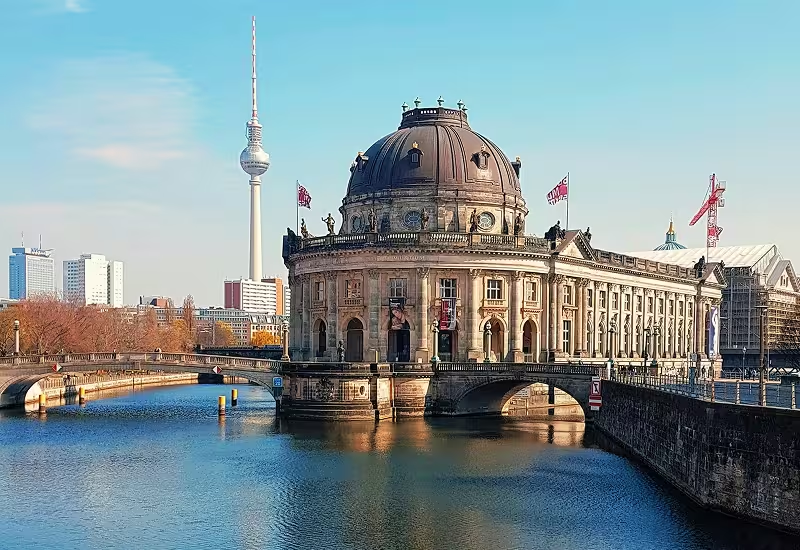
The Bode Museum’s three standout Byzantine works comprise the Mosaic Icon of Christ Pantokrator (first quarter of the 12th century CE), the Ivory Plaque of the Dormition of the Virgin (late 10th century CE), and the San Michele in Africisco Apse Mosaic from Ravenna (6th century CE).
Dumbarton Oaks, Washington, D.C.
For sheer quality of portable, sumptuous objects, Dumbarton Oaks is in a class of its own. Its Byzantine Collection comprises more than 1,200 objects from the 4th to the 15th century — jewellery, coins, ivories, metalwork and enamels of imperial, ecclesiastical and secular life — and it holds the most important collection of Byzantine lead seals in the world, some 17,000 specimens. Paired with its renowned research institute, it is the intellectual heart of Byzantine studies in the Americas.
The Metropolitan Museum of Art, New York
The Met’s Late Antique and Byzantine holdings are among the most comprehensive anywhere, spanning the 4th to the 15th century. In April 2026 the museum completed the reinstallation of its Byzantine galleries (Galleries 300–303), which frame the Great Hall stairs — meaning the collection is freshly displayed and, as permanent galleries, open year-round. It is the most reliable place in the United States to encounter the full sweep of Byzantine art.
The Louvre, Paris
Paris has made a major institutional commitment to the field with the creation of a dedicated Department of Byzantine Art and Eastern Christianities. The move anchors this material within one of the world’s most-visited museums and signals years of expanded display and scholarship — increasingly presenting Byzantine and Eastern Christian art as a coherent story rather than scattering it across other departments. Among the Louvre’s most remarkable artefacts, the Harbaville Triptych (mid-10th century CE), the Barberini Ivory (early 6th century CE), and the Icon of the Transfiguration (c. 1200 CE) particularly stand out.
The British Museum, London
The British Museum holds a rich permanent collection of Late Roman and Byzantine art — including celebrated silver treasures, fine jewellery and ivories — displayed across its galleries with free entry. It is also the originator of the forthcoming touring exhibition “Byzantium: splendour of East Rome,” offered to host venues from 2029, but its standing collection alone justifies a visit any time.
Istanbul Archaeological Museums
In the former Byzantine capital itself, the Istanbul Archaeological Museums preserve a major collection of Byzantine material drawn from Constantinople and beyond — architectural sculpture and capitals worked with the deep-drill technique characteristic of the city’s workshops, mosaics including the celebrated Four Seasons mosaic, gold jewellery, fresco fragments, coins and liturgical objects. Among the most evocative holdings are the porphyry sarcophagi from the Church of the Holy Apostles, the imperial mausoleum of the early Byzantine emperors. For encountering Byzantine art in the very city that produced it, no museum sits closer to the source.
Benaki Museum, Athens
A second essential Athens museum, the Benaki holds an exceptionally rich Byzantine collection: decorative silver plates of the late 6th and early 7th century that preserve Greco-Roman subject matter, gold jewellery set with sapphires, amethysts, emeralds and pearls, bronze and silver vessels, enamels, ceramics and manuscripts. Its icons trace iconography from the Byzantine and Palaiologan periods through the workshops of Crete and Mount Athos — an ideal complement to the Byzantine and Christian Museum across town.
Cleveland Museum of Art, United States
Often a surprise to visitors, the Cleveland Museum of Art holds one of the finest and most comprehensive collections of Early Christian, Byzantine and Western medieval art in the world, assembled over ninety years by two distinguished medievalist curators. Among its treasures is an ivory Virgin and Child counted among the finest to survive the Middle Byzantine period, alongside important painted icons.
The Balkans: Ohrid and Sofia
The Byzantine world reached deep into the Balkans, and two collections there are essential. The Icon Gallery of Ohrid (North Macedonia) holds one of the most important icon collections in the world — works from the 11th to the 19th century gathered from Ohrid’s churches, including the oldest icon in Macedonia (c. 1045/50), an unusually large number of double-sided processional icons, and masterpieces of the Palaiologan renaissance. Few major Byzantine exhibitions anywhere are mounted without borrowing from it.
In Bulgaria, the Museum of Christian Art in the crypt of the St Alexander Nevsky Cathedral in Sofia (part of the National Gallery) presents some 2,000 icons, frescoes and pieces of church plate from the 4th to the 19th century — among the richest displays of Orthodox Christian art in the region.
The National Museum of Serbia in Belgrade also holds notable medieval icons.
Also worth knowing
Beyond these, the Walters Art Museum in Baltimore holds strong Byzantine material (and periodically hosts loans from Dumbarton Oaks), while the Vatican Museums and the State Hermitage Museum in St Petersburg preserve significant Byzantine silver, icons and liturgical objects within their vast holdings. The monasteries of Mount Athos and the monastery of Saint John the Theologian on the island of Patmos also hold rich collections of icons, manuscripts, and other artifacts from Byzantine times.
At a glance
| Museum | City | Type | Known for |
| Byzantine and Christian Museum | Athens | Dedicated | ~25,000 objects; the broadest single-subject collection |
| Museum of Byzantine Culture | Thessaloniki | Dedicated | Award-winning displays; icons, funerary paintings, coins |
| Museum für Byzantinische Kunst | Berlin | Dedicated | Ivories, mosaic icons, Egyptian everyday objects |
| Dumbarton Oaks | Washington, D.C. | Collection + institute | 1,200+ objects; 17,000 lead seals (world’s largest) |
| The Met | New York | Encyclopedic | Comprehensive holdings; reopened galleries (2026) |
| The Louvre | Paris | Encyclopedic | New Byzantine & Eastern Christian department |
| The British Museum | London | Encyclopedic | Late Roman/Byzantine silver, jewellery, ivories |
| Benaki Museum | Athens | Encyclopedic (Greek) | Silver plates, gold jewellery, Cretan/Athonite icons |
| Cleveland Museum of Art | Cleveland | Encyclopedic | Early Christian–Byzantine masterpieces; ivories |
Frequently asked questions
What is the best museum for Byzantine art?
For a single dedicated collection, the Byzantine and Christian Museum in Athens is unrivalled in breadth (~25,000 objects). For object quality, Dumbarton Oaks in Washington and the Bode-Museum in Berlin are world leaders.
Where can I see the best Byzantine icons?
The Byzantine and Christian Museum and the Benaki Museum in Athens, and the Museum of Byzantine Culture in Thessaloniki, hold outstanding icon collections.
Is there a great Byzantine collection in the United States?
Yes — Dumbarton Oaks (Washington, D.C.), The Met (New York) and the Cleveland Museum of Art all hold collections of international importance.
Which museum has the most Byzantine seals and coins?
Dumbarton Oaks holds the world’s largest collection of Byzantine lead seals (~17,000); Thessaloniki’s Museum of Byzantine Culture holds about 30,000 coins from the region.
Conclusion
From the dedicated halls of Athens, Thessaloniki and Berlin to the sumptuous treasures of Dumbarton Oaks and the encyclopedic sweep of the Met, the Louvre and the British Museum, the world’s great Byzantine collections offer a lifetime of looking. Wherever you begin, you will find the same thing: an empire that poured its faith, wealth and artistry into objects that still hold the light a thousand years on. We’ll keep this guide updated as collections are redisplayed and reopened.
Most Byzantine mosaics can’t travel to a museum — here is where to see the most beautiful ones in place, from Ravenna to Mount Athos.
Sources
- Byzantine and Christian Museum — Wikipedia
- Collections — Museum of Byzantine Culture, Thessaloniki
- Awards (Council of Europe Museum Prize 2005) — Museum of Byzantine Culture
- Late Antique and Byzantine Art — Bode-Museum, Staatliche Museen zu Berlin
- Byzantine Collection — Dumbarton Oaks
- Reinstallation of the Byzantine Galleries — The Metropolitan Museum of Art
- Création du département des Arts de Byzance et des Chrétientés en Orient — Musée du Louvre
- Late Roman and Byzantine Art at the British Museum — The Byzantine Legacy
- Byzantine Art — Benaki Museum
- Byzantine Art at the Cleveland Museum of Art — The Byzantine Legacy