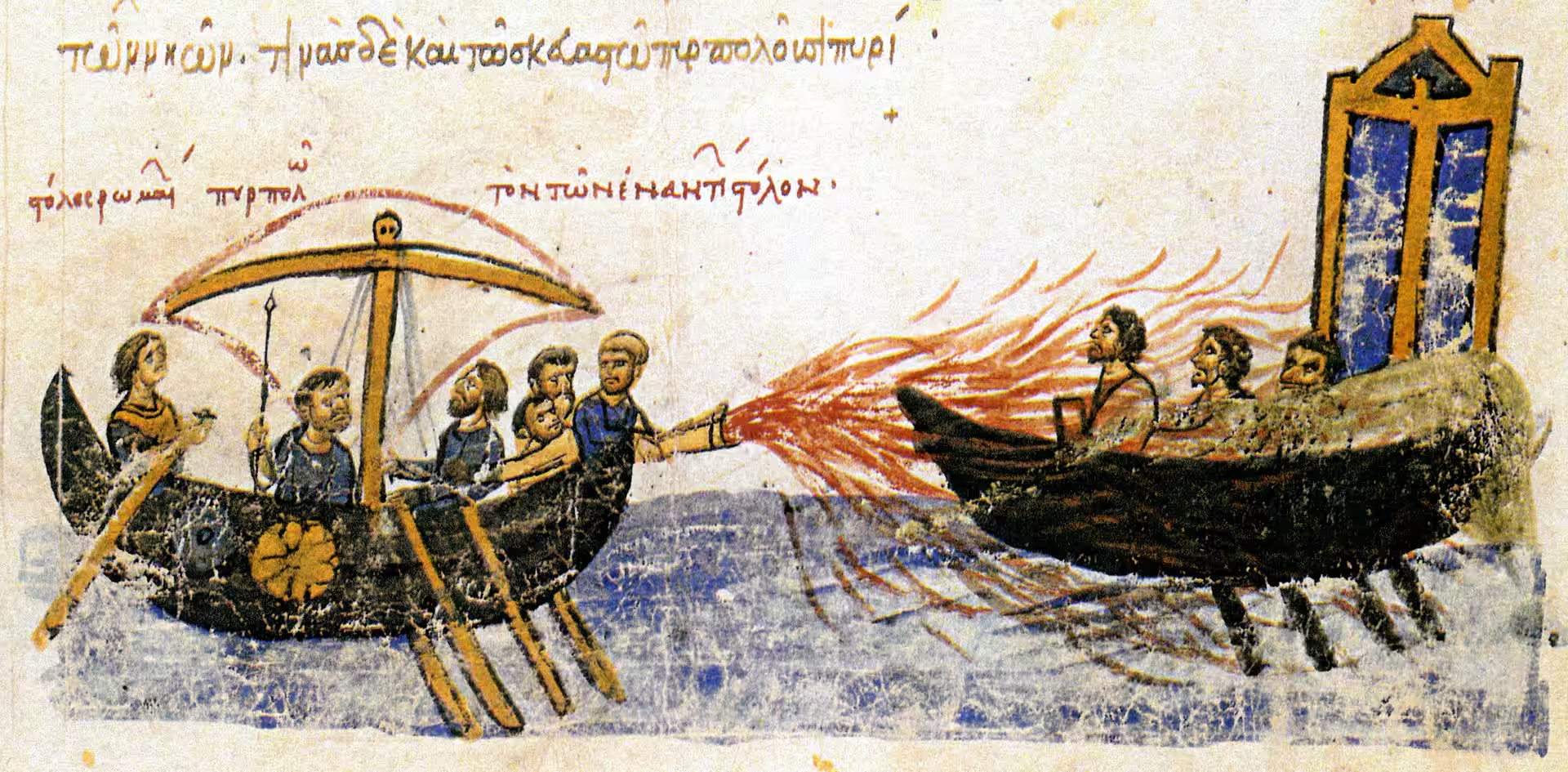
Greek Fire: The Byzantine Empire’s secret weapon that burned on water
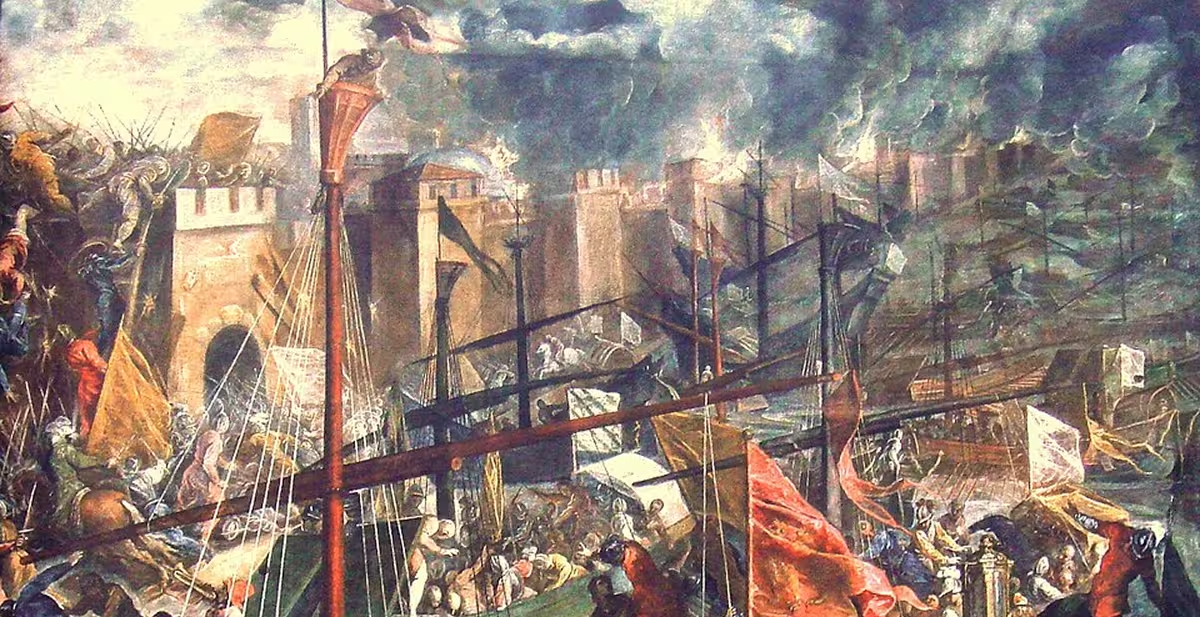
In the summer of 678, an Arab fleet lay before the sea walls of Constantinople, the climax of years of siege against the capital of the Byzantine Empire. Then the defenders unleashed something no enemy had seen: a liquid fire that shot from the prows of their ships, clung to hulls and men alike, and went on burning even as it spread across the surface of the sea. The Arab fleet was shattered. For the next four centuries this weapon — later called Greek fire — would be the most feared instrument in the Byzantine arsenal, and one of history’s best-kept secrets. Its formula was guarded so jealously that, to this day, no one knows for certain what it was.
Greek fire at a glance
What it was: a liquid incendiary weapon
First documented in battle: 678, at Constantinople
Attributed to: Kallinikos of Heliopolis (traditionally)
Delivered through: pressurised bronze siphons on warships
Status today: the recipe is lost — and was likely lost long before the empire fell
What was Greek fire?
Greek fire was a liquid incendiary that the Byzantine navy sprayed under pressure at enemy ships. What made it extraordinary was not simply that it burned, but how it burned: it stuck to whatever it touched, was extremely hard to put out, and continued to flame on the surface of water. Contemporary sources insist it could be smothered only with sand, strong vinegar, or — desperate sailors discovered — urine. Throwing water on it did nothing.
The Byzantines themselves never used the term “Greek fire.” To them it was “liquid fire,” “sea fire,” “Roman fire,” or simply “the prepared fire.” The label we use today is a later, Western coinage from the era of the Crusades. The name matters, because it points to the weapon’s real nature: this was not a single magic substance but an entire system. Incendiaries were ancient — armies had hurled flaming pots and shot fire-arrows for centuries. What the Byzantines achieved was the combination of a special liquid and the machinery to project it as a continuous, pressurised jet of flame. The substance without the apparatus, or the apparatus without the substance, would have been far less terrifying than the two together.
The invention of Greek fire: Kallinikos and the siege of Constantinople
Tradition credits the weapon to a man named Kallinikos (Callinicus), described as an architect or engineer who had fled the city of Heliopolis in Syria, then under Arab control, and brought his invention to the Byzantines. According to the chronicler Theophanes, the new weapon helped destroy the Arab fleet that had been pressing the siege of Constantinople, and was decisive again when the Arabs returned for a second great assault in 717–718. After that second failure, the Arabs never again seriously threatened the capital itself.
It is worth being careful with the legend. Theophanes also records that the emperor had ordered fire-bearing ships before Kallinikos appears in the story, and a later emperor, Constantine VII, implied that Kallinikos had perfected a way of projecting fire rather than inventing fire itself. The likeliest reading is that Kallinikos introduced a crucial improvement — probably the siphon-and-pump delivery — to incendiary techniques that already existed. Whatever the precise truth, the effect was real. Later historians did not understate it: the Belgian scholar Henri Pirenne thought the repulse of the Arabs at Constantinople a turning point comparable to any battle in European history, a judgement we will return to at the end.
How did Greek fire work? The siphon delivery system
The heart of the system was the siphōn: a bronze tube, often cast in the shape of a lion’s or dragon’s open mouth, mounted at the prow of a warship. Behind it sat the machinery that gave the weapon its reach. The prepared liquid was held in a sealed bronze reservoir, heated — most likely over a brazier — so that it was hot and under pressure when released. A force pump, a device the Greeks had known since antiquity, drove the mixture through the tube and out of the beast’s mouth in a roaring jet. The result could be aimed: eyewitnesses marvelled that the fire could be directed downward or to either side, “according to the will of the engineer.”
The ships that carried it were the workhorses of the Byzantine war fleet — the dromon and the lighter chelandion — and the men who operated the apparatus, the siphōnarioi, were specially trained. Nor was Greek fire confined to the sea. Byzantine soldiers also used hand-held projectors called cheirosiphons, and threw sealed pots of incendiary that worked much like early grenades. But it was at sea, against wooden ships packed with men, that the weapon was most devastating — and most famous.
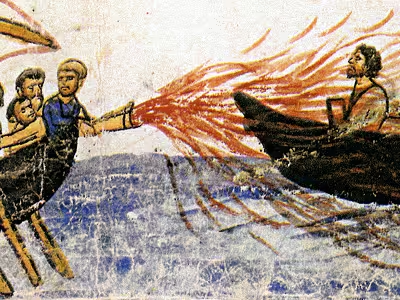
Detail of the siphon at the bow of the ship, illumination from the Skylitzes manuscript. 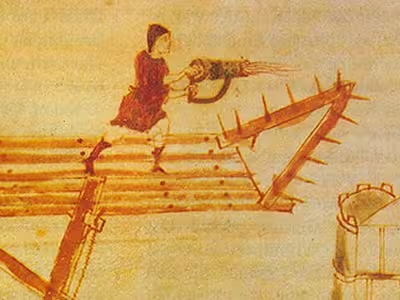
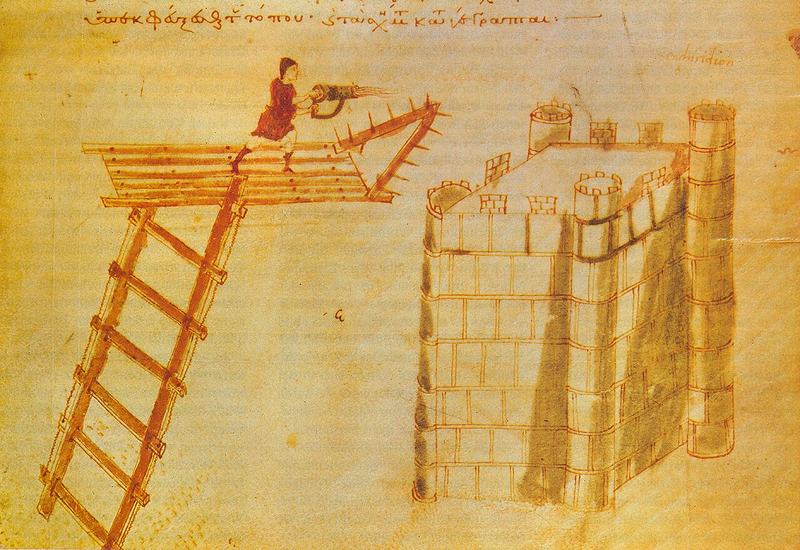
Detail of the hand-siphon, illumination from the Poliorcetica by Hero of Byzantium.
What was Greek fire made of? The lost recipe
Here we reach the enduring mystery. The honest answer is that nobody knows exactly what Greek fire was made of. The composition was a state secret, and it died with the institutions that kept it. Every modern account is, to some degree, informed guesswork built on scattered clues.
The leading theory points to a petroleum base. The eastern Mediterranean and the region around the Black Sea had natural seepages of crude oil and naphtha, a light, highly flammable fraction of petroleum. A naphtha or crude-oil base, thickened with pine resins to make it sticky and slow-burning, with sulphur added to help it catch and to produce choking fumes, would explain much of what the sources describe — including the way the burning liquid floated and spread on water.
Two other ingredients are often mentioned, and both deserve caution. The first is saltpetre (potassium nitrate), the key component of gunpowder. In the nineteenth century several French chemists argued that Greek fire was essentially an early gunpowder weapon. Most later scholars, including J. R. Partington in his classic 1960 study A History of Greek Fire and Gunpowder, rejected this: purified saltpetre was not known in the Mediterranean world this early, and the behaviour of Greek fire does not match. The saltpetre theory is best understood as a superseded idea, not a live possibility. The second is quicklime (calcium oxide), which reacts with water to release heat. A popular story holds that quicklime made Greek fire ignite on contact with the sea. But Greek fire also burned perfectly well on dry decks, and the sources do not list quicklime among its components; at most it may have been a minor additive, and the tidy “ignited by water” explanation is unreliable.
One tantalising clue survives from a royal hand. Anna Komnene, daughter of Emperor Alexios I, described a fire made from the resin of pine and other evergreens, ground with sulphur and forced through tubes by the breath of the men working it. Yet her account is best read not as a working recipe but as a deliberately incomplete one: it omits the petroleum base that almost certainly made the weapon what it was. Even a princess writing history did not spell out the secret — which tells us a great deal about how closely it was held.
Greek fire in battle: the Byzantine navy’s edge
The weapon’s reputation was built on a handful of spectacular victories. The repulse of the Arab fleets at Constantinople in 678 and again in 717–718 were the founding triumphs. In 941, during the middle Byzantine period, a fleet of the Rus under Prince Igor sailed against the city and was met by a far smaller Byzantine squadron equipped with fire. The chronicles describe the Rus ships ablaze on every side; men who leapt into the sea to escape the flames drowned under the weight of their armour, while those who tried to swim burned anyway. Generations later, Anna Komnene recorded Byzantine fire used against Pisan and Norman ships — at Rhodes in 1103 and at Dyrrhachium — and noted how foreign sailors panicked at a fire that, against all expectation, could be driven downward and sideways at will.
Yet Greek fire was never an all-purpose superweapon. It worked best in the calm, enclosed waters around Constantinople, at close range, against crowded wooden hulls. In open sea, in rough weather, or against an enemy who had learned to keep his distance, it was far less effective. As we will see, its limits were not only technical.
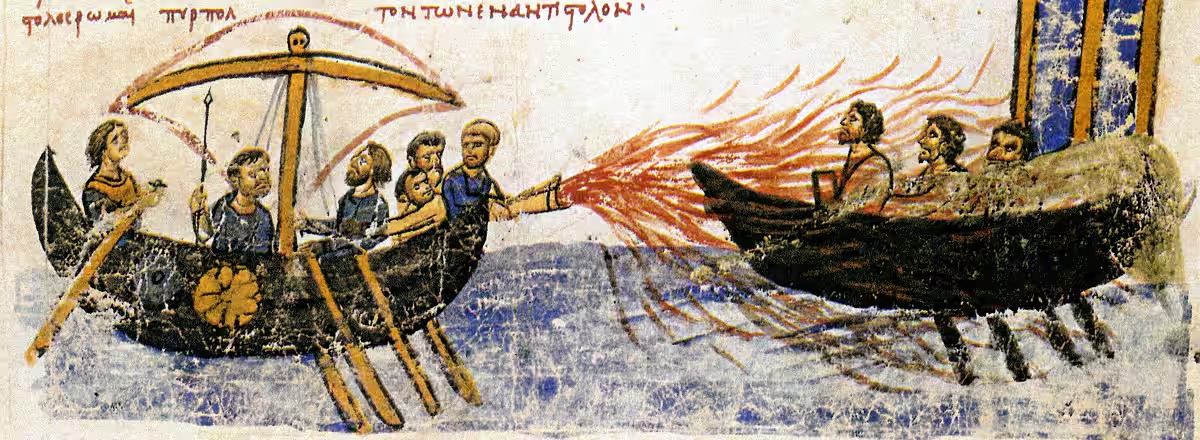
Greek fire on land
Although Greek fire won its fame at sea, the Byzantines did not keep it there. By the tenth century their military manuals describe a portable version, the cheirosiphōn or “hand-siphon” — a hand-held projector often called the earliest ancestor of the flamethrower. It first appears in the Tactica of Emperor Leo VI the Wise, who claimed to have invented it, and later commanders kept recommending it: Nikephoros II Phokas urged its use both against enemy siege towers and in the open field, where a jet of fire could break up a hostile formation. The fire was also thrown rather than sprayed. Soldiers hurled ceramic grenades filled with the incendiary — surviving examples, some packed around with caltrops, can be seen today in Athens — and in its earliest form the fire was flung in burning, cloth-wrapped bundles by light catapults, which could throw a charge of several kilograms a few hundred metres.
This is also where caution is needed, because not every “fire” in the sources is the same weapon. The historians John Haldon and Maurice Byrne have argued that the hand-siphon was probably much simpler than — and fundamentally different from — the great pressurised siphons of the warships: closer to a syringe that squirted liquid, perhaps unignited, along with noxious fluids to drive troops back, even though the illustrations in Hero of Byzantium’s Poliorcetica do show it throwing ignited fire. The chroniclers, who loved a dramatic blaze, were rarely chemists, and some land “Greek fire” was very likely naphtha pots, fire-arrows, or other incendiaries gathered under one frightening name. On land as at sea, Greek fire was as much a reputation as it was a recipe.
The best-kept secret — and the price the Byzantines paid for it
The Byzantines protected Greek fire with a discipline that anticipates the security culture of a modern weapons program. Knowledge was compartmentalised: the men who prepared the liquid, the engineers who built the pumps, and the crews who fired it each knew only their own part. No single captured soldier could betray the whole. The emperors wrapped the secret in religious awe as well, putting it about that the formula had been delivered by an angel; Constantine VII, in advice written for his son, warned that the secret must never be shared with foreigners, and that anyone who tried to give it away should be regarded as accursed. When the empire lent fire to allies, it sent the finished substance, never the recipe.
But secrecy came at a cost, and this is the part of the story most often missed. The historian Alex Roland has pointed out that, across the very centuries when the Byzantines supposedly held a monopoly on this war-winning weapon, their fleets suffered defeat after defeat in which Greek fire is conspicuously absent — off Carthage, at Crete, in Sicily, and elsewhere. The likeliest explanation is that the weapon was hoarded. Reserved above all for the defence of the capital, and kept out of the hands of provincial admirals who might one day turn it against the throne, Greek fire was — in Roland’s phrase — too important to be left to the admirals. The same obsessive secrecy that made it so fearsome also limited how often it was used, and made its knowledge dangerously fragile.
The decline and disappearance of Greek fire
Three forces gradually dimmed the weapon’s legend. First, enemies adapted: Arabs and, later, Crusaders developed incendiaries of their own, so that the shock of the unknown wore off. Second, the chain of secrecy was brittle. A weapon known to only a few specialists depends on an unbroken line of trained hands, and the upheavals of the empire — culminating in the sack of Constantinople during the Fourth Crusade in 1204 — broke institutions that such knowledge needed to survive. Many historians believe the true secret was lost well before 1204, perhaps centuries earlier.
It is worth clearing up a common confusion here. The name “Greek fire” lived on long after the genuine article had faded, becoming a loose Crusader-era label for almost any incendiary — at the siege of Acre, in the Nile campaigns against the army of Louis IX, and even, much later, in accounts of the final fall of Constantinople in 1453. These were not the same weapon Kallinikos brought to the walls in the seventh century. By then a different chemistry was rising: gunpowder, the subject that drew Partington to write the history of Greek fire in the first place, was beginning the long transformation that would eventually make liquid fire obsolete.
The legacy of Greek fire
For all the mystery around its chemistry, the weapon’s importance is not really in doubt. Historians have placed its first great victory among the hinges of European history. Pirenne ranked the repulse of the Arabs at Constantinople above more famous land battles; George Ostrogorsky judged that by holding the city, the Byzantines saved not only their own empire but the wider development of European civilisation. Whatever one makes of such sweeping claims, they capture why Greek fire matters: it helped a beleaguered state survive the moment of its greatest danger. To understand why the Byzantines endured for centuries when so many expected them to fall, it helps to understand who the Byzantines were — and the technological edge they guarded so fiercely.
Greek fire also has a fair claim to be the first true incendiary weapon system, integrating a chemical agent, a delivery machine, dedicated ships, trained crews, and a security regime — and it stands as a lasting lesson in how secrecy can both empower and imperil. It is sometimes called a medieval ancestor of napalm and the flamethrower, and it still grips the modern imagination: the “wildfire” of Game of Thrones is a clear descendant in fiction, however far from the historical reality. More than a thousand years on, Greek fire is remembered as much for the secret it kept as for the ships it burned.
Frequently asked questions about Greek fire
Did Greek fire really burn on water?
Yes — this is the detail every source emphasises. The burning liquid floated and spread across the surface of the sea, and could not be put out by throwing water on it. Sailors smothered it with sand or vinegar instead.
What was Greek fire made of?
No one knows for certain, because the formula was a state secret that was lost. The most widely accepted theory is a petroleum (naphtha) base thickened with resin and mixed with sulphur. The old idea that it contained saltpetre is now generally rejected.
Who invented Greek fire?
Tradition credits Kallinikos of Heliopolis, an engineer who brought it to the Byzantines around 670. He more likely perfected the delivery method than invented incendiary fire outright, but the attribution has stuck.
Can Greek fire be recreated today?
Not with certainty. Modern experimenters have built petroleum-based incendiaries that reproduce some of its effects, but because the original recipe and apparatus are lost, any reconstruction is informed guesswork rather than the genuine article.
How was Greek fire put out?
Contemporary accounts say it could be smothered with sand, strong vinegar, or — in a pinch — urine. Crucially, water did not extinguish it; it spread the flames.
Sources & further reading
- Anna Komnene, The Alexiad; Theophanes the Confessor, Chronographia; Constantine VII Porphyrogennetos, De Administrando Imperio (primary sources).
- J. R. Partington, A History of Greek Fire and Gunpowder (Cambridge, 1960).
- Alex Roland, “Secrecy, Technology, and War: Greek Fire and the Defense of Byzantium, 678–1204,” Technology and Culture 33:4 (1992), 655–679.