Armenians in the Byzantine Empire: From soldiers to emperors
Armenians were consistently one of the most important and influential minority groups in the Byzantine Empire, particularly during the middle Byzantine period. Their presence shaped political, military, and cultural life, with Armenians serving as soldiers, administrators, scholars, and even emperors. The community’s long integration into Byzantine society highlights the empire’s complex relationship with its diverse populations, and underscores the pivotal role Armenians played in its history. From frontier cavalrymen to occupants of the imperial throne itself, Armenians left a mark on Byzantium out of all proportion to their numbers.
Armenians during the Early Byzantine Era and the Dark Age.
Armenia and the Byzantine Empire until the Arab conquests.
Armenian territories formed a key strategic zone between the Roman and Parthian empires. They served as a buffer kingdom, contested both diplomatically and militarily by the two superpowers. Rome recognized the difficulty of annexing these mountainous regions and, for much of antiquity, preferred to maintain Armenia as a client kingdom; the Parthians, and later the Sassanids, followed the same policy whenever they gained the upper hand. This balance of power allowed Armenians to preserve and develop their own identity. In 301, Armenia became the first state to officially adopt Christianity as its religion — a choice that profoundly shaped its later history and its relationship with Byzantium.
For Byzantine emperors, Armenia held strategic importance as early as the 4th century, remaining a defensive bulwark against eastern powers, especially the Sassanids. Around 387, Theodosius I and Shapur III concluded a settlement that formally partitioned Armenia between their two empires (following earlier arrangements of the 380s). Byzantium secured the western portion, including Sophene and a part of Lesser Armenia, and continued to recognize Armenian princes and local rulers there, in keeping with Roman tradition, until the administrative reorganizations of the 6th century under Justinian (around 536).
This situation fostered strong economic and cultural connections between Byzantium and Armenia, especially with the Syro-Palestinian world. A striking result was the creation of the Armenian alphabet in the early 5th century by Mesrop Mashtots, whose letter order and phonetic structure show clear parallels with Greek. Armenian students travelled to Byzantine cultural centers such as Constantinople, Athens, Antioch, and Alexandria, where literature, art, music, and the sciences flourished. The so-called School of Hellenophiles, associated with figures such as Anania of Shirak, reflects this deep Byzantine influence on Armenian learning.
Armenians also gained importance inside the empire itself, particularly in the army, and some rose to prominence at the imperial court. Notable examples include the general Narses during the reign of Justinian and Valentinos Arsacius, who played a decisive role in the succession of Heraclius’ heirs and briefly seized power in 644–645. Meanwhile, the bulk of the Armenian population remained concentrated in its traditional homelands along Byzantium’s eastern border.
Armenians and the struggles of the Byzantine Dark Age.
The roughly twenty-year war with the Sassanids in the early 7th century was a devastating experience for Byzantium’s eastern provinces. Soon after, the rise of the Arabs and the creation of the Caliphate introduced a new and even more powerful threat, which ultimately replaced the Sassanids altogether. The Arabs launched repeated campaigns, exerting constant pressure and gradually pushing the frontier westward. Armenians living in these regions often fought alongside the Byzantines; in 696, for example, a joint Byzantine–Armenian force inflicted a notable defeat on Arab invaders in Armenia. Sources also mention frontier groups such as the Mardaites, who harried Arab advances along the eastern marches. Despite such efforts, Arab forces conquered large areas between the 7th and 9th centuries, including Mesopotamia, Cilicia, and Mopsuestia.
The wars with the Sassanids and the later Arab expansion contributed to the decline of cities in both Armenia and Byzantium, along with a contraction of trade and cultural exchange. The religious divide deepened as well: in 451, the Armenian Church had rejected the decisions of the Council of Chalcedon, and over the following centuries radical anti-Chalcedonian and anti-Orthodox movements, such as the Tondrakians and the Paulicians, gained broad support among Armenians.
Even so, Armenian–Byzantine interaction did not diminish. On the contrary, it intensified through population movements. Unlike the Sassanids, the Arabs adopted a policy of settling Arab tribes in their new territories and establishing emirates, while placing religious and fiscal pressure on local communities. This prompted many Armenians to emigrate to Byzantine lands — sometimes even at the cost of accepting the Chalcedonian dogma their church had long rejected. In the 8th century, large waves of Armenians fled Arab rule and resettled in territories still under Byzantine control. Around 790, for instance, several thousand Armenian nobles, together with their families and retainers, are reported to have resettled in Byzantium. Some migrants settled in Lesser Armenia, the Armeniakon, and Chaldia, while others moved westward — at times relocated by the imperial government — to the northern Balkans, where Philippopolis (modern Plovdiv) became a major Armenian center, and even to southern Italy.
These migrations unfolded in several phases that lasted until the 11th century, producing constant shifts in the Armenian presence along the border and in the interior of Asia Minor. Over time, they also strengthened the influence of the Armenian community within the empire, an influence that reached its peak during the Middle Byzantine era.
The Middle Byzantine era, peak of Armenian influence.
The resettling and creation of Armenian kingdoms.
The incessant warfare with the Arabs along the eastern border during the 8th and 9th centuries caused widespread destruction across a vast zone affected by looting and raids. Local populations shrank through famine, migration, and enslavement. From the 9th century onward, these zones were resettled by various peoples, but chiefly by Armenians fleeing regions further east. As Byzantine authority weakened in these lands — which were also never fully integrated into Muslim territory — a number of autonomous feudal kingdoms governed by Armenian aristocrats emerged in the space between the two great powers.
The most important of these was the Bagratid (Bagratuni) kingdom. Amid the Byzantine resurgence under Basil I and the decline of Abbasid authority, Ashot I Bagratuni consolidated his power over the rival Armenian noble houses and, in 884–885, was recognized as king of Armenia — receiving royal crowns from both the Abbasid caliph al-Mu’tamid and Emperor Basil I, a dual recognition that secured his international standing. Ashot I and his successors ruled through a feudal system in which the Bagratid family held formal supremacy over other aristocratic houses that controlled, more or less autonomously, their own territories. The principality of Taron, founded in the first half of the 9th century, progressively came under Bagratid influence. Over the course of the 10th century, however, several of these powerful houses — such as the kingdoms of Vaspurakan, Kars (Vanand), and Lori — broke away and became effectively independent.
The integration of the Armenians
Having considered the incorporation of the geographical territory of Armenia into the Byzantine Empire, it is worth examining how the empire sought to integrate the Armenian population itself. This proved a difficult task that took many years and, in essence, was never fully successful.
The influx of Armenians into Byzantine territory began very early. Already from the first partition of the Armenian kingdom by Byzantium and Persia in the 4th century, the upper aristocratic classes began migrating into Roman lands. This movement broadened dramatically during the Arab conquests, when the caliphs’ policy of resettling Arab tribes and their strict religious measures pushed many Armenians and Syrians toward the eastern regions of Byzantine Asia Minor — a wide belt of “scorched earth” devastated by the successive Arab–Byzantine wars. The populations that took refuge there tended to rally around the feudal states described above.
With Byzantium’s steady eastward expansion from the 10th century onward, new waves of migration followed the advancing frontier: the further east Byzantine control moved, the more Armenians, Syrians, and Jews entered imperial territory. Migration continued throughout the 10th century and peaked at its end and into the 11th, driven above all by the great conquests of Basil II. These conquests demanded a new administrative structure in eastern Asia Minor, more flexible than the old system of themes. From the mid-10th century, the older provinces were subdivided and roughly thirty new, smaller “Armenian” themes were created along the eastern frontier. These gradually came under the authority of three large doukata (duchies): in the south, the Duchy of Antioch (created after 969 on the initiative of John I Tzimiskes), which absorbed the themes of Cilicia; the Duchy of Mesopotamia, covering the central eastern region; and the Duchy of Chaldia, guarding the northeastern frontier. During the 11th century further commands appeared, such as the katepanikia of Iberia, Vaspurakan, and Edessa. The annexed Armenian kingdoms were folded into this same framework.
The local element was essential, both for the defense of these new themes and for staffing the offices they created. Because the new provinces lay far from Constantinople, immediate intervention by imperial troops was difficult, so Byzantine control had to rely on local magnates able to impose their authority on the frontier population.
That population was religiously complex. Nikephoros II Phokas had already attempted to settle Christian groups along the border — for instance, Armenians in Melitene — to create a Christian bulwark against the surrounding Muslim emirates. Yet both the miaphysite Armenians and the Jacobite Syrians were regarded as heretics by the imperial church, since they did not accept the dogma defined at the Council of Chalcedon in 451. The majority of the Armenian population, even after Byzantine conquest, remained miaphysite and hostile to Byzantine rule, and in most areas where they settled during the migrations of the 10th and 11th centuries they established their own dioceses (for example in Cilicia and northern Syria). In regions conquered earlier, such as Taron and Iberia, assimilation gradually extended to religion, and a large part of the population eventually accepted the Chalcedonian doctrine. But in territories annexed in the 11th century — Vaspurakan (1021), Ani and Shirak (1045), and Kars/Vanand (1064) — most inhabitants kept their Armenian faith. The relocation of Armenian rulers to central Asia Minor (Cappadocia, Sebasteia) and Cilicia did little to integrate them, since these lords brought with them their bureaucracy, their troops, and much of their population, all seeking refuge from the Seljuk raids that began early in the 11th century and intensified around mid-century.
The Byzantine administration tried to manage the religious problem in several ways. At first it granted offices and titles to native Armenians who had accepted the Chalcedonian dogma while retaining their customs and language. Rising through the Byzantine hierarchy, these men took on a special role in defending the eastern frontier and acted as intermediaries between the imperial center and the native population — the Dalassenoi being a notable example. Their position gave them considerable power, which some would later use to bring large regions under their personal control, effectively defecting during the turmoil that followed the defeat at Manzikert (1071).
Repressive measures made matters worse. Constantine IX Monomachos threatened to impose the Chalcedonian dogma on the Armenians and disbanded the Armenian frontier troops, replacing their military service with a tax — on the grounds that these units often joined rebellions in Asia Minor. Their dissolution, however, left a dangerous gap on the eastern border that Turkish invaders soon exploited. Constantine X Doukas went further, arresting Armenian clergy and imposing heavy taxation.
It can therefore be said that most of the Armenian population absorbed into Byzantine territory — whether before the 10th century or during the migrations of the 11th — remained hostile to Byzantine control, even when that control was exercised by native Armenian Chalcedonians. The Armenian aristocracy, by contrast, was absorbed far more successfully. Transferred (voluntarily or not) into the Byzantine hierarchy from the late 9th century onward, these nobles were initially distrusted but were gradually entrusted with military commands suited to the profile of the Armenian soldier-aristocrat, shaped by a social ideal of warrior manhood; after all, they knew very well how to deal with Arab raids. Their position remained precarious, as they could be replaced at will, but their descendants came to differ in no meaningful way from Byzantine commanders of Greek origin. Often the only trace of their ancestry was the inheritance of Armenian family names. Being Chalcedonian, they helped pave the way for the broader integration of Armenians in the 11th century. The historian Isabelle Brousselle aptly captured this process of assimilation, describing the imperial court as “a formidable melting pot” in which the ethnic and regional differences of the empire’s elites were erased or blurred in order to exalt strictly Byzantine values.
The age of Byzantine emperors of Armenian descent.
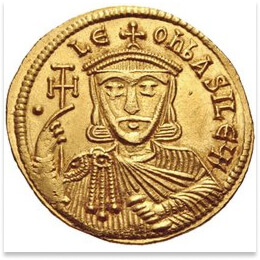
Across the 9th and 10th centuries, Armenians played a leading role in the Byzantine army, producing many generals and several emperors and imperial consorts. Leo V “the Armenian,” Basil I (founder of the so-called Macedonian dynasty), Romanos I Lekapenos, and John I Tzimiskes were all of Armenian origin, as was Theodora, the wife of Theophilos. Commanders such as Melias (Mleh) and John Kourkouas were instrumental in pushing Byzantine power toward the Euphrates. These Armenians were predominantly Chalcedonian — some even held high office in the Orthodox Church — and, culturally hellenized, they contributed much to the development of education and learning in Byzantium. Nevertheless, Byzantine attitudes toward Armenians were frequently negative, and the stereotype of the “cunning and treacherous Armenian” became firmly implanted in Greek literature.
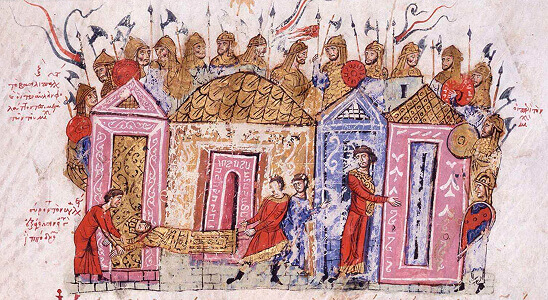
In the 11th century the number of Armenians within the empire rose sharply, as several Armenian states were annexed and their populations resettled in Cappadocia and neighboring lands. These newcomers largely retained their language, religion, and culture, including dress and custom, and clashes between semi-independent Armenian nobles and local Orthodox landowners and bishops could be acute. The most prominent case was that of Gagik II, the last Bagratid king of Armenia (r. 1042–1045). Persuaded to come to Constantinople, he was pressured into abdicating in exchange for the title of magistros and estates in Cappadocia. In the 1070s he killed the Greek metropolitan of Caesarea — by one account in revenge for a public insult — and was in turn murdered by Byzantine lords, reportedly hanged at the fortress of Kyzistra around 1079–1080.
Chalcedonian Armenian and Armeno-Georgian families, such as the Pakourianoi and the Tornikioi, continued to hold high office, especially as governors of frontier themes. Scholars — notably Peter Charanis — have argued that a substantial share of the Byzantine military aristocracy, on the order of 10 to 15 percent, was of Armenian stock, though no emperor of recognized Armenian descent reigned in this later period, and relatively few Armenians were tied to the Komnenian dynasty. From the end of the 11th century, after the disaster at Manzikert and the Seljuk advance across Asia Minor, the Armenian nobility increasingly founded its own independent states in Cilicia and the surrounding region. From that point on, Armenians serving in the Byzantine army were predominantly allies rather than subjects of the emperor.
The Diminished Role of Armenians in the Late Byzantine Period
In the final centuries of Byzantine history, the Armenian presence within the empire faded. Repeated attempts to reconcile the Armenian and Orthodox churches produced a vast body of polemical literature but no lasting practical result, and hostility toward Armenians grew. Patriarch Joseph I Galesiotes (in office 1266–1275 and 1282–1283) called the Armenians “a morbid and rebellious people,” while Patriarch Athanasios I (1289–1293 and 1303–1309), among others, regarded contact with Jews and Armenians as defiling.
At the same time, the territorial basis for Armenian influence had vanished: the shrunken late empire no longer controlled any region with a substantial Armenian population. An Armenian merchant community persisted in Constantinople, but Armenians no longer played a meaningful part in the administration of the empire or formed a significant element of its aristocracy. The center of Armenian political life had by then shifted decisively to the Armenian Kingdom of Cilicia, which sustained its own relations with Byzantium, the Crusader states, and the wider Mediterranean world until its fall in 1375.
For more than half a millennium, Armenians were woven into the fabric of the Byzantine state as soldiers, administrators, scholars, churchmen, and emperors. Their story is one of both remarkable integration and persistent tension: an Armenian could rise to the throne in Constantinople, yet Armenian communities on the frontier often remained religiously distinct and politically restless. The arc of that relationship — from the strategic buffer kingdoms of late antiquity, through the brilliance of the Macedonian age, to marginalization in the empire’s twilight — mirrors the broader trajectory of Byzantium itself, and remains one of the clearest illustrations of how the empire absorbed, exploited, and was in turn shaped by the diverse peoples within and along its borders.
Sources and Further Reading
- Charanis, Peter. The Armenians in the Byzantine Empire. Lisbon: Calouste Gulbenkian Foundation, 1963.
- Cheynet, Jean-Claude. Pouvoir et contestations à Byzance (963–1210). Paris: Publications de la Sorbonne, 1990.
- Kazhdan, Alexander P., ed. The Oxford Dictionary of Byzantium. Oxford: Oxford University Press, 1991 (see entries “Armenians,” “Bagratids,” “Armeniakon”).
- Brousselle, Isabelle. “L’intégration des Arméniens dans l’aristocratie byzantine au IXe siècle.” In L’Arménie et Byzance: histoire et culture (Byzantina Sorbonensia 12), 43–54. Paris: Publications de la Sorbonne, 1996.
- Garsoïan, Nina G. “The Problem of Armenian Integration into the Byzantine Empire.” In Studies on the Internal Diaspora of the Byzantine Empire, edited by Hélène Ahrweiler and Angeliki Laiou, 53–124. Washington, D.C.: Dumbarton Oaks, 1998.


One Comment