Michael Choniates: The Byzantine Bishop and Scholar Who Defended Athens.
In 1204, while the lower town of Athens burned, the metropolitan Michael Choniates held the Acropolis against the siege engines of Leo Sgouros. He had spent twenty-two years governing a city he loved, despised, petitioned for and wrote about more than anyone else in the Middle Ages. Almost everything we know about Byzantine Athens at the end of the twelfth century comes from his pen.
Choniates is usually read as a witness: the learned bishop whose letters and orations document taxes, piracy and depopulation in the province of Hellas. That reading undersells him. As metropolitan he was the effective authority in a city with no strong lay leadership, and his writings were instruments of that role. They were petitions, warnings, flattery and reproach aimed at governors and emperors. The same man also wrote one of the finest Byzantine poems on the loss of the classical past, owned what was probably the last complete copy of Callimachus’ Hecale, and ended his life as an exile who refused to accept the Latin Church.
Quick facts
Name: Michael Choniates (Μιχαὴλ Χωνιάτης); the surname “Akominatos/Acominatus” often given to him is incorrect
Born: Chonai, Phrygia (near ancient Colossae), c. 1138
Died: Monastery of the Prodromos, Boudonitza (Mendenitsa, above Thermopylae), 1222, probably in February; site and date debated
Office: Metropolitan of Athens, 1182 to 1204/5; in exile thereafter
Teacher: Eustathios of Thessalonike
Family: Elder brother of the historian Niketas Choniates
Key works: Inaugural Address at Athens (1182); Hypomnestikon to Alexios III (1198); 181 letters; elegy on Athens; Theano; epigram on the unicorn
Veneration: Painted as a nimbed bishop in Attic churches within about a decade of his death
From Chonai to Constantinople
Michael was born around 1138 at Chonai, the Phrygian successor town of Colossae, famous for its shrine of the Archangel Michael. His younger brother Niketas, born in the mid-1150s, would become a senior official and the most important historian of the period. Both brothers left the province for Constantinople to study. Michael became, in Hans-Georg Beck’s phrase, the most significant pupil of Eustathios, the great Homeric commentator who later became archbishop of Thessalonike. By the time he was appointed to Athens, Michael was an established scholar in patriarchal circles.
The name “Akominatos”, still found in older literature and library catalogues, rests on a misreading. Since Georg Stadtmüller’s study of 1934 scholars have agreed that the family name was Choniates, “the man from Chonai”.
1182: A Sermon in the Parthenon
Choniates arrived in Athens as its new metropolitan in 1182. His Inaugural Address was delivered inside the Parthenon, which had long been the cathedral of the Theotokos Atheniotissa, after the celebration of the liturgy. Even its title is an innovation within heavily codified Byzantine literature. Instead of the customary ἐπιβατήριος (“speech of arrival”), the manuscripts give εἰσβατήριος. Stephanos Efthymiadis reads the word as Choniates’ own coinage, fusing the ideas of initiation and triumphal entry.
The speech follows the template of St Paul on the Areopagus, the only other recorded Christian address to the Athenians. It begins by flattering its audience as heirs of the city of letters: hospitable to strangers, generous to the defeated, so fond of eloquence that Pericles could talk them out of their anger. Then it turns. Inherited virtue is barren unless practised; the gods of the ancestors were models of vice; the Athenians must become a wild olive grafted onto good stock.
The address is also a statement of authority. Choniates lists the roles of a bishop as healer, teacher, father, shepherd, salt, light and steersman. He then casts his flock as clay and himself as the potter. If they prove pliable, both will be blessed; if not, he warns, God will reward his labour anyway. Efthymiadis detects insecurity beneath the rhetoric, as the new bishop oscillates between praise and admonition.
The peroration rises to a mystical vision of the Parthenon’s ever-burning lamp, whose rays spread from the Acropolis to the city and from the city towards the ends of the earth. Choniates applies to the church Jacob’s words at Bethel, ὡς φοβερὸς ὁ τόπος οὗτος (“how awesome is this place”, Genesis 28:17), and imagines himself as Moses on Horeb. Efthymiadis has shown that the imagery of the light draws on Eustathios’ funeral oration for Nikolaos Hagiotheodorites, an earlier metropolitan of Athens. The two texts even share a rare verb for the light being cast outwards.
Governing Athens in All but Name
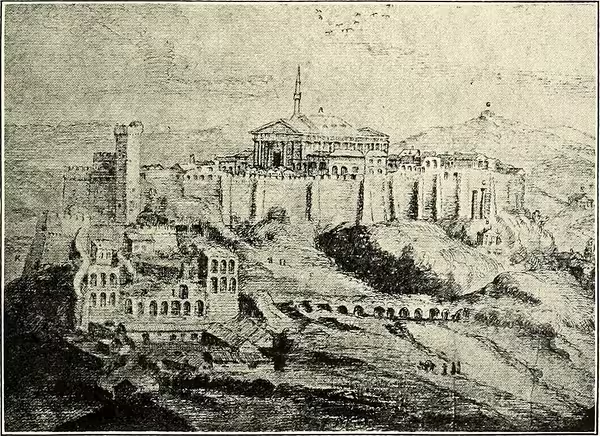
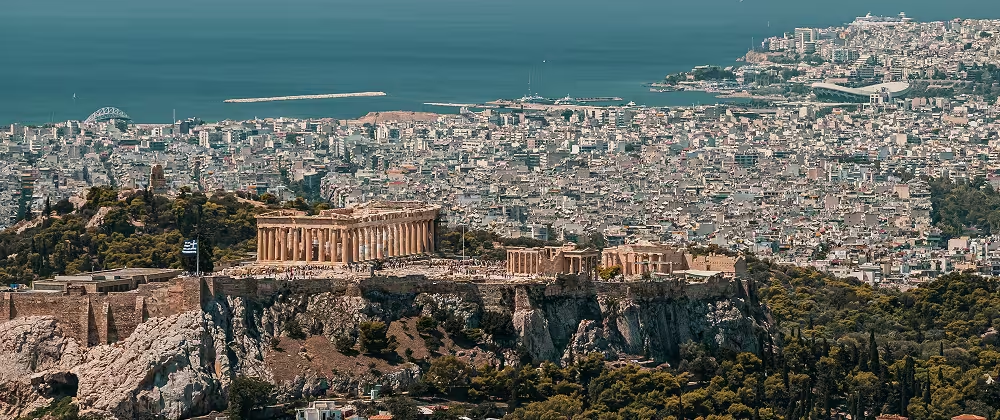
Twelfth-century Athens had no powerful lay family of the kind that seized power in Argos, Monemvasia or Lakedaimonia. Imperial governors (praetors) mostly resided at Thebes – at the time of flourishing city thanks to the silk industry – or in the capital. In practice, as Charalambos Bouras observes, local authority passed to the metropolitan, who lived on the Acropolis – likely in the Propylaia turned into a palace – and answered even for the city’s defence.
Much of Choniates’ surviving work belongs to this role. He wrote formal addresses of welcome to praetors such as Nikephoros Prosouch and Demetrios Drimys. These texts combine the flattery etiquette demanded with blunt descriptions of extortion, and with repeated warnings that Athens, unlike other cities, lay unwalled and at the mercy of raiders.
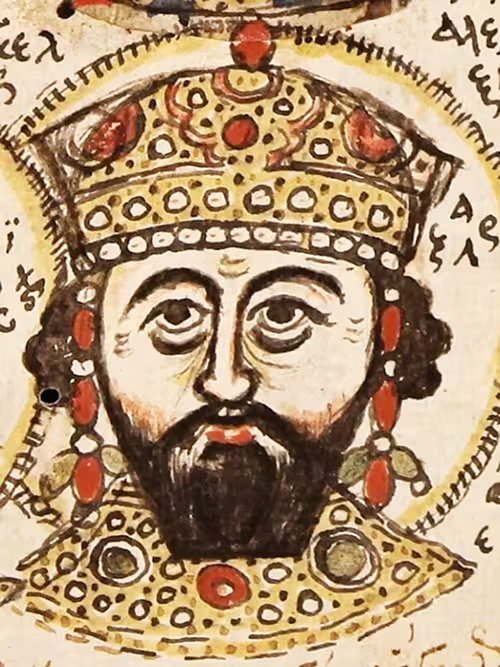
Officials were barred by imperial decree from entering the city, but they evaded the ban by coming as pilgrims to the Atheniotissa, at the inhabitants’ expense. Among the visitors Choniates names are Basil Kamateros, brother-in-law of Alexios III, and the megas doux Michael Stryphnos with his wife.
In 1198 he addressed the Hypomnestikon to Alexios III, a memorandum against the fiscal agents and the burden of taxation on Athens, including the levies for the fleet. The city, he warned, had long since been emptied of its people by successive disasters and risked becoming a desert. The memorandum also gave rise to a still-open debate. When Choniates laments the loss of the καστρηνοί, modern scholar like Lampros, Aikaterini Christophilopoulou and later Bouras understood the word as a garrison. Angeliki Papageorgiou has argued that it carries no military meaning and designates the inhabitants of the walled town, usually the upper class.
Behind the set pieces stood a network. Choniates corresponded with bishops, abbots and officials across Greece and in Constantinople. He travelled within his province, for instance to discipline an unruly bishop on Euboea. Kolovou’s edition counts 181 letters. Judith Herrin built her pioneering study of the social and economic structure of central Greece largely on this corpus. His brother Niketas, who rose under the Angeloi to the post of logothetes ton sekreton, gave him a channel to the court.
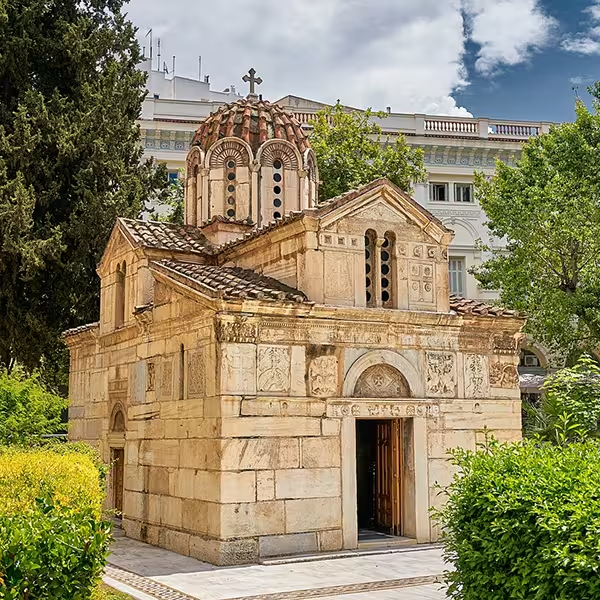
He was also a patron. He dedicated a golden dove above the altar of the Parthenon and, in a short poem to the Theotokos, records gifts of furnishings and liturgical vessels. The little church of the Panagia Gorgoepekoos, with its walls studded with ancient and Byzantine reliefs, is often attributed to him – with little solid foundations. Manolis Chatzidakis saw in it the work of a learned admirer of antiquity, and the late-twelfth-century date suits Choniates. Bouras accepts the attribution as plausible but notes that Choniates’ love of antiquity seems to have stayed on the page: in his letters he names the Stoa, the Peripatos or the “Lantern of Demosthenes” without ever describing them.
Constantinople and the Provinces
Choniates’ politics were those of a provincial bishop who had come from the capital and turned against it. The Oxford Dictionary of Byzantium describes him as a strong opponent of the civilian aristocracy of Constantinople, whom he blamed for indifference to the provinces. He was particularly scathing about those of its members who came from peasant or artisan families. He argued that the whole empire fed the capital while the state’s only interest in the provinces was tax collection. Bouras sees in this a wider provincial ideology of the last decades of the century.
His relations with emperors were pragmatic. He welcomed Andronikos I in 1182–83 as a reformer, then withdrew his support once the regime’s terror, which in his words put the whole world in fear, became apparent. Under the Angeloi he petitioned rather than opposed. His view of the crisis was of a state that no longer protected its periphery, not of a periphery that should break away.
Witness or advocate? The problem of Choniates’ Athens
Choniates paints a bleak picture. Attica, he complains, produced no silk, bred few animals and offered nothing of value; everything from Athens was meagre and cheap. Near the end he claimed that the city no longer had a single smith, coppersmith or cutler. Older historians took this at face value.
The archaeology disagrees. Bouras points to housing that expanded outside the late Roman wall into the late twelfth century, a sharp rise in coin finds in the Agora, a probable mint under Manuel I, at least eight twelfth-century churches, slag heaps from ironworking and an industry dyeing purple from local murex. A few years before Choniates’ claim, Georgios Tornikes had seen Athenian smiths at work. Bouras concludes that the sudden decline he describes cannot be verified.
Part of the gap may be explained by genre. Many of the darkest passages occur in petitions and appeals to officials, where a desolate city was an argument for tax relief and protection. Others belong to the classicist’s lament for an Athens of Pericles that no medieval town could match. Neither reading makes him a liar, but both mean his testimony must be weighed rather than copied.
1204: Choniates against Sgouros
The crisis came from the Peloponnese. Leo Sgouros had succeeded his father around 1198 as master of Nauplion. Exploiting the paralysis of the central government, he took Argos and Corinth. Niketas Choniates reports that he imprisoned the bishop of Nauplion and had the metropolitan of Corinth hurled from Acrocorinth. In one of his letters Michael describes how Sgouros had a young hostage beaten to death for dropping a glass at table. The megas doux Michael Stryphnos, sent to contain him, wintered in Athens in 1201–02 without effect.
In 1204 (or maybe already in 1203), while the Crusaders held Constantinople, Sgouros moved on Athens. His fleet attacked from the sea while his troops crossed the Isthmus. According to modern accounts, his pretext was that the Athenians were sheltering a fugitive from his justice. Niketas, our main narrative source, tells us that Michael first tried to talk him out of the attack and found him deaf to all counsel. Sgouros took and burned the lower town; excavations have revealed extensive fire damage of the late twelfth or early thirteenth century, which is interpreted as the result of this assault. But the Acropolis held under bombardment from siege engines, with the metropolitan directing its defence. Niketas praises his brother as a skilled tactician, not a neutral judgement, and Sgouros eventually left the citadel under blockade and marched north into Boeotia and Thessaly.
The episode reveals two opposite provincial responses to the empire’s collapse. Sgouros was the local strongman carving out a lordship of his own. Choniates was the bishop holding a city for an emperor who could no longer defend it. It is worth remembering that almost all we know of the siege comes from Michael’s own letters and from his brother’s history.
The Latin Conquest and the Refusal
In the autumn of 1204 Boniface of Montferrat, king of Thessalonike, marched south. Sgouros retreated before him, and Athens was occupied around November without a fight. Choniates surrendered the city, likely in 1205. The takeover seems to have brought no massacre, but the Parthenon was plundered and the metropolitan’s library dispersed. Boniface granted Athens and Thebes to the Burgundian Othon de la Roche, and the Parthenon became a Latin cathedral. In 1206 the Frenchman Berard was installed as the first Latin archbishop, confirmed by Innocent III that November.
Choniates would not submit to the papacy. Whether he ever sought an accommodation with the Latin Church is disputed. Teresa Shawcross has suggested contacts, while others hold that his attitude towards the Latins rules this out.
Exile on Kea and Death at Boudonitza
He withdrew to Kea, an island that belonged to his own ecclesiastical province, and lived there from about 1205 to 1217. He continued to act as the metropolitan of a see he could no longer enter. From Kea he wrote letters to his scattered flock and correspondents, some of which survive as a separate group in the manuscripts. Late in his life he recommended his chartophylax to the patriarch in exile at Nicaea, a sign that he kept up contact with the Orthodox hierarchy. His pupil George Bardanes, who shared his exile, later became a distinguished bishop.
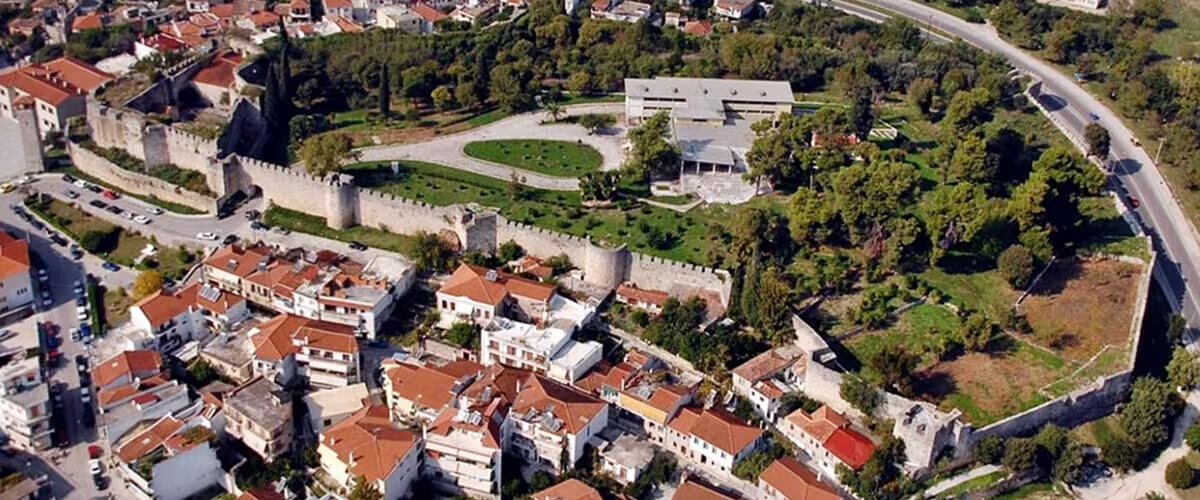
Kea also brought out his gift for the lively vignette. His description of the island’s filthy, draughty bathhouse is one of the most vivid passages in Byzantine letter writing, and it implies that Athens had been better provided for. In the spring of 1217 he left Kea and travelled by way of Euboea to the monastery of St John the Forerunner (Prodromos) at Boudonitza, modern Mendenitsa, on the slopes of Mount Kallidromo above Thermopylae. His brother Niketas died in Nicaea that same year. The monastery lay inside the Frankish marquisate of Bodonitsa, whose castle, with its two concentric enclosures, still crowns the village. He took the monastic habit there and spent his last five years in the community, still intervening in church affairs through his letters. He died in 1222, probably in February, and one of his nephews composed a monody for him.
Debate: where and when did Choniates die?
The place. His letters and those of his circle, including George Bardanes and John Apokaukos, name a “monastery of the Prodromos” without locating it precisely. Earlier scholarship took some of these references to mean a Prodromos monastery on Kea. Vasileios Katsaros (Byzantiaka 1, 1981) argued instead for Boudonitza and identified the house with the church of Agios Ioannis at Drakospilia, above Thermopylae. His identification is now widely followed, including by the Oxford Dictionary of Byzantium, but the question of Kea versus Mendenitsa is still discussed. A monastery stands at Drakospilia today, where the Metropolis of Phthiotis celebrates his feast. However, it is dedicated to St John the Theologian rather than the Forerunner, and no medieval fabric has been shown to survive there. On Kea, a local writer claims to have found in 1953 the ruins of a small church with an apse fresco of bishops, attributed to Choniates, near the later monastery of Agios Panteleimon. That attribution has not been confirmed by specialist study.
The date. Older reference works give “about 1220”. Katsaros placed the death in February 1222 on the strength of a synodal letter of John Apokaukos, metropolitan of Naupaktos and a friend of Choniates. Popular accounts give 4 July 1222, but that is his feast day in the Orthodox calendar and need not be the day he died.
The Scholar and the Poet
Choniates’ best-known poem is the elegy on Athens, around thirty dodecasyllables. It opens with desire: Ἔρως Ἀθηνῶν τῶν πάλαι θρυλουμένων, “love of the Athens famed of old”. The poet compares himself to Ixion, who lusted after Hera and embraced a cloud-phantom in her place. Its most famous line is the paradox at its centre:
οἰκῶν Ἀθήνας οὐκ Ἀθήνας που βλέπω,
κόνιν δὲ λυπρὰν καὶ κενὴν μακαρίαν.“Dwelling in Athens, I see Athens nowhere: only wretched dust and an empty blessedness.”
There follows a catalogue of what has vanished: law courts, elections, orators, councils, festivals, campaigns by land and sea, and the force of words. The poem ends by asking forgiveness for the image of the city the poet has “set up” (ἴνδαλμα … ἐστησάμην). Because the Greek word for “writing” also means “painting”, Paul Speck suggested that the poem accompanied a painted reconstruction of ancient Athens commissioned by Choniates. Christopher Livanos reads it as a meditation on the impossibility of recovering the past, linking Eros and idolatry in a way that anticipates Petrarch. He compares its central line with Hildebert of Lavardin’s lament for Rome, a parallel it seems no one had drawn before. Constantine Cavafy, writing in 1892, praised the small surviving poetic corpus of Choniates as full of genuine poetic feeling.
The shorter poems are mostly religious and were likely written to accompany images. One, recently re-edited by Maria Tziatzi-Papagianni, describes a picture of the parable of the man pursued by a unicorn from the romance Barlaam and Ioasaph. In fifteen Homeric hexameters, probably written on Kea, Choniates addresses the reader as Τλῆμον ἐφήμερε, “wretched creature of a day”, an echo of Pindar. He then sets out the parable: the man clinging to a tree and reaching for a drop of honey, the unicorn of death behind him, day and night gnawing at the trunk like mice, and Hades gaping below like a dragon. The details suggest a model close to the illustrations in the eleventh-century psalters, such as the Theodore Psalter of 1066. A century later Manuel Philes borrowed from this epigram for his own poems on the same image. Choniates also wrote Theano, a more than 450 hexameter long poem composed on Kea.
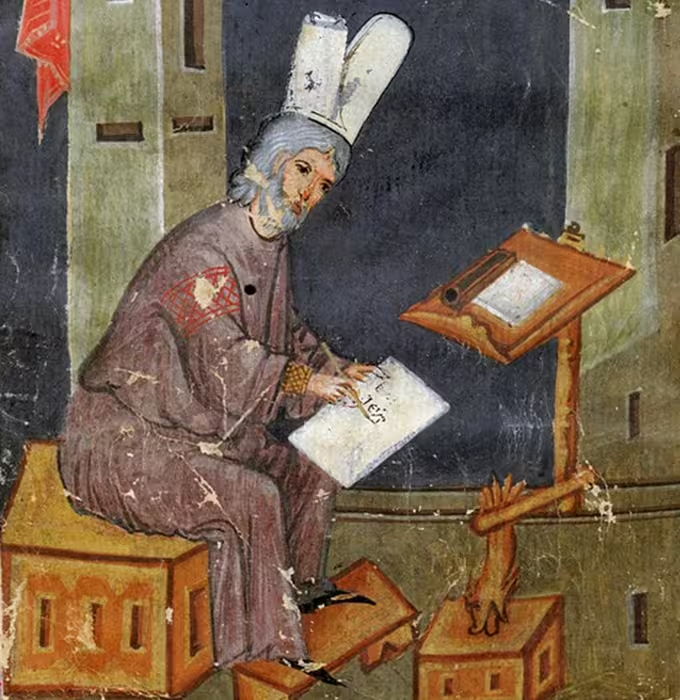
Few Byzantine libraries are known better. Choniates brought many books from Constantinople and kept adding to them in Athens; one letter thanks a young friend for copying a Nicander from a nearly illegible old exemplar. To classical scholars he is best known as the owner of what was probably the last complete copy of Callimachus’ Hecale and Aetia, which he quotes without ever naming the poet. His books were lost with the Latin conquest, and with them, it seems, the last complete Callimachus. The ODB also notes a treatise in which he defended the artist’s independence from the judgement of the crowd, a position that sat uneasily with the demands of public oratory.
Afterlife: A Saint painted in Attica
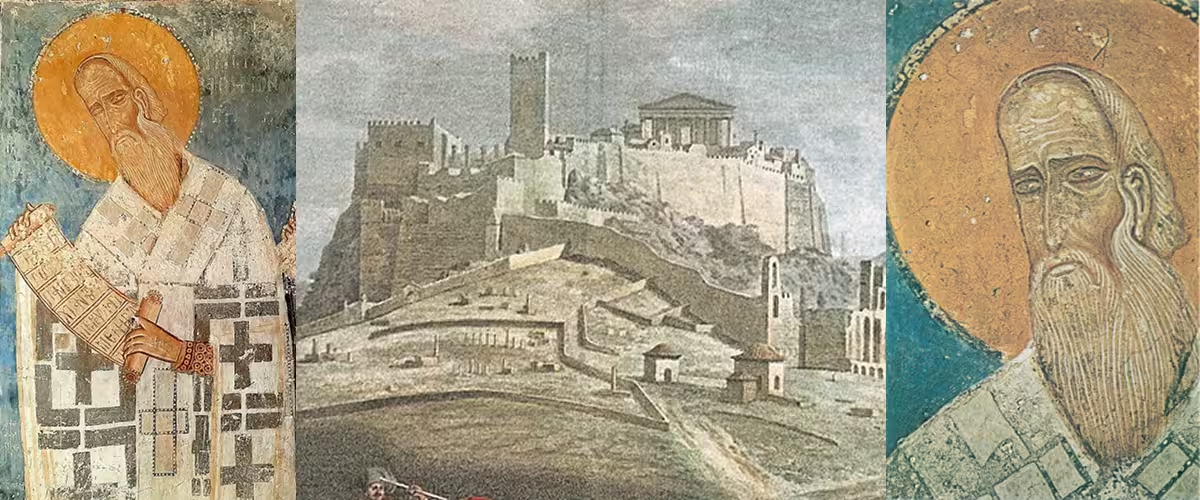
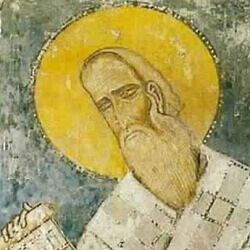
The Athenians did not forget him. In the church of St Peter at Kalyvia Kouvaras in eastern Attica, and in the south chapel of the Penteli cave, Choniates is depicted as a bishop with a halo. The Penteli paintings are dated by inscription to 1233/4. Within about a decade of his death, in a duchy ruled by the Latins, he was already being venerated as a saint. Today the Orthodox Church commemorates him on 4 July.
Choniates’ Athens was always half dream. He expected the descendants of Pericles and found taxpayers. He saw the Parthenon as the gate of heaven and lived to see it turned into a Latin cathedral. But when the city needed a leader, the man who had complained most about it was the one who stayed.
Frequently Asked Questions
Was Michael Choniates the brother of Niketas Choniates?
Yes. Michael was the elder brother, born around 1138; Niketas, the historian of the period up to 1206, was born in the mid-1150s. Both came from Chonai in Phrygia, and Niketas’ History is the main narrative source for Michael’s defence of the Acropolis.
Why is he sometimes called Michael Akominatos?
The name results from an old misreading of the sources. Modern scholarship, following Stadtmüller (1934), uses Choniates, “from Chonai”. Library catalogues still list “Acominatus” as a variant.
Did Michael Choniates really defend the Acropolis?
Yes. When Leo Sgouros attacked Athens in 1204, he took and burned the lower town, but the Acropolis held out under the metropolitan’s leadership until Sgouros withdrew. Our accounts come mainly from Choniates himself and his brother, so the details reflect their perspective.
Was Athens really in decline in his time?
Choniates describes a poor and depopulated city, but archaeology shows growing housing, coin circulation, workshops and new churches throughout the twelfth century. Many historians now read his complaints partly as rhetoric and as arguments for tax relief.
Is Michael Choniates a saint?
Yes. He was depicted with a halo in Attic churches within a decade or so of his death, and the Orthodox Church commemorates him on 4 July.
Sources
- S. Lampros (ed.), Μιχαὴλ Ἀκομινάτου τοῦ Χωνιάτου τὰ σωζόμενα, 2 vols, Athens 1879–80 (repr. Groningen 1968).
- F. Kolovou (ed.), Michaelis Choniatae Epistulae, CFHB 41, Berlin–New York 2001.
- A. Kazhdan (ed.), The Oxford Dictionary of Byzantium, Oxford 1991, s.v. “Choniates, Michael” and “Choniates, Niketas”.
- Niketas Choniates, Historia, ed. J. L. van Dieten, Berlin–New York 1975; Eng. trans. H. Magoulias, O City of Byzantium, Detroit 1984.
- S. Efthymiadis, “Michael Choniates’ Inaugural Address at Athens: Enkomion of a City and a Two-Fold Spiritual Ascent”, in P. Odorico and C. Messis (eds), Villes de toute beauté, Paris 2012, 63–80. ⚠ CHECK year and pages
- C. Bouras, Byzantine Athens, 10th–12th Centuries. ⚠ CHECK edition, publisher and year
- A. Kaldellis, The Christian Parthenon: Classicism and Pilgrimage in Byzantine Athens, Cambridge 2009, ch. 6.
- B. D. MacDougall, “Michael Choniates at the Christian Parthenon and the Bendideia Festival of Republic 1″, GRBS 55 (2015) 273–299.
- C. Livanos, “Michael Choniates, Poet of Love and Knowledge”, BMGS 30 (2006) 103–114.
- M. Tziatzi-Papagianni, “Die Legende vom Einhorn bei Michael Choniates: Quellen und Imitationen”, Byzantina Symmeikta 34 (2024) 11–38.
- P. Speck, “Eine byzantinische Darstellung der antiken Stadt Athen”, Hellenika 28 (1975) 415–418.
- J. Herrin, The Social and Economic Structure of Central Greece in the Late Twelfth Century, PhD thesis, University of Birmingham 1972; and “Realities of Provincial Government: Hellas and Peloponnesos”, DOP 29 (1975) 253–284.
- A. Papageorgiou, “Το Υπομνηστικόν του Μιχαήλ Χωνιάτη και οι καστρηνοί”, Byzantina Symmeikta 18 (2008) 159–169.
- A. S. Hollis, “A New Fragment on Niobe and the Text of Propertius 2.20.8”, Classical Quarterly 47 (1997) 578–582.
- G. Stadtmüller, Michael Choniates, Metropolit von Athen (ca. 1138–ca. 1222), Orientalia Christiana 33.2, Rome 1934.
- K. M. Setton, “Athens in the Later Twelfth Century”, Speculum 19 (1944) 179–207.

One Comment