Gello (Gylou): Byzantium’s Child-Stealing Demon and her witches
Gello, whom the Byzantines called Gylou, was a female demon blamed for miscarriage, the death of women in childbirth and the death of newborns. Sappho already mentions her around 600 BC, and she outlived Byzantium by five centuries: in the 1960s, Greek islanders still pointed out the girls they believed were her kind, and village priests still kept the exorcisms written against her.
Behind the single name stand three different beings. Gello is the ancient ghost of a girl who died young. Gylou is the Byzantine demon, a supernatural creature that only saints and archangels can defeat. The gelloudes, her plural, are flesh-and-blood women suspected of witchcraft, who could be denounced, tried and punished. Following the historian Maria Patera, this article uses the three names in this way. What makes Gylou fascinating is that the Orthodox Church officially denied she existed, yet for a thousand years it ruled on her, punished her witches and watched its own priests read her exorcisms.
Quick facts
Names
Gello (Γελλώ) in antiquity; Gylou, Gyllou (Γυλλοῦ) in Byzantium; gelloudes (γελλοῦδες) for her witches
First mention
Sappho of Lesbos, c. 600 BC
Blamed for
Miscarriage, death in childbirth, wasting and death of infants, dried-up breast milk
Vanquished by
Saint Sisinnios, the Archangel Michael; Solomon on amulets
Protection
Her secret names written on a charm, priestly exorcism, baptism, the cross
Officially
Declared non-existent by the Church, which nonetheless set penances for her witches
Last attested
Exorcism “papers of Gylou” still owned by village priests in the 1960s
The ghost of Lesbos: Gello in antiquity
The oldest trace of Gello is a proverb preserved from Sappho: Γελλὼ παιδοφιλοτέρα, “fonder of children than Gello” (fr. 168A Voigt, 178 Lobel-Page). The saying only makes sense if Sappho’s audience already knew the figure. In the 2nd century AD the proverb collector Zenobius explained it: Gello was a maiden who died before her time, and the people of Lesbos said her ghost haunted small children and caused their early deaths. The proverb, he adds, was used of women who died young or of those whose love for children ruined them.
Gello thus belongs to the aōroi, the “untimely dead”, souls who left life before fulfilling it and who, in Greek belief, return to take from others what they were denied. The lexicographer Hesychius (5th–6th century) still glosses her as a phantom attacking virgins and newborns. She shares this role with two other bogeywomen of Greek nurseries, Lamia and Mormo, and later authors often blur the three together.
Where her name comes from is uncertain. Walter Burkert and Martin West, following the Assyriologist Carl Frank, derived it from the Mesopotamian gallû demons; others connected it with the Greek root for laughing or grinning. Neither etymology is proven.
From ghost to witch: the gelloudes on trial
The decisive change is Byzantine. By the 8th century, Gello was no longer a single ghost but a whole category of women. John of Damascus (died c. 750), in a short treatise on dragons and stryggai, equates the gelloudes with the striges, the night witches of Roman lore. According to “the most ignorant”, he writes, these women slip into houses at night although doors and locks are shut, and devour the liver of infants or strangle them. John’s rebuttal is theological: only Christ, in his resurrected body, passed through a closed door, and to grant the same power to ordinary women is heresy.
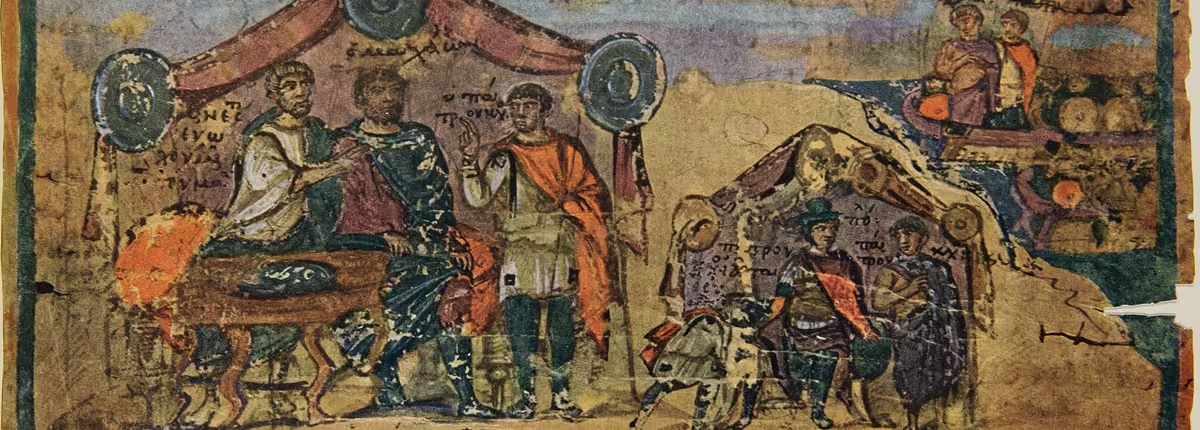
The same argument decided a real trial. The Life of the Patriarch Tarasios, written around 843 by Ignatios the Deacon, tells how Tarasios’s father Georgios, a judge in Constantinople, heard the case of women accused of entering houses through cracks and locked doors and killing newborns. Their accusers, says Ignatios, believed “the myths of the Hellenes” about a girl called Gello who returned as a spirit. Georgios acquitted the women. Christ, he reasoned, had shown his disciples that a spirit has neither flesh nor bones; real women could not pass through walls, and claiming otherwise put the Incarnation itself in doubt. The emperor – probably Constantine V, displeased, had the judge arrested, but did not overturn the verdict, and the women went free. Had they been convicted, they would probably have faced death, which tells us how seriously such accusations were taken.
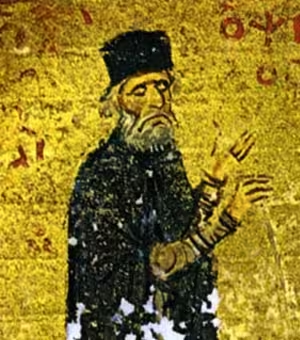
Three centuries later, the polymath Michael Psellos (1018–c. 1078) reports that people still blamed old winged women for slipping in to suckle infants and drain them of their vital fluids. Wasting babies were called γιλλόβρωτα, gillobrota, “food for Gillo”, a power hostile to birth that caused miscarriages and deaths in the first year of life. Psellos himself treated the phenomenon as an ordinary childhood disease wrongly blamed on old women. He also noted that the name Gillo, though “ancient and famous”, appeared in none of his classical sources, only in a secret Hebrew book of Solomon, and he suggested a link with Lilith.
In the 17th century the Chiot scholar Leo Allatios rejected that identification.
The demon defeated: Saint Sisinnios and the Archangel Michael
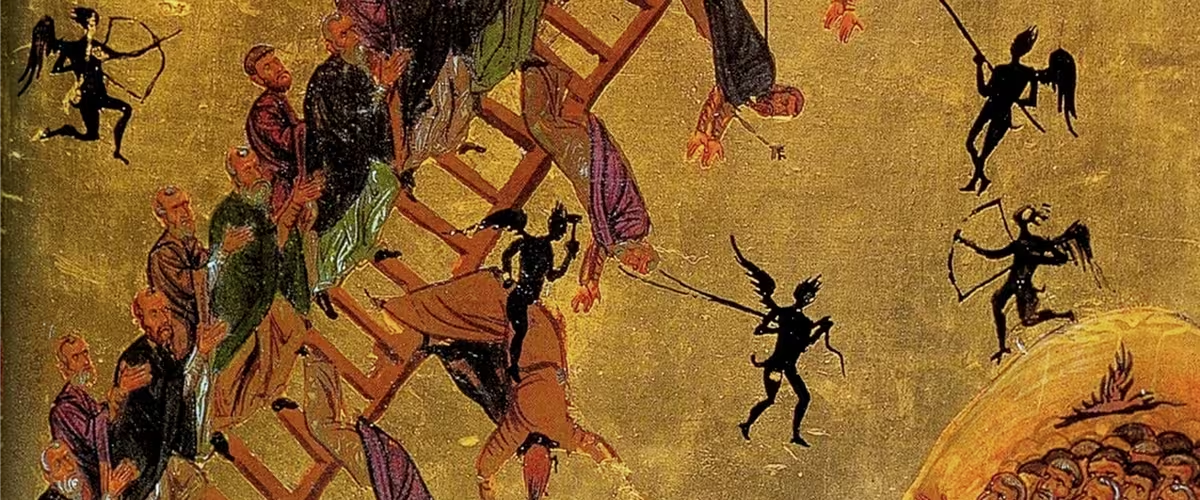
Alongside the witches, Byzantium knew Gylou in the singular: a demon, never a woman, fought with prayers. Her stories survive as historiolae, short narratives embedded in exorcisms. They were read aloud over sick children and copied onto phylacteries worn around the neck. Most surviving manuscripts date from the 15th to the 20th century, and they fall into two families.
In the Sisinnios type, a woman named Melitene has lost her children to Gylou. Pregnant again, she shuts herself in a sealed tower, in one 15th-century version built at Chalkoprateia in Constantinople, to give birth safely. Her brothers, Saint Sisinnios and one or two companions, come to visit; as the door opens, Gylou slips in, turned into a fly or a speck of dust, kills the newborn and flees. The saints hunt her down, as far as Lebanon in the same version, and torture her until she restores the child, or all the children she ever took. To do so she needs milk, either Melitene’s or that of the woman who once nursed Sisinnios: the anthropologist Muriel Djéribi read the exchange as “milk against child”. A second round of torture forces Gylou to reveal the secret of her power, her names.
In the Michael type, there is no particular crime to avenge. The archangel comes down from heaven, or from Mount Sinai, meets the demon on the road and asks where she comes from and where she is going. The demon, with wild hair, burning eyes and lion’s teeth, sometimes breathing smoke, boasts of her powers. She enters houses as a snake or a dragon, kills cattle, sinks ships, separates couples, sets priests against each other, dries up springs and milk, causes miscarriages, keeps children awake, whips and strangles them. Some versions even have her recall a failed attack on the Virgin in childbirth. Defeated, she must tell the archangel how mortals can protect themselves, and lists her names.
How old is the legend?
Scholars disagree. The Byzantinist Irène Sorlin dated the Sisinnios legend to the late 4th or early 5th century, close to the earliest amulets naming the saint. Richard Greenfield’s survey of the Greek texts, however, found no copy earlier than the 15th century. A recently published lead tablet from Cyprus, dated to the early 8th century, bridges part of the gap: it carries the same kind of exorcism, in which Michael defeats Gylou-Abyzou, and its author specifies that it is directed against the gelloudes. Demon and witches were therefore already one belief by 700. Scholars also differ on which adversary dominates: Sarah Iles Johnston treats Sisinnios as Gylou’s regular opponent, while Jeffrey Spier notes that Michael is the one she meets most often in medieval texts.
The twelve and a half names
Gylou’s strength lay in what humans did not know. Once her names were spoken or written, she lost her power over the household. Most texts give twelve and a half, though the count ranges up to seventy-two and a half. The strange “half name” served a precise purpose: it showed that the list was complete, closing the loophole through which a forgotten name would let her return. Many names are corrupted magic words, but some still speak Greek, and one at least fits the story: Myia, the “Fly”, is the shape in which she entered Melitene’s tower. Most manuscripts also leave blanks where the copyist wrote in the names of the real family to be protected.
| Paris, BnF gr. 395 (15th–16th c.) | Leo Allatios (1645) | Meaning where recognisable |
|---|---|---|
| Gyllou | Gylo | Her “first and proper” name |
| Amorphous | Morrha | “Formless” |
| Abyzou | Byzo | From abyssos, “the deep” |
| Karkhous | Marmaro | Obscure |
| Brianê | Petasia | Petasia: possibly “she who flies” or “strikes” ⚠ CHECK |
| Bardellous | Pelagia | Pelagia: “of the sea”, a counterpart of Abyzou |
| Aigyptianê | Bordona | Aigyptianê: “the Egyptian” |
| Barna | Apleto | Apleto: “boundless” |
| Kharkhanistrea | Chomodracaena | Contains drakaina, “she-dragon” |
| Adikia | Anabardalaea | Adikia: “Injustice”; Anabardalaea also names Abyzou on an amulet |
| (lacuna) | Psychoanaspastria | “She who snatches souls” ⚠ CHECK gloss |
| Myia | Paedopniktria | Myia: “Fly”; Paedopniktria: “child-strangler” |
| Half name: Petomene | Half name: Strigla | Petomene: “flying”; Strigla: “witch”, from strix |
Amulets and the holy rider
Middle Byzantine amulets often show a rider spearing a female demon, sometimes with a fish or serpent tail. On the best-known example, published by Gustave Schlumberger in 1892 and now in the Cabinet des Médailles in Paris, the inscription reads φεῦγε μεμισιμένι, Σολομόν σε διόκι, Σισίννιος, Σισιννάριος: “Flee, hated one, Solomon pursues you, Sisinnios, Sisinnarios.” Its reverse shows an eye labelled Envy, attacked by weapons and animals.
The demon on such amulets is routinely called Gylou in popular books. Yet, as Jeffrey Spier pointed out, no surviving amulet actually names her. Early Byzantine amulets of the 6th–7th century call their demon Abyzou, a cousin of the Obyzouth who strangles newborns in the Testament of Solomon. Abyzou and Gylou merged only gradually: an 18th-century exorcism in Athens describes “Abyzouth, whom men also call Gylou”, and Psellos already equated the two. The identification of the amulet demon with Gylou is reasonable, but it rests on the saints and names around her, not on any label.
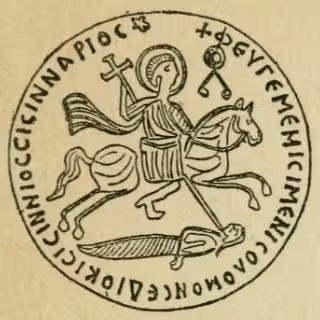
Holy rider piercing recumbent female demon, drawing of a Byzantine amulet. 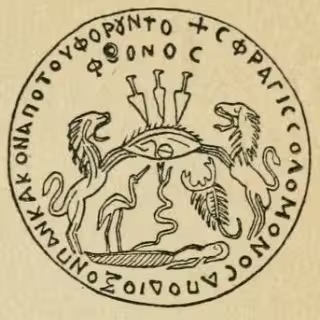
Evil eye – “Envy” attacked by three blades and beasts, drawing of a Byzantine amulet.
Gylou and the evil eye
The eye on the Schlumberger amulet points to Gylou’s closest relative, the evil eye. In Greek belief, a child could “catch gelloudes” through the evil eye, typically when someone praised it too much and “ate it with words”. Some gelloudes were thought to be women who cast the eye without knowing it, out of malice or out of love. In certain exorcisms Gylou herself is called Baskania or Baskanosynē, the evil eye, or Zēlos, envy. One Greek charm against the evil eye simply retells the Melitene story without naming the demon: a “bad neighbour” turns into a fly, steals and swallows the baby, and gives it back under the threat of Melitene’s brothers. The bad neighbour, the person most likely to envy a mother, was commonly called “a Gylou”.
The Church drew a sharp line between the two. It accepted the evil eye as real, following Basil of Caesarea, who explained in his homily On Envy that demons use the eyes of the envious for their own ends, and it eventually adopted its own prayer against it. Gylou and the gelloudes it rejected outright. Patera’s explanation is elegant: the evil eye is a vague, diffuse threat that can come from anyone, whereas Gylou gives it a face, a history and a weakness. A demon with a biography can be beaten by a saint; an anonymous glance is much harder to fight.
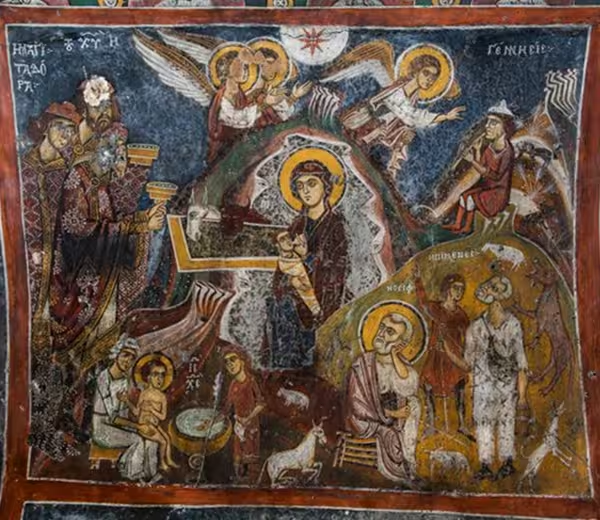
The fear even reached the Mother of God. The Nativity fresco of 1289 in the Omorfi Ekklisia on Aegina shows the Virgin nursing Christ in a cave ringed with eyes, and one charm against the evil eye shows a troop of gelloudes pulling the Virgin’s hair.
The Church against the “papers of Gylou”
Officially, the gelloudes did not exist. In 1438 a Cretan priest named Drazinoutas asked the patriarchate in Constantinople whether there really were women called gilloudes who sucked infants’ blood and killed them; the reply was that this was a deception of the devil and must not be believed at all. Yet a penitential rulebook later printed by Jean-Baptiste Cotelier (1677), in its chapter on infanticide, set a penance for a gylou who repented: ten years and five hundred prostrations. Other rulebooks punished those who believed in gelloudes. The Church, in short, denied the witch and sentenced her anyway.
The exorcisms posed the same problem in reverse. The gialloudocharta, “papers of Gylou”, used against the evil eye, magic and incurable illness, were very often owned by priests, bishops and monasteries. The Pedalion, the canon-law collection of the Orthodox Church published in 1800, forbade priests to read them on pain of suspension. The ban achieved little. At the end of the 19th century the bishop of Paros and Naxos reprimanded Primikirios, priest of Apeiranthos on Naxos, and the island priests refused to obey, convinced the papers worked. On Amorgos, the priest of Tholarion told a folklorist in 1963 that he had not used his paper of Gylou for more than twenty years, which suggests he had used it before. In Romania, where the same legend spread, an icon of Saint Sisinnios hung in most houses as protector of mothers and children.
The demon on the wedding night
Gylou was popular enough to be a joke. The Spanos, an anonymous satire of the 14th or 15th century that parodies the liturgy and was reprinted in Venice from about 1553 until 1832, mocks a “beardless man”, a stock figure of ugliness and cunning. On his wedding night, around midnight, Gylou’s favourite hour, he asks his bride her name. She answers that she has twelve and a half, like the demon of the exorcisms. Terrified that she will strangle him, the groom falls gravely ill.
Modern Greek gelloudes
After Byzantium, demon and witches drew ever closer. In Greek folk belief recorded in the 19th and 20th centuries, gelloudes could be born into ordinary families: they were girls born around Christmas, the ill-omened days when, so it was said, no child should be born, since conceiving on the Annunciation, 25 March, was a sin. On Amorgos such a girl was a “fruit of the feast”, and in 1963 villagers still remembered that “we had a giallou here, and she was the mayor’s daughter”. On Thera, grown gelloudes were said to rise from their beds during the twelve days between Christmas and Epiphany and sit at street corners. A passer-by had to wake one with a slap and seize her by the breasts; otherwise she would catch him and throw him into a well.
Children’s illnesses were widely blamed on Gylou or on her human counterparts. A sick child was gialloudiasmeno, “struck by gelloudes”; in eastern Crete people said the gelloudes were eating it and it was burning down like a candle. A child who cried and could not sleep “had gelloudes”, but a child who laughed in its sleep also had to be woken, or Gylou might strangle it. On Amorgos, “gellou” was simply the name of a childhood disease, and in Greek Macedonia the word gillobrota, Psellos’s “food for Gillo”, survived until recently for children who died young. Gylou was said to suck children’s blood, shoot arrows at them, carry them off or smother them, preferably before baptism. She also threatened mothers, which helped justify the forty days during which a new mother stayed indoors and away from church.
Families defended themselves with their own rituals. In Thrace a healer came at midnight for six nights in a row, wielding a black-handled knife and a formula to bind the demon. In eastern Crete the gelloudes were “nailed”: nine reed pins were driven into an onion while the healer named the gelloudes, the gellou and their little ones, down to their eyes, teeth, hearts and lungs, nine times over. Like the twelve and a half names, the formula left nothing out.
Gylou among the exôtika
Greeks placed Gylou and the gelloudes among the exôtika, “those from outside”, a loose family of supernatural beings that also includes the Nereids, with whom gelloudes were identified on Crete and Chios, and the striges, with whom they merged on Karpathos. The Church condemned them all as superstition, but, as the anthropologist Charles Stewart showed, the official “great tradition” and the village “little tradition” mirrored each other: the theologians had the Devil, the villagers had devils, and people met the second far more often than the first. Cyril Mango observed the same divide as early as the 4th century, when ordinary demons were experienced as real while the Devil remained a theological idea.
Gylou’s long life owes much to that position. She struck at the most fragile moments of a family’s life, between birth and baptism, before the mother returned to church, during the first year of childhood, and she turned the unbearable, the death of a healthy baby, into something that had a cause, a name and a remedy. Saints needed her to show their power, priests read her papers, and mothers wrote down her names. Officially she never existed, yet from Sappho to the 1960s, few Greek demons were more real.
Gylou’s sisters
Child-killing demons forced to confess their names appear across the medieval Mediterranean, in Coptic, Ethiopian, Armenian, Slavonic, Romanian, Syriac, Arabic and Hebrew texts. The oldest known versions, Aramaic incantations of the 5th–6th century on a silver lamella from Palestine and two incantation bowls, call the demon Sideros and her victim Smamit. In Ethiopia the demon Werzelya is the evil sister of Saint Susenyos, a form of Sisinnios. Jewish tradition attached a similar role to Lilith, the identification Psellos proposed for Gylou.
Frequently asked questions
Who was Gello in Greek mythology?
Gello was the ghost of a girl from Lesbos who died before she could marry and bear children, and who was believed to return to kill the children of others. Sappho mentions her around 600 BC, and the proverb “fonder of children than Gello” was still being explained by Zenobius in the 2nd century AD.
Is Gylou the same as Gello?
Yes. Gylou (or Gyllou) is the Byzantine and later Greek form of the same figure. Scholars usually reserve Gello for the ancient ghost and Gylou for the Byzantine demon, while the plural gelloudes designates mortal women accused of being witches.
Who defeats Gylou?
In the exorcism texts she is defeated either by Saint Sisinnios, who forces her to return the children she stole from his sister Melitene, or by the Archangel Michael. On amulets, the rider who spears the demon is often Solomon or Sisinnios.
What are Gylou’s twelve and a half names?
They are the secret names the demon is forced to reveal, which were then written on a protective charm. The half name proved that no name had been forgotten. The lists vary from manuscript to manuscript; see the table above.
Is Gylou connected to the evil eye?
Yes. In some Greek exorcisms Gylou is called Baskania (the evil eye) or Zelos (envy), and folk belief held that the evil eye could make a child “catch gelloudes”. The Church accepted the evil eye but rejected belief in Gylou.
Did the Byzantines put women on trial as gelloudes?
Yes. The Life of Tarasios (c. 843) records a trial in Constantinople in which women accused of being gelloudes were acquitted by the judge Georgios, father of the future patriarch.
Sources and further reading
- Maria Patera, “Gylou, démon et sorcière du monde byzantin au monde néogrec”, Revue des études byzantines 64 (2006), 311–327.
- Irène Sorlin, “Striges et Géloudes. Histoire d’une croyance et d’une tradition”, Travaux et Mémoires 11 (1991), 411–436.
- Richard P. H. Greenfield, “Saint Sisinnios, the Archangel Michael and the Female Demon Gylou: the Typology of the Greek Literary Stories”, Byzantina 15 (1989), 83–142. ⚠ CHECK volume number
- Richard P. H. Greenfield, Traditions of Belief in Late Byzantine Demonology, Amsterdam 1988.
- Jeffrey Spier, “Medieval Byzantine Magical Amulets and Their Tradition”, Journal of the Warburg and Courtauld Institutes 56 (1993), 25–62.
- Karen Hartnup, On the Beliefs of the Greeks: Leo Allatios and Popular Orthodoxy, Leiden 2004.
- Sarah Iles Johnston, Restless Dead: Encounters between the Living and the Dead in Ancient Greece, Berkeley 1999.
- Charles Stewart, Demons and the Devil: Moral Imagination in Modern Greek Culture, Princeton 1991.
- Cyril Mango, “Diabolus Byzantinus”, Dumbarton Oaks Papers 46 (1992), 215–223.
- Henry Maguire (ed.), Byzantine Magic, Washington DC 1995.
- Gustave Schlumberger, “Amulettes byzantins anciens”, Revue des Études Grecques 5 (1892), 73–93.