Eunuchs in the Byzantine empire
Eunuchs played a significant and distinctive role in Byzantine society, serving in various administrative, military, and ecclesiastical capacities. Their unique status, neither fully male in a traditional sense nor female, allowed them to occupy roles that were inaccessible to other men, particularly in environments where trust and loyalty to the emperor or Church were paramount. But the imperial palace was only the most visible stage: eunuchs served in aristocratic households, provincial administration, monasteries far from Constantinople, and — in far greater numbers than the famous names suggest — in perfectly ordinary families who saw castration as a path to social advancement for a son who would otherwise have none.
Quick facts
Legal status: castration formally prohibited by Roman and Byzantine law, but widely tolerated in practice
Roles: court administration, military command, ecclesiastical office, private household service
Titles: a distinct hierarchy of court ranks reserved for eunuchs, recorded as early as the Kletorologion of Philotheos (899)
Peak influence: 9th–11th centuries
Decline: pushed out of the highest offices under the Komnenian dynasty (from 1081) as an aristocratic, hereditary, “bearded” ideal of masculinity took hold.
Origins and social role of Byzantine Eunuchs.
Legislation originally prohibited castration, although Leo VI mitigated the punishment imposed for performing this surgery. Despite this prohibition, the operation was often performed on both children and adults, including members of the aristocracy, while boys from enslaved populations or captured foreigners could also be castrated. Some eunuchs were also imported from the Caucasus, the caliphate, and Slavic countries. One reason to perform such an operation — which occasionally resulted in the death of the subject — was the higher prices that slaves could fetch. At certain times, a 10-year-old child on the slave market of Constantinople was worth 10 nomismata, while a castrated one was worth 30. An adult male was worth 20 nomismata, while an adult eunuch was worth 50.
Eunuchs occupied a wide variety of roles in Byzantine society. They were often employed in the imperial court, monasteries, and high-ranking administrative roles due to their perceived loyalty and inability to establish independent dynasties. As a result, the practice continued despite legal restrictions, and the legislation was not always enforced. Some members of the imperial family were even castrated, such as Basil I’s son Stephen, who was castrated in childhood — precisely to remove him as a dynastic rival to his brothers — and later became Patriarch Stephen I (886–893). Another example is Romanos IV Diogenes, whose sons were castrated to eliminate any dynastic threat. More modest families, hoping for the promising career paths available to eunuchs, did not hesitate to castrate their own children. Lastly, like blinding, castration was also a punishment frequently administered to rebels.
Importance of the Eunuchs in the Byzantine imperial Court.

Eunuchs were prominent figures in the bureaucracy and in the imperial palace. Rare during the time of Constantine I, they gained more importance during the reign of Constantine II, alongside the growth of the bureaucratic system. Emperor Julian’s attempt to restrict their role failed, and they retained important positions through the 11th century. However, the Komnenian dynasty pushed them out of the highest posts as aristocratic ideology, emphasizing hereditary masculinity, became dominant. Eunuchs had become rare by the 14th and 15th centuries.
A parallel hierarchy of titles.
What made the Byzantine court genuinely unusual was not simply that eunuchs held power, but that the state built an entire second ladder of official ranks reserved specifically for them, running alongside the ranks open to “bearded” men. The Kletorologion of Philotheos, a court precedence manual compiled in 899, lists eunuch dignities as a distinct category from the outset — titles such as parakoimomenos (the emperor’s chief chamberlain, literally “the one who sleeps beside” the imperial bedchamber), protospatharios eunouchos, and primikerios, each with its own seating order at court banquets and its own place in imperial processions. A eunuch could rise through this ladder to positions of real executive power — finance, the palace guard, foreign embassies — while remaining permanently barred from the one office that mattered most: the throne itself. That structural ceiling is precisely why emperors trusted eunuchs with so much: a eunuch minister could accumulate immense personal power without ever being able to found a rival dynasty.
Two notable examples are Basil Lekapenos and Joseph Bringas, who both effectively served as regents during the reigns of several emperors — Lekapenos’s career is detailed below. Under Empress Irene in the 9th century, the eunuchs Aetios and Staurakios also wielded significant power. In the 11th century, John the Orphanotrophos held considerable power in a case that shows exactly how far a eunuch minister’s ambitions could reach: as chief minister to Emperor Romanos III, he engineered the marriage of his own brother, Michael the Paphlagonian, to Empress Zoe in 1034, making Michael IV emperor and effectively placing his own family on the throne while he ran the government behind the scenes. When Michael IV died in 1041, John pushed through the succession of his nephew as Michael V — who almost immediately tried to have his uncle exiled, a fair measure of how uneasy that kind of power made even the men who benefited from it.
Basil Lekapenos: the eunuch who ran an empire
If one figure demonstrates just how far Byzantine eunuchs could rise, it is Basil Lekapenos, known to contemporaries as ho Nothos — “the Bastard.” An illegitimate son of Emperor Romanos I Lekapenos, he was castrated as a child specifically to remove any possibility of his ever claiming the throne himself, which paradoxically freed him to serve at the very center of imperial power for nearly forty unbroken years, under five successive emperors: Constantine VII (his brother-in-law), Romanos II (his nephew), Nikephoros II Phokas, John I Tzimiskes, and finally Basil II, his own great-nephew.
Raised to parakoimomenos — head chamberlain — around 947/8, Basil was no mere administrator content to stay behind palace walls: in 958 he personally led troops east to reinforce the future emperor John Tzimiskes against the Arabs, storming Samosata and inflicting a heavy defeat on a relief army sent by the Hamdanid emir of Aleppo, a victory substantial enough to earn him a triumph in the Hippodrome of Constantinople.
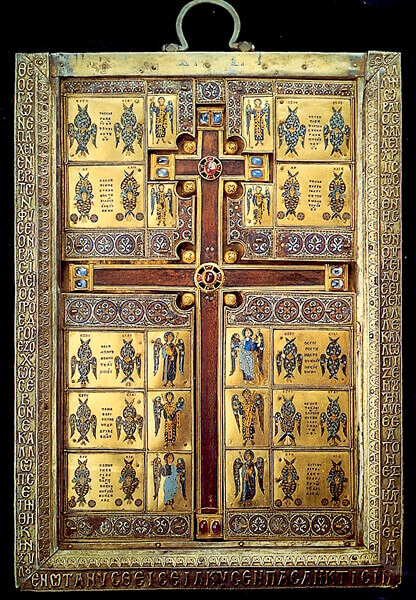
His enormous, and not entirely legally acquired, wealth made him one of the great art patrons of the tenth century: he commissioned the celebrated enamelled reliquary of the True Cross now known as the Limburg Staurotheke, along with a jasper paten and chalice still held at St. Mark’s Basilica in Venice.
When John I Tzimiskes died in 976, Basil Lekapenos became the effective ruler of the empire in all but name, governing on behalf of his eighteen-year-old great-nephew Basil II and helping steer the young emperor through the opening rebellion of Bardas Skleros. But that same accumulated wealth and influence eventually made him a liability rather than an asset.
In 985, the emperor — by then determined to govern in his own right after three decades of regents and soldier-emperors — accused Basil of secretly favoring the rebel Bardas Phokas, stripped him of every office and estate, annulled all administrative acts issued under his authority, and sent him into exile, where he died not long afterward. It is one of the sharper ironies of the man’s career that the same structural safeguard that had made him trustworthy for four decades — his inability to found a dynasty — offered him no protection at all once the emperor he had raised decided he no longer needed him.
Eunuchs in the military.
While eunuchs were generally excluded from active combat roles, they often held logistical or administrative positions within the military. A few eunuchs rose to command armies, relying on their strategic acumen rather than physical prowess. Byzantine emperors sometimes entrusted eunuchs with military power precisely because their inability to establish a dynasty made them less of a threat to the ruling family.
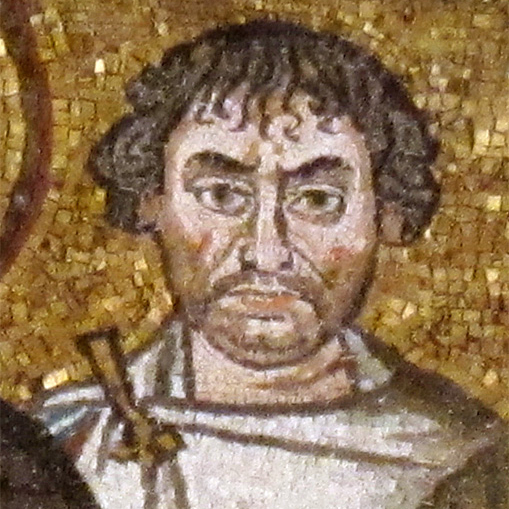
The most famous example is Narses, a renowned general of Armenian origin who played a key role in the reconquest of Italy under Emperor Justinian I. His decisive victory against the Ostrogoths at the Battle of Taginae in 552 was instrumental in reasserting Byzantine control over the region. He was appointed governor of Italy, and slowly retired from official functions before dying peacefully in the 570s, leaving a reputation as one of Byzantium’s most skilled and influential generals.
Under Empress Irene (797–802), the eunuch Staurakios exerted great influence over the empress and actively participated in the affairs of state. In 783, he led an imperial expedition against the Slavic communities in Greece, through Thrace, Thessaly, Central Greece, and the Peloponnese. Byzantine imperial control was partially restored over these areas, and tribute was collected. Empress Irene rewarded Staurakios with a triumph in the Hippodrome in January 784.
A less well-known but equally striking case is Peter, a eunuch who began his career as a servant in the household of the powerful Phokas family of Cappadocia and rose, under Nikephoros II Phokas, to the senior military rank of stratopedarches of the East. He led the capture of Antioch and the subjugation of Aleppo in 969, then served as a senior commander against the Rus’ invasion of Bulgaria under John I Tzimiskes in 970–971.
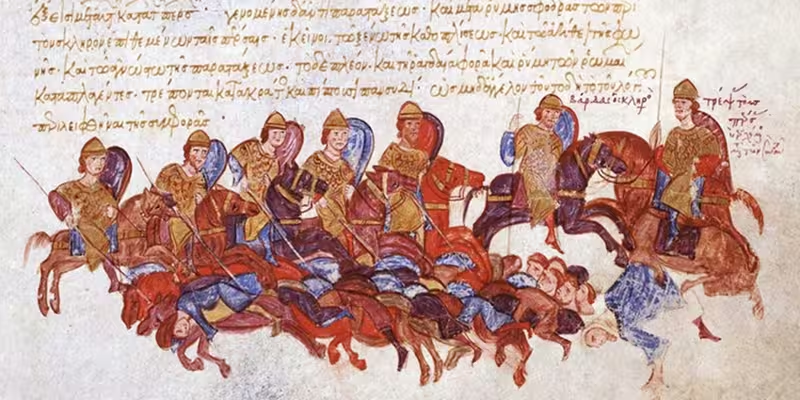
The historian Leo the Deacon, no casual flatterer, records that Peter “abounded in bodily strength” and once defeated the leader of an enemy warband in single combat — a detail worth pausing on, since it directly contradicts the stereotype, common in Byzantine writing about eunuchs, that they were physically unsuited to war. When Bardas Skleros rose in revolt after Tzimiskes’s death in 976, Peter was placed in command of the loyalist forces sent against him — and fell in battle in the autumn of 977, one of the very few named Byzantine eunuchs known to have died in active combat command.
In the 11th century, Stephanos Pergamenos was commissioned by Constantine IX to quell the rebellion of Georgios Maniakes. He reported a decisive victory in the Battle of Ostrobos, near Thessaloniki, in 1043. The emperor granted him a triumph in Constantinople. However, later that same year, Stephanos instigated a conspiracy against the emperor. When it was uncovered, he was convicted of high treason, shorn and exiled as a monk, and his property was confiscated.
In the church: a significant role.
Eunuchs also played a significant role in the Byzantine Church, where their unique status often allowed them to rise to high-ranking ecclesiastical positions. As celibacy was a requirement for certain clerical roles, eunuchs were particularly well-suited for such positions. They were seen as individuals who could dedicate their lives entirely to the service of God, free from familial obligations — which was not always true — or the potential for scandal. This perception often gave eunuchs an advantage in ecclesiastical hierarchies, enabling them to gain influence within the Church.
Byzantine history includes many examples of brilliant ecclesiastical careers among eunuchs. Among them is Germanos I, who was castrated in 669 when his father was executed but was elected bishop of Kyzikos around 705 and later became patriarch in 715. Another example is Theophylact of Constantinople, son of Emperor Romanos I Lekapenos — and therefore Basil Lekapenos’s own half-brother — who served as patriarch between 933 and 956; or Stephen I (886–893), son of Basil I, castrated in childhood precisely so that he could never contest the throne with his brothers. Another example is Ignatios of Constantinople, the son of Emperor Michael I Rangabe. After being castrated, Ignatios became a monk following his father’s abdication and eventually rose to become Patriarch of Constantinople, serving two non-consecutive terms (847–858 and 867–877), during which he played a critical role in defending Orthodox doctrine and mediating the Photian Schism. The last eunuch to serve as patriarch of Constantinople was Eustratios Garidas (1081–1084) — his tenure closing, fittingly, right at the start of the Komnenian era that would push eunuchs out of the summit of Church and state alike.
Eunuchs were also active in monastic communities, but because of their fear of homosexuality, some monastic leaders tried to exclude the “beardless” from certain monasteries, for instance on Mount Athos. On the other side, the monastery of St. Lazaros in Constantinople was reserved for eunuchs by Leo VI.
Eunuchs and court political struggles.
Holding key positions in the imperial court, eunuchs were often at the heart of plots and conspiracies. Due to their elevated positions in the imperial court, the military, and the administration, they often became involved in power struggles within the Byzantine political system. In several instances, powerful eunuchs even became contenders for imperial power by supporting members of their families, or close circles, who were not castrated — Basil Lekapenos’s own downfall in 985, discussed above, is one of the clearest examples of an emperor moving decisively against exactly this kind of accumulated eunuch power.
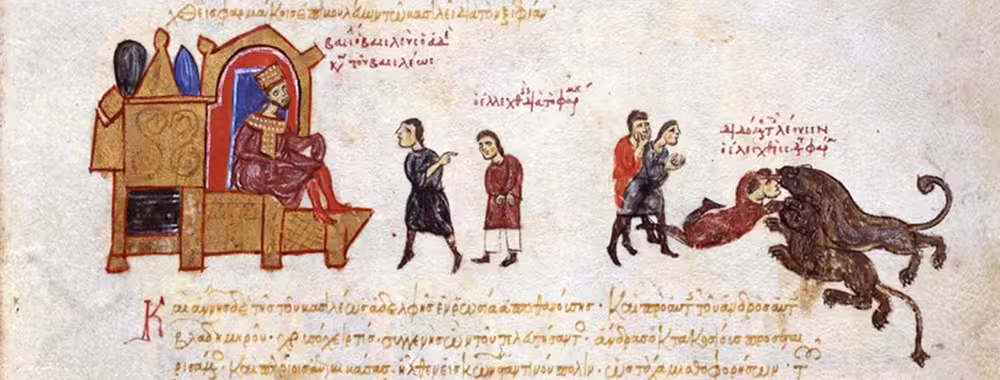
Eunuchs as key political contenders promoting the imperial ambitions of their kin.
In several instances, powerful eunuchs even became contenders for imperial power by supporting members of their families, or close circles, who were not castrated.
At the end of Empress Irene’s reign, Aetios allegedly planned to elevate his brother to the throne. Fearing an imminent coup, Aetios’s opponents, led by the logothetēs tou genikou Nikephoros, entered the Great Palace and acclaimed him as emperor, deposing Irene and forcing her to retire to a convent.
In the 11th century, Stephanos Pergamenos was convicted of high treason in 1043 for a conspiracy against Constantine IX, allegedly aiming to place Leon, the son of his confidant Lampros, on the throne. John the Orphanotrophos, discussed above, is the fullest example of the pattern: rather than seeking the throne for himself, he built and placed an entire dynasty of blood relatives on it.
Beyond the palace and the Church: eunuchs across Byzantine society
It is tempting, given how much of the source material concerns emperors, patriarchs, and generals, to picture the Byzantine eunuch as an exclusively palace phenomenon. The reality was much broader. The same legal and economic pressures that produced a Basil Lekapenos or a Narses also produced thousands of anonymous eunuchs who never appear in any chronicle at all.
Aristocratic households across the empire kept eunuch servants as a matter of course — not only in Constantinople, but on provincial estates, where a eunuch steward or bodyguard was considered a mark of status as much as a practical necessity. Wealthy families entrusted eunuchs with the supervision of their wives’ and daughters’ quarters precisely because their presence there raised none of the concerns that an intact male servant would have. Provincial governors and local magnates employed eunuch secretaries and financial agents, borrowing the same logic that worked at the imperial level: a man who could found no rival family line made a safer confidant with sensitive information.
Further down the social scale, the calculation was more brutally economic than dynastic. As the price differential noted above shows — a castrated child was worth roughly three times an intact one on the Constantinople slave market — the practice was in significant part driven by ordinary market incentives rather than court intrigue. And for freeborn families with few other options, castrating a son and directing him toward a monastic or clerical career, or toward domestic service in a great household, could represent a genuine, if drastic, path to social mobility that simply did not exist for his uncastrated brothers. This is worth stating plainly: the eunuchs who reached the summit of Byzantine power were a tiny, spectacularly visible minority. The overwhelming majority lived and worked in conditions we know only in outline — a reminder that behind every Narses or Basil Lekapenos stood an entire, largely undocumented social institution.
Social perception of Eunuchs in Byzantine society.
Eunuchs occupied an ambiguous position in Byzantine society. They were both admired for their loyalty and service and mocked for their physical condition, often being the subject of satire and derision in popular culture. However, their unique capabilities and close proximity to the emperor allowed them to wield considerable power, sometimes rivaling that of aristocratic families.
Showing this unusual and defamed position, Theophylaktos of Ohrid wrote a defense of the status of eunuchs, outlining that they had always played an important role in the palace, the church, and especially in the creation of ecclesiastical music. He included a list of eunuch-martyrs and named a contemporary, a certain Symeon, who organized a community of eunuch-monks.
Frequently asked questions
Why did the Byzantine Empire rely so heavily on eunuchs?
Because a eunuch could not found a dynasty, emperors could grant them extraordinary power — running the treasury, commanding armies, leading the Church — without fear of creating a hereditary rival family. This made eunuchs uniquely trustworthy servants of an emperor’s personal authority.
Was castration legal in the Byzantine Empire?
No — it was formally prohibited under Roman and Byzantine law, and Leo VI only reduced, rather than removed, the penalties for performing it. In practice the law was widely ignored, and castration remained common among enslaved populations, ambitious families, and as a punishment for defeated rebels.
Could Byzantine eunuchs hold military command?
Yes, though it was unusual. Narses led Justinian I’s reconquest of Italy and won the decisive Battle of Taginae in 552. Peter the stratopedarches commanded loyalist forces against the rebellion of Bardas Skleros and died in battle in 977.
Who was Basil Lekapenos?
An illegitimate son of Emperor Romanos I Lekapenos, castrated in childhood, who served as parakoimomenos (chief chamberlain) under five successive emperors across nearly forty years, effectively ruling the empire during Basil II’s minority before being stripped of power and exiled in 985.
Did eunuchs become patriarchs of Constantinople?
Yes, several times. Notable eunuch patriarchs include Germanos I, Stephen I (son of Basil I), Theophylact (son of Romanos I Lekapenos), Ignatios (son of Michael I), and Eustratios Garidas, the last eunuch to hold the office, whose term ended in 1084.
When did the power of Byzantine eunuchs decline?
Their exclusion from the highest offices accelerated under the Komnenian dynasty from 1081 onward, as an aristocratic ideology centered on hereditary, “bearded” masculinity took hold at court. Eunuchs had become rare in elite positions by the 14th and 15th centuries.
Sources & further reading
Shaun Tougher, The Eunuch in Byzantine History and Society (Routledge, 2008)
Shaun Tougher, “Byzantine eunuchs: an overview, with special reference to their creation and origin,” in Elizabeth James (ed.), Women, Men and Eunuchs: Gender in Byzantium (Routledge, 1997)
Shaun Tougher, “Byzantine eunuchs: an overview, with special reference to their creation and origin,” in Elizabeth James (ed.), Women, Men and Eunuchs: Gender in Byzantium (Routledge, 1997)
Kathryn M. Ringrose, The Perfect Servant: Eunuchs and the Social Construction of Gender in Byzantium (University of Chicago Press, 2003)
Rodolphe Guilland, Les Eunuques dans l’Empire Byzantin
John Skylitzes, Synopsis Historiarum, trans. John Wortley