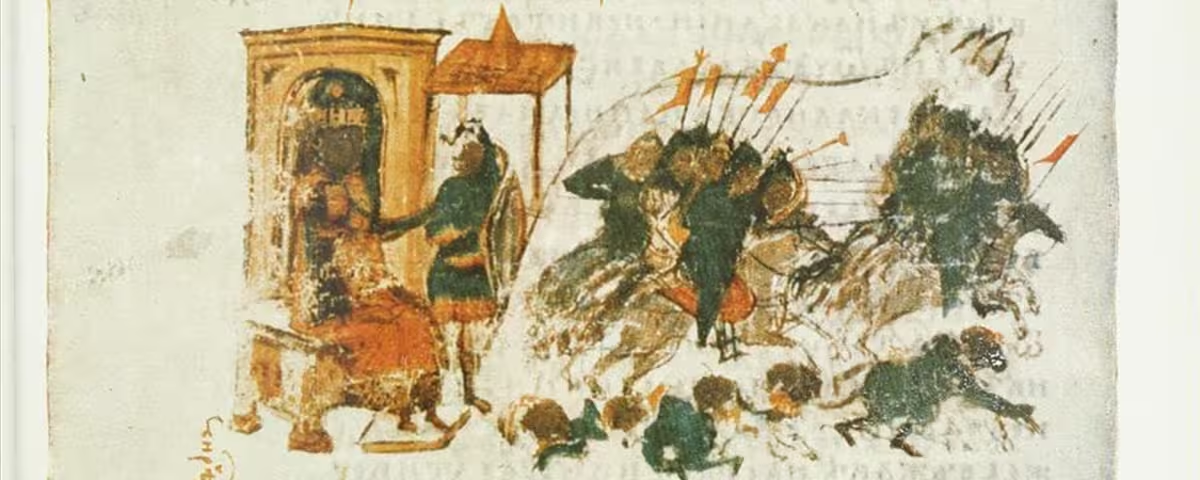
The Second Arab Siege of Constantinople (717–718)
The Second Arab Siege of Constantinople was a thirteen-month attempt by the Umayyad Caliphate to capture the Byzantine capital, lasting from August 717 to August 718. Led by the general Maslama ibn Abd al-Malik, a massive Arab army and fleet blockaded the city by land and sea, only to be broken by Emperor Leo III’s use of Greek Fire, a catastrophic winter, and a Byzantine alliance with Bulgaria. The failed siege is widely considered one of history’s turning points, halting the westward expansion of the early Islamic caliphates into southeastern Europe.
Quick Facts
Dates: August 717 – August 718 (roughly 13 months)
Location: Constantinople and the waters of the Bosporus and Sea of Marmara
Belligerents: Byzantine Empire vs. the Umayyad Caliphate
Byzantine Emperor: Leo III the Isaurian (seized the throne weeks before the siege began)
Arab commander: Maslama ibn Abd al-Malik, brother of the Caliph
Caliphs involved: Suleiman ibn Abd al-Malik (ordered the campaign, died during it) and Umar II (ordered the retreat)
Byzantine ally: Khan Tervel of Bulgaria, whose army attacked the besiegers from the rear
Decisive factors: Greek Fire, the Theodosian Walls, a catastrophic winter, and Bulgarian intervention
Outcome: Decisive Byzantine victory; the Umayyad invasion force was almost entirely destroyed
Why it matters: Widely regarded as one of the events that halted the westward expansion of the early Islamic caliphates into southeastern Europe
A city the Caliphate could not ignore
By the early 8th century, the Umayyad Caliphate was the largest empire the world had seen since Rome at its height, stretching from the Iberian Peninsula to the borders of India. Constantinople was the one prize that had eluded it. An Arab fleet had already tried and failed to take the city once before, in a long siege between 674 and 678, during which Byzantine engineers first unveiled a terrifying new weapon: Greek Fire. That failure had not discouraged Damascus. If anything, it sharpened the ambition. Constantinople sat at the hinge between Asia and Europe, controlling the straits that linked the Black Sea to the Mediterranean. Whoever held it did not simply own a city — they held the gate between two continents.

By 716, the Caliph Suleiman ibn Abd al-Malik decided to finish what his predecessors had started. He entrusted the campaign to his brother, Maslama ibn Abd al-Malik, one of the most experienced generals in the Umayyad state, and began assembling what medieval chroniclers describe as an extraordinary force: armies numbering in the tens of thousands and a fleet said to run into the hundreds, if not over a thousand, ships. Modern historians treat the largest of these figures — some medieval sources claim as many as 1,800 ships and 120,000 men — with real skepticism, since chroniclers on both sides had every incentive to inflate the scale of the threat Byzantium had overcome. What is not in doubt is that this was the single largest and most determined effort the Caliphate would ever make against the Byzantine capital, combining a land army advancing through Anatolia with a massive naval force meant to blockade the city by sea.
A new emperor, weeks before the storm
The timing could not have been more precarious for Byzantium — and the precariousness went far deeper than simply facing an invasion while the throne changed hands. The two decades before 717, a period historians now call the “Twenty Years’ Anarchy,” had been among the most chaotic in Byzantine history. It began in 695, when Emperor Justinian II was deposed, had his nose slit as a mark of disqualification from rule, and was exiled — only to fight his way back to power a decade later in 705 with the help of a Bulgar army, and to mark his restoration with a bloody purge of everyone he held responsible for his downfall. Justinian II was himself overthrown and executed in 711, and the throne then passed through a rapid succession of short-lived, often violently installed emperors — Philippikos Bardanes, Anastasios II, Theodosios III — none of whom held power for more than a few years, and several of whom were removed by military coup or mutiny. Provincial armies made and unmade emperors almost at will, administrative continuity collapsed, and Arab raiding parties pushed deeper into Anatolia nearly every campaigning season, probing an empire that seemed unable to stop fighting itself.
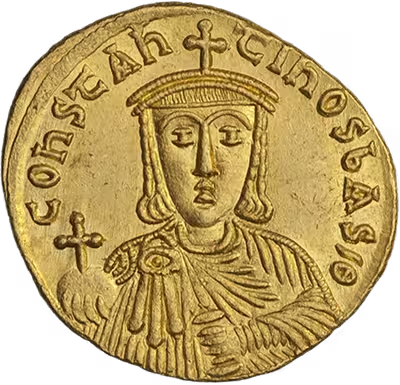
It was against this backdrop that Leo, then strategos of the Anatolic Theme and one of the empire’s most capable eastern commanders, rose in rebellion against Theodosios III in league with Artabasdos, strategos of the Armeniac Theme. Leo marched on Constantinople and forced Theodosios to abdicate in March 717, taking the throne just months — in some accounts, mere weeks — before Maslama’s invasion force arrived at the city’s walls.
The Umayyads were watching this instability closely, and by some accounts tried to actively use it to their advantage. As Maslama’s forces advanced through Anatolia in 716–717, they made contact with Leo while he was still a rebel general rather than emperor, and several chroniclers describe the Arabs extending him support — supplies, and possibly an informal understanding — apparently calculating that backing his bid for the throne would tip the empire further into civil war just as the main invasion arrived, leaving Constantinople too divided against itself to mount an effective defense. It was a shrewd strategic bet: an empire busy fighting a civil war around a new usurper would be far easier prey than one united behind a settled ruler.
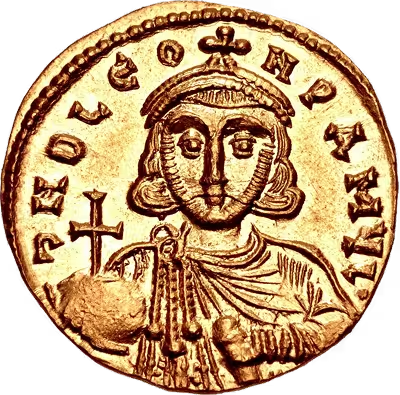
Leo, however, proved considerably better at this game than his would-be backers expected. Byzantine sources describe him stringing Maslama along with vague promises of cooperation even after seizing the throne — reportedly using the arrangement to secure grain and buy critical time to fortify and provision the city before the noose of the siege closed around it — only to abandon any pretense of accommodation once he was secure in power and the city was as ready as it could be. What the Umayyads had hoped would be a weakened, self-destructing rival instead became, almost overnight, the hardened and unified defense that would break their invasion. Leo’s own background as a veteran of the eastern frontier, who understood Arab tactics and capabilities from years of fighting them directly, only sharpened the irony: the very general the Caliphate had hoped to use as a tool against Byzantium turned out to be exactly the ruler best equipped to defeat it.
The siege begins
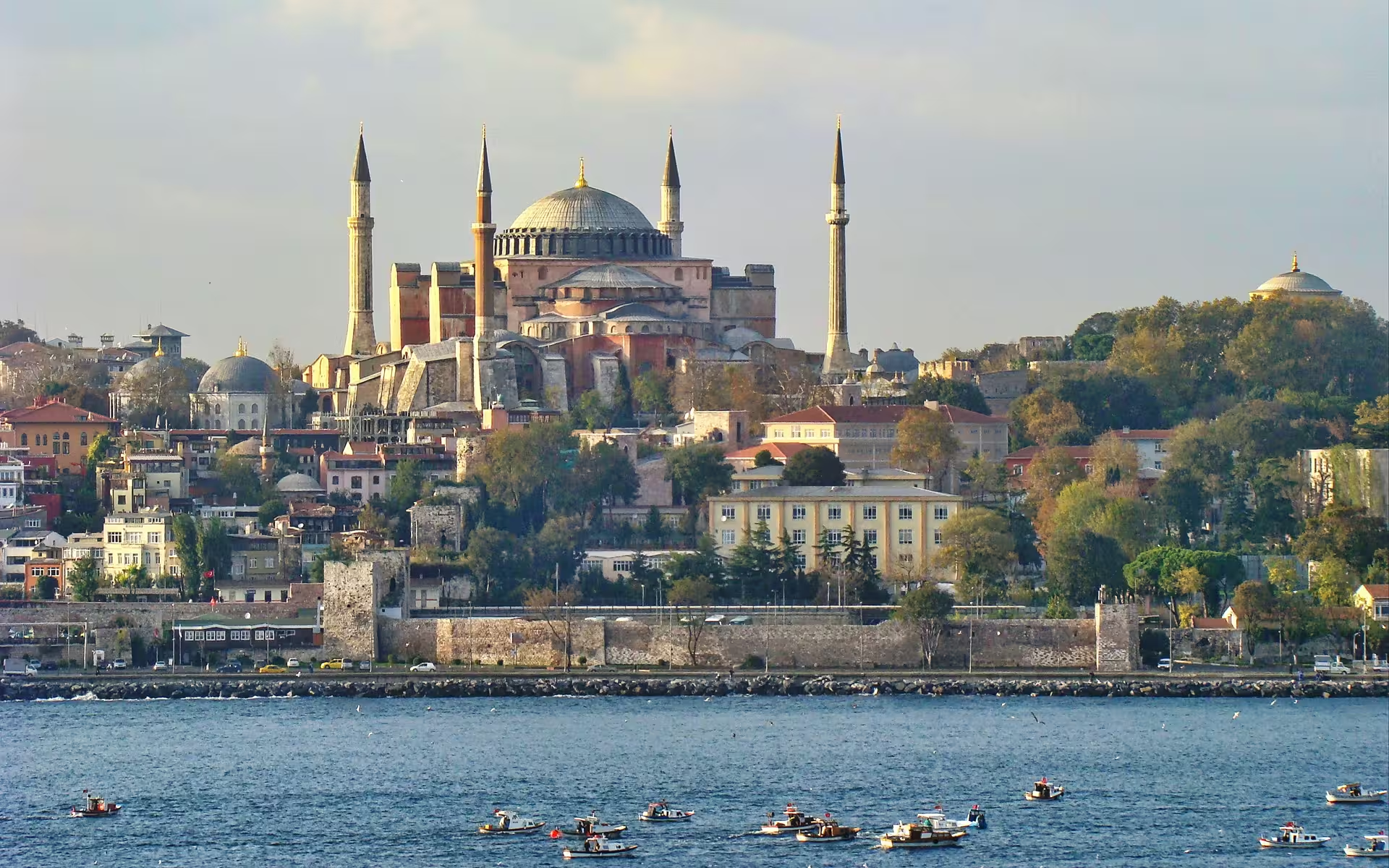
Maslama’s land army crossed into Byzantine Anatolia in the summer of 717 and advanced largely unopposed toward the Bosporus, crossing into Europe near Abydos and marching on Constantinople from the landward, western side. By late August, the Arab army had reached the city and begun constructing siege lines, digging a double ditch and wall to protect their own camp both from Byzantine sorties and from any relief force. But Constantinople was not a city that could be starved out quickly, or overrun by a land army alone. Its famous Theodosian Walls — a system of double fortifications stretching across the entire landward approach to the city — had already turned back every land assault attempted against it for nearly three centuries, and would continue to do so for another seven hundred years, until 1453 – the Crusaders sacked the city through the sea walls in 1204.
The real Arab strategy depended on the fleet. Maslama’s plan was to combine the land blockade with a total naval blockade of the Bosporus and the Sea of Marmara, cutting Constantinople off from all seaborne supply and reinforcement, and slowly starving a city of several hundred thousand people into submission. In early September 717, the Umayyad fleet sailed up to the city and attempted to force its way into the waters directly beneath the walls.
It sailed into a trap.
Greek Fire and the Battle of the Bosporus
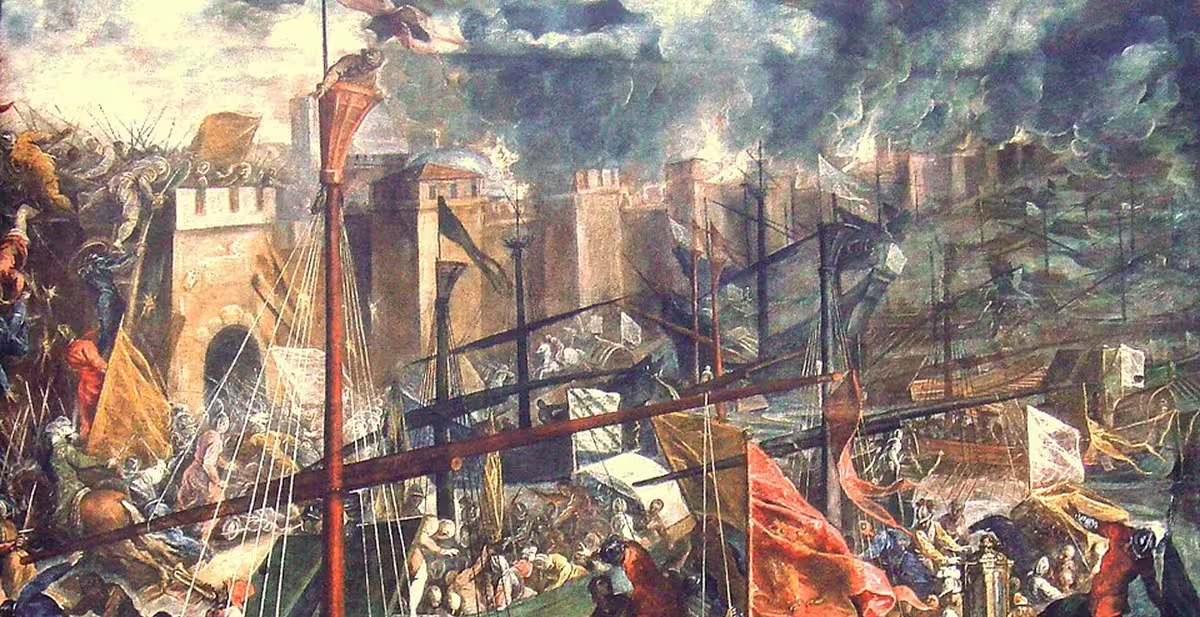
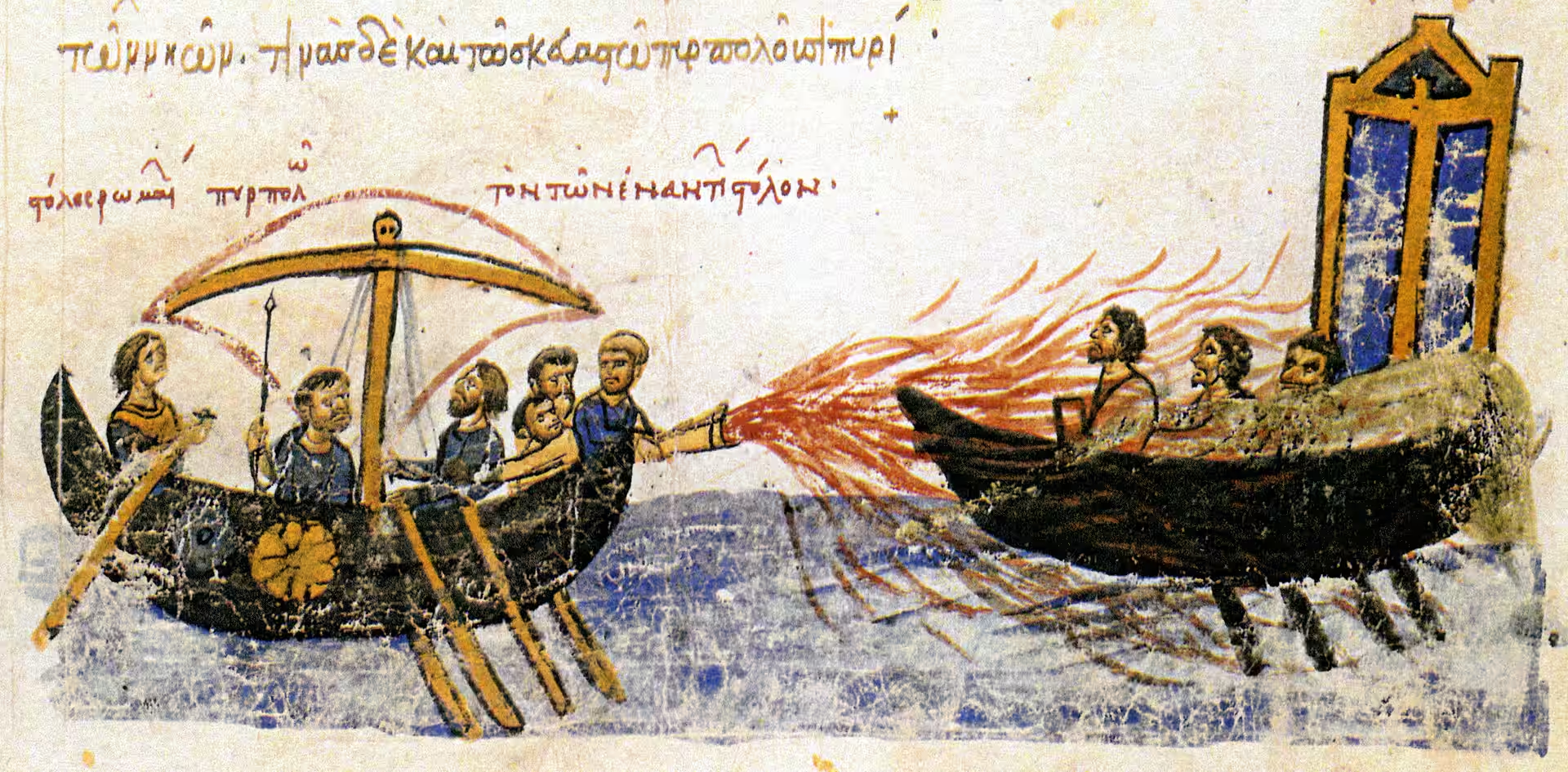
Leo III had prepared for exactly this moment. As the Arab ships advanced, Byzantine dromons equipped with siphons of Greek Fire moved out to meet them. Greek Fire — an incendiary substance, likely petroleum-based, that could be projected from shipborne siphons and that famously continued to burn even on the surface of water — had already proven itself against Arab fleets during the first siege forty years earlier, and it worked again with devastating effect. Panic spread through the tightly packed Umayyad ships as burning liquid clung to hulls, rigging, and men, and entire vessels were destroyed within the straits. Whatever the precise scale of the destruction, the psychological effect was total: from that point on, the Arab fleet largely avoided directly engaging the Byzantine navy in the straits, choosing instead to anchor at a safer distance and rely on the land blockade — which meant the total naval stranglehold Maslama had planned for never fully materialized. Constantinople, though under siege, was never entirely cut off from the sea.
An ally from the North
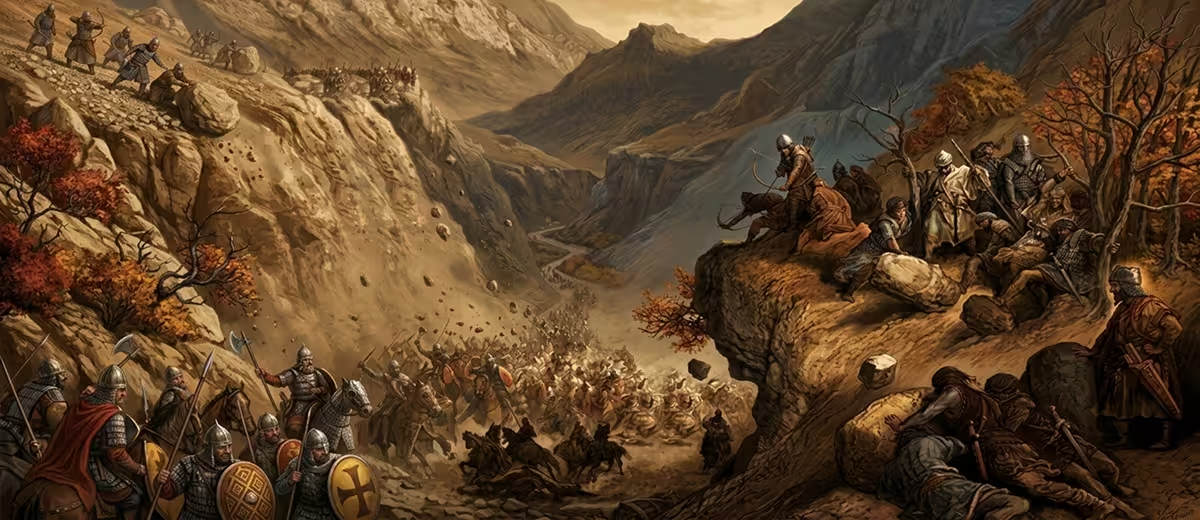
As autumn turned to winter, Leo’s diplomacy paid off in a way that would prove decisive. Khan Tervel of Bulgaria — ruler of a state that had, only a few years earlier, been a dangerous rival to Byzantium itself — chose to intervene on the empire’s behalf. Bulgarian forces struck the Arab army’s rear and its foraging parties north of Constantinople, inflicting what several chronicles describe as extremely heavy casualties, reportedly tens of thousands of dead among the besiegers. Whatever the true figure, the effect was to squeeze Maslama’s army from an unexpected direction at the worst possible time of year, cutting further into the food and supplies it needed to survive the winter and denying it freedom of movement in the countryside around the city.
The winter that broke an army
If Greek Fire and Bulgarian spears wounded the siege, the winter of 717–718 very nearly finished it outright. Byzantine and later Arab chroniclers alike describe one of the harshest winters in living memory, with snow lying on the ground for an unusually long stretch of the season. The Arab army, encamped in the open with supply lines already strained by the naval setback and Bulgarian raids, began to suffer catastrophic losses — not primarily from Byzantine arms, but from cold, starvation, and disease. Later Arab sources speak of soldiers reduced to eating their own pack animals, and some accounts, likely exaggerated for dramatic effect but nonetheless testifying to the scale of the disaster, even describe cannibalism in the camp. Whatever the literal truth, every source agrees on the essential point: the Umayyad army that had marched on Constantinople in the summer of 717 was, by the spring of 718, a shadow of the force that had set out, and it had barely fought a major land battle to become one.
Reinforcement, betrayal, and a second naval disaster
Damascus was not yet ready to give up. In the spring of 718, fresh fleets were dispatched from Egypt and North Africa to reinforce Maslama and renew the naval effort — a clear sign that the Caliphate, even after a catastrophic winter, still believed the city could be taken. But this reinforcement produced one of the most consequential twists of the entire siege. Many of the crews manning the Egyptian ships were Christian Copts, conscripted into Umayyad service rather than willing participants in a war against a Christian capital. In significant numbers, these crews defected to the Byzantines, bringing with them not just their ships but detailed knowledge of the fleet’s movements and dispositions.
Armed with this intelligence, the Byzantine navy struck again, inflicting another severe defeat on the Arab fleet in the waters around the city. Coupled with the losses already suffered from disease, starvation, and the earlier Greek Fire attacks, the Umayyad naval power that had once threatened to strangle Constantinople was, by mid-718, effectively broken.
Retreat and catastrophe
By the summer of 718, the situation had become untenable. Caliph Suleiman had died during the siege — before it had even truly begun to unravel — and his successor, Umar II, inherited a campaign that had already cost the Caliphate enormous resources for no gain whatsoever. Compounding the crisis, a Byzantine-allied force in Anatolia may have threatened Arab territory closer to home, adding further pressure to abandon the campaign. In August 718, Umar II ordered Maslama to lift the siege and withdraw.
The retreat proved almost as costly as the siege itself. As the surviving fleet sailed home, it was struck by violent storms in the Aegean and Sea of Marmara, and further losses were reportedly inflicted by an eruption of Thera (modern Santorini), whose ash and disturbed seas added to the chaos facing the retreating ships. What remained of the land army, meanwhile, had to march back through Anatolia harassed at every stage. Of the enormous force that had set out from Damascus with such confidence little more than a year earlier, only a small fraction is said to have returned home. Medieval sources claim the fleet alone returned with as few as five ships out of the many hundreds that had set out — a figure modern historians treat cautiously, but which nonetheless captures just how total the disaster was understood to be by contemporaries on both sides.
Aftermath
For Byzantium, the immediate relief was obvious: the empire’s capital, and with it the empire itself, had survived the single greatest external threat of its history to that point. Leo III, whose reign had begun in near-desperate circumstances only months before the siege, emerged from it as one of the most capable and legitimate emperors Byzantium had seen in decades, free to turn his attention to the internal reforms — including the controversial religious policy of Iconoclasm — that would define the rest of his rule.
For the Umayyad Caliphate, the failure marked a genuine turning point. The dream of taking Constantinople and pushing directly into southeastern Europe through the Bosporus was never seriously attempted again on this scale. Umayyad expansion did continue elsewhere in the years that followed — most famously into the Iberian Peninsula and across the Pyrenees into Frankish territory, a push that would be checked at the Battle of Tours in 732 — but the eastern route into Europe, through Constantinople itself, had been decisively closed.
Why it matters: The impact of the siege on world history
It is difficult to overstate how differently the history of Europe and the Mediterranean world might have unfolded had Constantinople fallen in 718. Had the city been taken, the Byzantine Empire — the last direct continuation of the Roman state, and at the time still one of the wealthiest and most sophisticated civilizations in the world — would very likely have collapsed entirely, more than seven centuries before its actual fall in 1453. The Balkans and southeastern Europe would have lain open to Umayyad expansion at a moment when Western Europe itself was fragmented, militarily weaker, and in no position to mount an effective defense of the kind that would, only fourteen years later, stop a separate Umayyad advance at Tours.
Historians have long placed the siege of 717–718 alongside the Battle of Tours as one of the two events most commonly credited with halting the westward advance of the early Islamic caliphates into Europe — one blocking the route through the Balkans, the other through Iberia and Gaul. Unlike Tours, however, the siege of Constantinople was not a single battle but a thirteen-month trial of endurance, technology, diplomacy, and sheer survival, in which no single dramatic clash decided the outcome. Instead, it was decided by the layered advantages Byzantium had spent centuries building: walls that no army had yet breached, a weapon whose secret no rival power could replicate, and a web of diplomatic relationships — with Bulgaria above all — that could be called upon in the empire’s darkest hour.
The siege’s failure also had consequences far beyond the immediate military balance. It preserved Constantinople as the guardian of Greco-Roman learning, Christian theology, and Roman law at a moment when much of that inheritance had already been lost in the West. Manuscripts, institutions, and traditions that would later feed into the Carolingian Renaissance, the Islamic Golden Age’s own engagement with Greek philosophy through later, more peaceful channels, and eventually the Italian Renaissance itself, all depended in part on Byzantium’s continued existence as a bridge between antiquity and the medieval world. Had Constantinople fallen in 718, that bridge would have been severed centuries before Europe was ready to do without it.
In the long view of history, the Second Arab Siege of Constantinople stands as one of the quiet hinge-points of the medieval world — less famous today than Tours or the later fall of the city in 1453, but arguably just as consequential in shaping the boundary between the Islamic and Christian worlds that would define European and Near Eastern history for the next thousand years.
Frequently Asked Questions
What was the Second Arab Siege of Constantinople?
It was a thirteen-month siege of the Byzantine capital by the Umayyad Caliphate, lasting from August 717 to August 718. An Arab army and fleet under the general Maslama ibn Abd al-Malik attempted to blockade and starve the city into surrender, but were ultimately defeated by Byzantine defenses, Greek Fire, and a brutal winter.
When did the Second Arab Siege of Constantinople take place?
The siege began in August 717, shortly after Leo III seized the Byzantine throne, and ended in August 718, when Caliph Umar II ordered the surviving Arab forces to withdraw.
Who defended Constantinople during the siege?
The city was defended by the Byzantine army and navy under Emperor Leo III the Isaurian. Byzantium was also aided by Khan Tervel of Bulgaria, whose forces attacked the besieging Arab army from the rear.
Why did the Arab siege of Constantinople fail?
Several factors combined to defeat the siege: the Theodosian Walls proved impossible to breach, Greek Fire devastated the Arab fleet in the Bosporus, an unusually harsh winter caused mass starvation and disease in the Arab camp, and Bulgarian attacks cut into the besiegers’ supply lines and manpower.
What role did Greek Fire play in the siege?
Greek Fire, a Byzantine incendiary weapon that could burn on water, was used by Byzantine dromons to destroy Arab ships attempting to force the Bosporus in September 717. Its effectiveness discouraged the Arab fleet from directly engaging the Byzantine navy for the remainder of the siege, preventing a full naval blockade of the city.
How does this siege differ from the First Arab Siege of Constantinople (674–678)?
The first siege was a longer, more sporadic naval campaign during which Greek Fire was first introduced against the Arab fleet. The second siege, in 717–718, was a single sustained land-and-sea blockade on a far larger scale, and its failure had a more decisive and lasting effect on halting Umayyad ambitions toward Constantinople.
What would have happened if Constantinople had fallen in 718?
Historians generally agree that the fall of Constantinople in 718 would have opened southeastern Europe to Umayyad expansion at a time when Western Europe was poorly positioned to resist it, likely ending the Byzantine Empire more than seven centuries before its actual fall in 1453 and severing a key link between the classical and medieval worlds.