How Byzantine scholars rewrote Odysseus and Troy’s Heroes
No ancient author mattered more to Byzantine education and culture than Homer. The Iliad and Odyssey sat at the core of the enkyklios paideia, the standard curriculum through which Byzantine children were educated — a schoolboy in Constantinople in the twelfth century would have spent years with Homer’s verses the way a modern student spends years with basic arithmetic. That centrality is also the entire reason we still have complete texts of both poems today: every surviving manuscript descends from copies made by Byzantine scribes, and it was Byzantine teachers, archbishops, and princes who kept Homer alive as a living subject of study rather than a curiosity from a vanished world. Because Homer mattered this much, Byzantine scholars did something a modern literature student rarely does with a poem in a classroom: they treated Homer’s gaps, contradictions, and open questions as things a good education demanded they resolve.
Quick Facts
Byzantine consensus:
the Trojan War was widely accepted as a real historical event, not myth
Key figure:
John Malalas (6th c.) recorded almost forensic descriptions of heroes as if cataloguing real people
Isaac Komnenos Porphyrogennetos (1093–after 1152), sebastokrator, wrote on the fates of Homer’s heroes after the poems end
John Tzetzes (12th c.) wrote a 1,700-line poem narrating the entire war, plus allegorical commentaries
Eustathius of Thessalonica (12th c.) wrote the standard Byzantine commentary on both epics
Preferred “true” source:
many Byzantines trusted the prose accounts attributed to Dictys Cretensis and Dares Phrygius over Homer himself, because they read as sober eyewitness reports rather than poetry
Not Byzantine:
the famous “Achilles’ heel” is a Roman invention (Statius, c. AD 95–96) that Byzantine authors simply inherited, not something they originated
Did Byzantines think the Trojan War was real?
Modern readers tend to encounter the Trojan War as literature first and ask about its historicity second, if at all. Byzantine readers largely worked the other way around. For most Byzantine authors, the war against Troy was accepted as a historical event that had actually taken place — the open questions were not “did it happen,” but “exactly what happened, in what order, and to whom.” This was never a single, universally-held position enforced by any authority; it reflects a broad tendency across the chroniclers, commentators, and educators whose work survives, and individual authors could and did disagree with one another on details, dates, and which sources to trust.
This historicizing impulse produced a strange and very Byzantine phenomenon: scholars who treated gaps in Homer’s narrative as gaps in the historical record, to be researched and filled, rather than as artistic choices to be admired. Homer told only part of the story — a few weeks in the tenth year of the siege for the Iliad, a return voyage for the Odyssey. Byzantine readers wanted the rest: what happened before, what happened to secondary characters after, and how it all fit into a continuous chronology of world history stretching back to Adam.
The Heroes, one by one
Below is how several of the war’s central figures were handled by Byzantine scholarship — not as literary characters, but as historical persons whose biographies had beginnings, middles, and (crucially) endings that Homer had left unwritten.
Odysseus – the commentator’s favorite
Odysseus received the single most sustained scholarly treatment of any Homeric hero in Byzantium. Eustathius of Thessalonica’s commentary on the Odyssey alone runs to roughly 2,000 oversized pages in its modern printed form — on top of a nearly 4,000-page commentary on the Iliad — and it made Odysseus a permanent fixture of Byzantine secondary education. Generations of Byzantine schoolboys encountered him not primarily through the poem itself but filtered through Eustathius’ line-by-line scholarly apparatus.
The clearest example of that apparatus at work is Eustathius’ treatment of the poem’s very first description of its hero: the epithet polytropos, from the opening line of the Odyssey. Rather than settling on one English-style gloss, Eustathius works through a whole cluster of possible senses — of many turns, agile, versatile, of many counsels, of many minds, resourceful, enterprising — treating the single word as a genuine interpretive problem to be unpacked rather than a fixed epithet to be translated once and moved past. That word-by-word density is exactly what makes his commentary a scholarly tool rather than a popular retelling.
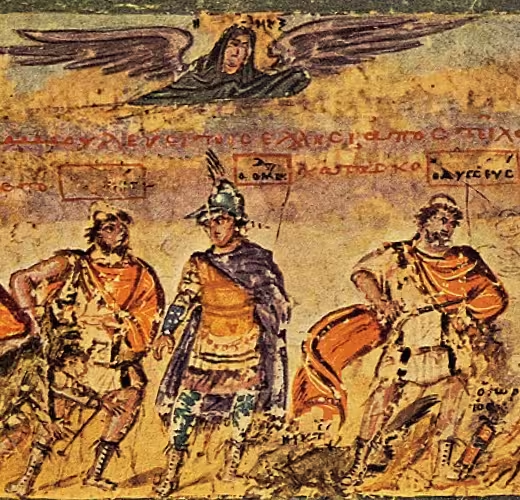
Odysseus’ wanderings also became a live philosophical topic in twelfth-century Constantinople. Modern scholarship on Eustathius and Tzetzes together shows that Byzantine intellectuals used the theme of Odysseus’ journey to articulate their own ideas about the relationship between travel and knowledge — his wandering became a lens for Byzantine scholars to think through what philosophy itself was, and what it meant to be a Homeric exegete in their own right, not just a summary of adventures to be catalogued.
Tzetzes approached the same material differently, book by book: he paired a plain summary of each rhapsody with an allegorical reading underneath it, typically resolving divine interventions into natural or astrological causes. His method survives in miniature in his handling of a minor Odyssey character, Antilochus — where Tzetzes explains that a poetic reference to his death at Memnon’s hands means nothing more than that he died young, before his time, a small but telling example of how systematically he stripped mythic incident down to plain biographical fact.
Penelope
Penelope does not appear to have received anything like the dedicated scholarly attention Byzantine commentators gave Odysseus, Helen, or the war’s central male figures. She is present throughout Eustathius’ line-by-line commentary as the poem itself requires.
Telemachus – preserved through the old plot summaries
Telemachus survives in the Byzantine tradition mainly through the ancient hypotheseis — short prose plot-summaries of each book of the Odyssey — that Byzantine scholars like Tzetzes and Eustathius inherited, copied, and incorporated into their own commentaries rather than composing from scratch. One surviving summary of Book 1 states that the gods wished to bring Odysseus home to Ithaca and that Athena went to Telemachus and advised him to travel to Nestor and Menelaus in search of news of his father — the same errand that structures the opening books of the poem. The Byzantine contribution here is less original interpretation than careful custodianship: preserving and transmitting a summarizing apparatus that was already centuries old by the time it reached Constantinople.
Achilles – the unfinished life
Homer’s Iliad never narrates Achilles’ death — it ends with Hector’s funeral. For Byzantine readers treating the war as history, that was an unacceptable gap: the war’s most important warrior needed a documented death. This is precisely the gap Isaac Komnenos Porphyrogennetos set out to close in his essay On the Things Left Out by Homer (see below), and it’s also where the Dares/Dictys tradition supplied a workable answer: Achilles killed in an ambush at Troy, engineered by Paris and Deiphobus, rather than by the semi-divine arrow-and-heel mechanism modern audiences know from later legend.
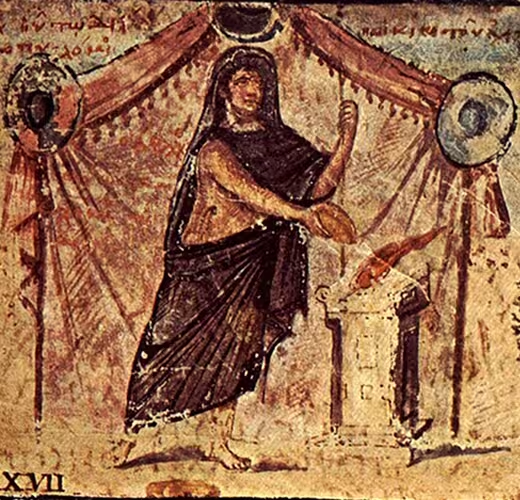
That heel vulnerability, worth being precise about, is not a Byzantine idea at all — it is Roman, and centuries older than Byzantium. Homer’s poem never mentions a single vulnerable spot; the Styx-dipping story survives first in the Roman poet Statius’ unfinished Achilleid (c. AD 95–96), with an even earlier variant recorded by Apollodorus (1st–2nd century AD) locating the fatal wound at the ankle rather than the heel.
Byzantine authors simply inherited this already-finished Roman-era tradition along with the rest of the post-Homeric material, the same way they inherited Dares and Dictys.
Agamemnon – the synchronizing king
Malalas’ Chronographia gives the clearest illustration of how the whole war was anchored into world history: Book V states plainly that Priam of Troy reigned in the time of David, and names Agamemnon and Menelaus as the most celebrated of the Greek commanders who then devastated Troy and the whole land of Phrygia over the abduction of Helen. Pinning Agamemnon’s campaign to a Biblical reign is exactly the synchronizing technique that let Byzantine chroniclers treat the Trojan War as a datable episode alongside sacred history, not a separate legendary track running beside it.
Menelaus – rewritten as an astrological near-miss
Menelaus gets one of the best worked examples of Tzetzes’ allegorical method in action. In the Iliad, Menelaus is about to kill Paris in their single combat when Aphrodite snaps his helmet strap and spirits Paris away to Helen’s bedchamber. Tzetzes’ Allegories of the Iliad reinterprets this as astrology rather than divine intervention: Paris was born under a favorable position of Venus, which is why he escaped death at the critical moment, and Venus’ influence is also what made Helen unable to resist his charm even after his humiliating defeat. The gods disappear from the account; a horoscope takes their place. Separately, the Dares Phrygius tradition gives Menelaus a plain physical description — of average height, auburn-haired, handsome, and pleasant in manner — in keeping with the same forensic, cataloguing impulse seen for Paris and Hector.
Helen – not just a victim, but the cause
In Byzantine treatments, Helen functions less as a passive prize and more as the hinge on which the entire war’s causality turns — the chroniclers who narrated the war’s origins (see Malalas, below) devoted real attention to the judgment of Paris and Helen’s abduction as the mechanical, historical trigger of the conflict, the way a modern historian would treat the assassination that sparked a war, rather than treating it as a poetic motif.
Tzetzes’ Little Big Iliad — his compressed retelling of the entire war — opens its account before Helen is even born, tracing the story back to the judgment of Paris, which places her firmly at the start of a continuous causal chain rather than as a mid-story complication.
Paris – a forensic sketch
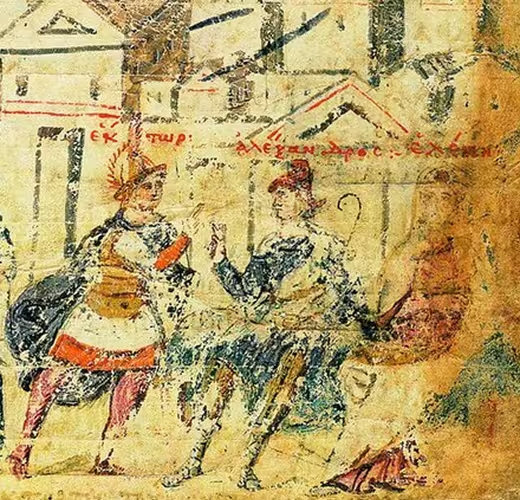
Paris is where the strangest feature of Byzantine Homeric reception shows up most clearly: John Malalas, writing in the 6th century, gives a physical description of Paris that reads like a police report rather than an epic introduction — noting his build, coloring, nose, eyes, hair, and even his temperament (charming and eloquent, but also, in Malalas’ account, cowardly and hedonistic). These descriptions circulating under Malalas’ name derive from the euhemerizing tradition associated with the pseudo-eyewitness account of Dares Phrygius, which Malalas draws on directly; for any line we quote verbatim in the published article, we should translate it ourselves from the Migne or CSHB critical edition of the Chronographia rather than reuse the secondary paraphrase used here.
Hector – two competing “witnesses”
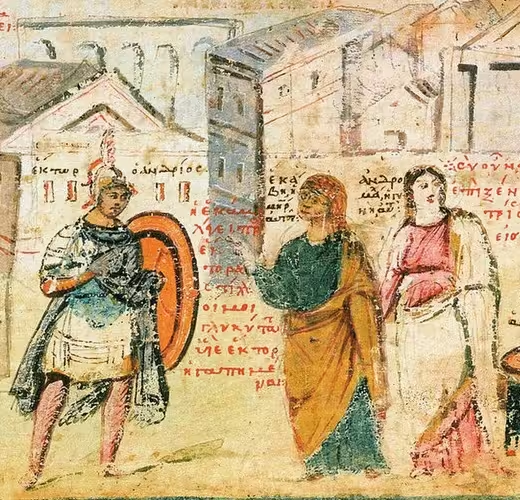
Hector is a good example of Byzantine readers holding two sources up against each other the way a historian would cross-examine two witness statements. Malalas describes him as dark-skinned, tall, powerfully built, with a good nose, woolly hair, a squint, and a speech impediment — an unflattering, almost clinical account.
The Dares Phrygius tradition instead gives a more admiring picture: fair-complexioned, curly-haired, quick-moving, dignified, and “deserving of love.” Byzantine commentators inherited both and had to reconcile — or simply juxtapose — two flatly contradictory descriptions of the same “historical” man.
Priam – the chronology anchor
As Troy’s king, Priam functioned in Byzantine world-chronicles (the genre Malalas represents) as a chronological peg — his reign let chroniclers slot the Trojan War into a synchronized timeline running alongside Biblical patriarchs, Egyptian dynasties, and later Roman history. This is arguably more historically consequential than anything said about Priam as a character: it’s the mechanism by which the Trojan War got a fixed “date” in Byzantine historical memory at all.
The Byzantine scholars who rebuilt Troy
The hero-by-hero picture above comes from a small number of identifiable scholars working across roughly six centuries, and their shared habit of treating Homer’s gaps as research problems says as much about Byzantine intellectual culture generally as it does about any one of them. Here is what each of them was actually doing.
John Malalas (6th century)
Malalas’ Chronographia is a world chronicle running from Adam to his own time, and it treats the Trojan War as a datable historical episode within that continuous timeline — not a separate mythological interlude. His physical descriptions of the war’s participants (Paris, Hector, Polyxena, Deiphobus, and others) read as an attempt at documentary precision: build, complexion, hair, features, and temperament, in the manner of an identifying record rather than a heroic portrait. This material is generally traced back to the euhemerizing pseudo-history attributed to Dares Phrygius.
Isaac Komnenos Porphyrogennetos (1093–after 1152)
A sebastokrator — third son of Emperor Alexios I Komnenos, younger brother of Emperor John II Komnenos, and younger brother of the historian Anna Komnene — Isaac is also known to Byzantine-art visitors as the patron who rebuilt the Chora Monastery in Constantinople, where his own donor mosaic portrait still survives.
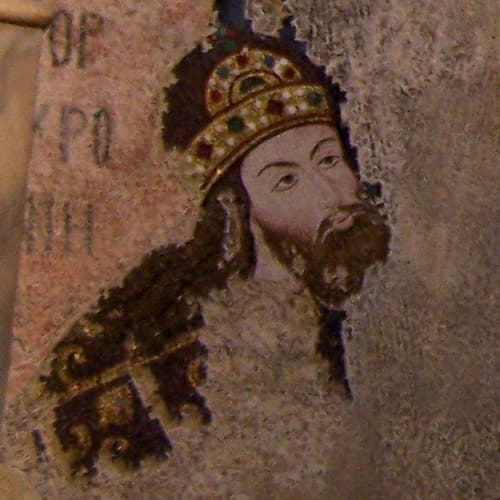
His engagement with Homer took the form of three short prose essays — On Homer, On the Things Left Out by Homer, and On the Quality and Features of the Trojan and Greek Heroes (the latter two effectively one continuous essay in two parts) — written to accompany his own personal copy of the Iliad, complete with his own scholia, later preserved in the manuscript Paris.gr. 2682.
Isaac says plainly that he assembled the essay because he did not want his readers left disappointed at not knowing how the story actually ended, and modern scholarship confirms that his portraits of the individual Trojan and Greek heroes were drawn directly from Malalas’ Chronicle — the same forensic hero-descriptions already discussed above for Paris and Hector.
John Tzetzes (c. 1110–1180s)
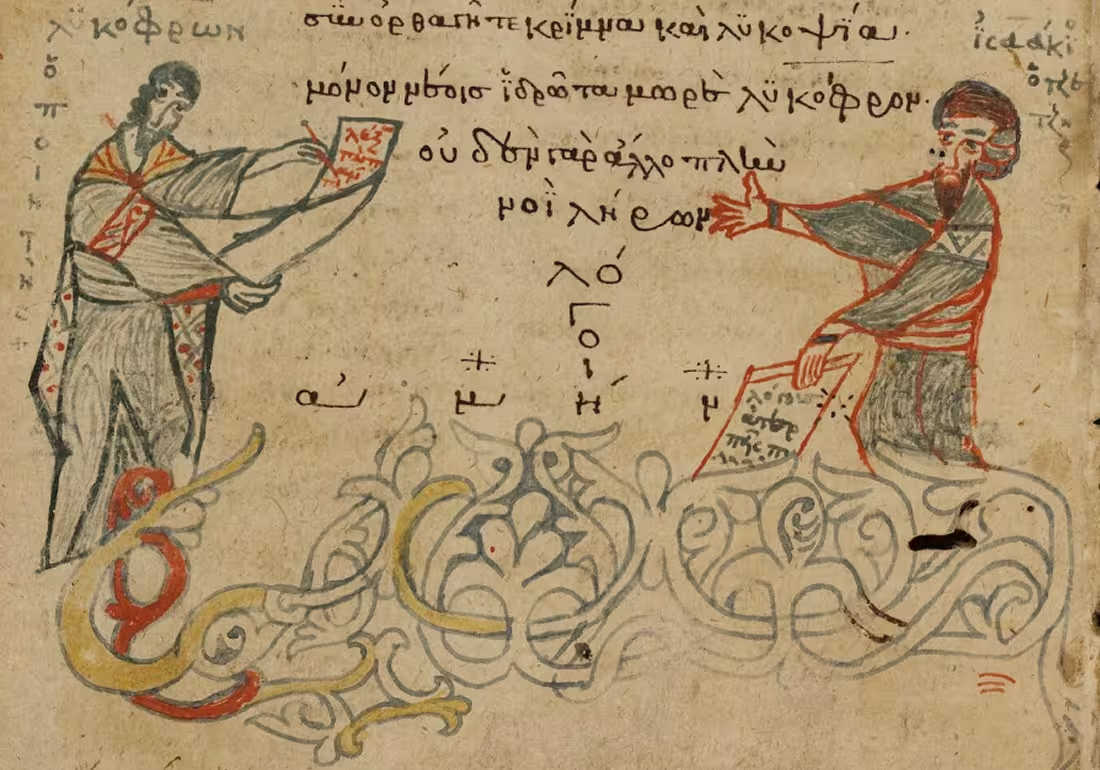
Tzetzes wrote across several registers on the same material. His Little Big Iliad (Mikromegalē Ilias) is roughly 1,700 hexameter lines covering the entire war in three movements: events before the Iliad begins, the events of the Iliad itself, and events after Hector’s death through the fall of Troy. His Allegories of the Iliad works through the poem rationalizing its gods and monsters for a Christian readership. He also produced the commentary on Lycophron’s Alexandra — a separate, notoriously obscure Hellenistic poem structured as Cassandra’s prophecy of the war’s aftermath — illustrated in a 13th-century Heidelberg manuscript (Cod. Pal. graec. 18, f.96v) showing his brother Isaac presenting the work to Lycophron.
Eustathius of Thessalonica (c. 1115–1195/6)
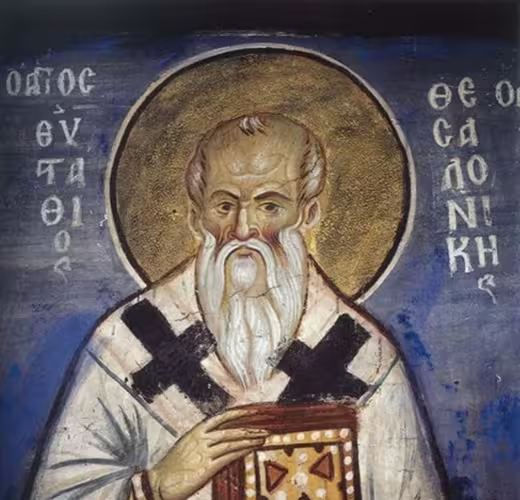
Archbishop of Thessalonica – one of the most important Byzantine cities which preserves numerous monuments from the medieval era – and the era’s leading Homeric scholar, Eustathius produced the standard Byzantine commentaries on both the Iliad and the Odyssey — enormous works of grammatical, geographical, and interpretive scholarship that shaped how educated Byzantines read Homer for generations.
FAQ
Did Byzantines believe Homer was telling the literal truth?
Not uncritically. Many trusted the plainer, ungodded prose accounts attributed to Dictys Cretensis and Dares Phrygius over Homer precisely because they read as sober records rather than poetry — a preference for the “boring” witness over the poetic one.
Why did Byzantine scholars care so much about filling narrative gaps?
Because they were reading the war as history, not fiction. A history with an unexplained gap is a research problem; a poem with an artful ellipsis is not.
Is any of this related to the Odyssey’s manuscript survival?
Related but distinct — this article covers how Byzantines read and interpreted the heroes; the separate question of how the physical texts of the Iliad and Odyssey survived via Byzantine copying is its own story, worth its own article.
Sources & Further Reading
Ravani, A., “Outlining the Iliad in the Komnenian Age: Between Trojan Matter and Achilles’ Wrath,” Greek, Roman, and Byzantine Studies 65 (2025) 127–153.
Van den Berg, Baukje. “Reading Homer in Constantinople,” discussed in Homer in the Byzantine Classroom: Eustathios of Thessaloniki and John Tzetzes, Antigone Journal.
John Malalas, Chronographia — [full critical edition citation needed]
Universitätsbibliothek Heidelberg, Cod. Pal. graec. 18 (digi.ub.uni-heidelberg.de/diglit/cpgraec18)
Universitätsbibliothek Heidelberg, Cod. Pal. graec. 45 (Odyssey with scholia)
Cullhed, Eric and S. Douglas Olson (eds. and trans.), Eustathius of Thessalonica, Commentary on the Odyssey, Volume I: Preface and Commentary on Rhapsodies 1–4, Brill, 2022.
Malalas, Chronographia, Book V (Trojan War section) — Latin translation, Bonn edition, 1831, via mediterranees.net.
Statius, Achilleid (c. AD 95–96) — earliest surviving source for the Achilles heel/Styx tradition.
Apollodorus, Library (1st–2nd c. AD) — earlier variant locating Achilles’ fatal wound at the ankle (sphyron).
Kindstrand, J. F., Isaac Porphyrogenitus: Praefatio in Homerum, Uppsala, 1979.
Hink, H., Polemonis Declamationes quae extant duae, Leipzig, 1873 (contains Isaac’s De rebus ab Homero praetermissis and De proprietate et characteribus Graecorum et Troianorum).
Pontani, F., “The First Byzantine Commentary on the Iliad: Isaac Porphyrogenitus and his Scholia,” Byzantinische Zeitschrift 99 (2006) 551–596.
Lovato, V. F. (ed.), Isaac Komnenos Porphyrogennetos: Walking the Line in Twelfth-Century Byzantium, Abingdon, 2024.