Battle of Mantzikert 1071: The defeat that cost Byzantium Anatolia
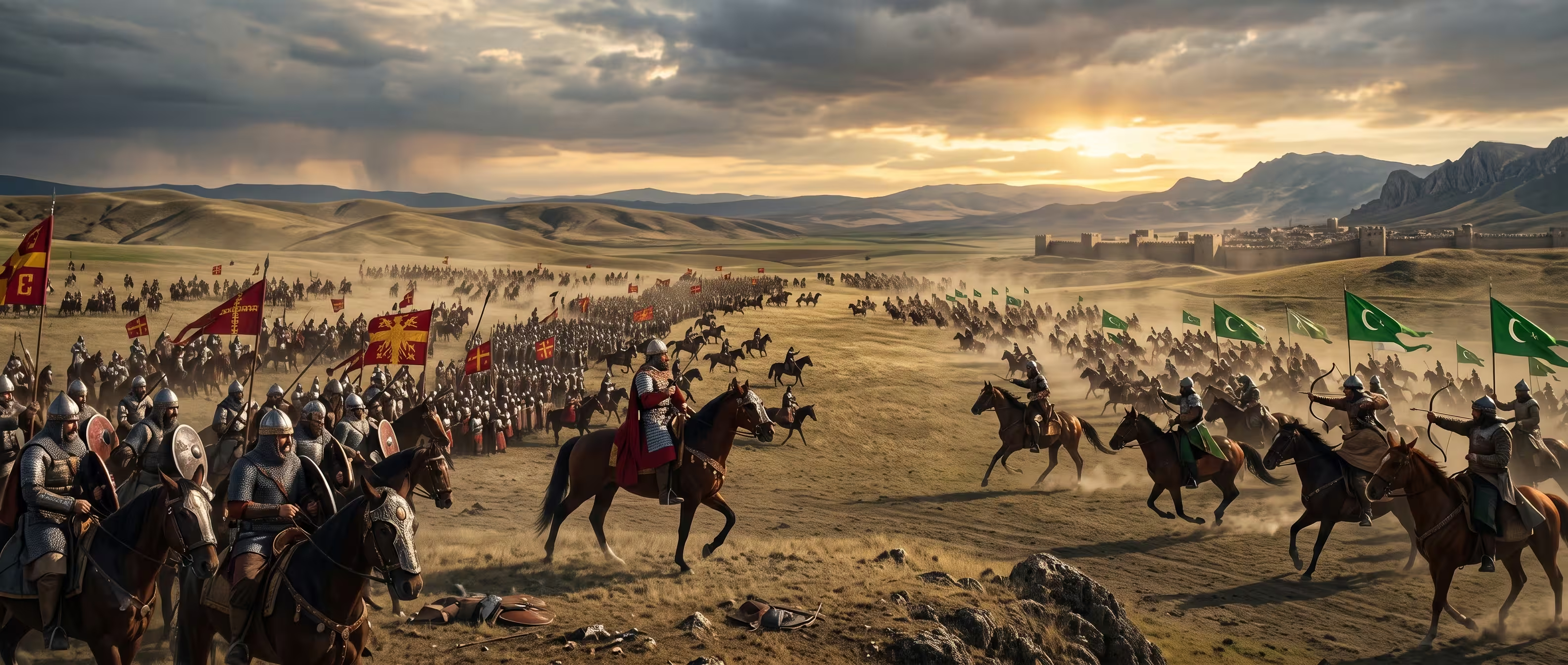
On a dusty plain near Lake Van, in what is now eastern Turkey, an army led by the Byzantine emperor in person marched out to crush a raiding force of Seljuk Turks — and instead marched into the single most consequential defeat in the empire’s medieval history. Byzantine history offers only a handful of afternoons that truly changed the empire’s trajectory: the loss of the Levant and Egypt to the Arabs at the Battle of Yarmouk in 636 permanently shrank the empire’s borders in the east, and a century after Mantzikert, the Byzantine defeat at Myriokephalon in 1176 shattered Manuel I Komnenos’s own attempt to reverse it and finally closed the door on retaking central Anatolia. Mantzikert, fought on 26 August 1071, belongs at the head of that short, grim list. It did not by itself destroy Byzantium — the empire would stagger on for nearly four more centuries, until the fall of Constantinople in 1453 — but it broke something that never fully healed. Within a decade of the battle, the Byzantines had lost the Anatolian heartland that had fed their armies and filled their treasury for seven hundred years — not primarily to Seljuk arms, but to a civil war the defeat itself unleashed. Few single afternoons in medieval history did more to reroute the fate of an empire.
What was the battle of Mantzikert?
The Battle of Mantzikert (also spelled Manzikert, from the Armenian Manazkert, modern Malazgirt) was fought on 26 August 1071 between the Byzantine army of Emperor Romanos IV Diogenes and the Seljuk Turkish army of Sultan Alp Arslan, near Lake Van in Byzantine Armenia. The Byzantines were routed and the emperor himself was taken prisoner — an almost unheard-of humiliation for a reigning Roman emperor. The military defeat was serious but not fatal in itself; Alp Arslan freed Romanos on generous terms within a week. What proved fatal was what happened next at home: a Byzantine civil war that gutted the empire’s defenses in Anatolia and let the Seljuks occupy, almost unopposed, the very heartland Rome and then Byzantium had held for over a thousand years. Historians still argue about how much to blame the battle itself versus the decade of self-inflicted chaos that followed it — but either way, Mantzikert marks the point at which Byzantium’s slow, centuries-long decline began in earnest.
Byzantium before Mantzikert: an empire living on borrowed strength
To understand why a single defeat could do so much damage, it helps to look at the state Byzantium was actually in in 1071 — not the confident, expanding empire of a century earlier, but a state coasting on the achievements of a vanished generation.
Under Basil II, who died in 1025, the empire had reached its medieval zenith: the Bulgarian state crushed, the eastern frontier pushed deep into Armenia and northern Syria, the treasury overflowing. Basil II left no direct heir capable of holding that inheritance together, and the half-century after his death saw the throne pass through a rapid succession of civilian emperors, empresses, and short-lived dynasties who, by and large, showed less interest in frontier warfare than Basil II had. It would be an exaggeration to say the eastern defenses collapsed overnight — the frontier system did not simply fall apart, and later Byzantine emperors would still field capable armies there for generations. But several strands of policy in this period did work against the empire’s long-term interests in the east, and one in particular reshaped the frontier more than any other: what Constantinople did with Armenia.
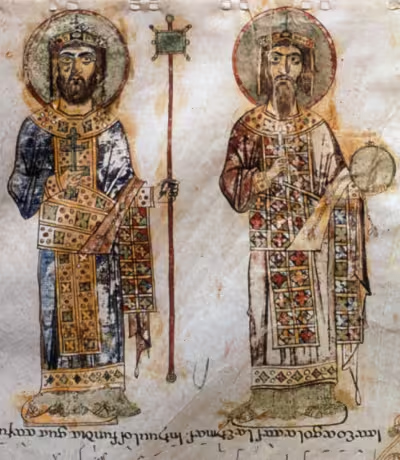
For much of the 10th and early 11th centuries, Armenia had been organized into a patchwork of Armenian kingdoms and principalities — Bagratid Ani foremost among them, alongside Vaspurakan, Kars, and others — nominally independent but increasingly drawn into the Byzantine orbit as client states along the empire’s eastern approaches. Rather than leave these buffer states in place, successive emperors chose to absorb them directly. In 1021–22, King Senekerim-Hovhannes of Vaspurakan, already under pressure from Turkish raiders pushing into his lands, ceded his kingdom outright to Basil II in exchange for territory and rank in Cappadocia, moving his court and much of his nobility westward. Ani itself, the Bagratid capital, followed in 1045 under Constantine IX, its last king likewise compensated with estates in Anatolia. On paper, each annexation extended direct imperial rule further east and looked like a gain. In practice, it replaced local Armenian dynasties — who had every personal incentive to defend their own ancestral lands — with distant governors answering to Constantinople, while transplanting a large, unsettled Armenian military nobility into Cappadocia, where it did not always integrate smoothly with its new Byzantine neighbors. The eastern frontier that the Seljuks found in the 1040s and 1050s was, in this sense, less a fortress in decline than a recently reorganized borderland whose traditional defenders had, by imperial design, largely been moved elsewhere.

Into this changing frontier rode a new and different threat. The Seljuk Turks, recently converted to Islam and newly dominant across Persia and Mesopotamia, were not at first interested in conquering Byzantine Anatolia outright — their initial raids into Armenia and beyond, from the 1040s onward, were more like large-scale plundering expeditions probing a wealthy but unfamiliar province, rather than a coordinated campaign of conquest. Still, each raid met less organized resistance than an Armenian king’s own army might once have offered, and each one advanced a little further west. By 1068, Seljuk horsemen had reached as far as Caesarea in central Anatolia and sacked its great cathedral. Constantinople could no longer treat these as isolated nuisances.
The enemy: the Seljuk Empire and Sultan Alp Arslan
A young, expanding Turkish-Persian empire
If Byzantium in 1071 was an old power living off a vanished generation’s achievements, the Seljuks were the opposite: a young, ferociously dynamic empire still in the first flush of its expansion. Originating as a clan of Oghuz Turks from the steppes north of the Aral Sea, the Seljuks had converted to Sunni Islam in the 10th century and, under the founder Tughril Beg, swept south into Persia and Mesopotamia in the 1030s and 1040s. By 1055, Tughril had entered Baghdad itself and been proclaimed sultan by the Abbasid caliph — nominally the caliph’s protector, in practice the master of an empire stretching from Central Asia to the Fertile Crescent. Unlike the Arab caliphates that had confronted Byzantium in earlier centuries, the Seljuk state fused Turkish military energy with Persian administrative sophistication, giving it both the manpower for sustained campaigning and the bureaucratic depth to hold what it conquered. It was, in every sense, an empire on the way up — the mirror image of the empire it was about to collide with.
The Seljuks’ style of warfare was equally unfamiliar to Byzantine commanders. Where Byzantium still fought, in part, in the heavier, more static tradition of late Roman and early medieval warfare, the Seljuk armies were built around fast, lightly armored horse-archers, steeped in the same nomadic cavalry tactics — feigned retreats, encirclement, harassment at a distance — that had unsettled sedentary empires from China to Persia for centuries. The recently reorganized eastern frontier, with its traditional Armenian defenders largely resettled elsewhere, gave this style of warfare more room to operate than it might once have had.
Alp Arslan, “the Heroic Lion”
The man who led that army to Mantzikert was Tughril Beg’s nephew and successor, Alp Arslan — a name that itself means “Heroic Lion” in Turkic.
Born around 1029 and sultan since 1063, Alp Arslan had spent most of his reign not looking west toward Byzantium at all, but consolidating Seljuk authority over rival Turkish and Persian claimants and, above all, pressing his real strategic priority: a war against the Shia Fatimid Caliphate of Egypt, the Seljuks’ great sectarian rival for leadership of the Islamic world.
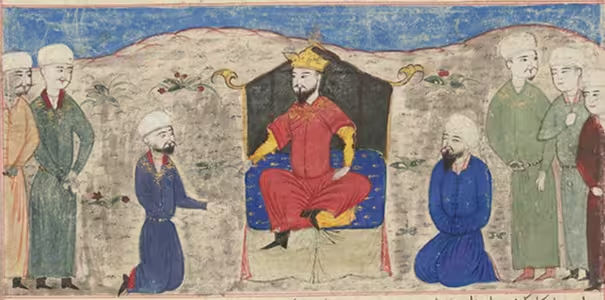
His march into Byzantine Armenia in the summer of 1071 was, in large part, incidental to that Fatimid campaign — a reaction to Emperor Romanos IV’s own advance, not a long-planned invasion of Byzantine territory.
Contemporary and later sources, Muslim and Byzantine alike, describe Alp Arslan as a capable, disciplined commander and a notably restrained victor — a reputation the aftermath of Mantzikert would go on to confirm. He was, by most accounts, a pious and comparatively conventional Sunni ruler rather than an empire-builder in the mould of a Genghis Khan or a Mehmed II; his ambitions after 1071 remained fixed on the Islamic world to his south and east, not on conquering Byzantine Anatolia outright. That relatively modest ambition is precisely what makes the scale of Byzantium’s territorial collapse over the following decade so striking: the man who won at Mantzikert never set out to take Anatolia from the empire. Byzantium’s own civil war handed it to his successors and to independent Turkish warlords almost by default. Alp Arslan did not live to see how far the consequences of his victory would run — he was killed the following year, in 1072, murdered by a captured governor while on campaign in Central Asia, and was succeeded by his son Malik-Shah I, under whom the Seljuk Empire reached its greatest territorial extent.
Romanos IV Diogenes and the road to war
A soldier-emperor for a fraying empire
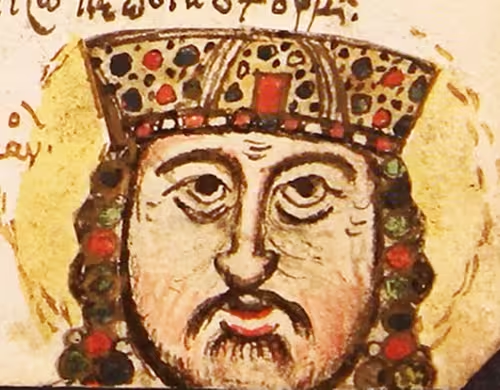
It was against this backdrop that the Anatolian military aristocracy finally reasserted itself at court. In 1068, Romanos Diogenes, a general from a prominent Cappadocian military family, married Eudokia Makrembolitissa, the widowed empress and regent for her young sons by the late Constantine X Doukas, and was crowned co-emperor. It was, in effect, a bet by the civilian establishment that a soldier on the throne could stop the bleeding on the frontier — and a bet the powerful Doukas clan, sidelined from real power by the marriage, deeply resented from the very start. That resentment would prove more dangerous to Romanos than any Seljuk army.
Romanos threw himself into rebuilding the eastern defenses, leading campaigns into Syria and Anatolia in 1068 and 1069 with mixed but encouraging results. By 1071 he had assembled the largest Byzantine field army in living memory for a final, decisive campaign — determined to deal with the Seljuk threat once and for all rather than continue reacting to their raids piecemeal.
The 1071 campaign
Modern estimates put the Byzantine army Romanos led east in the spring of 1071 at somewhere between 20,000 and 40,000 men — a far cry from the wildly inflated figures of 100,000 or more found in some later medieval chronicles, but still an unusually large and expensive force for the empire to field. It was also a dangerously heterogeneous one: alongside the core Anatolian and Balkan troops marched sizeable contingents of Frankish, Norman, and Pecheneg mercenaries, plus a large body of Oghuz Turkish auxiliaries — soldiers whose loyalty to Constantinople, and whose kinship ties to the very Seljuks they were marching against, would matter enormously in the days ahead.
Romanos’s goal was to recapture the fortress of Manzikert and the nearby stronghold of Chliat, securing the approaches to Lake Van before the Seljuks could concentrate their own forces. What he did not know — because Alp Arslan had, in fact, been campaigning in Syria against the Fatimids and had no initial intention of confronting the Byzantines directly — was that the sultan would turn his own army north at speed once he learned of the Byzantine advance, arriving in the region far faster than Constantinople’s scouts anticipated.
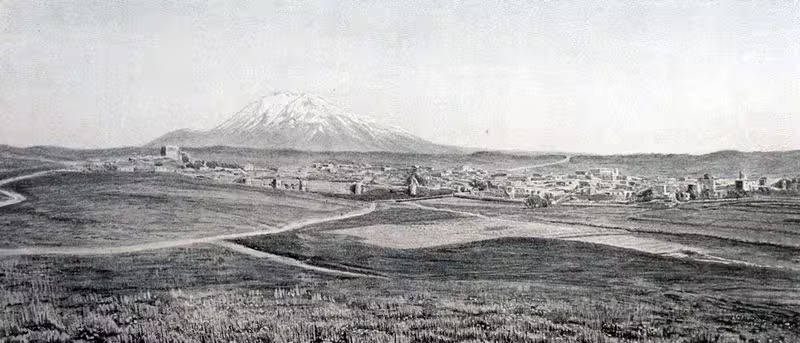
The Battle of Mantzikert, 26 August 1071
Two armies, and a peace offer refused
By late August, Romanos had retaken Manzikert itself with little resistance. But a detachment he sent toward Chliat under the general Joseph Tarchaneiotes was routed, or possibly withdrew, without ever informing the emperor — removing a significant portion of the Byzantine force from the campaign before the main battle had even begun. Alp Arslan, meanwhile, arrived with an army of perhaps 20,000–30,000 men, dominated by fast, lightly armored horse-archers — a force built for exactly the kind of mobile, harassing warfare the heavier Byzantine army struggled to counter.
Before committing to battle, Alp Arslan reportedly offered Romanos a peace treaty. Confident in his numbers and unaware of how badly his flanking detachment had already been compromised, Romanos refused, determined to force a decisive engagement rather than negotiate from what he believed was a position of strength. It was the first of several miscalculations that would prove disastrous.
A day of feints, envelopment, and betrayal
On the morning of 26 August, the Byzantine army advanced in a broad battle line against a Seljuk force that, true to steppe cavalry tradition, refused to stand and fight directly. Alp Arslan’s horsemen harried the advancing Byzantines with arrows, fell back in staged retreats, and drew the cumbersome imperial line further and further from its camp — a classic feigned-withdrawal tactic that Roman and Byzantine commanders had faced, and occasionally fallen for, since the days of the Parthians.
By late afternoon, with his army strung out and exhausted without ever having forced a real engagement, Romanos ordered a withdrawal back to camp — a routine and defensible maneuver in principle, but a catastrophically dangerous one to execute in the presence of an undefeated, highly mobile enemy. It was at this critical moment that the campaign’s underlying political rot proved fatal. The rearguard, commanded by Andronikos Doukas — a kinsman of the resentful Doukas family, and a man with every personal and dynastic incentive to see Romanos fail — did not cover the retreat as ordered. Whether through deliberate treachery, panic, or simple confusion in the ranks, word spread through the army that the emperor had been killed and the retreat had turned into a rout. Andronikos’s division left the field largely intact, but the rest of the army did not: Seljuk cavalry poured into the gaps left in the disintegrating Byzantine line, and what had been an orderly withdrawal collapsed into a slaughter.
The capture of an emperor
Romanos himself fought on with his personal guard after the rest of the army broke, was wounded, and was eventually taken prisoner — the first reigning Byzantine emperor captured in battle by a foreign power in centuries.
Historical accounts differ slightly, but Alp Arlsan treated his captive with nobable courtesy rather than humiliation. A brief and symbolic gesture of submission may have taken place, but Alp Arslan also reportedly rised to greet Romanos and remarked that he did not intend to keep him prisoner but to send him home with honor once terms were agreed.
It is one of the more striking scenes in medieval military history: a defeated Roman emperor and the Muslim sultan who had just shattered his army, negotiating almost as equals.
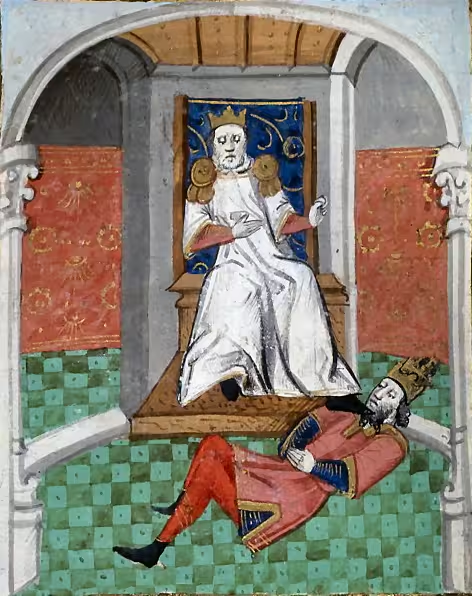
Aftermath: from a lenient peace to a shattering civil war
Alp Arslan’s surprising mercy
The peace Alp Arslan offered was, by the standards of the age, remarkably restrained. In exchange for his freedom, Romanos agreed to pay a substantial ransom, an annual tribute, and to cede a handful of frontier towns — a costly settlement, but one that left the Byzantine Empire’s core territory in Anatolia essentially intact. Alp Arslan had no interest in occupying Byzantine lands himself; his ambitions lay against his Muslim rivals, chiefly the Fatimids of Egypt, and a chastened but functioning Byzantine state on his western flank suited him better than a power vacuum. Had this treaty held, Mantzikert might well have become a serious but survivable defeat, remembered alongside other Byzantine reverses that the empire had absorbed and recovered from in the past.
It did not hold — and not because of anything the Seljuks did.
Betrayal at home: the fall of Romanos IV
News of the defeat reached Constantinople before Romanos himself did, and the Doukas faction, which had never accepted his marriage to Eudokia or his hold on the throne, seized the opportunity ruthlessly. They moved to depose him in his absence, proclaiming Eudokia’s son by her first husband — Michael VII Doukas — as sole emperor. When Romanos attempted to fight his way back to power with what forces remained loyal to him, he was defeated, captured by his domestic rivals rather than any foreign enemy, and blinded so brutally — a traditional Byzantine method of political disqualification, meant to render a rival incapable of ruling — that he died of his wounds shortly afterward.
With Romanos dead and the new Doukas government determined to distance itself entirely from his policies, the treaty he had personally negotiated with Alp Arslan was simply repudiated. Constantinople had, in effect, thrown away the lenient peace its own emperor had won on the battlefield, for the sake of a domestic power struggle — and given Alp Arslan and his successors every reason to stop treating Byzantium as a state worth respecting agreements with.
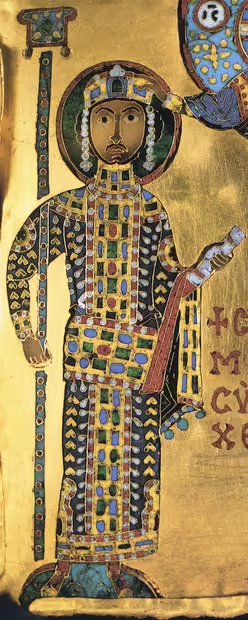
A decade of civil war, and an open door into Anatolia
What followed was, in the end, far more destructive to Byzantium than the battle itself. Through the 1070s, rival generals — Nikephoros Bryennios, Nikephoros Botaneiates, Nikephoros Melissenos among them — rose in successive revolts against the weak Doukas government and against one another, each seeking to seize the throne outright. Anatolia, the empire’s most valuable province, became the main battleground and recruiting ground for this civil war rather than a frontier to be defended. Byzantine commanders, desperate for troops to use against their fellow Byzantines, began hiring Turkish mercenary bands by the thousand — the very people the empire should have been organizing to repel.
The result was that the Seljuks, and increasingly independent Turkish warlords only loosely tied to Alp Arslan’s authority, did not need to fight their way across Anatolia so much as walk into it. Town after town, deprived of any coherent imperial defense and sometimes actively invited in by one Byzantine faction to use against another, passed into Turkish hands through the 1070s. By 1080, a Seljuk-descended dynasty had established itself at Nicaea — a city barely a hundred kilometers from Constantinople itself, and a striking measure of how completely Byzantine authority in Anatolia had collapsed within less than a decade of Mantzikert. It is the same city that, two centuries later, would briefly become the capital of a Byzantine government-in-exile after the sack of Constantinople in 1204 — a reminder of just how central Anatolia remained to any Byzantine recovery, and how costly its loss in the 1070s truly was.
Impact and legacy
The permanent loss of the Anatolian heartland
The single most important consequence of Mantzikert was not the battle’s casualties but the territorial collapse the following civil war enabled. Anatolia had been the demographic, agricultural, and military backbone of the empire since late antiquity — the source of most of its soldiers, most of its grain, and most of its tax revenue. Losing it did not simply shrink Byzantium; it permanently altered what kind of state Byzantium could be. Even after Alexios I Komnenos stabilized the empire in the 1080s and 1090s and clawed back parts of western Anatolia, the empire never again controlled the Anatolian plateau in depth. Every subsequent century of Byzantine history — including the catastrophe of 1204 and the fractured, diminished empire that limped on afterward through the Late Byzantine period — played out with a permanently smaller resource base than the empire had commanded before 1071.

The road to the First Crusade
Mantzikert’s aftershocks also reached far beyond Byzantine or Turkish history. The loss of Anatolia left the empire dangerously exposed and its rulers, particularly Alexios I Komnenos, increasingly convinced that outside military help was the only realistic way to recover lost ground. Alexios’s appeals to the West — and specifically his request to Pope Urban II for mercenary support against the Turks — became one of the direct triggers for the Council of Clermont in 1095 and the launch of the First Crusade the following year. The crusaders who marched east in 1096 were, in a very real sense, answering a call that traced back to the defenses Byzantium had lost at Mantzikert a quarter-century earlier — an irony compounded when, little more than a century later, crusaders turned their swords on Constantinople itself in 1204.
A battle, or a symptom? The historiographical debate
Historians remain genuinely divided over how much weight to put on the battle itself. An older tradition, going back to Byzantine chroniclers writing with the benefit — and the bias — of hindsight, treated Mantzikert as an outright catastrophe, the day the empire’s fate was sealed. Many modern historians push back against this framing: the military defeat was serious but not unprecedented, the peace terms Alp Arslan offered were genuinely generous, and Byzantium had absorbed comparable battlefield losses before without permanent territorial collapse. On this reading, the real catastrophe was not what happened on the battlefield at all, but the political decision, taken entirely in Constantinople, to blind and destroy the one emperor who had actually negotiated a survivable peace — and then to spend the next decade fighting a civil war instead of a frontier war. Either way, the two readings converge on the same conclusion: Mantzikert is the hinge on which Byzantium’s fortunes turned, whether one blames the sword or the dagger in the back.
Mantzikert in memory: Malazgirt Day and the modern battlefield
The battle’s afterlife has been strikingly asymmetric. In Turkey, 26 August is still marked as Malazgirt Victory Day, commemorated as the opening of Anatolia to Turkish settlement and the deep root of the modern Turkish nation’s presence in the region — a foundational date in national memory, on a par with events centuries closer to the present. In Greek and Byzantine historical memory, by contrast, Mantzikert is remembered less as a single glorious or tragic day than as the moment a slow decline became visible — a defeat whose true meaning only became clear in hindsight, as the empire’s Anatolian heartland disappeared over the following decade.
The physical battlefield itself, on the plain near modern Malazgirt, went essentially unlocated by archaeologists for centuries. That changed in recent years, when a dedicated survey project used geophysical scanning across a wide stretch of the Mantzikert plain to recover arrowheads, weapon fragments, coins bearing the likeness of Romanos IV Diogenes, and other direct physical traces of the 1071 campaign — the first hard archaeological confirmation of a battle known almost entirely from chronicle accounts until now. We covered those finds in detail when they were announced: see Archaeologists uncover physical evidence of the famed Battle of Mantzikert for the artifacts themselves and what the excavation team hopes to learn next.
Sources and further reading
World History Encyclopedia — “Battle of Manzikert”
Encyclopaedia Britannica — “Battle of Manzikert”
Select bibliography:
Michael Attaleiates, The History (contemporary Byzantine chronicle) Anna Komnene, The Alexiad (retrospective account from the following generation)
J. C. Cheynet, “Mantzikert: un désastre militaire?”, Byzantion 50 (1980) Carole Hillenbrand, Turkish Myth and Muslim Symbol: The Battle of Manzikert (2007) Warren Treadgold, A History of the Byzantine State and Society (1997) Anthony Kaldellis, Streams of Gold, Rivers of Blood: The Rise and Fall of Byzantium, 955 A.D. to the First Crusade (2017)



One Comment