The Gabalas family: Byzantine naval leaders and rulers of Rhodes
The Gabalas family stands out in late Byzantine history as a dynamic lineage deeply tied to maritime power, territorial lordship, and intellectual life. Active primarily from the late 12th century through the mid-14th century, members of the family distinguished themselves as high-ranking naval officers, autonomous rulers of the island of Rhodes, prominent landowners, and influential scholars.
Key milestones of the Byzantine Gabalas Family
Late 12th C. – First verified records of Stephen and John Gabalas in imperial service.
1204 – Leo Gabalas establishes independent rule over Rhodes after the Fourth Crusade.
1234 – Leo Gabalas signs a treaty with the Republic of Venice against Nicaea.
1240 – John Gabalas succeeds his brother Leo as ruler of Rhodes.
1249 – Empire of Nicaea under John III Vatatzes recaptures Rhodes.
1329-1351 – Manuel Gabalas serves as Metropolitan of Ephesus (Matthew of Ephesus).
Mid-14th C. – Decline of family presence in high imperial administration.
Uncertain origins and first historical mentions
The precise origins of the Gabalas family name remain a subject of historical debate. Early historiographical attempts to link the name to the Syrian city of Gabala (Byblos) were rejected by modern scholars such as S. Kourouses, who suggested a connection to the Old Testament figure Cabaelos. Other proposed links to the Arab chieftain Jabala (father of the Ghassanid king Arkas) or to the late Roman patrikios Gabalas lack firm documentary evidence.
While early references are difficult to verify, a lead seal attributed to a John Gabalas was dated by numismatist K. Regling to the period between 850 and 1050. However, this seal alone is insufficient to prove continuous family prominence from the 9th century. Another seal, in Dumbarton Oaks, belonged to Andronikos Gabalas, patrikios and strategos, and is dated to the 9th or 10th century. It depicts the rarely depicted military saint Andronikos, likely in reference to the name of its owner, and shows that some members of the family were already prominent at that time. Firm historical documentation emerges at the end of the 12th century, identifying further family members serving in high-ranking administrative and naval positions, such as the protonobelissimohypertatos Stephen Gabalas and John Gabalas.
Rulers of Rhodes: The zenith of Gabalas power (1204-1249)
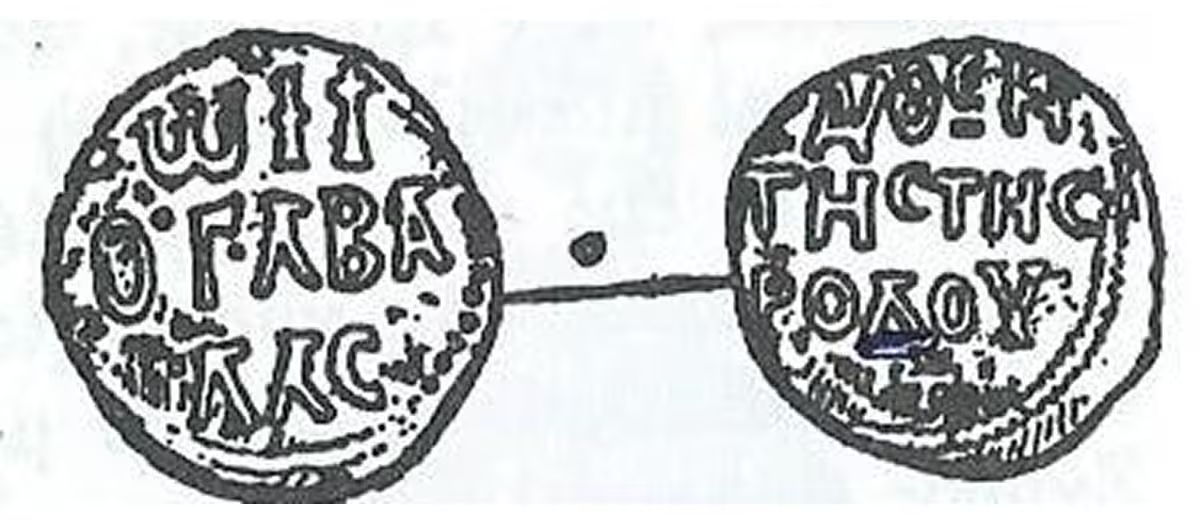
Following the sack of Constantinople by the Fourth Crusade in 1204, the central authority of the Byzantine Empire collapsed. Taking advantage of this power vacuum, the Gabalas family carved out an independent realm in the Aegean centered on the island of Rhodes and including neighboring islands, issuing their own aniconic copper coinage.
Leo Gabalas: the independent caesar
Leo Gabalas established an independent lordship on Rhodes following the dissolution of the Empire in 1204. Holding the exalted title of caesar (which may have been inherited, granted by Angeloi emperors prior to 1203, or recognized by Nicaean rulers), Leo maintained near total autonomy throughout his reign. In 1232/3, his independent stance provoked an expedition by Emperor John III Doukas Vatatzes of Nicaea, led by Grand Domestic Andronikos Palaiologos. Although Nicaean forces devastated the island, Leo retained effective control. In August 1234, Leo struck back diplomatically by concluding an alliance with the Republic of Venice. Styling himself “Caesar” and “Lord of Rhodes and the Cyclades,” he acknowledged the Doge of Venice as his lord, agreed to mutual defense against Vatatzes, and offered assistance in suppressing rebellions in Venetian Crete. Nevertheless, by 1235/6, Leo pragmatically realigned with Vatatzes to join the siege of Constantinople, even engaging Venetian fleets. He ruled until his death in the early 1240s, leaving a legacy as an astute autonomous monarch.
John Gabalas: Nicaean vassalage and the fall of Rhodes
Following Leo’s death around 1240, his brother John Gabalas succeeded him as ruler. Unlike Leo, who had exercised near-sovereign authority, held the title of caesar, and concluded independent treaties, John acted under much tighter Nicaean oversight. Attested only as “Master of Rhodes” on his copper coinage, John held the Nicaean court titles of sebastos and megas doux. He was also bound to the imperial dynasty by marriage (gambros), likely to a lady of the Vatatzes family. In 1248, while John was campaigning with the Nicaean army near Nicomedia, the Republic of Genoa launched a surprise attack and captured Rhodes. John was forced to call upon Nicaean troops led by the pinkernes John Kantakouzenos for assistance. Although Nicaean forces successfully evicted the Genoese by 1250, the island was not returned to John. Instead, it was formally annexed as a Nicaean province, ending the Gabalas dynasty’s territorial lordship over Rhodes.
Imperial service: Naval command and political maneuvers
Despite losing Rhodes, the Gabalas family remained deeply embedded in the military and political structure of the Empire. Their traditional expertise in maritime affairs led several members to hold the rank of megas droungarios (grand admiral) in the Byzantine navy. One notable commander, also named John Gabalas, directed naval operations under John III Vatatzes until approximately 1266-1267.
During the 14th century, the family continued to hold high naval and political offices:
- John Gabalas (megas droungarios): Documented as grand admiral in 1341, he initially supported John VI Kantakouzenos during the Byzantine civil war before changing allegiances, earning the high title of megas logothetes by 1344.
- Landholdings in Smyrna: Throughout the 13th century, family members acquired significant landed estates in the region of Smyrna, cementing their wealth.
- Crete Settlement: The presence of family branches in Venetian-controlled Crete highlights their ongoing commercial interest in eastern Mediterranean trade networks.
Scholars and churchmen: The figure of Manuel Gabalas
Beyond military service, the family contributed to Byzantine intellectual life through Manuel Gabalas (later known as Matthew, Metropolitan of Ephesus). Born in Philadelphia around 1272 or 1273, Manuel began his ecclesiastical career as an anagnostes, deacon, and protonotarios under Metropolitan Theoleptos. During the Second Siege of Philadelphia, he traveled to Constantinople in 1309 to seek imperial aid against Turkish raids. Between 1311 and 1317, he fell out with Theoleptos during “Theoleptos’ Schism,” opposing his anti-Arsenite stance and accusing his nephew of corruption. Stripped of his office, censured, and grieving the death of his wife—which left him to raise their infant son John alone—Manuel spent years in exile and petitioning Patriarch John Glykys. He reconciled with Theoleptos in 1321, becoming chartophylax, but was expelled from Philadelphia by the military governor Manuel Tagaris in late 1322. He subsequently took monastic vows in Constantinople under the name Matthew.
In December 1329, Matthew was named Metropolitan of Ephesus, a city that had fallen to Turkish Beyliks in 1308 and whose cathedral, the Basilica of Saint John, had been converted into a mosque. Prevented from entering his see for a decade, he governed from Constantinople and Thracian Brysis. In 1339, after a perilous 20-day journey avoiding pirates and bandits, Matthew finally reached Ephesus with imperial letters from Andronikos III. After bribing Emir Umur of Aydin, he was granted entry, but Hidir Bey refused to return church property, relegating Matthew and his clergy to a tiny house where hostile local Muslims threw stones at their roof at night.
Matthew was also a prolific scholar, copyist, and active correspondent with major figures such as Nikephoros Gregoras, Nikephoros Choumnos, and Theodore Metochites. Deeply influenced by classical antiquity, he wrote extensive commentaries on Homer’s Odyssey (notably The Wanderings of Odysseus), an oration to Andronikos II, funeral monodies, and a vast collection of moral and theological writings known as the “200 Chapters.” However, his fierce opposition to Hesychasm and Gregory Palamas led to his trial and excommunication at the Fifth Council of Constantinople in 1351. Stripped of his vestments during synodal clashes, he lived in monastic seclusion until his death between 1355 and 1357.
Waning of Gabalas influence in the 14th century
By the second half of the 14th century, the political influence of the family waned, with one of the last notable mentions being Michael Gabalas, who served as an oikeios (court official) to Emperor Manuel II Palaeologus around 1400. After this period, the family disappears from imperial records, indicating that they likely lost all political significance during the final decades of the Byzantine Empire.
However, the history of the Gabalas family illustrates the versatility of the late Byzantine aristocracy. From commanding naval fleets and carving out an independent realm in Rhodes to navigating court intrigues and producing major literary works, the Gabalas legacy remains a compelling chapter in the history of Byzantium.
Sources and further reading
Primary sources
- Akropolites, George. The History. Translated with introduction and commentary by Ruth Macrides. Oxford: Oxford University Press, 2007. (Covers Nicaean naval campaigns against Leo and John Gabalas on Rhodes.)
- Kantakouzenos, John. Historiarum Libri IV. Edited by L. Schopen. 3 vols. Corpus Scriptorum Historiae Byzantinae. Bonn, 1828–1832. (Provides records of 14th-century naval command and political shifts involving John Gabalas.)
- Matthaios von Ephesos (Manuel Gabalas). Die Briefe des Matthaios von Ephesos. Edited and translated by Dieter Reinsch. Berlin: Walter de Gruyter, 1974. (Critical edition of 63 surviving letters of Manuel Gabalas, illustrating his intellectual network and life in Turkish-occupied Ephesus.)
Secondary literature
- Ahrweiler, Hélène. Byzance et la mer: la marine de guerre, la politique et les institutions maritimes de Byzance aux VIIe–XVe siècles. Paris: Presses Universitaires de France, 1966. (Key reference on Byzantine naval organization and Gabalas family commanders.)
- Kazhdan, Alexander, ed. The Oxford Dictionary of Byzantium. 3 vols. Oxford and New York: Oxford University Press, 1991. (S.v. “Gabalas” [Vol. 2, pp. 811–812] and “Gabalas, Manuel” [Vol. 2, p. 812].)
- Kourouses, Stavros I. Manouel Gabalas eita Matthaios metropolites Ephesou (1271/2–1355/60): A’ Ta Biographika. Athens: Athena, 1972. (The definitive biographical study on Manuel Gabalas and family lineage.)
- Savvides, Alexis G. C. Rhodes in the Graeco-Latin Period, 1204–1310. Athens, 1988. (Detailed study on the autonomous lordship of Leo and John Gabalas on Rhodes.)
- Trapp, Erich, et al., eds. Prosopographisches Lexikon der Palaiologenzeit (PLP). Vienna: Verlag der Österreichischen Akademie der Wissenschaften, 1976–1996. (S.v. nos. 3290–3310, detailing individual late Byzantine members of the Gabalas family.)



One Comment