
The Byzantine monastery of Kaisariani near Athens
Writing to a correspondent in the early 13th century, the metropolitan of Athens Michael Choniates mentioned the monasteries scattered along the edge of Mount Hymettus — a mountain he called “honeyed” — and judged them far from unpleasant places to live. Kaisariani, tucked into a wooded ravine on Hymettus a few kilometres from the centre of Byzantine Athens, is the best surviving of those monasteries. Its enclosure, church, bathhouse, refectory and kitchen are preserved almost entirely intact, and its main church ranks among the finest Middle Byzantine monuments of Athens.
Yet Kaisariani keeps its secrets. No founding inscription survives, its date is still debated, its famous library has vanished without trace, and almost every written record of the monastery comes from the centuries of Ottoman rule, leaving many open questions that we also address in this article.
Quick facts
Location
Western slope of Mount Hymettus, Moni Kaisarianis, about 5 km east of central Athens
Founded
Late 11th or first half of the 12th century (debated)
First written mention
Papal letter of Innocent III, 1208/1209
Dedication
Presentation of the Virgin (Eisodia tis Theotokou)
Main church
Cross-in-square, four columns, dome; 9.47 × 8.12 m externally
Byzantine buildings
Katholikon, bathhouse, refectory, domed kitchen, probably the enclosure wall
Wall paintings
One 14th-century fragment; the rest post-Byzantine
A sacred spring on Mount Hymettus
Located on the wooded slopes of Mount Hymettus, the monastery occupies a site that likely has a much older religious tradition, with evidence suggesting it was once a sanctuary of Aphrodite. Nestled in a ravine on the mountain slope, the monastery was invisible from afar while commanding a view of the surrounding area as far as the sea.
In the 5th or 6th century the site was converted to Christian use, and the remains of an Early Christian basilica are visible to the west of the monastery. Whether a basilica also stood where the monastery is now is less certain.
History of the Kaisariani Monastery
Foundation, around 1100: a dating debate
Kaisariani was not the first monastery on Mount Hymettus: the Moni Asteriou is said to have existed in the area since the 10th century. Kaisariani was likely founded around 1100, when the church at the heart of the monastery was built. Nestled in a ravine on the mountain slope, the monastery’s secluded location made it invisible from afar while providing a commanding view of the surrounding area, extending to the sea. A third community, the monastery of Kynegos higher up the same ridge, was founded in the early 12th century (see our Athens visitor guide).
With no inscription to fix the date, the chronology rests on architectural analysis. Arthur Megaw, studying construction technique, placed the katholikon in the last quarter of the 11th century, with 1209 as the latest possible date; his chronology has been widely accepted. More recently Charalambos Bouras has argued, on the basis of new observations, that the church more probably belongs to the first half of the 12th century. Both proposals remain in circulation, which is why “around 1100” is the safest formula.
Under Latin rule (1204–1458)
The first documented mention of the monastery comes only after the Fourth Crusade, during the Frankish period. In 1208 or 1209, Pope Innocent III referred to it as “Santa Syriani” in his correspondence. By 1210 the monastery remained in Greek hands: Michael Choniates, the Orthodox metropolitan who had surrendered Athens to the crusaders, wrote to its Orthodox abbot and called it “Kaisariani”. The contrast with the other great monastery of Attica is striking: Daphni was handed to Cistercian monks from Burgundy around 1207, while Kaisariani kept its Greek community.
During the 12th and 13th centuries the monastery flourished. The monks kept bees, and Hymettus honey — already famous in antiquity — became one of their main sources of income. The monastery also held extensive estates and dependencies around Mount Hymettus and elsewhere in Attica. Its abbots placed themselves directly under the pope, which brought privileges including tax immunity.
The Ottoman period (1458–1821)
When the Ottomans occupied Attica in 1458, five years after the fall of Constantinople, the abbot of Kaisariani is said to have handed the keys of Athens to Sultan Mehmed II — a legend recorded by the traveller Jacob Spon in 1675. In return, the story goes, the monastery was exempted from taxation, its obligations reduced to a small annual payment. The exemption was later confirmed by the Patriarchate, but rescinded in 1716.
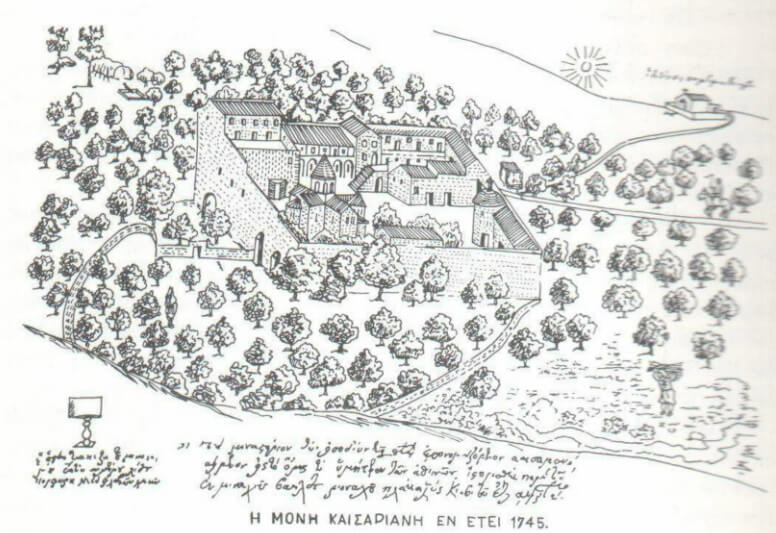
Over the following centuries, buildings were remodelled: the bathhouse became an oil press, and cells were rebuilt and enlarged. By the 19th century the monastery was close to ruin.
Restoration in the 20th century
The complex has undergone numerous conservation treatments, not all of them fully documented. Two major reconstruction projects took place in the early and mid-20th century. During the 1950s campaign the marble templon of the church was restored, and the monks’ cells were reconstructed using Barsky’s 1745 drawing as a guide.
The katholikon: classical austerity in a Byzantine church
Plan and proportions
The katholikon (main church) is a classic Middle Byzantine four-column cross-in-square church with a dome, marked by clear geometric volumes and high-quality construction. It measures 9.47 by 8.12 m externally, with an interior of 6.65 by 5.88 m (about 31.1 × 26.6 ft and 21.8 × 19.3 ft). Small as these figures are, the interior feels grand: its proportions are broad and harmonious, and the precision of the masonry is exceptional for Attica.
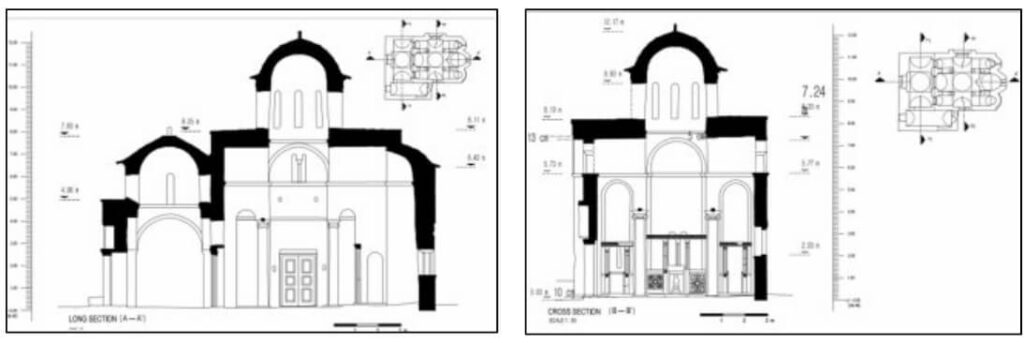
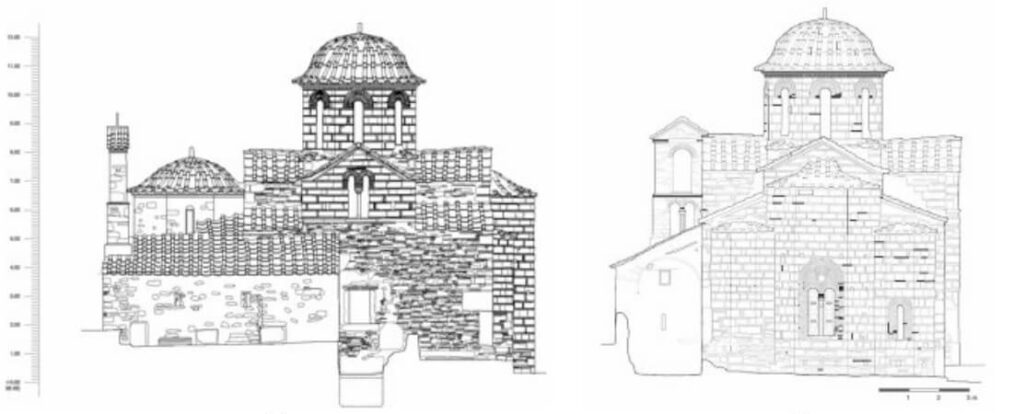
Details that reveal a master builder
Several features set Kaisariani apart from the other Middle Byzantine churches of Athens. On the east facade, the bricks in the tympanum above the double-light sanctuary window are laid in a carefully composed pattern. The dome is austere, with little of the decorative brickwork common elsewhere. Most striking is the great arch on the north side, built of large, finely carved stone voussoirs with concentric bands (fasciae) — a direct borrowing from ancient architecture that gives the whole building a distinctly classical tone.
Inside, the four marble columns carrying the dome are reused from Late Antique buildings and still wear their Ionic capitals. The marble templon (chancel screen), by contrast, was made for the church and is contemporary with it. For how this church fits into the wider story, see our guide to Byzantine architecture.
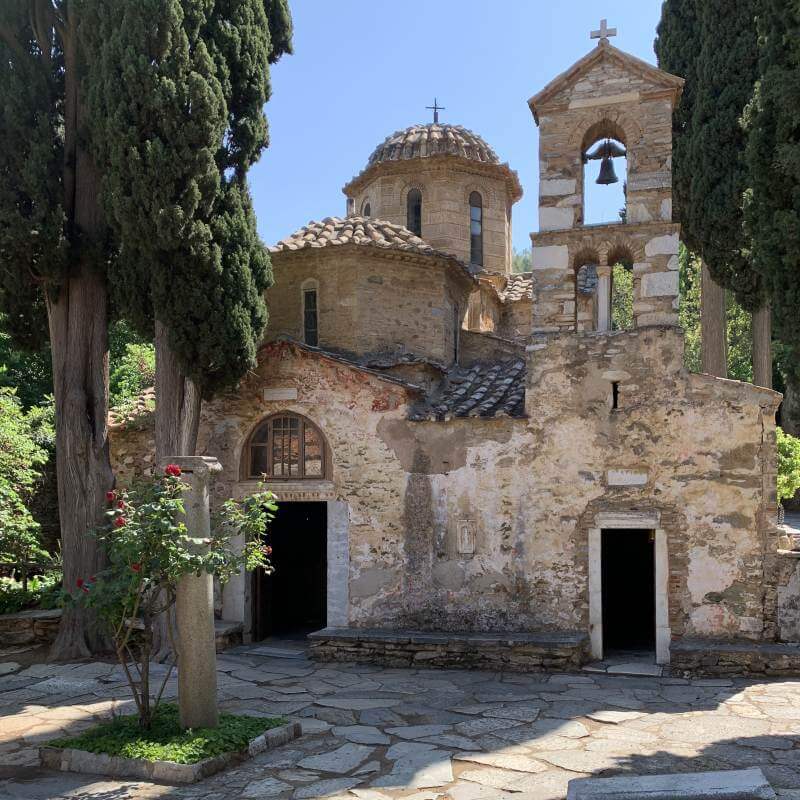 View of the byzantine katholikon (main church) of the Kaisariani monastery near Athens
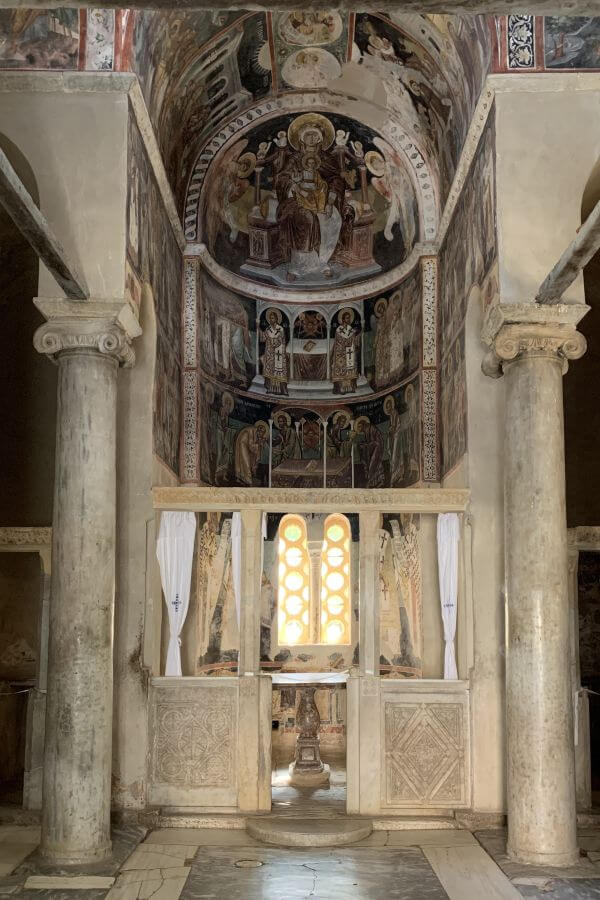 View of the templon and the apse
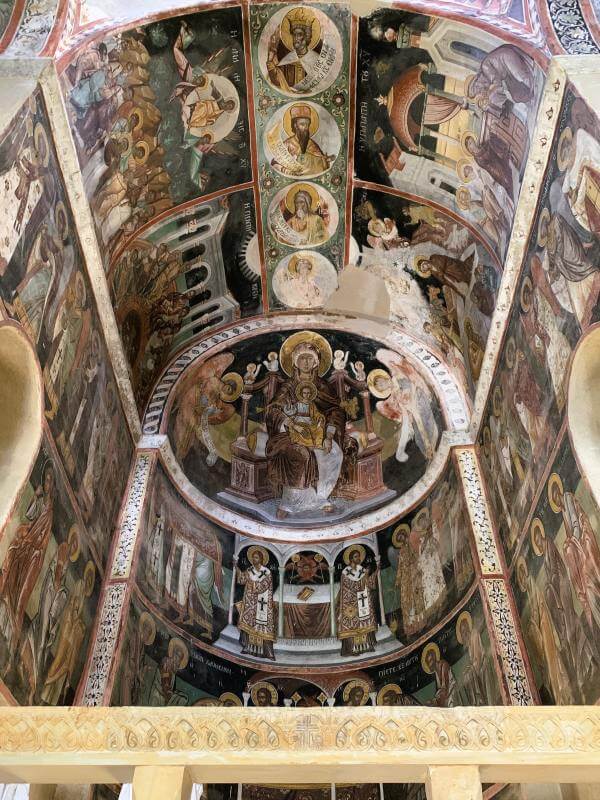 Templon and apse with post-byzantine paintings.
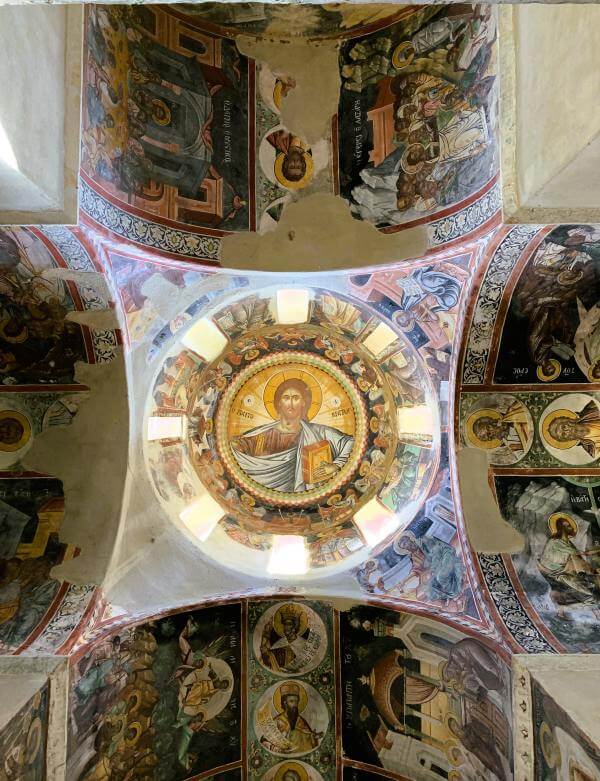 Dome of the church with post-byzantine paintings.
Later additions: narthex, chapel and bell tower
In the 17th century the church was extended westwards with a domed narthex, and later a barrel-vaulted chapel dedicated to Saint Anthony was added on the south side.
Bouras describes this chapel as a vaulted, basilica-type building; many of the carved architectural fragments of the site are built into it.
The bell tower, raised in the 18th or 19th century, was the last significant addition.
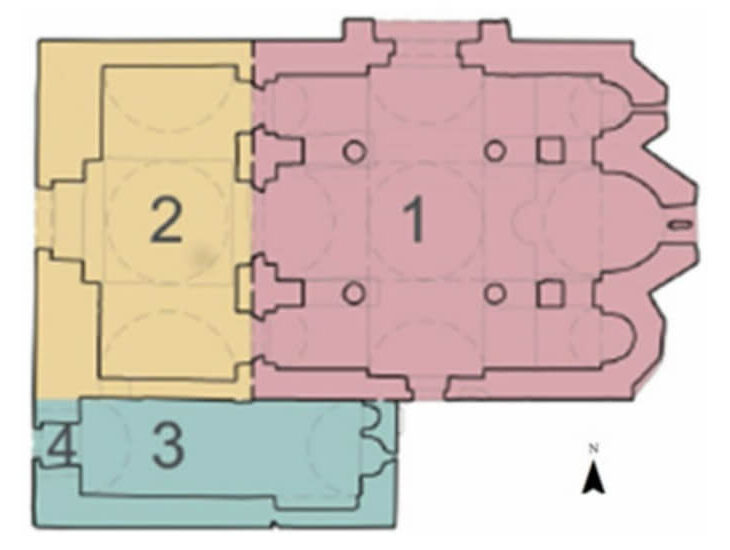
The wall paintings
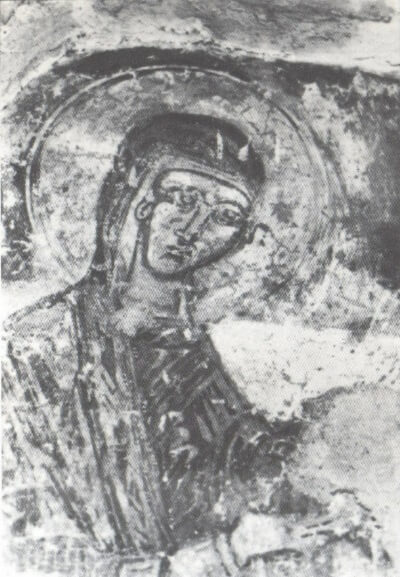
None of the church’s original Byzantine frescoes survive. The oldest remaining mural is on the exterior of the south wall, now inside the chapel of Saint Anthony.
It was once part of a Deesis — Christ enthroned between the Virgin Mary and John the Baptist — of which only the Virgin in prayer remains. Its provincial style points to the 14th century.
The paintings that now cover the nave and narthex are post-Byzantine, and they are of outstanding quality. The narthex was decorated in 1682; the nave paintings probably date to the early 18th century.
For how such programmes were planned and painted, see our guide to Byzantine monumental painting.
- Templon and apse with post-byzantine paintings.
- Dome of the church with post-byzantine paintings.
The monastic complex: a rare intact Byzantine layout
What makes Kaisariani exceptional is not only its church but the survival of the whole monastery around it. Some buildings were renovated under Ottoman rule, but the overall arrangement remains Byzantine, and the defensive wall enclosing the square courtyard seems to be original. It is one of the best places near Athens to see how a Byzantine monastery actually worked: church, bath, refectory and kitchen within one wall.
The bathhouse
South of the katholikon stands a trefoil-shaped building that was originally a bathhouse, dated to the 11th century and built over a natural spring. Its hemispherical cupola rests on four pendentives. Monastic baths are rare survivals; comparable examples exist at Daphni and in ruins at the monastery of Zoodochos Pigi at Dervenosalesi. At Daphni only the hypocaust survives; at Kaisariani the vaulted building still stands. Under Ottoman rule the bath became an oil press, a modification that still leaves traces of its first use, including hypocaust pillars and water conduits.
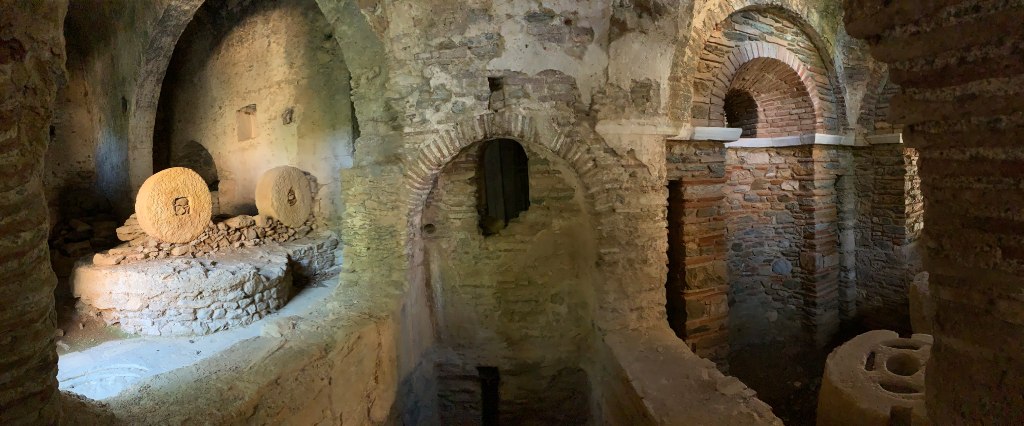
Its construction follows the tradition of Roman baths and reflects monastic rules on regular washing. At Zoodochos Pigi the bath had benches in its main chamber; at Kaisariani, the marble benches now in the courtyard may have belonged to the original bathhouse. If the katholikon dates to the 12th century, as Bouras proposes, the bath may be slightly older than the church.
The refectory and the domed kitchen
On the west side of the courtyard stand the vaulted refectory (trapeza), partly restored, where the community ate together, and the kitchen, covered by a dome that drew off smoke and heat. Daphni preserves the same pairing, a refectory with a small kitchen attached, but in ruins; Kaisariani’s are roofed.
The lost library
Kaisariani was renowned for a fine library, but no one knows where in the monastery it was kept, and its books are no longer there.
The ruins of a small domed church
On the site of the Early Christian basilica west of the monastery lie the ruins of a smaller domed church, probably built in the 10th or 11th century on the basis of its features.
Open questions: what the sources do not tell us
When was the church built?
No inscription survives. Megaw’s late-11th-century date would make the katholikon roughly contemporary with Daphni; Bouras’s first half of the 12th century would place it in the Komnenian period. Neither has been disproved.
What stood here before?
The Aphrodite sanctuary rests on tradition more than excavation. Many carved architectural members of different periods are built into the chapel of Saint Anthony or lie around the monastery, and they have often been read as proof that an Early Christian basilica preceded the Byzantine church. Bouras cautions that they prove no such thing: reused marble travelled easily. The basilica ruins west of the enclosure are a separate question from what, if anything, lies beneath the katholikon.
How much of the complex is Byzantine?
Older accounts, including earlier versions of this article, treated the refectory, kitchen, cells and enclosure wall as later additions, leaving only the katholikon and bathhouse as Byzantine. Bouras regards the enclosure wall as probably original and the refectory and kitchen as Byzantine, though partly restored. The cells, rebuilt in the 1950s from Barsky’s drawing, are the least reliable guide to the medieval layout.
What do the written sources really say?
Very little from the Byzantine centuries. Beyond Innocent III’s letter and Choniates’ correspondence, nearly every testimony dates from the Ottoman period, and the most famous story — the abbot handing Mehmed II the keys of Athens — was written down by Spon more than two centuries after the event it describes.
Who painted the church, and where were the books?
The post-Byzantine painters still need firm attribution, and the location and fate of the library are unknown. At least three monographs have been devoted to Kaisariani, yet these gaps remain; further research may yet fill them.
What to look for when you visit
Before entering the church, look up at the east end for the brick pattern above the twin sanctuary window, then walk around to the north side to see the classical stone arch. Inside, note the Ionic capitals on the four columns and the Byzantine marble templon. In the chapel of Saint Anthony, find the 14th-century Virgin and the carved fragments embedded in the walls. Then cross the courtyard to the bathhouse, the refectory and the domed kitchen. Kaisariani pairs naturally with Daphni and its mosaics on the other side of the city, or with the Kynegos monastery higher up Hymettus; transport and timing are in our Byzantine Athens visitor guide. Those who know Choniates from his letters can also seek out his haloed portrait, painted in 1233/34 in a cave chapel on Mount Pentele.
Frequently asked questions
When was the Kaisariani Monastery built?
Around 1100. Megaw dated the church to the last quarter of the 11th century; Bouras argues for the first half of the 12th century. No inscription settles the question.
Is Kaisariani the oldest monastery on Mount Hymettus?
No. The Moni Asteriou nearby is said to be older, and the site of Kaisariani itself was a Christian sanctuary by the 5th or 6th century.
Are the frescoes at Kaisariani Byzantine?
Only one fragment, a 14th-century Virgin from a Deesis in the chapel of Saint Anthony. The paintings covering the church date from 1682 (narthex) and the early 18th century (nave).
Why is the monastery famous for honey?
Mount Hymettus honey was prized since antiquity, and beekeeping was one of the monks’ main sources of income in the 12th and 13th centuries.
What Byzantine buildings survive at Kaisariani?
The katholikon, the bathhouse, the refectory and the domed kitchen, and probably the enclosure wall. Ottoman-period renovations and 20th-century restorations have altered parts of the complex.
Is Kaisariani or Daphni better to visit?
They complement each other. Daphni is the place for mosaics; Kaisariani is the better-preserved monastery, where church, bath, refectory and kitchen still stand together within their wall.
Sources and further reading
- A.Moropoulou, M.Apostolopoulou, P.Moundoulas†, E.Aggelakopoulou, L.Siouta, A.Bakolas, Maria Douvika, Panagiotis Karakitsios, Panagiotis G. Asteris, The role of restoration mortars in the earthquake protection of the Kaisariani Monastery, ECCOMAS Congress 2016 VII European Congress on Computational Methods in Applied Sciences and Engineering.
- Elisabet Tsilimadou, A Multidisciplinary Approach for Historic Buildings Diagnosis: The Case Study of the Kaisariani Monastery, 2019.
- Theano Chatzidakis, The Monastery of Kaisariani, Apollo ed. Athens 1977.
- Charalambos Bouras, Byzantine Athens, 10th–12th Centuries, Routledge, 2017, p. 221.
- A. H. S. Megaw, “The Chronology of Some Middle-Byzantine Churches”, Annual of the British School at Athens 32 (1931–32).