Digenes Akritas: The one epic Byzantium ever wrote
Byzantium inherited Homer. For a thousand years its schools taught the Iliad and the Odyssey as the foundation of a proper education. Yet in all that time, the empire turned almost none of its own heroic material into epic. It is not that the raw material was missing. Frontier warriors, dragon-slayers, and abducted brides fill a whole cycle of shorter Greek ballads from the ninth century onward. Almost none of that material was ever stitched into a sustained narrative. One text crossed that line: Digenes Akritas. That gap, between abundant heroic song and a single surviving epic, is worth asking about directly. Why did so much raw material produce so little epic? And how did the one example that did get written manage to survive at all?
A literature split in two
The answer starts with language. Byzantine written culture ran on two registers that barely spoke to each other. Educated authors wrote in an archaizing Greek, modelled on Attic writers more than a thousand years dead, because rhetorical training had always been built around imitating the ancients. That register carried prestige. It was the language of history, theology, and court oratory. The language that ordinary Byzantines actually spoke, medieval demotic Greek, had almost no place in serious literature. Composing a heroic narrative in that vernacular register would have struck most educated Byzantines as a contradiction: epic required classical dignity, and the living language had none, by their own standards.
This split, sometimes called Byzantine diglossia, is the main reason the empire left behind chronicles, saints’ lives, and theological treatises by the shelf-load, but almost nothing resembling a national epic. The raw material for one, warrior tales, frontier legends, oral songs, certainly existed. It simply had nowhere to go in writing.
A whole cycle, one epic
The frontier songs this material came from are usually grouped together as the Acritic cycle, after the akritai, the border guards who populate them. The Song of Armouris, a heroic ballad of around two hundred lines about a young man riding into Arab territory to free his captured father, may be the oldest surviving piece of it, with features of oral composition that some scholars read as even more archaic than anything in Digenes Akritas. Smaller ballads about other border heroes, Andronikos, Xanthinos, Porfyris, share the same heroic world and the same fifteen-syllable political verse. None of them grew beyond a few hundred lines. They stayed ballads, sung and resung, never assembled into a continuous story with a beginning, a childhood, and a death. Digenes Akritas is the one place where that raw material was gathered up and built into something on the scale of an epic rather than a song.
A crack opens in the twelfth century
That changed, briefly, in the twelfth century. The Komnenian court developed a fresh appetite for secular storytelling: prose romances modelled on the ancient novelist Achilles Tatius, experiments in verse closer to spoken Greek, and a general loosening of what counted as serious literature. Digenes Akritas took shape in this window. Scholars generally date its compilation to the twelfth century, built from oral material about frontier warriors that had circulated for generations before anyone wrote it down. A poem by the court satirist Ptochoprodromos already calls Emperor Manuel I Komnenos a “new Akrites,” which tells us the hero was common knowledge by then.
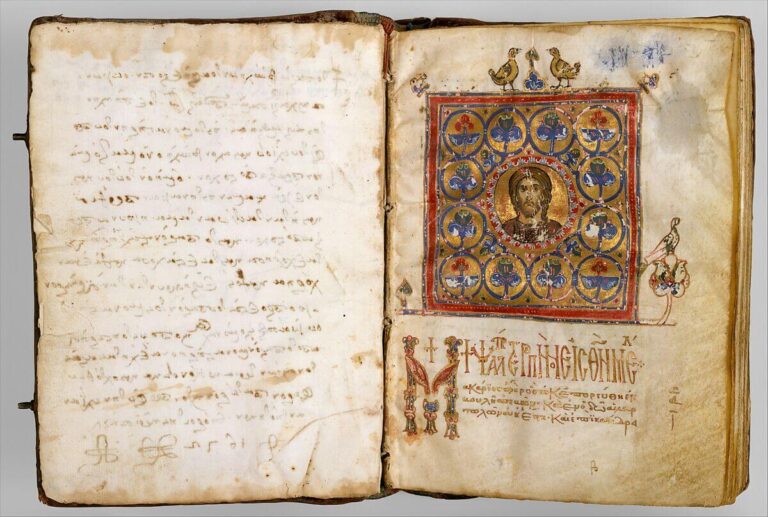
The poem runs to roughly 3,000 to 4,000 lines of fifteen-syllable “political verse,” the same accentual meter that would later carry Greek popular poetry for centuries. It survives in six Greek manuscripts and one Slavic adaptation, no two of them identical. The two oldest, Grottaferrata and Escorial, clearly descend from the same lost original, yet they disagree enough in length and style that scholars still debate which sits closer to it. Grottaferrata is polished and closer to the literary register. Escorial is rougher, closer to everyday speech, and full of gaps. Between them, they show a poem still being pulled in two directions: toward classicizing dignity, and toward the vernacular world it came from.
The story the empire almost didn’t write down
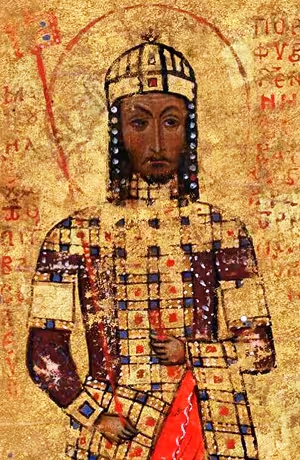
The epic falls into two halves. The first tells of Digenes’ parents: a Syrian emir who raids Byzantine territory, falls in love with the daughter of a Byzantine general, and converts to Christianity for her sake, by choice rather than compulsion. The second follows their son, Basil, whose epithet “Digenes Akrites” means roughly “two-blood border lord.” He is fighting by the age of twelve, kills a lion bare-handed, defeats brigands, and elopes with a general’s daughter.
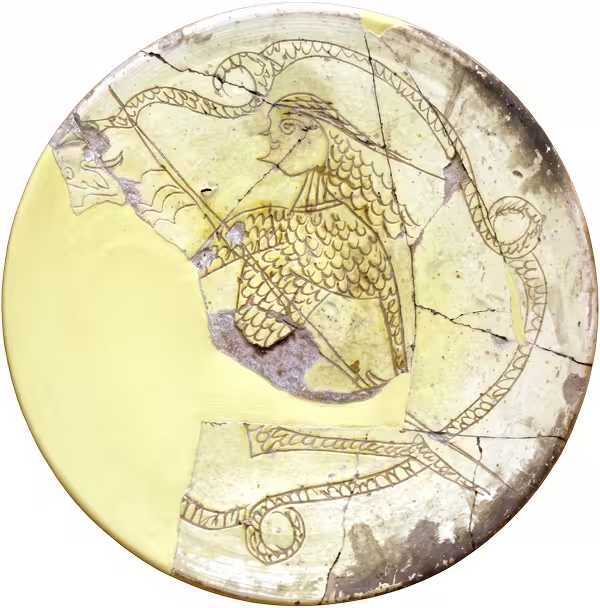
One episode has him battling a monstrous serpent, a scene scholars have compared to dragon-slaying traditions found across medieval literature. He eventually settles into a life of peace in a palace on the Euphrates, where the poem describes mosaic ceilings mixing Old Testament scenes with episodes from the Iliad, the Odyssey, and the life of Alexander the Great, before he dies there surrounded by his family.
Parallel: A Byzantine frontier hero with a Spanish cousin
Digenes Akritas is not entirely alone as a type, even if it is alone within Byzantine literature. The Castilian Poema de Mio Cid tells a similar kind of story from a similar kind of place: a frontier warrior operating in a zone where Christian and Muslim powers fought, negotiated, and occasionally intermarried. Both poems come out of societies where the border was porous rather than absolute, and both reflect it in their heroes: men who fight across a religious divide without the poem treating that divide as impassable. The comparison is useful less for the few plot similarities than for what it says about genre. True epic, in medieval Christian Europe, seems to have needed exactly this kind of frontier to grow in: a place loose enough from central authority and classical convention that vernacular heroic storytelling could take written form at all.
Why it survived
Digenes Akritas owes its survival to exactly the conditions that made it rare. Two of its oldest manuscripts were copied far from the Byzantine heartland, at the Grottaferrata monastery near Rome and in the Escorial library in Spain, which kept them out of reach of the conquests and fires that destroyed so much else. The surrounding Acritic cycle, the Song of Armouris and its smaller companion ballads, kept circulating independently in oral form, sung in Greek communities for centuries after Byzantium itself had fallen. Between the monasteries and the song tradition, Digenes Akritas had two separate routes through time, and it needed both. The manuscripts alone, fewer than a handful, could easily have been lost entirely.
After the frontier: when the vernacular turned to romance
Once the twelfth century had opened the door to vernacular narrative, Byzantine writers did not go on producing more epics. They went somewhere else with it. The thirteenth to fifteenth centuries, the Palaiologan period, saw a real boom in long vernacular verse narratives, but almost all of them are romances rather than epics: Kallimachos and Chrysorrhoe, Velthandros and Chrysantza, and Livistros and Rhodamne tell stories of courtship, magic, and separated lovers, built on the same fifteen-syllable verse as Digenes but aimed at a different kind of plot. Even the Byzantine Achilleid, which takes its hero from the most martial poem in the Greek tradition, recasts him as a courtly lover in a medieval romance rather than a warrior in an epic. The vernacular had found a permanent place in Byzantine literature by then. It simply never went back to writing epic. Digenes Akritas turned out to be a single, unrepeated crossing from frontier ballad into sustained heroic narrative, not the start of a tradition.
The epic’s afterlife did not stop at the end of Byzantium. Its feeling for nature and family loyalty fed directly into Erotokritos, the great Cretan romance of the seventeenth century, and through it into later Greek popular poetry. Centuries later, in 1955, a Greek Cypriot colonel named Georgios Grivas adopted “Digenis” as his nom de guerre when he launched the EOKA campaign against British rule, reaching back to the border fighter’s name as a symbol of resistance. It is a minor irony that a hero defined by mixed parentage ended up lending his name to a nationalist cause, but it says more about the twentieth century’s needs than about the poem itself.
A hero kept alive by song, not by school
Digenes Akritas left its deepest mark outside the manuscripts entirely. Long after scribes stopped copying the poem, Greek communities kept singing ballads about the hero’s last fight, a wrestling match against Charos, the folk personification of Death, an image that recurs across Greek folk art and sits alongside the dragon-slaying icons of Saints George and Theodore. Its feeling for nature and family loyalty also fed into Erotokritos, the great Cretan romance of the seventeenth century, and through it into later Greek popular poetry. One of the oldest manuscripts only resurfaced in 1868, found in the monastery of Sumela on the Black Sea coast, and that discovery is largely what brought the poem back to scholarly and literary attention at all. Centuries later, in 1955, a Greek Cypriot colonel named Georgios Grivas adopted “Digenis” as his nom de guerre for the EOKA campaign against British rule, reaching back to the border fighter’s name as a symbol of resistance, a minor irony given that the original hero’s whole identity rests on mixed, not purely Greek, parentage.
None of that has made Digenes Akritas a household name next to the Iliad, Beowulf, the Chanson de Roland, or the Poema de Mio Cid, and the reasons have more to do with circumstance than with the poem itself. It survives in a handful of disputed, incomplete manuscripts rather than one settled text. It stayed buried until the nineteenth century instead of being copied continuously through a school canon. And it is written in a form of Greek that most Greek speakers today still need help reading. The material was there for an international classic. It simply never had the centuries of institutional promotion that turned its Western counterparts into household names.
One text, carrying the weight of a genre
Digenes Akritas is often introduced as Byzantium’s only epic, as though that were simply a curiosity. The more precise picture is that Byzantium had an abundance of heroic material, a whole cycle of frontier ballads, and a long run of vernacular narrative poetry both before and after it, yet almost none of that output ever crystallized into epic specifically. Digenes Akritas is the single case where a court briefly willing to take vernacular storytelling seriously, a frontier society with centuries of oral material ready to be written down, and a transmission history lucky enough to place its oldest copies outside the empire’s own collapsing borders, all lined up at once. Take away any one of those conditions, and Byzantine literature would likely have left no epic at all, only ballads and romances either side of it.
Further reading
- Adam J. Goldwyn and Ingela Nilsson (eds.), Reading the Late Byzantine Romance: A Handbook (Cambridge University Press).
- Roderick Beaton and David Ricks (eds.), Digenes Akrites: New Approaches to Byzantine Heroic Poetry (Routledge).
- Elizabeth Jeffreys (ed. and trans.), Digenis Akritis: The Grottaferrata and Escorial Versions (Cambridge University Press).
- Christopher Livanos, “A Case Study in Byzantine Dragon-Slaying: Digenes and the Serpent,” Oral Tradition, vol. 26:1 (2011).
- “Digenes Akritas,” Oxford Dictionary of Byzantium.
- David Ricks (trans.), “The Song of Armouris,” in Byzantine Heroic Poetry.
Cover image credit: Sailko, CC BY-SA 3.0
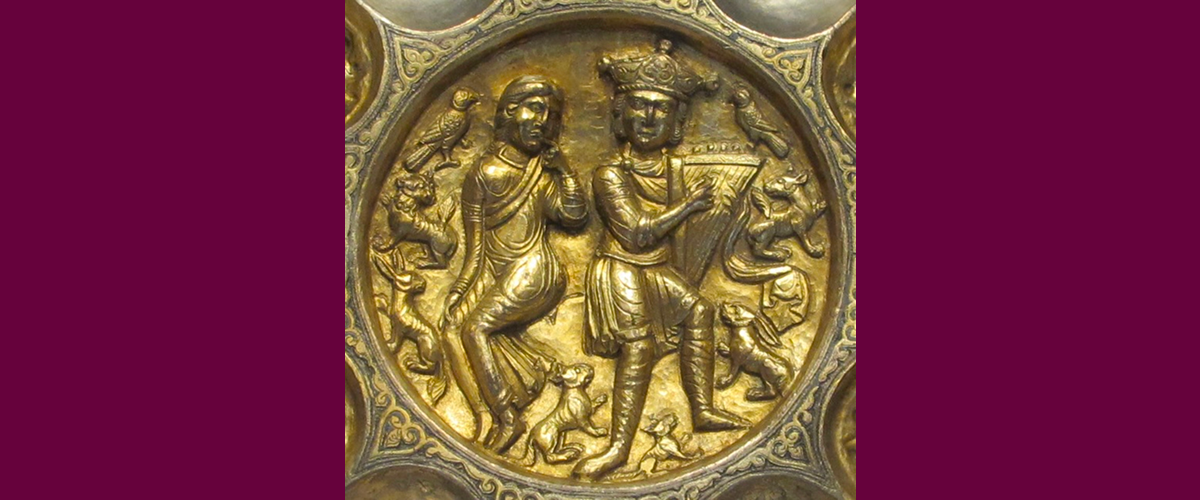
The Vilgort Byzantine cup in silver, gilding and black enamel, dates to the 12th or 13th century, and was produced either in the Armenian Kingdom of Cilicia or in Anatolia. Silver, gilding, black enamel. 12th-13th centuries. Discovered in 1925 in the village of Vilgort (East Urals), it is now in the State Hermitage museum, Saint Petersburg. The cup has been interprated as King David with his wife, or as Digenes Akritas with his wife Eudocia, playing the rota – a triangular psaltery, different from the modern harp. A similar cup, the Chernihiv cup, is hosted in the Museum of Historical Treasures of Ukraine.