Naxos, Cyclades: Byzantine Churches, Castles, and medieval Sites
Most visitors to Naxos never leave the coast. But inland, beyond the beaches that give the island its modern reputation, lies one of the richest concentrations of Byzantine heritage anywhere in Greece: a hilltop fortress that once served as the island’s capital, a valley of medieval churches dense enough to earn comparison with Mystras, and rare survivals of art from one of the most turbulent centuries in Byzantine history.
Naxos’s Byzantine story is not one of imperial patronage on the scale of Constantinople or Thessaloniki. It is a story of an island community organizing itself, generation after generation, against the threat of raiders from the sea — and building, in the relative safety of its interior, an extraordinary density of small, locally funded churches that still stand today, many with their original frescoes intact.
Byzantine Naxos – in brief
Location
Cyclades, Aegean Sea — the largest Cycladic island
Byzantine administrative unit
Theme of the Aegean Sea (established c. 843)
Byzantine-era capital
Kastro Apalirou, an inland hilltop fortress-settlement
Main threat
Arab raids, especially from the Emirate of Crete (824–961)
Church-building heartland
The Tragea and Sagri valleys, nicknamed “Little Mystras”
Byzantine churches surviving
Roughly 200 documented, about 120 with original frescoes
End of Byzantine rule
1207 — conquest by Marco Sanudo, founding the Venetian Duchy of Naxos
Today
Part of Greece; historic monuments concentrated inland around Chalki, Sagri, and Apiranthos
Early Byzantine Naxos: Raiders, refuge, and the rise of Kastro Apalirou
Naxos entered the Byzantine period as a peaceful agricultural island, but the seventh century changed that decisively. As Arab fleets began contesting Byzantine control of the eastern Mediterranean, communications between Constantinople and the western half of the empire were disrupted, and the Aegean islands found themselves newly exposed. Naxos’s response was to build Kastro Apalirou, a fortified hilltop settlement in the island’s south-central interior — constructed in the 7th century specifically to buttress the Aegean’s defenses, and positioned to control both the island’s most productive farmland and the sea lanes running between Naxos, Paros, and Ios, part of the wider shipping route linking Crete to Constantinople.
The island’s administrative and military weight in this period should not be underestimated. In 727, the fleets of mainland Greece and the Cycladic islands — Naxos presumably among them — rose in rebellion against the iconoclast emperor Leo III and laid siege to Constantinople itself, a revolt that ultimately failed but signals just how much naval and economic clout the islands of this region carried. By the mid-9th century, Naxos had been folded into the newly created Theme of the Aegean Sea, one of the Byzantine navy’s three dedicated naval provinces, reflecting the island’s ongoing strategic value.
The threat that had prompted Apalirou’s construction did not fade quickly. Throughout the 9th and 10th centuries, the Cyclades faced repeated raids from the Emirate of Crete (824–961), an Arab state established after the conquest of Crete that used the island as a base for raiding across the Aegean; Naxos is recorded as occasionally paying tribute to avoid worse treatment. The cultural contact was not purely hostile — traces of Muslim artistic influence have been identified in some of Naxos’s 10th-century frescoes, a reminder that even adversarial relationships in the medieval Mediterranean left their mark on art and material culture.
A Rare Survival
Two of Naxos’s oldest churches — Panagia Drosiani near Moni and Agia Kyriaki near Apiranthos — preserve fresco fragments from the Iconoclast period (roughly the early 8th to mid-9th century), when Byzantine authorities banned figural religious imagery and had existing images destroyed across most of the empire. Because Naxos sat at a relative remove from Constantinople, some of this aniconic, non-figurative decoration survived here when it was overpainted or lost almost everywhere else — making the island an unusually valuable window into a period of Byzantine art that is otherwise known mostly through written polemic rather than surviving objects, with the exception of the mosaic program of Hagia Eirene.
Middle Byzantine Naxos: The age of the village churches
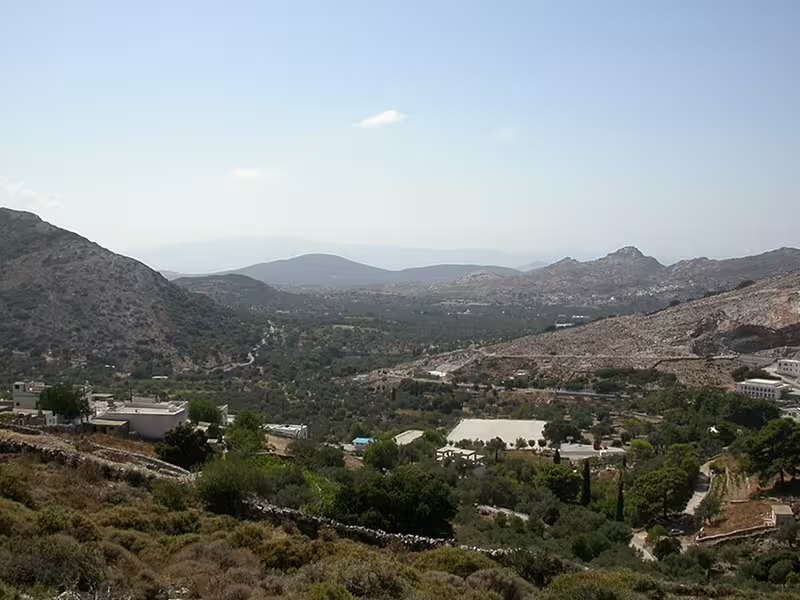
As Arab raiding pressure eased following the Byzantine reconquest of Crete in 961, Naxos entered a long period of comparative stability that produced its most distinctive legacy: an extraordinary density of small, locally funded churches, concentrated above all in the inland Tragea and Sagri valleys. This cluster of churches, monasteries, and fortified towers packed into a relatively small stretch of farming countryside has earned an informal nickname among specialists — “Little Mystras” — in reference to the far more famous Byzantine hill-town in the Peloponnese, though the comparison speaks to density and character rather than scale or imperial patronage.
Estimates of exactly how many churches survive vary depending on what is being counted. Popular tourism sources often cite “500 churches” on Naxos, but that figure appears to include post-Byzantine and modern chapels built well after the Byzantine period ended. A more conservative, better-sourced estimate puts the number of Byzantine-era churches at roughly 200, of which about 120 retain some or all of their original frescoes — still an exceptional concentration for an island of this size, and one of the richest in Greece outside major urban centers.
Architecturally, the island’s churches fall into two broad categories: small, single-nave, barrel-vaulted chapels scattered across the rural landscape, and larger domed cross-in-square churches clustered near the old inland settlements of Sagri, Potamia, Chalki, and Moni. The domed basilicas tend to be older, with the earliest examples dating to the 6th century, while the cross-in-square form — the same architectural family as the Chora Monastery and countless other middle Byzantine churches across the empire — became the dominant type from roughly the 9th century onward as the island’s confidence and prosperity grew.
The end of Byzantine rule: The Venetian Duchy of Naxos
Naxos’s Byzantine period ended not through Ottoman conquest, as in most of the empire, but through the fallout of the Fourth Crusade. In 1207, the Venetian nobleman Marco Sanudo, taking advantage of the collapse of centralized Byzantine authority after the sack of Constantinople in 1204, seized Naxos and made it the seat of a new maritime state, the Duchy of the Archipelago (commonly known as the Duchy of Naxos). Kastro Apalirou, the island’s Byzantine-era capital and stronghold, was abandoned around this time as the center of power shifted to a new fortified town — the kastro that still dominates the skyline of modern Naxos Town today, built by the Venetians rather than the Byzantines. Byzantine Naxos, in institutional terms, was over; but the churches its communities had built over the preceding six centuries remained, and largely still stand.
Byzantine and medieval monuments of Naxos
Naxos’s Byzantine heritage is scattered across the island’s interior rather than concentrated in a single site, which makes it one of the most rewarding — and most overlooked — destinations in Greece for anyone willing to head inland. Below are the essential sites, with links to our dedicated articles on each.
The Castles
Kastro Apalirou
The island’s Byzantine-era capital, built in the 7th century atop a steep, naturally defensible hill in south-central Naxos. Far more than a simple refuge fort, recent Norwegian-led archaeological survey work (2010–2013) has shown it functioned as a genuine fortified town with a substantial resident population for several centuries, before being abandoned after the Venetian conquest of 1207.
→ Read more: Kastro Apalirou, the lost Byzantine capital of Naxos
Two further fortifications from this period are worth seeking out, though they tell different stories.
Kalogeros Kastro (“Monks’ Castle”), on a steep, hard-to-reach hill above Apollonas at the island’s northern tip, is genuinely Byzantine through and through: built around the 7th to early 8th century, contemporary with Apalirou itself, it functioned as a watch-post and refuge overlooking the sea route from Constantinople via Chios toward Naxos, relaying warnings of approaching raiders by smoke and fire signal to neighboring posts. It remained in continuous use throughout the Byzantine period and saw only occasional use afterward.
Apano Kastro (“Upper Castle”), west of the Tragea plain, has a longer but more layered history — first fortified in antiquity, then refortified in Byzantine times specifically to shelter the Tragea valley’s inhabitants from Saracen raids — but most of what stands today was rebuilt by the Venetians in the 13th and 14th centuries after Marco Sanudo’s conquest, making its visible remains predominantly Venetian rather than Byzantine, despite the site’s much older defensive role.
The Churches of the Tragea and Sagri
Panagia Protothronos
Located in the village of Chalki, at the heart of the Tragea, this is among the most architecturally important churches on the island: an early Christian basilica later converted into a middle Byzantine cross-in-square church, with its original synthronon and episcopal throne still preserved in the sanctuary — physical evidence that it once served as a cathedral. Tradition holds it has been in continuous liturgical use since at least 1052.
→ Read more: Panagia Protothronos, history, architecture and frescoes
[Internal link placeholder: please confirm the URL of your third Naxos monument article so it can be added here in its proper place — likely alongside Panagia Drosiani or another Tragea/Sagri church.]
Beyond these, the Tragea and Sagri valleys hold a remarkable cluster of further sites: Panagia Drosiani near Moni, one of the island’s oldest churches and the setting for the aniconic frescoes discussed above; the church of Agios Artemios at Stavros, a simple single-room church with a dome which preserves a rare iconoclastic decoration; the fortified 6th-century monastery of Christ Photodotis near Danakos, generally considered the island’s oldest monastic foundation; Agioi Apostoloi, a rare two-story domed church of the 10th–11th century unique among Naxos’s Byzantine buildings; and Agios Georgios Diasoritis, a domed cruciform church of the same period known for its unusually rich fresco cycle.
→ Discover the Church of Agios Georgios Diasoritis, jewel of the 11th century
Elsewhere on the Island
Byzantine churches are scattered well beyond the Tragea core. Near Apiranthos, Agia Kyriaki preserves further Iconoclast-period aniconic decoration; in the Melanes valley, Agios Georgios combines early Christian foundations with a 12th–13th century rebuilding; and in Episkopi, the church of Agios Mamas, dating to the 10th–11th century, is thought to preserve the memory of an early Byzantine bishopric seat.
Frequently Asked Questions
What was the Byzantine capital of Naxos?
Kastro Apalirou, an inland hilltop fortress-settlement built in the 7th century, served as the island’s administrative and defensive center throughout most of the Byzantine period, until it was abandoned after the Venetian conquest of 1207.
How many Byzantine churches are there on Naxos?
Estimates vary. Popular sources often cite around 500 religious buildings, but that figure includes post-Byzantine and modern chapels. A more conservative estimate for genuinely Byzantine-era churches is around 200, of which roughly 120 retain original frescoes — still an exceptional concentration for a single island.
Why is the Tragea valley called “Little Mystras”?
The nickname refers to the density and Byzantine character of the churches, chapels, and towers packed into the Tragea and neighboring Sagri valley — a comparison to the famous Byzantine hill-town of Mystras in the Peloponnese, based on atmosphere and concentration rather than scale or imperial status.
When did Byzantine rule over Naxos end?
In 1207, when the Venetian nobleman Marco Sanudo conquered the island in the aftermath of the Fourth Crusade and founded the Duchy of the Archipelago, commonly known as the Duchy of Naxos.
What threatened Byzantine Naxos most?
Arab raiding, particularly from the Emirate of Crete (824–961), which used its base on nearby Crete to raid across the Cyclades. This threat directly prompted the construction of Kastro Apalirou and the island’s other Byzantine fortifications.
Sources
- David Hill, Håkon Roland, and Knut Ødegård (eds.), Naxos and the Byzantine Aegean: Insular Responses to Regional Change, Papers and Monographs from the Norwegian Institute at Athens, vol. 7 (Athens, 2020).
- “Naxos (island),” Wikipedia, accessed July 2026.
- “Aegean Sea (theme)” and “Samos (theme),” Wikipedia, accessed July 2026.
- “Church of Panagia Protothronos,” Wikipedia, accessed July 2026.
- Naxos and the Small Cyclades, “Byzantine Period” and “Keeping the Faith: Exploring Naxos’ Byzantine Legacy,” naxos.gr.
- Topoguide.gr, “86 Churches of Naxos,” topoguide.gr.
- Naxos Tours, “Byzantine Naxos,” naxostours.net.
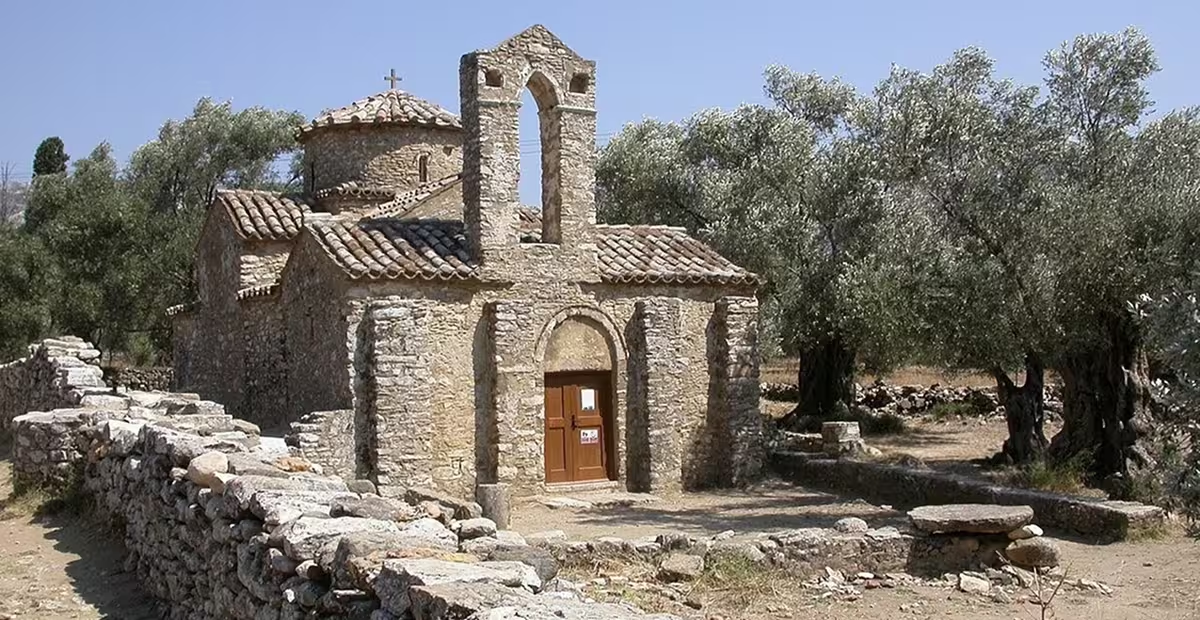
Cover image credits: Church of Agios Georgios Diasoritis, © Stepanps, CC by-SA 4.0