Byzantine Fashion: From imperial dress to monastic robes
The Byzantine Empire, spanning more than a thousand years from the 4th to the 15th century, expressed its wealth, faith, and political ideology as much through dress as through architecture or art. At one end of the social spectrum stood the emperor, wrapped in gold and gem-studded silk that proclaimed his divinely sanctioned rule; at the other, monks and nuns wore unadorned black wool as a deliberate rejection of that same worldly splendor. Between them lay the aristocracy, the clergy, and the ordinary people whose more modest garments still carried the empire’s love of color, pattern, and craftsmanship. Remarkably, several individuals crossed this divide within a single lifetime — Byzantine funerary art preserves more than one powerful courtier or ruler who is shown twice: once in the silk and gold of office, and once in the plain habit of the cloister he retired to before death.
Quick facts
Key imperial garments:
loros, divetesion, chlamys, skaramangion, tablion
Colors of authority:
Tyrian (murex) purple for the emperor; kermes red as a costlier alternative available more widely
Primary written source:
the Book of Ceremonies (De Ceremoniis) of Constantine VII Porphyrogennetos, 10th century
Monastic garments:
rason (tunic), mandyas (cloak), koukoulion (hood) — black wool or linen, worn by monks and nuns alike
Rare surviving textiles:
fragments of elite female dress excavated at Mystras — among the only physical remains of Late Byzantine court clothing
Splendor of the Byzantine imperial court
The Byzantine court was the empire’s stage for visualizing power, and dress was its most immediate language. Emperors and empresses wore garments of silk and gold thread, sewn with pearls and precious stones, whose form and color were regulated with the same seriousness as court ceremonial itself. The imperial attire evolved over the long history of the Byzantine Empire, but its main characteristics remained consistent and are well known from numerous artworks, including miniatures, mosaics, frescoes, and even surviving pieces. Our clearest window onto this world is the Book of Ceremonies, compiled under Constantine VII in the 10th century, which describes in detail which garments were worn for which feast, procession, or reception — dress here was not personal taste but state protocol.
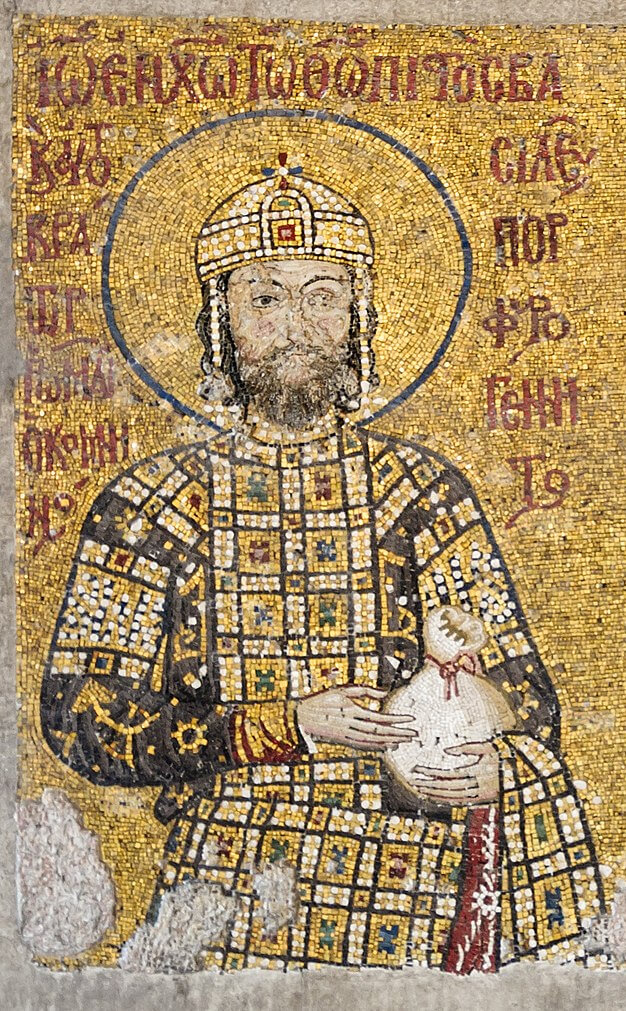
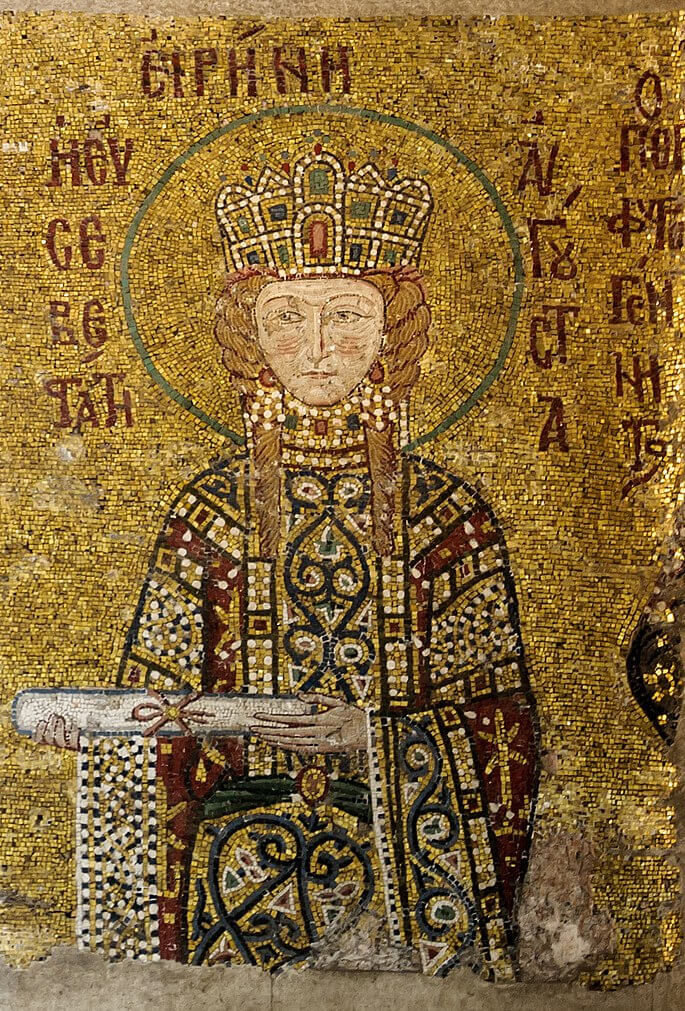
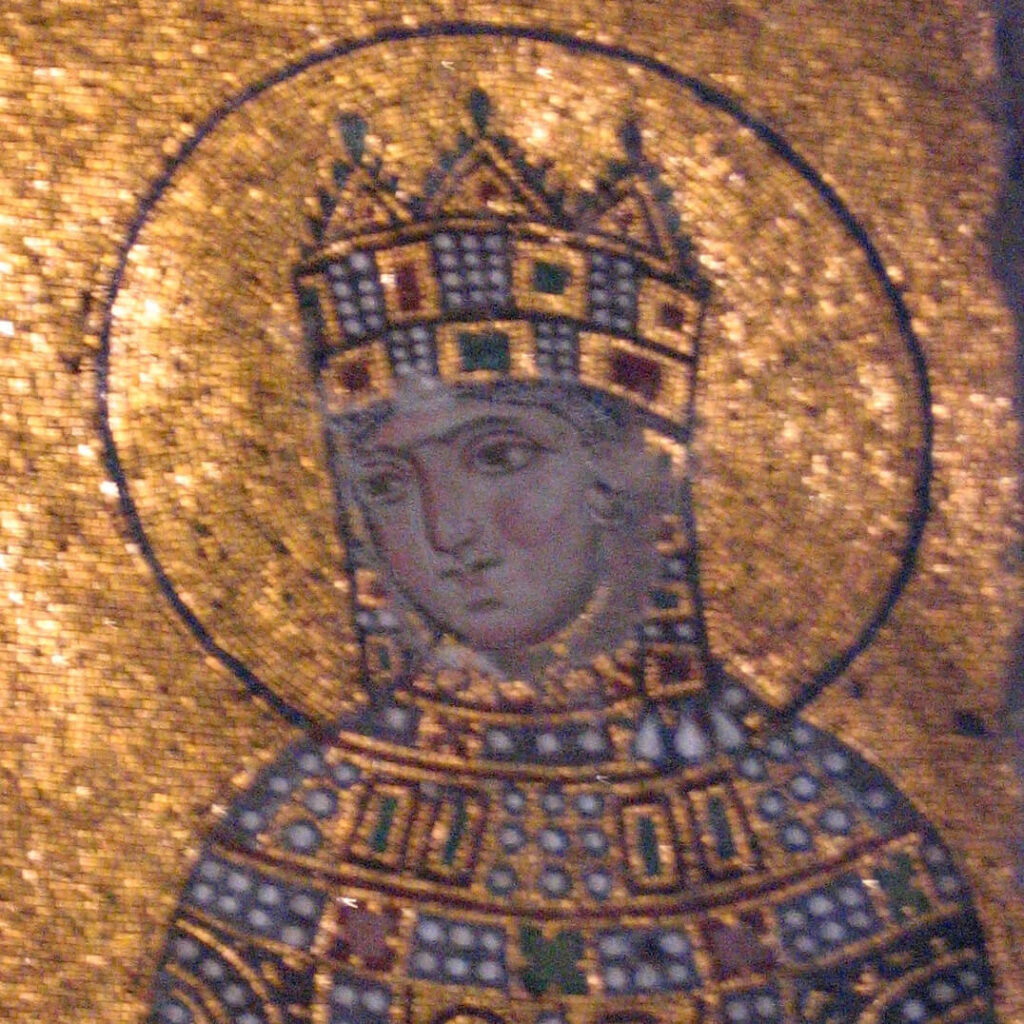
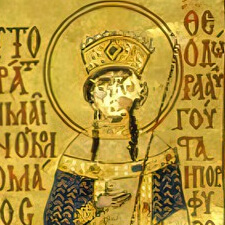
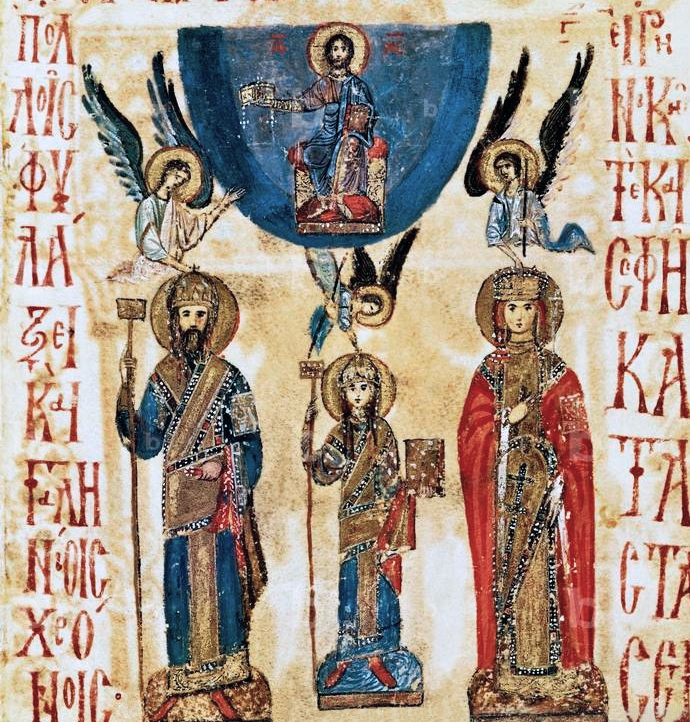
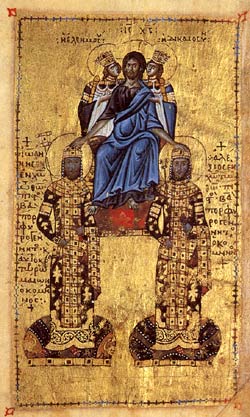
The single most recognizable piece of this wardrobe was the loros, a long, narrow, heavily bejeweled scarf reserved for the emperor, empress, and a small circle of the most senior officials. It developed out of the trabea triumphalis, the ceremonial garment of Roman consuls — a direct visual claim, centuries after the Western consulship had lapsed, that the Byzantine emperor was heir to Roman authority. The loros was wound across the chest, tightened at the waist, and its end draped over the left forearm; by the Middle Byzantine period a second, “pullover” style existed alongside the older wrapped form, and mosaic evidence — such as the paired portraits of Constantine IX Monomachos and Zoe in Hagia Sophia, or of John II and his wife Irene — shows that empresses wore an equally elaborate version, sometimes visually indistinguishable from the emperor’s own. Beneath the loros, emperor and empress wore the divetesion, a long silk ceremonial tunic, sometimes replaced in the Late Byzantine period by a similar garment called the sakkos.
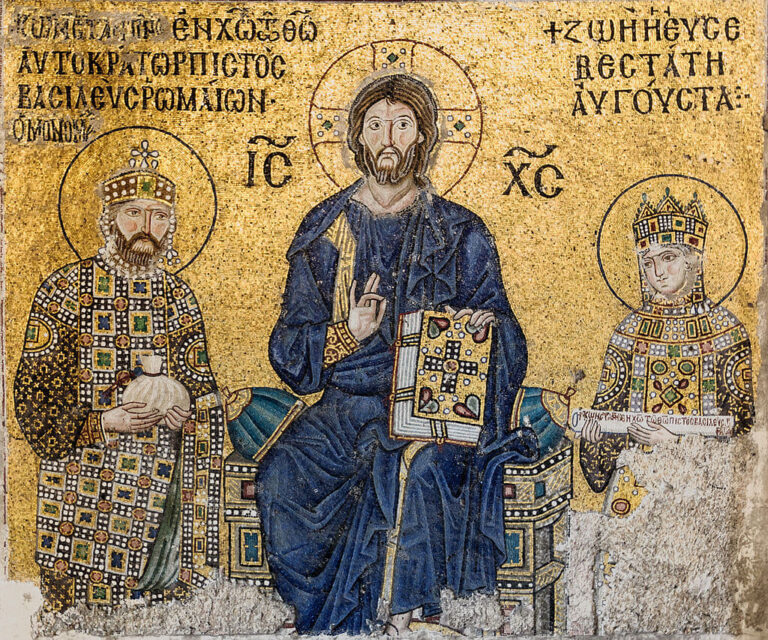
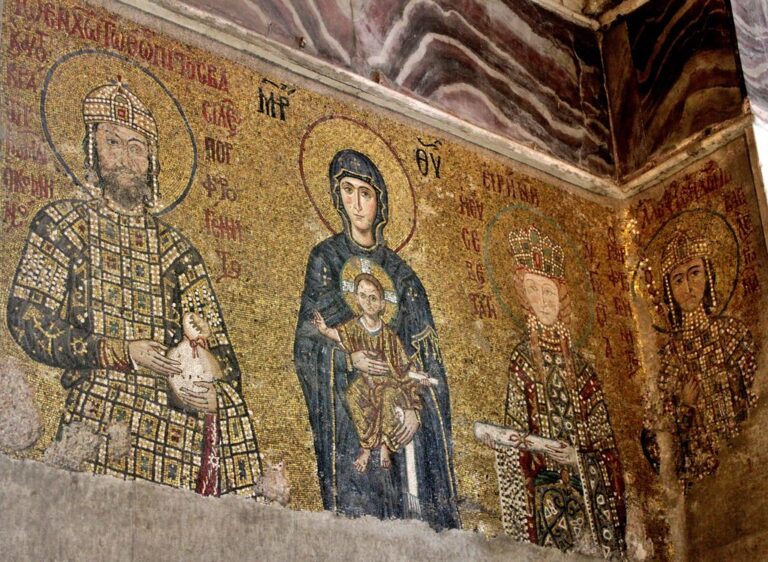
The less formal (though still highly ceremonial) alternative to the loros costume was the chlamys, a cloak fastened at the shoulder and marked with a tablion, a rectangular panel of contrasting color and rich decoration sewn onto the front — originally a Roman senatorial and consular device, absorbed into imperial and high-official dress. The chlamys and its tablion were worn far more often than the loros, which was reserved for the highest feasts of the liturgical and imperial calendar.
The emperor’s wardrobe
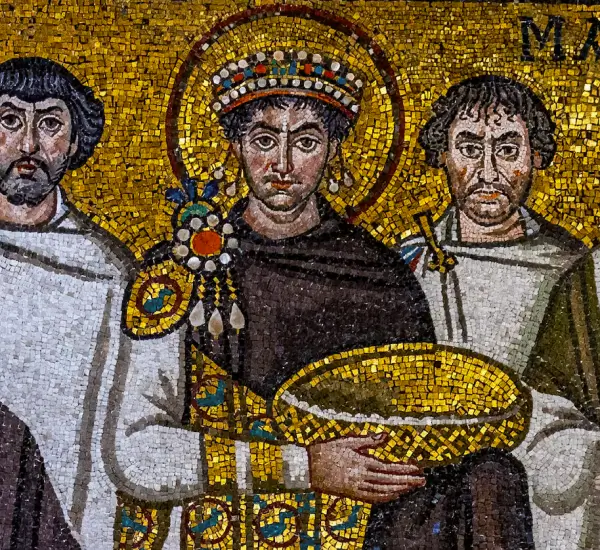
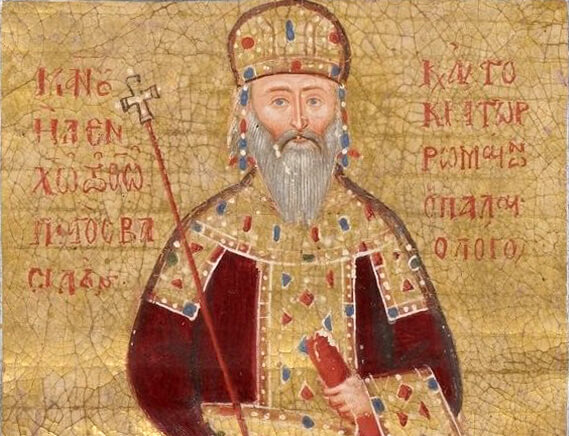
For the emperor, the loros was wound across the chest, tightened at the waist, with its end draped over the left forearm. By the Middle Byzantine period a second, “pullover” style existed alongside this older wrapped form. The less formal (though still highly ceremonial) alternative to the full loros costume was the chlamys, a cloak fastened at the shoulder and marked with a tablion, a rectangular panel of contrasting color and rich decoration sewn onto the front — originally a Roman senatorial and consular device, absorbed into imperial and high-official dress. The chlamys and tablion were worn far more often than the full loros, which was reserved for the highest feasts of the liturgical and imperial calendar.
The empress’s wardrobe
Empresses wore their own version of the loros, and at the most formal level of court dress the two were strikingly close: mosaic evidence — such as the paired portraits of Constantine IX Monomachos and Zoe in Hagia Sophia, or of Nicephoros III Botaneiates and Maria of Alania, illustrated below — shows empress and emperor in matching loros costumes, at times visually near-indistinguishable in silhouette. Where the empress’s dress diverged was largely in accessory and headdress: a jeweled collar-ornament called the maniakion is attested for empresses without a clear male equivalent, and empresses’ hair was conventionally covered or bound beneath the crown in a way male imperial portraiture does not show. The thorakion — a term whose meaning is itself debated by specialists (see callout above) — has been associated by some modern scholars with a shield-shaped panel formed by the train of the empress’s loros specifically, though this identification remains uncertain rather than settled.


Color, dye, and the law of purple
Byzantine imperial dress was not simply expensive — its color was, at times, legally restricted. The deepest, most prized purple came from murex (or Tyrian) dye, extracted in minute quantities from the glands of sea snails and requiring many thousands of mollusks to produce even a small amount of cloth; its cost and rarity made it a natural marker of the very top of the social hierarchy, and its association with the imperial office is the origin of the phrase “born to the purple” (porphyrogennetos), applied to children born to a reigning emperor. A less costly red, derived from the kermes insect, offered a related but distinct color available to a wider circle of the wealthy without infringing on the emperor’s exclusive shade.
Byzantine regulatory texts, including the 10th-century Book of the Eparch, governed the guilds that produced imperial silk and restricted the export or sale of the finest grades of purple cloth outside the empire — a policy that made Byzantine silk both a diplomatic gift of the highest order and a closely guarded state resource. The main production centers were Constantinople, but also Thebes and Boetia in the middle Byzantine times.
-
The so-called Dalmatic of Charlemagne in the Vatican
The dalmatic of Charlemagne in the Vatican is likely an imperial garment from Constantinople, dated to the 11th or 14th century.

Noble attire: the opulence of the Byzantine aristocracy
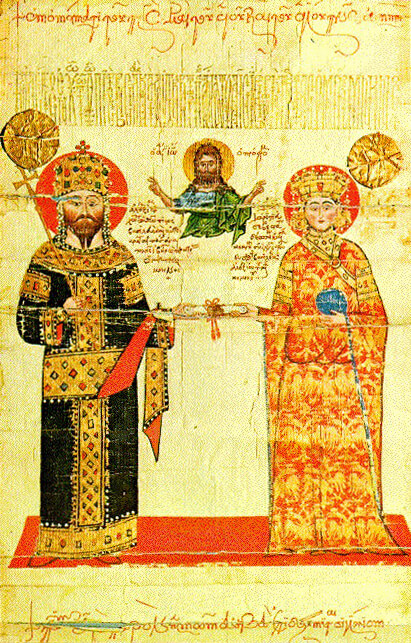
The Byzantine aristocracy embraced its own version of imperial splendor, just below the threshold reserved for the emperor. Noblemen wore fine tunics and cloaks; noblewomen wore elaborate gowns and headdresses; both sexes displayed gold, silver, and gemstone jewelry as a visible marker of rank. Silk, produced and exported by the empire itself, was the fabric of choice, worked into intricate patterns that reflected the same craftsmanship visible in Byzantine mosaic and manuscript art. The donor portraits of Alexios Apokaukos and of Theodoros Metochites at the Chora Church are among the best-preserved examples of this aristocratic material culture.

Donor portrait of Alexios Apokaukos in a late Byzantine manuscript, early 14th century 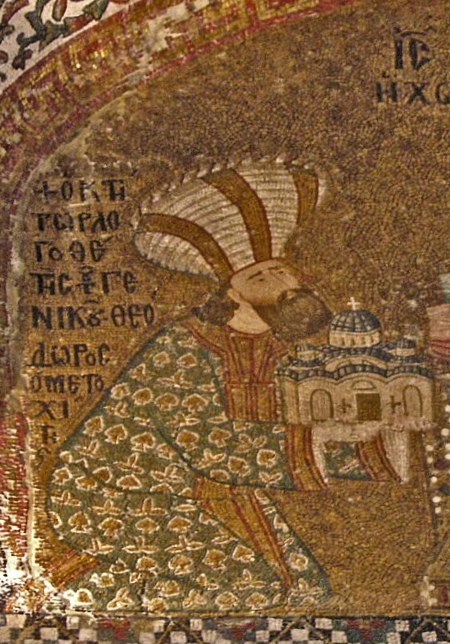
Mosaic depicting Theodoros Metochites offering the Chora Church to Christ. © Gryffindor, CC by-SA 4.0
Fashion at court shifted markedly in the empire’s final centuries, when headdresses in particular took on increasingly elaborate, Eastern-influenced forms. The tall, conical hat associated with Andronikos I Komnenos in the 12th century is often cited as an early instance of this trend — though this specific attribution rests on later literary tradition rather than a securely dated contemporary image, so it’s worth treating as reported rather than certain. By the 14th century the trend is unambiguous in the visual record: Theodoros Metochites is shown at Chora in a broad, turban-like hat far removed from earlier imperial headwear, and similar “melon”-shaped hats appear on members of the imperial family itself in the last Palaiologan generations, including the aristocrat Manuel Laskaris Chatzikis, whose funerary portrait at the Pantanassa monastery in Mystras shows him wearing a hat otherwise associated only with Emperor John VIII Palaiologos and his immediate family — a striking visual claim to proximity to the throne.

Jewelry, meanwhile, remained a constant across the aristocratic centuries — rings, pendants, and bracelets in gold and enamel that fused the empire’s Greco-Roman inheritance with Eastern and Western decorative influences absorbed over its long history.

Gold ring, 10th century 
Gold pendant, 7th to 9th century
Foreign influences on Byzantine fashion and clothing
Eastern and Islamic influence
Centuries of contact along the empire’s frontiers left a visible mark on Byzantine dress. Exchange with the Islamic world was especially significant: while Byzantium shaped early Islamic art during the formative period of the caliphate, the traffic ran increasingly in the other direction from the 8th century onward, as Islamic decorative motifs and garment forms filtered into Byzantine fashion. Kaftans and turban-like headdresses, inspired by textiles and dress from the Islamic world, gained visible popularity from the Middle Byzantine period onward, particularly in the empire’s border regions, and by the Late Byzantine period these orientalizing headdresses had become a prominent feature of elite dress at the very center of the court.
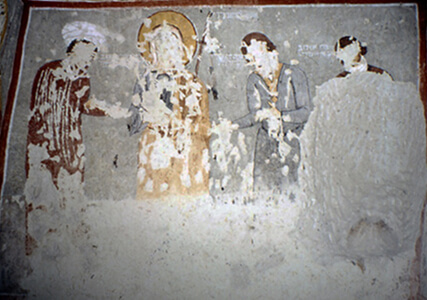
Portrait of donor Theognostos wearing a turban on the left, fresco from ca. 1050, çarikli kilise, Göreme, Cappadocia 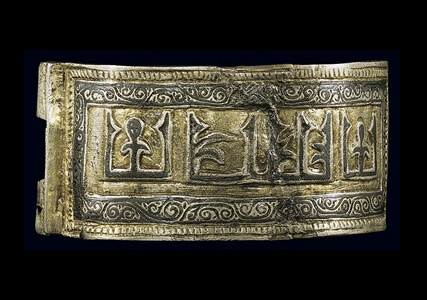
Silver gild and niello bracelet with repoussé pseudo-arabic motifs in scrollwork frame, 11th century, Benaki museum 
Theodoros Metochites wearing an extravagant headdress, mosaic of the Chora Church in Istanbul, 14th century
Western influence after the Fourth Crusade
Influence flowed from the Latin West as well, and it intensified sharply after the Fourth Crusade (1204), when Constantinople itself fell to Latin forces and much of the empire’s territory was carved into Frankish and Venetian states. Byzantine scholarship on this period — notably the work of Maria Parani — documents that Byzantines adopted Western garments and headdresses as everyday, non-ceremonial wear, contemporary writers like Nikephoros Gregoras among the sources for this. The phenomenon was most pronounced precisely where Frankish or Venetian rule was most direct and durable: Crete under Venice and Cyprus under Frankish and then Venetian rule are the best-documented cases.
Mystras offers a Byzantine-ruled example of the same pattern. The city began as a Frankish castle, built in 1249 by the crusader William II of Villehardouin, before reverting to Byzantine control in 1262 and eventually becoming the Despotate of the Morea’s capital. In the despotate’s final flourishing under the Palaiologan despots, local textile production had declined enough that the Moreot elite imported much of their luxury clothing directly from Venetian and Florentine merchants — a direct, concrete channel of Western fashion into the Byzantine court’s own wardrobe, at the same court that produced the surviving textile fragments discussed below.
Sacred vestments: Byzantine ecclesiastical fashion
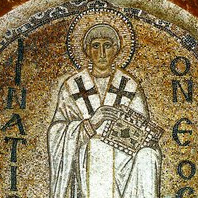
Religion played a crucial role in Byzantine society, and this influence extended to fashion. Clergy and religious figures wore distinctive garments that reflected their spiritual status.
Bishops and priests wore elaborate vestments adorned with religious symbols and embroidery. These garments were not only functional but also served as visual representations of the wearer’s spiritual authority. Seeing ecclesiastical attire as fixed in time would be wrong, as it also witnessed significant changes accompanying the evolution of the liturgy.
One of the most recognizable religious garments was the omophorion, a long, narrow strip of cloth worn by bishops. The omophorion was decorated with crosses and other religious symbols and was draped over the shoulders and around the neck. While this garment was a powerful symbol of spiritual leadership in the first centuries of Christianity, in the Eastern Church it began to be worn by bishops from the 11th century onwards.
Monks and nuns were also a common sight in Byzantium, where they were particularly revered. Monastic dress stood in deliberate contrast to both imperial and clerical splendor. Unlike the Latin West, Byzantium had no distinct monastic orders — individual monasteries followed broadly similar rules, producing a relatively uniform ascetic dress across the empire.
Monks wore a black tunic (rason) as a sign of repentance, with the mandyas over it, and higher-ranking monks added the analavos, a cross-shaped vestment symbolizing spiritual crucifixion. Those who took the Great Schema — the highest monastic rank — wore garments elaborately inscribed with crosses and prayers. A simple hood (koukoulion) and belt (zōstēr) completed the habit; all of it was black wool or linen, with minimal or no footwear, in keeping with a discipline of strict asceticism.
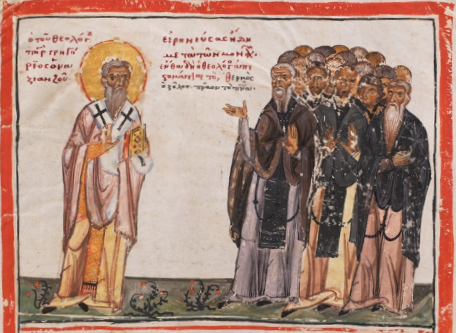
Nuns wore the same black rason, an outer cloak (mandyas), and a veil, sometimes layered with a longer veil called the epikalymma.
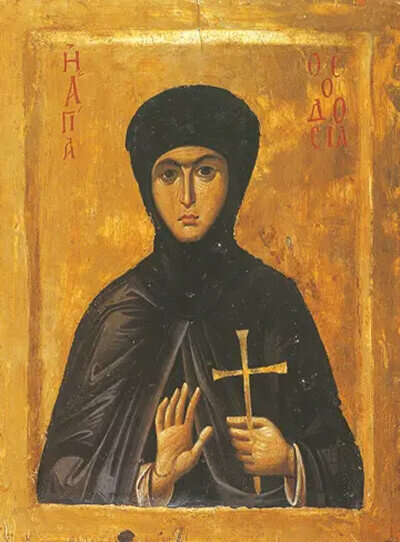
Icon depicting Saint Theodosia, monastery Saint Catherine in Sinai, Egypt, 13th century 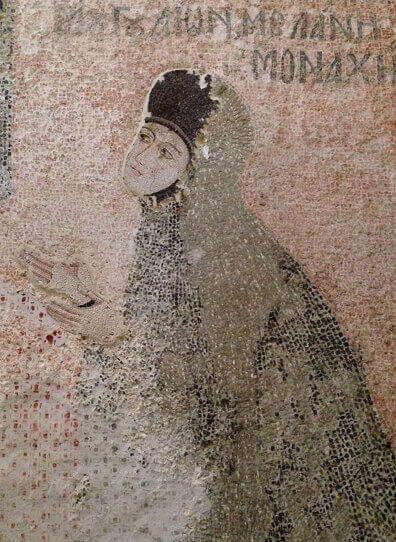
Mosaic in the Chora Church in Istanbul depicting nun Melane, formerly Maria Palaiologina, 13th century 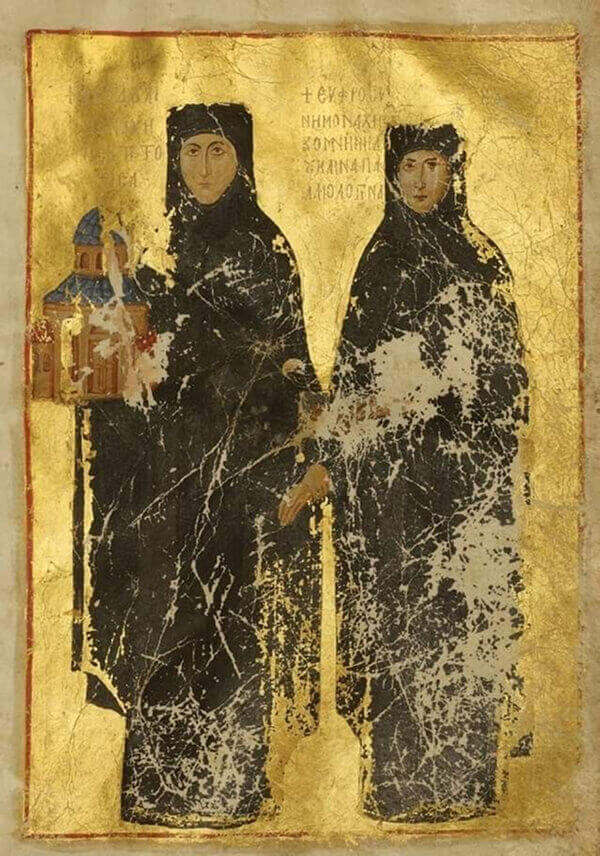
Theodora and her daughter Euphrosyne, Lincoln College Typicon, 14th century
Two wardrobes, one life: the funerary portraits
Nowhere is the gap between imperial splendor and monastic austerity captured more directly than in the funerary art of Byzantium’s last two centuries, when it became common for powerful men and women to take monastic vows shortly before death — and, in a handful of remarkable cases, to be commemorated in both identities at once.
At the Chora Church in Constantinople, the tomb of Michael Tornikes, Grand Constable under Andronikos II, and his wife shows the couple twice: once in the fine dress of the Byzantine court, and again — labeled by inscription as “the same person, monk Makarios” and “the same person, nun Eugenia” — in the plain habit they took at the end of their lives. The church’s founder himself, Theodore Metochites, lived the same arc without a double portrait to record it: shown in his famous donor mosaic in the extravagant dress and turban-like hat described above, he was in reality one of the wealthiest and most powerful men of his age as Andronikos II’s chief minister — until his patron’s fall stripped him of his fortune and sent him into exile. He returned to Constantinople only to retire to the monastery he himself had restored, taking the monastic name Theoleptos and dying there in 1332.
The theme recurs even more explicitly in manuscript art. A well-known miniature in a Paris manuscript (Paris. gr. 1242, fol. 123v) shows the emperor John VI Kantakouzenos twice on the same page: enthroned in full imperial dress, and — following his abdication in 1354 — in the black habit of the monk Ioasaph, the name he took on entering religious life. Few images make the empire’s dual language of dress, majesty and humility side by side, as literal as this one.
The Peloponnese offers a further example. Theodore I Palaiologos, despot of the Morea and son of Emperor John V, took monastic vows under the name Theodoret shortly before his death in 1407 and was buried in the northwest chapel of the Church of the Hodegetria (the Aphentiko) at the Brontochion Monastery in Mystras — a chapel whose decoration was explicitly built around its function as a mausoleum.
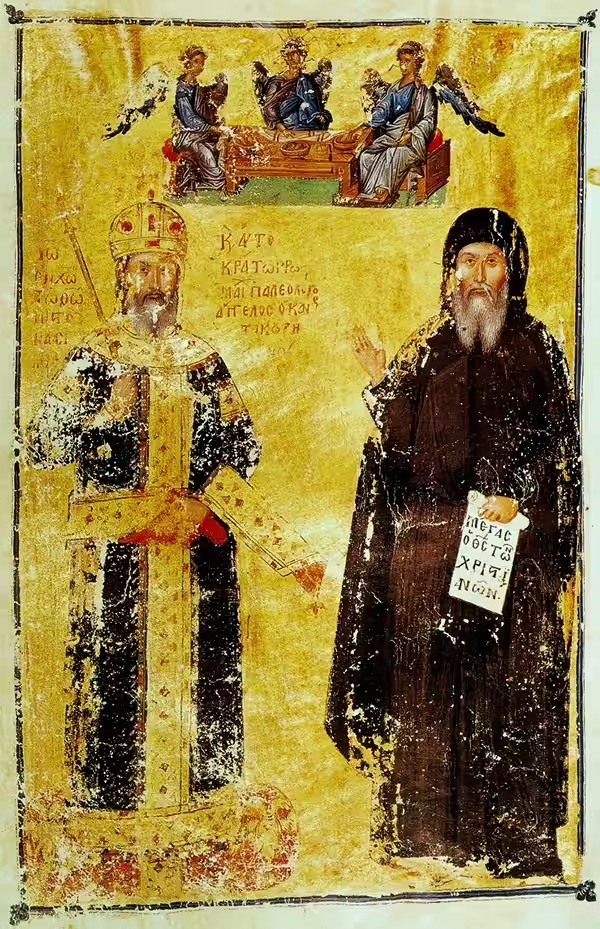
John VI Cantacuzenus as emperor and monk, 14th century illumination from the Paris Manuscript 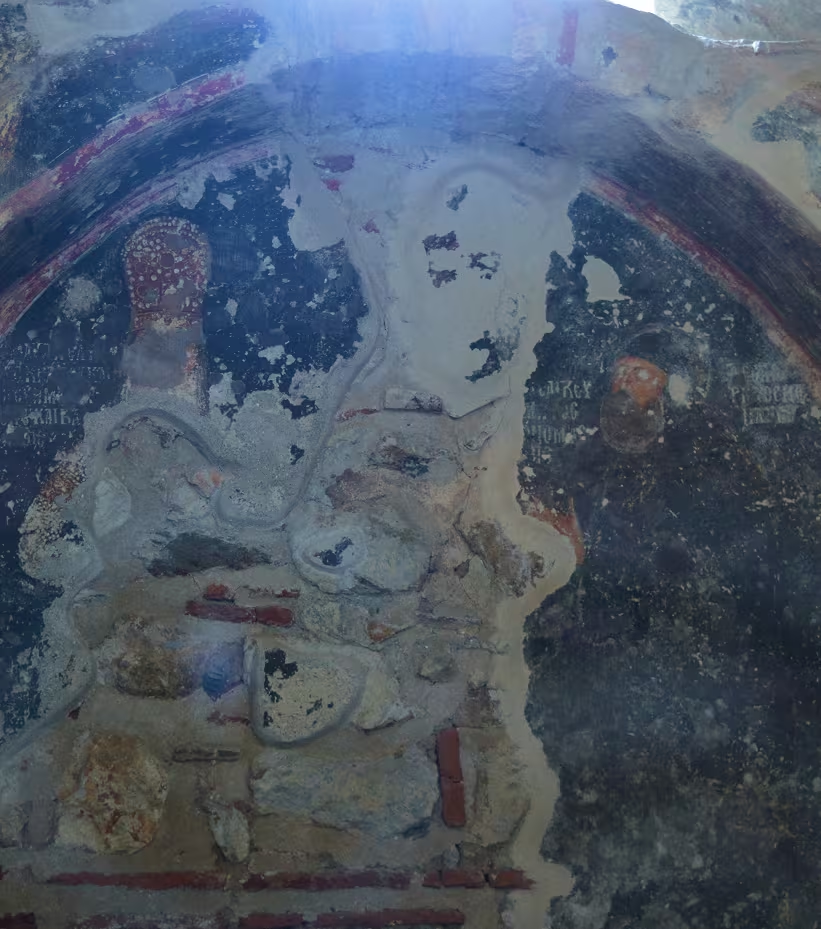
Funerary fresco in the Brontochion Monastery in Mystras, depicting Theodore I Palaiologos as a despot and a monk © Byzantine World
The fabric of daily life: Everyday wear in Byzantium.
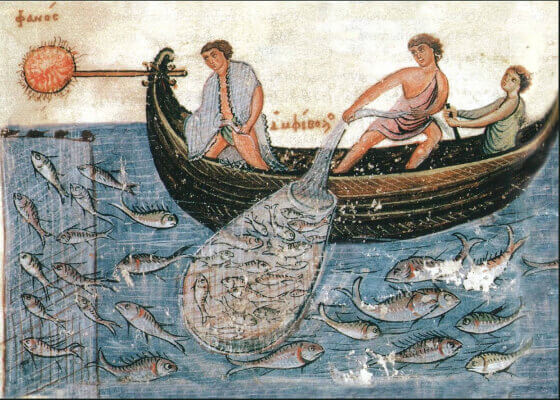
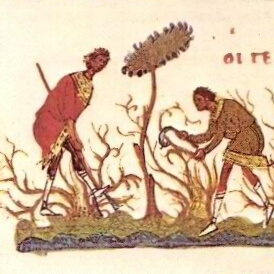
Away from the court and the cloister, most Byzantines dressed for practicality. Commoners wore simple tunics, cloaks, and dresses of linen, wool, and cotton, typically dyed in earthy tones and far less ornate than elite dress. Even so, everyday clothing carried the same Byzantine instinct for detail: garments were embroidered where budgets allowed, and belts, brooches, and pins added a note of personal decoration to otherwise plain outfits. Miniatures of farmers, fishermen, and other working Byzantines — such as those preserved in the Skylitzes manuscript — remain among the best visual evidence for this largely undocumented end of the social spectrum.

Material evidence: the Mystras textile fragments
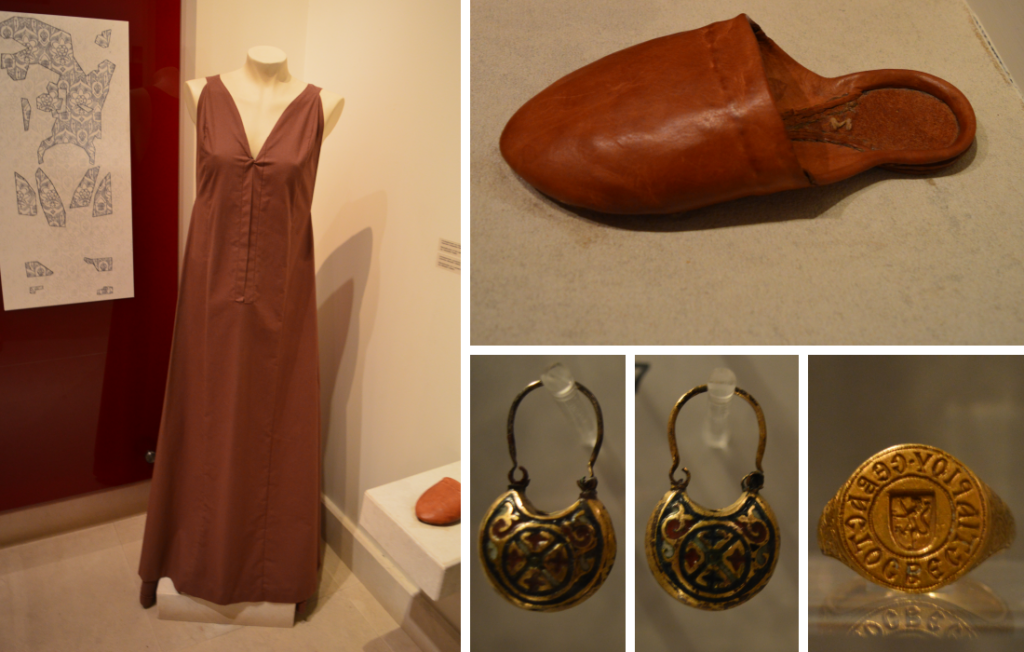
Almost everything known about Byzantine fashion comes from images — mosaics, frescoes, and manuscript miniatures — rather than surviving cloth, since textiles rarely survive the centuries intact. Mystras is a striking exception. Fragments of elite female dress recovered there are, by current evidence, among the only surviving physical remains of Late Byzantine court clothing, offering a rare direct check on what the visual sources depict rather than another layer of artistic representation. They provide a uniquely concrete link to the fashion of the empire’s final generations, made all the more valuable given how thoroughly Mystras itself — covered in full in our Mystras travel guide — embodies the last flowering of Byzantine art and ceremony before 1453.
Influence and legacy of the Byzantine fashion.
Contemporary and successor states
During the empire’s lifetime, Byzantine imperial dress functioned as a language of legitimacy that neighboring rulers borrowed deliberately. Georgian, Bulgarian and Serbian rulers, in particular, adopted elements of Constantinopolitan court regalia and ceremonial vocabulary when asserting their own imperial or quasi-imperial status — Emperor Stefan Dušan of Serbia’s adoption of the purple imperial divellion banner is one documented example of this wider pattern of visual appropriation. Norman Sicily offers a further case in image if not in political succession: the 12th-century royal mosaics of Palermo and Monreale show Norman kings Roger II and William II dressed in unmistakably Byzantine loros and divetesion, a conscious visual borrowing of Constantinopolitan authority by rulers with no dynastic claim to it at all.
Modern haute couture
Byzantine fashion’s afterlife extends into 20th- and 21st-century design, most often mediated through its art rather than its garments directly. Gianni Versace’s final haute couture collection (autumn/winter 1997–98) drew directly on his visit to the Metropolitan Museum’s Glory of Byzantium exhibition, translating mosaic gold and cross motifs into gowns. Dolce & Gabbana’s “Tailored Mosaic” (Fall/Winter 2013–14) was inspired by Sicily’s own Byzantine-era mosaic churches — Cefalù, the Palatine Chapel, La Martorana, and Monreale — the same Norman monuments discussed above.
Valentino’s Spring 2016 couture collection took a more indirect route: designers Maria Grazia Chiuri and Pierpaolo Piccioli cited the early-20th-century Delphos and Eleonora gowns of Mariano Fortuny, who had himself recreated the Byzantine tunica and referenced the loros in his draped shawls — a lineage running from Byzantium through Fortuny to the contemporary runway. Coco Chanel’s own Byzantine-inspired cuff, designed by jeweler Fulco di Verdura in the 1930s, shows the same influence reaching back still earlier into the century.
In sum, Byzantine fashion reflected the empire’s wealth, faith, and political ideology at every level of society, from the loros of the emperor to the plain wool of the monastery. Its visual vocabulary — gold, purple, mosaic pattern, and dramatic silhouette — has outlived the empire itself, resurfacing on runways more than five centuries after Constantinople fell.
FAQ
What did Byzantine emperors wear?
For the most formal state occasions, the emperor wore the loros, a long jeweled scarf derived from the Roman consul’s ceremonial dress, over a silk tunic called the divetesion. For less formal but still ceremonial occasions, he wore the chlamys, a cloak marked with a decorative panel called the tablion.
What color was reserved for the Byzantine emperor?
True Tyrian (murex) purple was the color most closely associated with imperial authority, prized for its extreme cost and rarity; children born to a reigning emperor were described as “born to the purple” (porphyrogennetos). Kermes-derived red served as a related but distinct, more widely available alternative.
Did Byzantine monks and nuns dress the same way?
Broadly, yes. Byzantine monasticism had no distinct religious orders as existed in the medieval West, so monastic dress was relatively uniform across the empire: a black wool or linen tunic (rason), an outer cloak (mandyas), and a hood (koukoulion), for both men and women, with additional vestments for the highest monastic ranks.
Why are there so few surviving Byzantine garments?
Textiles decay far more readily than stone, mosaic, or manuscript, so most of what is known about Byzantine dress comes from visual sources rather than surviving cloth. The fragments recovered at Mystras are a rare exception, offering physical evidence of elite Late Byzantine female dress.
Has Byzantine fashion influenced modern designers?
Yes — Byzantine mosaics and imperial dress have inspired several haute couture collections, including Gianni Versace’s final 1997–98 collection, Dolce & Gabbana’s 2013 “Tailored Mosaic,” and Valentino’s 2016 collection, the last by way of early-20th-century designer Mariano Fortuny’s own Byzantine-inspired gowns.
Sources and further reading
- Constantine VII Porphyrogennetos, Book of Ceremonies (De Ceremoniis), 10th century
- Piltz, E., Costume of the Byzantine Court Officials in the Palaiologan Era
- Ball, J., Byzantine Dress: Representations of Secular Dress in Eighth- to Twelfth-Century Painting
- Necipoğlu, N., Byzantium between the Ottomans and the Latins, Cambridge University Press, 2009
- Kalopissi-Verti, S., Mistra: A Fortified Late Byzantine Settlement
- Millet, G., Les monuments byzantins de Mistra
- Parure d’une princesse byzantine: Tissus archéologiques de Sainte-Sophie de Mistra, Geneva, 2000