Fortress monastery of St. John the Theologian, Patmos: A Byzantine citadel of learning
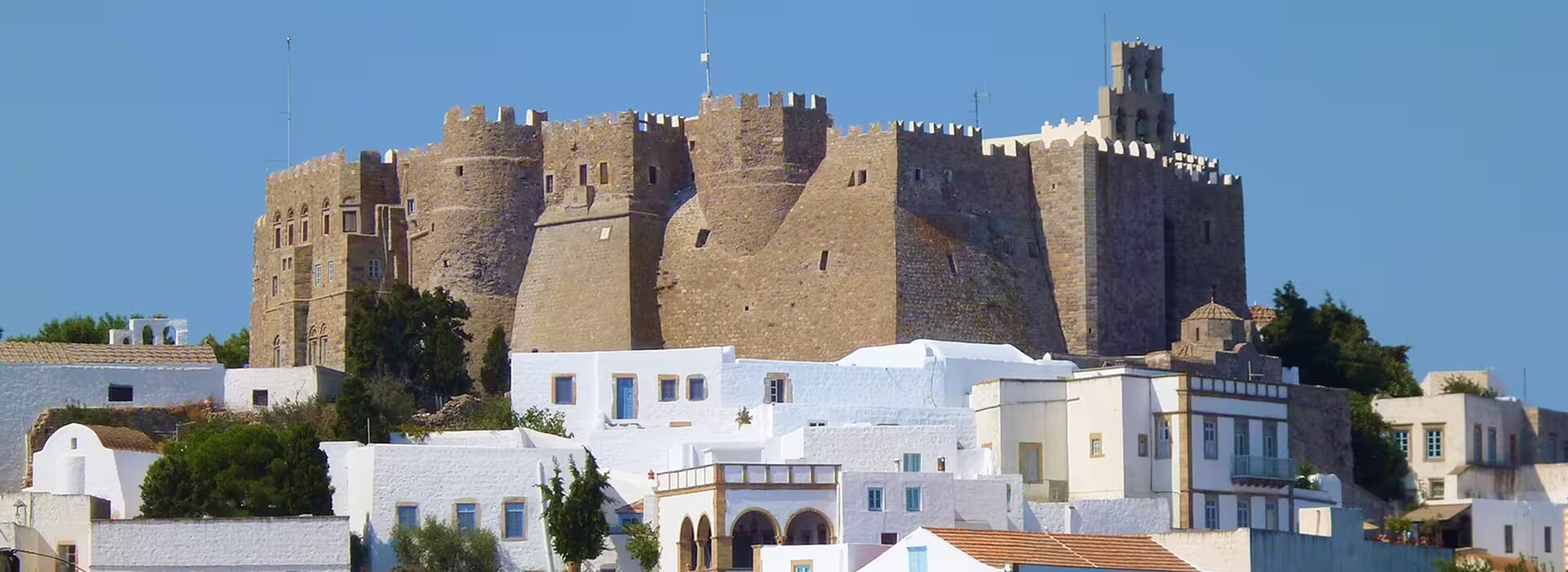
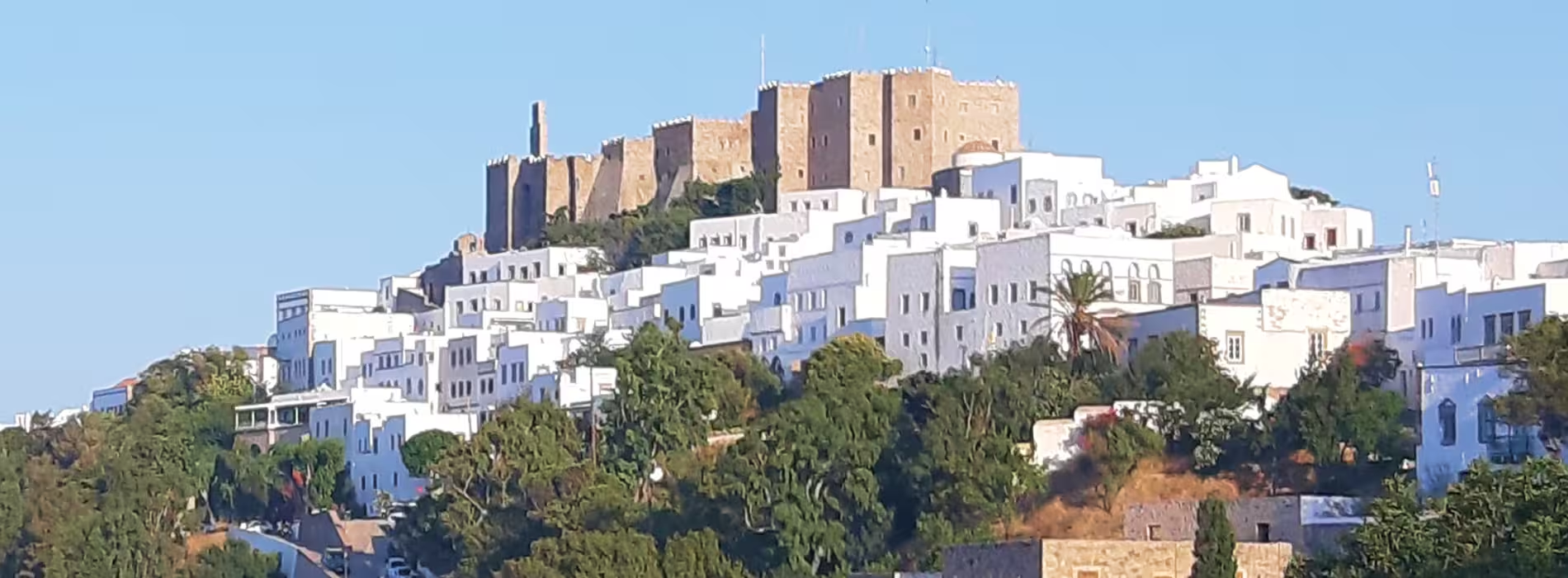
Seen from the harbor at Skala, the Monastery of St. John the Theologian does not read as a place of worship so much as a citadel — a mass of grey stone crowning the island’s highest hill, its walls windowless and sheer, more suited to a siege than a liturgy. That impression is accurate. Patmos’s monastery was conceived from the outset as a fortress, and its survival across nine centuries of piracy, Turkish raids, Ottoman rule, and Italian and German occupation owes as much to its defenses as to its sanctity.
What makes the monastery a subject of genuine historical weight, beyond its religious significance, is what it protected inside those walls: one of the most important surviving Byzantine manuscript libraries anywhere in the world, a body of imperial chrysobulls documenting nearly a millennium of Aegean political history, and a small but exceptional collection of Komnenian-era wall paintings and icons. Few Byzantine institutions have left behind an archive this rich, or one this continuously inhabited by the community that produced it.
Quick Facts
Founded: 1088, by Christodoulos of Latros
Founder emperor: Alexios I Komnenos
Dedication: St. John the Theologian (the Evangelist)
UNESCO status: World Heritage Site since 1999, jointly with the Chora settlement and the Cave of the Apocalyps
Notable holdings: ~1,000+ manuscripts today, including c. 125 Byzantine codices ; several Byzantine icons.
Location: Chora, Patmos, Dodecanese, Greece
The Byzantine founding: Christodoulos and Alexios I
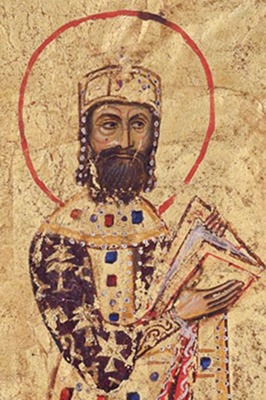
The monastery’s origin is unusually well documented for a Byzantine foundation, because its founder wrote about it himself. Christodoulos, a monk who had trained in the ascetic tradition of Mount Latros in Asia Minor, held properties at Strobilos and on the island of Kos. Seeking greater isolation, he petitioned Emperor Alexios I Komnenos (r. 1081–1118) for an exchange: his existing holdings, in return for the island of Patmos.
The emperor granted the request. A chrysobull dated April 1088 ceded Patmos to Christodoulos as an inalienable possession, and a follow-up praktikon — a formal transfer document issued that August by Nicholas Tzanzes, the imperial judge of the Cycladic islands — completed the handover. That document is worth quoting for what it reveals about the island Christodoulos actually received: it describes Patmos as waterless and desolate, with no buildings at all except for a single small chapel.
That existing chapel is traditionally said to have stood on the site of an earlier, 4th-century basilica, itself believed by some to have replaced a pagan sanctuary dedicated to Artemis. The layered-sanctity narrative is a common feature of early Christian foundation stories across the Aegean, and while plausible, it rests on tradition rather than confirmed archaeological sequence — it should be read as such rather than as settled history.
Christodoulos’s motives, by his own account, were straightforward: solitude, and a decisive break from the Kos properties that had drawn him into disputes he wished to leave behind. The choice of Patmos was reinforced by the island’s association with the Apostle John, traditionally held to have written the Book of Revelation there during his exile — a connection that gave the new foundation both spiritual prestige and a built-in identity distinct from any other Aegean monastery.
Christodoulos: Founder, Exile, Saint
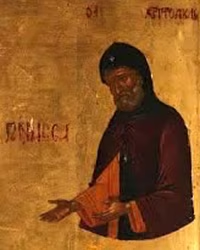
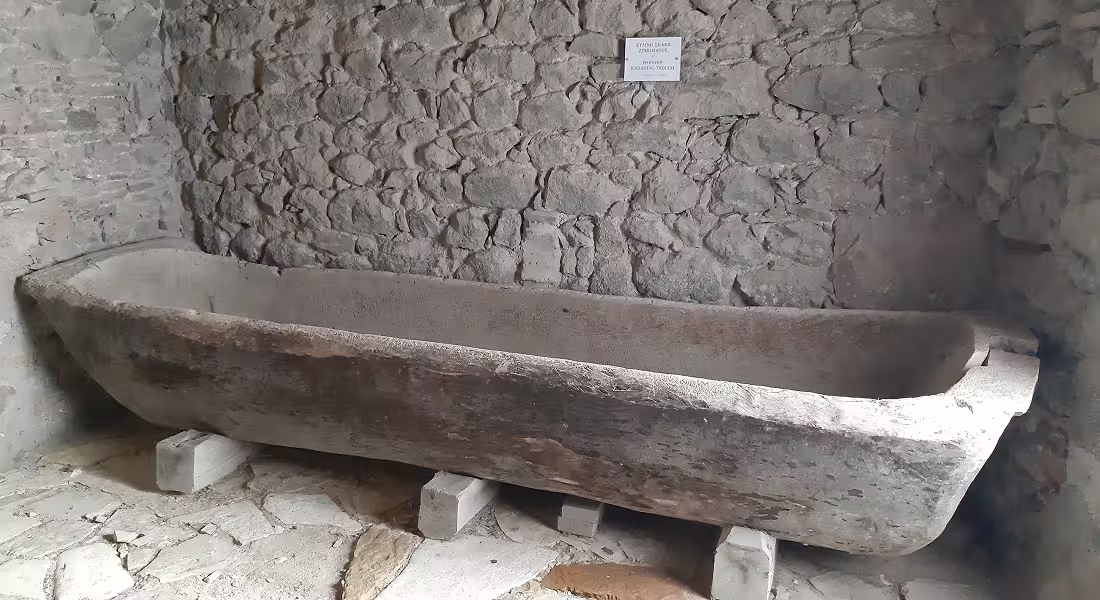
Christodoulos did not remain long on the island he had fought to secure. Turkish raids and, by some accounts, internal disputes among his own monks compelled him to leave Patmos, and he died in exile on Euboea on 16 March 1093 — barely five years after founding the monastery he never saw fully realized. His remains were brought back to Patmos in 1094 and placed in a marble sarcophagus beneath an arcosolium in what is now the Chapel of Christodoulos, within the monastery complex, where they remain an object of veneration to this day.
His death did not end his influence on the institution. Christodoulos left behind a Rule (Typikon) and Testament governing the monastery’s administration, along with correspondence with Constantinople’s patriarchs — documents that, together with the imperial chrysobulls, form the backbone of what historians know about the foundation’s earliest decades.
Later history
The centuries after Christodoulos’s death were markedly less settled than the monastery’s high walls might suggest. Piracy remained a constant threat throughout the late Byzantine period, and the fortress character of the complex — walls, a single defensible gate, minimal exterior windows — reflects a community that built for siege as a matter of course, not exception.
Patmos passed under Ottoman control following the wider collapse of Byzantine authority in the Aegean, but the monastery negotiated a degree of administrative autonomy that allowed monastic life, and crucially the library, to continue largely undisturbed. This continuity is a significant part of why so much of the manuscript collection survives intact: unlike many mainland Byzantine institutions, the monastery was never sacked in a way that broke the chain of custody over its archive.
Patmos came under Italian administration in the early 20th century, then Greek sovereignty after the Dodecanese was incorporated into the Greek state in 1948. In 1999, UNESCO inscribed the monastery on the World Heritage List jointly with the Chora settlement that grew around it and the Cave of the Apocalypse below — recognition of the complex as a continuous, still-functioning expression of Byzantine and post-Byzantine monastic life.
The complex and its fortification
The monastery’s defensive character is not an later addition but a founding design principle. Christodoulos and his immediate successors built with raids in mind from the start, and the result is a structure that reads, from outside, almost entirely as military architecture: massive buttressed walls, a single fortified entrance, and a compact, defensible footprint at the summit of the island’s highest point.
Inside, the logic shifts entirely. The exterior austerity gives way to a dense, almost labyrinthine cluster of courtyards, stairways, chapels, cells, and covered passages accumulated over nine centuries of continuous use and rebuilding — a spatial contrast between hostile exterior and sheltered interior that is one of the complex’s most striking features for visitors today.
The katholikon
The monastery’s main church, or katholikon, occupies the heart of the complex and preserves the core of the original Komnenian-period foundation more faithfully than almost any other part of the site. Its plan follows the cross-in-square design typical of middle Byzantine church architecture, with a narthex leading into the main worship space beneath a central dome.
Adjoining the katholikon is the Chapel of the Virgin (Panagia), which holds the monastery’s most important surviving body of Byzantine wall painting — see below — and the Chapel of Christodoulos, built specifically to house the founder’s tomb after the 1094 translation of his relics.
Other buildings: Refectory, cells, and courtyards
The monastic refectory, used for communal meals in accordance with Christodoulos’s Rule, once carried an extensive fresco program of its own. Most of this decoration has been lost to humidity damage over the centuries — a common fate for refectory paintings across Byzantine monastic sites, given their proximity to food preparation and storage. What survives are a small number of fragments dated to the late 12th or early 13th century, offering only a partial sense of what was once a much larger decorative scheme.
Beyond the refectory, the complex’s cells, storage vaults, and interconnected courtyards reflect centuries of organic growth rather than a single building campaign — a pattern typical of long-lived Byzantine monastic institutions, where each generation added to the fabric of the site without erasing what came before.
Wall paintings
Byzantine fresco survival at the monastery is, in truth, limited — a point worth stating plainly rather than glossing over, since much of what visitors see today across the complex belongs to later, post-Byzantine repainting campaigns.
What is genuinely Byzantine: The only wall paintings at the monastery securely dated to the Byzantine period are the few surviving ones in the Refectory and those of the Chapel of the Virgin (Panagia), executed around 1185–1190 — placing them firmly within the Komnenian era, roughly a century after the monastery’s foundation. Everything else visible in the complex’s painted decoration belongs to later phases and should not be described as Byzantine without qualification.
The Panagia chapel frescoes belong to a broader wave of high-quality Komnenian fresco painting that appeared across the Aegean and mainland Greece in the final decades of the 12th century, and they are treated by art historians as an important, if geographically isolated, example of that late Komnenian style.
Treasures and icons
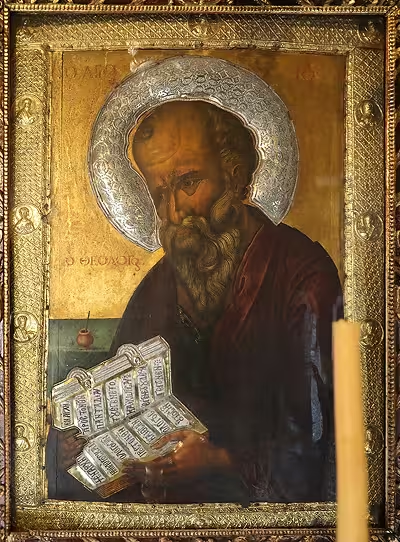
Among the monastery’s treasury holdings, one icon stands apart in both religious and historical significance: an image of St. John the Theologian, dated to the 12th century and retouched in the 15th, regarded as the palladium — the protective, defining sacred image — of the entire institution.
Tradition vs. record: Monastery tradition holds that the icon was a personal gift from Alexios I Komnenos, the founder’s imperial patron. This attribution is first attested in a monastery codex dating from before 1200 — early enough to be taken seriously as a claim with real roots in the community’s own memory, though it should still be understood as tradition rather than a contemporary record of an actual imperial donation. It may equally reflect a later community wish to bind the icon symbolically to the emperor who made the monastery’s existence possible.
The wider treasury includes numerous other Byzantine icons, liturgical vessels, vestments, and reliquaries accumulated across centuries of imperial and private patronage, reflecting the monastery’s status as a favored recipient of donations from Byzantine and, later, Ottoman-era Orthodox patrons alike.
The library
If the monastery’s walls explain how it survived, its library explains why its survival matters. Few Byzantine institutions anywhere have preserved a manuscript collection of comparable scale, continuity, and documented growth.
Christodoulos’s own founding collection is generally given as some 330 manuscripts, a figure recorded in early monastery sources. Independent study of surviving inventories suggests the true early holdings may have run higher than that number across various points in the following centuries, so the 330 figure is best understood as a documented founding benchmark rather than a hard ceiling on what the library ever held.
By 1890, cataloguing recorded roughly 855 manuscripts in the collection. Today the library holds more than 1,000 manuscripts in total, of which approximately 125 — excluding later copies — are properly Byzantine in date and origin, making it one of the largest surviving concentrations of Byzantine codices outside Mount Athos.
Notable Manuscripts
| Manuscript | Date | Content / Notes |
|---|---|---|
| The Purple Codex | 6th century | Written in silver and gold on purple-dyed parchment; the Patmos portion is only part of a codex now dispersed across several institutions |
| Codex 171 | 9th century | Illuminated manuscript of the Book of Job |
| Codex 33 | Dated 941 | Homilies of Gregory of Nazianzus, produced at Reggio Calabria in southern Italy |
The Purple Codex is a particularly instructive case of how Byzantine manuscripts scattered across post-Byzantine centuries of trade, looting, and scholarly acquisition: alongside the folios held at Patmos, further leaves survive at the National Library of Russia in St. Petersburg (182 folios), the Austrian National Library in Vienna (2 folios), the British Museum (4 folios), the Vatican Library (6 folios), and the National Archaeological Museum in Athens (1 folio) — a single original codex now held in fragments across five countries.
Codex 33, produced in Reggio Calabria in 941, is a reminder that the manuscript culture represented at Patmos was never purely local: southern Italy remained a significant center of Greek manuscript production well into the middle Byzantine period, and the presence of a Calabrian-made codex in an Aegean monastic library reflects the broader circulation of Greek learning across the Byzantine Mediterranean.
The Cave of the Apocalypse
Partway down the hill between Skala and the monastery lies the Cave of the Apocalypse, traditionally identified as the site where St. John received the visions recorded in the Book of Revelation. Inscribed by UNESCO alongside the monastery itself in 1999, the cave functions today as a subordinate but historically linked institution — administratively tied to the monastery and central to the same John-the-Theologian tradition that justified Patmos’s selection as a monastic site in the first place.
Frequently Asked Questions
When was the Monastery of St. John the Theologian of Patmos founded?
It was founded in 1088, after Emperor Alexios I Komnenos granted the island of Patmos to the monk Christodoulos in exchange for his existing properties on Kos and at Strobilos.
Who was Christodoulos of Patmos?
Christodoulos was a Byzantine monk trained in the ascetic tradition of Mount Latros who founded the monastery, wrote its governing Rule and Testament, and died in exile on Euboea in 1093. His relics were returned to Patmos the following year and remain in the monastery’s Chapel of Christodoulos.
Are the monastery’s wall paintings Byzantine?
Only the frescoes in the Chapel of the Virgin (Panagia), dated to around 1185–1190, and the scarce surviving frescoes in the refectory, are securely Byzantine. Other painted decoration in the complex, including what remains of the refectory paintings, belongs to later, mostly post-Byzantine phases.
How large is the monastery’s library today?
The library holds more than 1,000 manuscripts, of which approximately 125 — not counting later copies — are Byzantine in date and origin.
Is the monastery part of a UNESCO World Heritage Site?
Yes. It was inscribed in 1999 together with the Chora settlement on Patmos and the Cave of the Apocalypse.
Sources
- Christodoulos of Patmos, Rule, Testament, and Codicil (autobiographical foundation documents, Patmos archives; Codex Patmou 267)
- Imperial chrysobull of Alexios I Komnenos, April 1088 (preserved at the monastery)
- Praktikon of Nicholas Tzanzes, imperial judge of the Cyclades, August 1088
- Monastery library inventories, 1890 and modern cataloguing records
- UNESCO World Heritage List, “Monastery of Saint-John the Theologian and the Cave of the Apocalypse on the Island of Patmos” (inscribed 1999)
Related Byzantine Travel Guides
- Exploring Byzantine Istanbul: monuments, churches, and imperial history
- Byzantine Thessaloniki: a walking guide to the city’s churches and walls
- Mystras: A Complete Visitor’s Guide to the UNESCO Byzantine Ghost City
- Byzantine Naxos: monuments of the Cyclades
- Leros: Byzantine Churches and Panteli Castle




One Comment