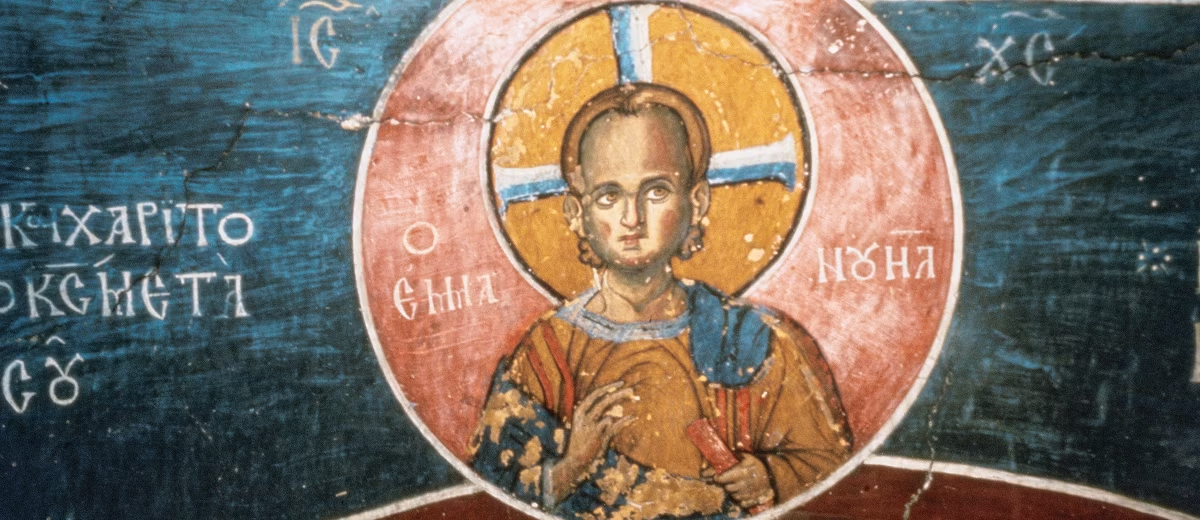
Christ Emmanuel: The youthful face of God
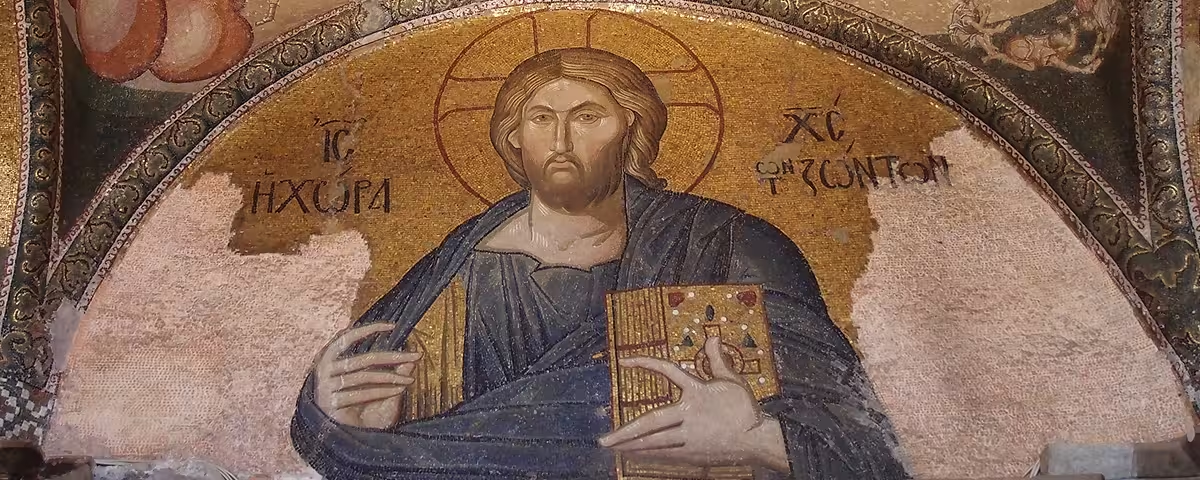
In the twelfth century, an emperor put his own name on his coinage — without writing it. Manuel I Komnenos struck coins bearing the image of Christ Emmanuel, a pun no Greek speaker could miss: Emmanouēl, “God with us,” beside Manouēl, his own name shortened by exactly one syllable. It is a small, telling moment, and a useful entry point: Christ Emmanuel is the beardless, youthful image of Christ, the Incarnate Word made visible as a child — one member of a wider family of Byzantine types through which artists depicted Christ at different ages and in different roles, alongside the mature, enthroned Pantocrator and others besides. Where the Pantocrator asks who Christ is eternally, Emmanuel asks what it meant for God to become a particular, vulnerable human being — a question the Pantocrator’s iconography, built for majesty and judgment, was never designed to answer.
Emmanuel has no single dramatic origin story — no one image that historians point to as the first of its kind. That absence is itself informative, and worth being honest about rather than papering over: youthful images of Christ were common in Byzantine and early Christian art long before anyone thought to label one “Emmanuel,” and what survives today is a small, uneven fraction of what once existed. The type accumulated its name and its fixed features gradually, over centuries, and it never stood entirely on its own — it borrowed its face for several other, related images. Understanding Emmanuel means following that process of borrowing and accumulation, not looking for a single moment of invention.
What is Christ Emmanuel?
Christ Emmanuel is one of the principal iconographic types of Christ in Byzantine art, showing him as a frontal, beardless youth — the pre-existent Logos, the incarnate Word, depicted at the age associated with his early life rather than his public ministry or his cosmic reign. The name comes from the Hebrew Immanuel, “God with us,” the sign given in the Book of Isaiah and read by Christian tradition as a prophecy of Christ’s birth.
The type asserts the reality and immediacy of the Incarnation: this is God who has become genuinely, physically present among human beings, not merely in symbol — a claim distinct from, though related to, the several other ways Byzantine art found to depict Christ’s nature and authority.
Origins and meaning of the name
The name is scriptural before it is visual. Isaiah 7:14 announces: “the virgin shall conceive, and bear a son, and shall call his name Immanuel.” The Gospel of Matthew, writing centuries later, explicitly identifies this prophecy as fulfilled in Christ’s birth, translating the name for a Greek-speaking audience: “they shall call his name Emmanuel, which being interpreted is, God with us” (Matthew 1:23). The title names a relationship rather than an attribute: not what Christ possesses, but where he is — with us, among us, one of us. Applied to an image of Christ as a child, the name makes the theological content of the Incarnation immediately legible: this is not simply “young Christ,” it is Christ specifically understood through the prophetic promise of God’s presence in human form.
From youthful Christ to a named type
It would be a mistake to imagine Byzantine artists inventing the Emmanuel image at some particular date, the way the Sinai panel anchors the early history of the Pantocrator. The evidence points to a slower, less tidy process. Images of a youthful, beardless Christ were already common in the 4th and 5th centuries — visually descended, in part, from the beardless Good Shepherd of Early Christian art, itself borrowed from Greco-Roman depictions of youths and shepherd-gods. What changed later was not the appearance of the young Christ so much as the label attached to it: separate images specifically identified by inscription as “Emmanuel” appear with any real frequency only from the 11th century onward. In other words, the visual raw material existed for centuries before Byzantine artists and patrons began consistently naming it and using it as a distinct type with its own theological weight, rather than simply an alternative way of picturing Christ generally.
This matters for how the type should be understood: Emmanuel was not a sudden theological statement translated into a new image, but an existing visual tradition that was gradually claimed, named, and put to increasingly specific uses — appearing in Gospel manuscripts, on coins, and, most distinctively, in a fixed place on the body of the Virgin herself.
Description of the iconographic type
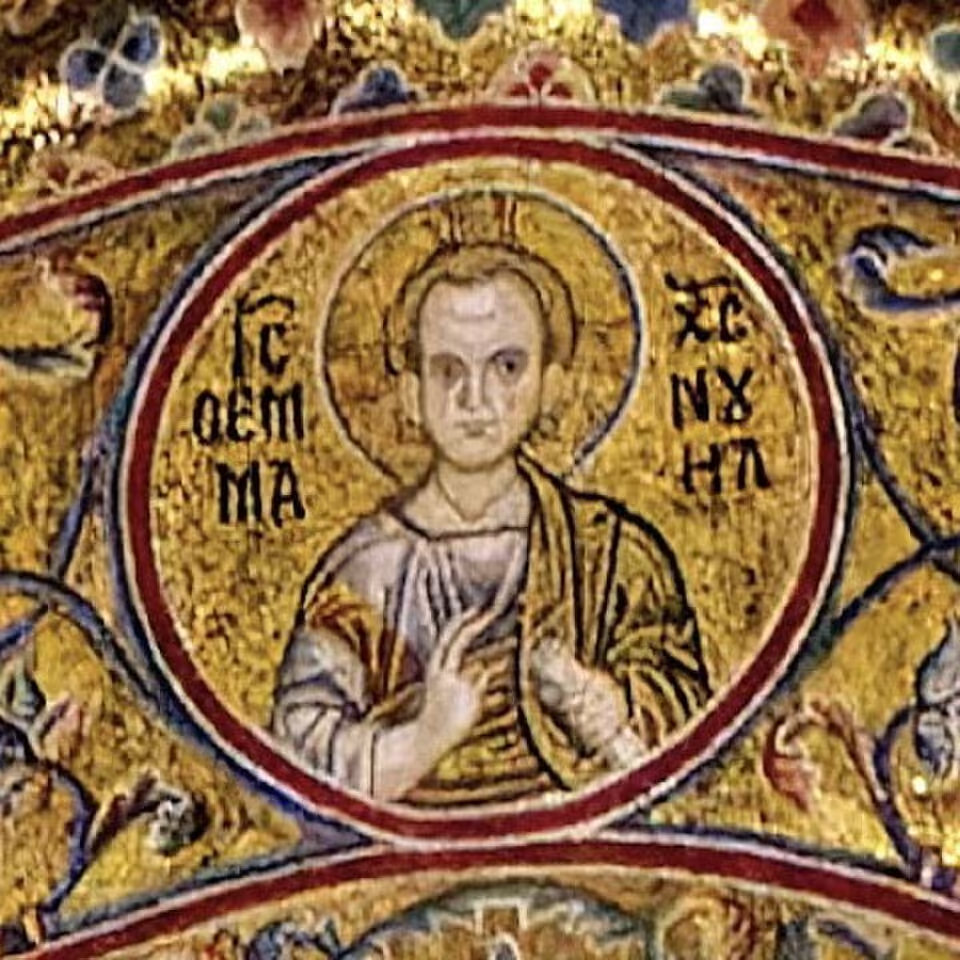
The mature, labeled Emmanuel type follows a description precise enough to be genuinely diagnostic. Christ is shown frontally, beardless, with curly locks of hair characteristically pushed back behind the ears, and a notably high forehead. His halo carries the cross, the nimbus reserved for Christ alone across his iconographic types, though on the smaller scale at which Emmanuel is usually depicted (medallions, coins, manuscript miniatures) the cross-halo is often simplified. He may appear alone, in bust or half-length, or — most distinctively — enclosed within a medallion on the chest of the Virgin.
Christ Emmanuel and the Virgin: the Blachernitissa medallion
The best-documented and most visually distinctive setting for Christ Emmanuel is not a standalone image at all, but a detail within an image of the Virgin. In the type known as the Blachernitissa — named for the Church of St. Mary of Blachernae in Constantinople — the Virgin is shown in the Orans posture, praying with her arms raised, while the bust of Christ Emmanuel appears enclosed in a roundel or medallion directly over her chest. The composition makes a visual argument out of anatomy: the child is not beside the Virgin or in her arms, as in other Marian types, but carried within her, over her heart, a direct pictorial statement of the Incarnation itself.
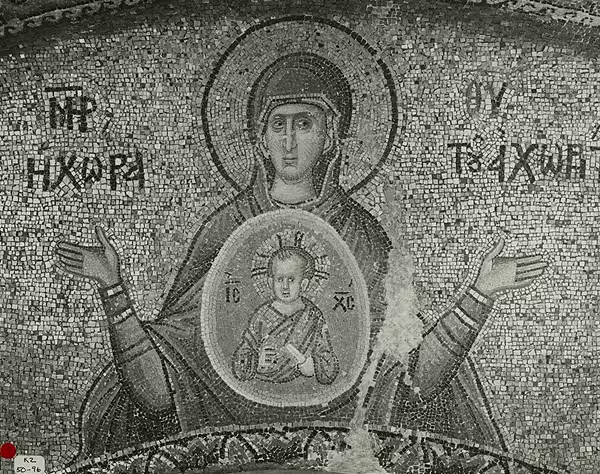
The type is securely dated by more than one line of evidence. It appears, identified by accompanying inscription, on coins issued jointly or separately by Constantine IX Monomachos, Theodora, and Michael VI between 1055 and 1057 — meaning the Blachernitissa-with-Emmanuel composition was official enough, and recognizable enough, to be placed on imperial coinage. It also survives on Byzantine lead seals and on small ivory and steatite pendants, several of which associate the composition directly with the Blachernae church and its famous relics. Exactly which physical image at Blachernae — the church’s principal icon, one of its other icons, or its apse mosaic decoration — originally generated this coin-and-seal type is not settled in the scholarship, and is worth presenting as an open question rather than a solved one.
[IMAGE NEEDED — a Blachernitissa example showing the Emmanuel medallion clearly: an 11th-century seal or coin (Dumbarton Oaks holds relevant material), or one of the Sinai ivory/steatite pendants. This section is the structural core of the article, so it deserves at least one dedicated image beyond whatever runs as the lead.]
Christ Emmanuel across media
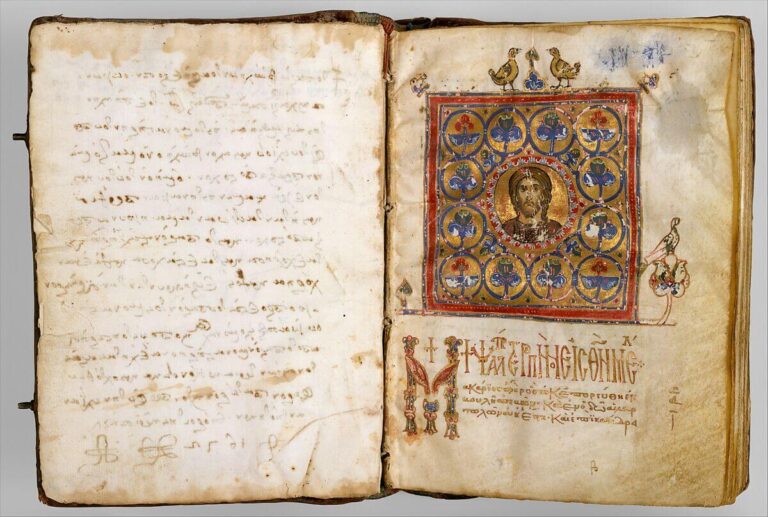
Once established as a named type, Emmanuel spread across the same range of media that carried the Pantocrator, but with its own particular strongholds. In illuminated Gospel manuscripts of the so-called Decorative Style group, frontispiece images of Christ in Majesty — the Majestas Domini composition, more usually showing the mature, bearded Christ — were sometimes given the features of the young Emmanuel instead, substituting the youthful Incarnate Word for the customary image of cosmic authority at the very opening of the Gospel text.
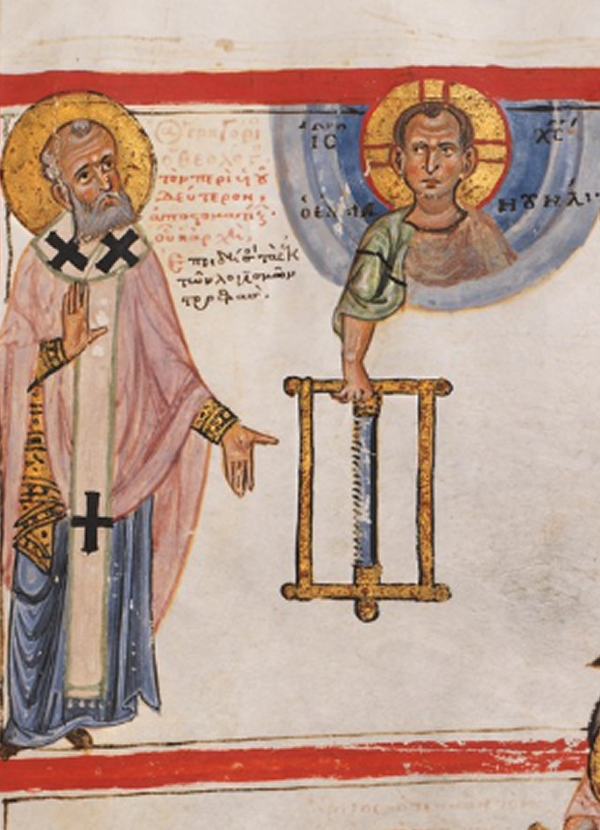
Christ Emmanuel in a 13th-century manuscript of Elias of Crete’s Commentary (University of Basel). 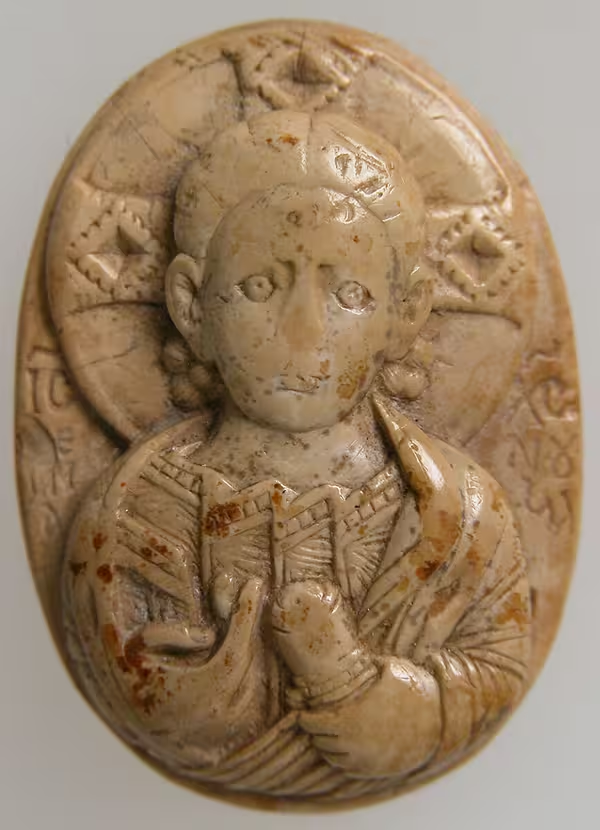
Steatite cameo with Christ Emmanuel, between 1200 and 1400, Metropolitan Museum
The clearest and most personal example, however, comes from the coinage of a single emperor. Manuel I Komnenos (r. 1143–1180) used the image of Christ Emmanuel on his own coinage — a deliberate reference to his own name, since Emmanouēl and Manouēl differ by only their opening syllable. It is a rare, concrete case of a Byzantine emperor choosing a specific Christological image type for reasons of personal and dynastic branding rather than purely doctrinal argument, and it gives the type a level of imperial visibility that most other iconographic subtypes of Christ never achieved.
Borrowed elsewhere: Anapeson, Amnos, and the Burning Bush
One of the more striking facts about Christ Emmanuel is that it did not remain confined to images labeled with that name. Its distinctive features — the youthful, beardless face — were borrowed to construct several other, theologically distinct images of Christ, each using the “look” of Emmanuel to make a different argument:
In the Anapeson (“the Reclining One”), Christ is shown asleep or reclining, an image rooted in Jacob’s blessing of Judah in Genesis 49:9 — “he stooped down, he couched as a lion… who shall rouse him up?” — read by Byzantine exegetes as a prophecy of Christ’s death and Resurrection. Giving this reclining figure Emmanuel’s youthful features ties the image of Christ’s Passion back to the image of his Incarnation, the beginning and the culmination of the same story told through one recognizable face.
In the Amnos (“the Lamb”), used in depictions connected to the Melismos — the ritual “fraction” or breaking of the Eucharistic bread understood as a symbolic re-enactment of Christ’s sacrifice — the infant or child Christ is shown lying on the paten as the sacrificial offering. Here too, Emmanuel’s youthful face carries the theological weight: the same childlike Christ who embodies the Incarnation is shown as the Lamb of sacrifice, binding birth and Eucharistic death into a single visual statement.
And in images of Christ in the Burning Bush — the bush that burned but was not consumed, understood typologically as a prefiguration of the Virgin Birth, since Mary bore God without being “consumed” by the experience — Christ again appears with Emmanuel’s features, embedded within the flames Moses witnessed, collapsing Old Testament prophecy and New Testament fulfillment into one image.
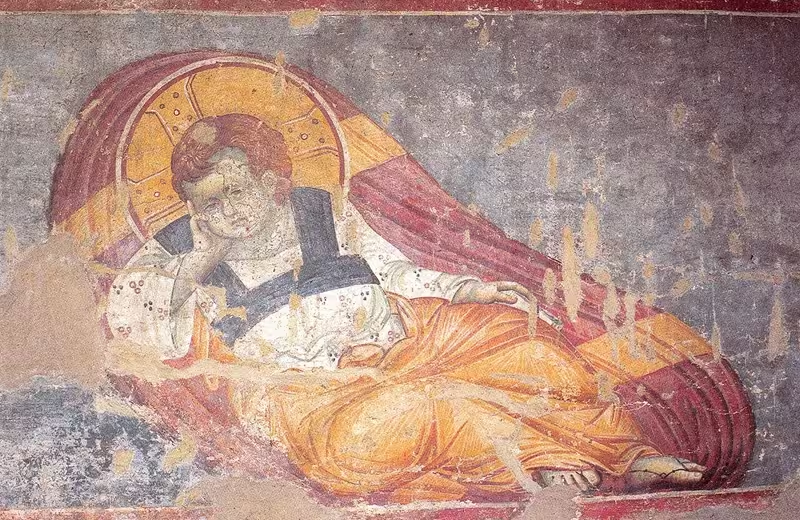
Reclining Christ by Manuel Panselinos, Protaton Church (Athos), 14th century
Variants and related types
Christ Emmanuel belongs to a considerably wider family of images than any single pairing suggests. Byzantine art developed several distinct ways of depicting Christ, each carrying its own theological emphasis: the mature, enthroned Pantocrator, asserting eternal authority; the white-haired Ancient of Days, making eternity itself visible ; the sorrowful Man of Sorrows (Akra Tapeinosis), showing Christ dead or suffering; and, as discussed above, the Anapeson, Amnos, and Burning Bush images that borrow Emmanuel’s own youthful features for still other purposes. Emmanuel’s place within this family is specific rather than oppositional: it is the image of beginning, of Christ newly present among humanity, and the other types are best understood as covering different moments and roles within the same continuous identity, not as alternatives competing to be the “true” image of Christ. The type is also inseparable from Marian iconography: alongside the Hodegetria and the Hagiosoritissa, the Blachernitissa-with-Emmanuel forms one of the fixed constellation of Marian types at the center of Orthodox iconography, and arguably the one that states the doctrine of the Incarnation most literally.
Influence and legacy
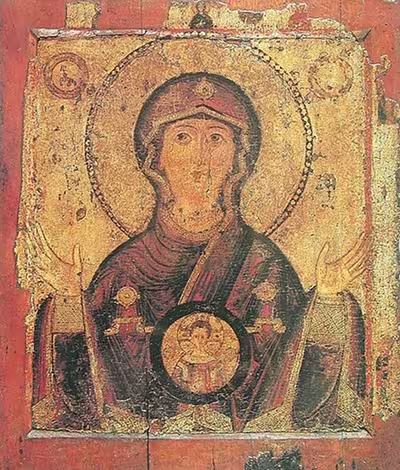
The Blachernitissa-with-Emmanuel composition proved to be one of the most durable exports of Byzantine iconography. It passed into Russian icon painting as the “Our Lady of the Sign” (Znamenie) type, associating the image with a celebrated icon of Novgorod and, further back, tradition traced its origin to the Photeinos Chapel of the Blachernae church itself. In these later icons, the essential composition survives intact across centuries and a different language and culture: the Virgin, arms raised in prayer, the young Christ enclosed in a roundel at her chest — proof that the visual argument first fixed in middle Byzantine Constantinople continued to communicate the same theological point long after the empire that produced it had fallen.
Frequently asked questions about Christ Emmanuel
What does “Emmanuel” mean?
Emmanuel (Hebrew Immanuel) means “God with us.” The name comes from the prophecy of Isaiah 7:14 and is identified in the Gospel of Matthew as fulfilled in the birth of Christ.
How is Christ Emmanuel different from Christ Pantocrator?
The Pantocrator shows Christ mature, bearded, and enthroned in judgment, asserting his eternal cosmic authority. Christ Emmanuel shows him as a beardless youth, asserting the reality of the Incarnation — God made present as a particular, vulnerable human child.
When did the Christ Emmanuel type first appear?
There is no single point of origin. Youthful images of Christ were common from the 4th–5th centuries onward, but images specifically labeled “Emmanuel” by inscription become frequent only from the 11th century.
Why is Christ Emmanuel shown on the Virgin’s chest?
In the Blachernitissa type, named for the Church of St. Mary of Blachernae in Constantinople, the Virgin is shown praying with the Christ child enclosed in a medallion over her heart — a direct visual statement of the Incarnation, Christ carried within her rather than beside her.
Which Byzantine emperor used Christ Emmanuel on his coins?
Manuel I Komnenos placed the image of Christ Emmanuel on his coinage, a deliberate play on his own name — Emmanouēl and Manouēl differing by only one syllable.
Sources and further reading
- Alexander Kazhdan (ed.), The Oxford Dictionary of Byzantium, Oxford University Press, 1991 — entry “Emmanuel, Christ.”
- Isaiah 7:14; Matthew 1:23.
- Kurt Weitzmann, The Monastery of Saint Catherine at Mount Sinai: The Icons, Princeton University Press, 1976 — for related Sinai ivory and steatite material.
- Michigan-Princeton-Alexandria Expeditions to Sinai (Sinai Archive) — Blachernitissa medallion pendants.
- Helen C. Evans and William D. Wixom (eds.), The Glory of Byzantium, The Metropolitan Museum of Art, 1997.
- [Flag: additional sourcing needed specifically for Anapeson, Amnos, and Burning Bush examples — see note in that section above.]