
The Petraliphas family, a noble Byzantine lineage of Western origin
The Petraliphas — sometimes rendered Petraleiphas — were a Byzantine aristocratic lineage descended from a Western knight who defected to Emperor Alexios I Komnenos in the late 11th century. Settled at Didymoteichon in Thrace, the family rose over the following century to the top of the Byzantine elite, producing generals, a provincial governor, and, through marriage, rulers of Epirus and a canonized empress still venerated today in Arta.
Their trajectory is a compact case study in how Western knights who entered imperial service during the Norman wars and the First Crusade could, within a few generations, become fully Byzantine — intermarrying with the Komnenoi, the Doukai, and the Angeloi, and shaping the politics of the successor states that emerged after 1204.
Origin of the Petraliphas family: Norman or Frankish?
The ancestor of the family was Peter Aliphas, an 11th-century knight whose precise background is disputed among modern historians. He is most often identified with Peter of Aulps, a knight from Provence in southern France — which would make him Frankish in the narrower sense. A minority of scholars instead connect him to Robert of Caiazzo, a Norman lord who also held Alife, near Caserta in southern Italy — the toponym generally taken to be the source of the family name “Petraliphas,” or “Peter of Alifa.” Neither identification is certain, and the family’s own name is really the strongest evidence tying it to Alife rather than to any specific ethnic label.
It is worth noting that when the 12th-century historian Niketas Choniates later called the Petraliphas brothers of Didymoteichon “Franks,” he was using the term the way Byzantine writers generally did: as a catch-all for Western Europeans of any origin — French, Norman, Italian, or otherwise — not as a precise ethnic distinction from “Norman.” The safest description, and the one closest to the family’s own near-contemporary characterization, is simply that the Petraliphas were of Western origin.
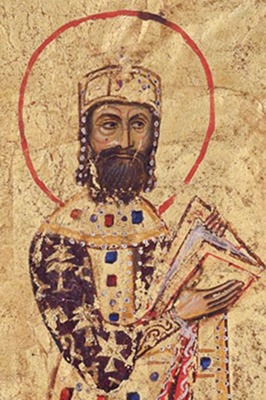
Whatever his exact background, Peter Aliphas first appears fighting for the Norman duke Robert Guiscard during the invasion of the Balkans in 1081. Serving as second-in-command to the Count of Brienne, he held the town of Kastoria until it was besieged and taken by Alexios I Komnenos in October 1083, at which point he entered Byzantine service. Anna Komnene later described him in the Alexiad as a warrior glorious in battle and faithful to the emperor.
Peter went on to take part in the First Crusade as governor of Placentia within the Byzantine contingent of the general Tatikios. He left this post in 1098 and, together with Stephen of Blois, met Alexios I at Philomelium, warning him of a large Turkish army approaching — a report that led the emperor to turn back rather than march to relieve the crusaders besieged at Antioch. Peter reappears in the Balkans in 1107, fighting the invasion of Bohemond of Antioch, and served as one of the witnesses to the Treaty of Devol in 1108. He eventually settled at Didymoteichon in Thrace, where his descendants took root as the Petraliphas family.
Rise to prominence under the Komnenoi
Little is recorded of the family for the following decades. By the reign of Manuel I Komnenos (1143–1180), two Petraliphas appear as distinguished generals: Alexios Petraliphas, whom the historian John Kinnamos records as commander of a Byzantine force sent to support the emperor’s ally Kilij Arslan II, Sultan of Rum, and Nikephoros Petraliphas, also praised as a general of the same reign.
Niketas Choniates separately mentions four Petraliphas brothers living at Didymoteichon and serving as soldiers of Manuel I. Whether Alexios and Nikephoros were among these four brothers is not recorded, though the coincidence of period and place makes it plausible. A later literary tradition, preserved in the Byzantine romance of Belisarios, remembered the Petraliphas more modestly, as a minor family of Didymoteichon.
Around 1200, a sebastokrator Nikephoros Komnenos Petraliphas issued a sigillion for the monastery of Xeropotamos on Mount Athos, confirming a donation made by his grandmother, Maria Tzousmene Komnene — a document that also attests the family’s marriage ties to the Komnenos dynasty by this date.
Sebastokrator John Petraliphas and the Angeloi
The family reached the height of its influence with the sebastokrator John Petraliphas, appointed governor of Thessaly and Macedonia under Emperor Isaac II Angelos (r. 1185–1195, 1203–1204). John was married to Helena, from an unnamed noble house of Constantinople. In 1195 he was among the leading nobles who conspired to overthrow Isaac II, replacing him with Alexios III Angelos.
After the sack of Constantinople by the Fourth Crusade in 1204, John Petraliphas threw his support behind Theodore Komnenos Doukas, the founder of the state of Epirus — a natural alliance, since Theodore had married John’s sister, Maria Petraliphaina. John’s son, Theodore Petraliphas, married a daughter of Demetrios Tornikes, a leading minister at the Nicaean court of John III Vatatzes, and played a prominent part in the Nicaean–Epirote rivalry of the 1250s, defecting briefly to Nicaea before returning to the side of his brother-in-law, Michael II Komnenos Doukas.
Theodora Petraliphaina: from Epirote consort to Saint Theodora of Arta
John Petraliphas’s daughter, Theodora Petraliphaina, is by far the best-remembered member of the family. Born in Thessalonica between about 1210 and 1216, she was married as a child, shortly after 1231, to Michael II Komnenos Doukas, ruler of Epirus and Thessaly. While pregnant with Michael’s son Nikephoros, she was banished from court for some five years so that Michael could live with his mistress; she is said to have borne the hardship without complaint, sheltered by a village priest, before Michael repented and recalled her. As consort, she is later recorded accompanying her son to Nicaea for his betrothal and marriage to a daughter of Theodore II Laskaris, a diplomatic rapprochement that briefly eased relations between Epirus and Nicaea.
Together with Michael, Theodora is credited with founding three monasteries in and around Arta as an act of repentance: the Panagia tou Vlacherna, the Kato Panagia, and a convent dedicated to Saint George within the city itself. It was in this last convent, mid-Byzantine in its original core but rebuilt in the 13th century, that Theodora took the veil after Michael’s death, added a domed narthex to house her own tomb, and was buried.
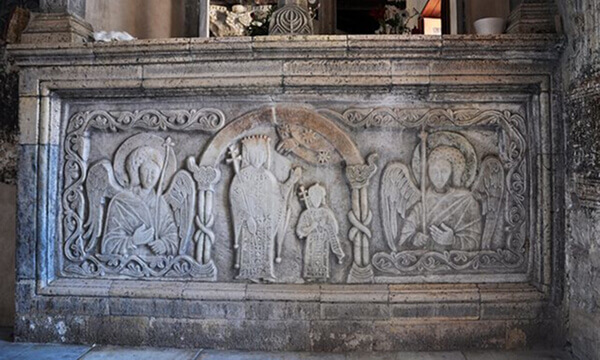
The building has been known ever since as the Church of Saint Theodora, and her cenotaph — remodelled in 1873 when her relics were translated, and incorporating a carved marble slab thought to depict Theodora with her son Nikephoros flanked by archangels — is still venerated today, with her relic kept in a silver reliquary inside the church. She was canonized, is commemorated by the Orthodox Church on 11 March, and remains the patron saint of Arta.
Michael II himself is traditionally thought to have been buried not at Saint Theodora’s but at the Panagia Vlacherna monastery on the far bank of the Arachthos, which served more broadly as the burial church of the ruling Komnenos Doukas dynasty of Epirus; an inscribed tomb there has been identified as his. More recently, however, scholars have argued that Vlacherna in fact housed the tombs of members of the Petraliphas family. Several funerary monuments survive at the site today, and their attribution remains debated.
A separate branch in the Empire of Nicaea
Not every branch of the family followed Epirus. According to George Akropolites, a different John Petraliphas served John III Vatatzes (r. 1221–1254) in the Empire of Nicaea, rising to the office of megas chartoularios and acting as a courageous military commander around 1237. Modern scholarship treats the identification of this Nicaean John with the sebastokrator John of Thessaly and Macedonia as questionable, suggesting instead that the Petraliphas had split into at least two distinct branches operating on opposite sides of the Nicaea–Epirus rivalry.
The family’s later fortunes are harder to trace, but a ridge known as Petraleiphes, near Perigardikeia in Macedonia, is recorded in a 1341 charter of the Docheiariou monastery — possibly a last toponymic trace of Petraliphas landholding in the region.
Legacy of the Petraliphas family
From a Western knight who changed sides after the siege of Kastoria in 1083 to a lineage entwined with the ruling houses of Epirus and Nicaea, and counting a canonized empress among its descendants, the Petraliphas family illustrates how thoroughly Western warriors could be absorbed into the Byzantine aristocracy within a few generations — through military service, strategic marriage, and provincial governorship. In Arta, that legacy still stands in stone: the Church of Saint Theodora keeps the memory of a Petraliphas daughter who became the city’s patron saint.
Sources.
Alexander Kazhdan (ed.), The Oxford Dictionary of Byzantium, Oxford University Press, 1991, “Petraliphas”, p. 1643.
Ruth Macrides, George Akropolites: The History – Introduction, Translation and Commentary, Oxford University Press, 2007, pp. 73, 97, 172–176, 203, 250, 358.
Basile Skoulatos, Les personnages byzantins de l’Alexiade: Analyse prosopographique et synthèse, Bureau du Recueil Collège Érasme / Éditions Nauwelaerts, Louvain-la-Neuve/Louvain, 1980, pp. 266–268.
Alice-Mary Talbot, “A Saintly Empress: Saint Theodora of Arta”, in Holy Women of Byzantium: Ten Saints’ Lives in English Translation, Dumbarton Oaks Research Library and Collection, 1996, pp. 323–333.
Angeliki E. Laiou, The Crusades from the Perspective of Byzantium and the Muslim World, Dumbarton Oaks, 2001, p. 94.
Donald M. Nicol, The Despotate of Epiros, Basil Blackwell, Oxford, 1957, pp. 202–203.
Actes de Xéropotamou, ed. J. Bompaire, Archives de l’Athos 3, Paris, 1964, no. 8.
Actes de Docheiariou, ed. N. Oikonomidès, Archives de l’Athos 13, Paris, 1984, no. 20.