Saint Polyeuktos, Istanbul: Anicia Juliana’s Lost Church and Her Challenge to Justinian
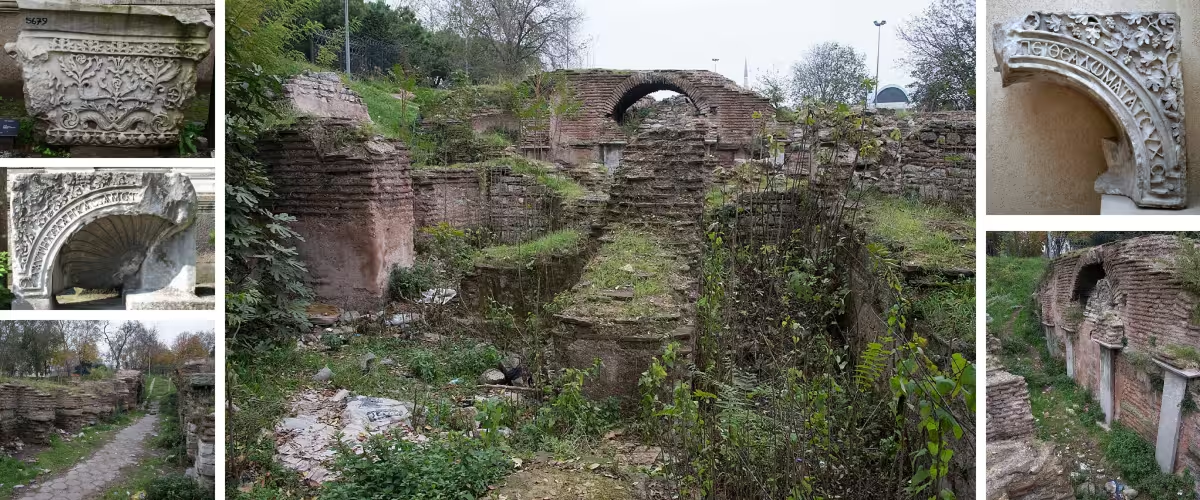
In the spring of 1960, road builders cutting an underpass at Saraçhane, beside Istanbul’s city hall, hit blocks of marble covered in carving and Greek verse. They had found the church of Saint Polyeuktos, built in the 520s by Anicia Juliana, the richest aristocrat in Constantinople and a descendant of emperors. Until Hagia Sophia rose a few years later, it was the most ambitious church in the city. Its inscription compared its founder to Solomon, and much of its sculpture now stands in Venice. The church has gone, but its foundations still lie open at Saraçhane, and they changed how we understand the architecture of Justinian’s age.
Quick facts
Name: Hagios Polyeuktos (St Polyeuctus), dedicated to a soldier martyr of Melitene.
Location: Saraçhane, Fatih, beside the Istanbul Metropolitan Municipality building, near the Aqueduct of Valens and the Şehzade Mosque.
Founder: Anicia Juliana (c. 462–527/8), daughter of the western emperor Olybrius.
Predecessor: a smaller church built by Empress Eudokia, wife of Theodosius II and Juliana’s great-grandmother.
Date: 520s; the traditional dating is 524–527, while the brickstamps have been read as c. 518–522.
Inscription: a 76-verse dedicatory poem, partly carved on the church and preserved in full in the Palatine Anthology.
Fate: abandoned by the 12th–13th century and quarried. After 1204, Venetians shipped its piers to San Marco (the “Pilastri Acritani”).
Rediscovered: 1960; excavated 1964–1969 by R. Martin Harrison and Nezih Fıratlı (Dumbarton Oaks and the Istanbul Archaeological Museums).
A Theodosian princess in Justin’s Constantinople
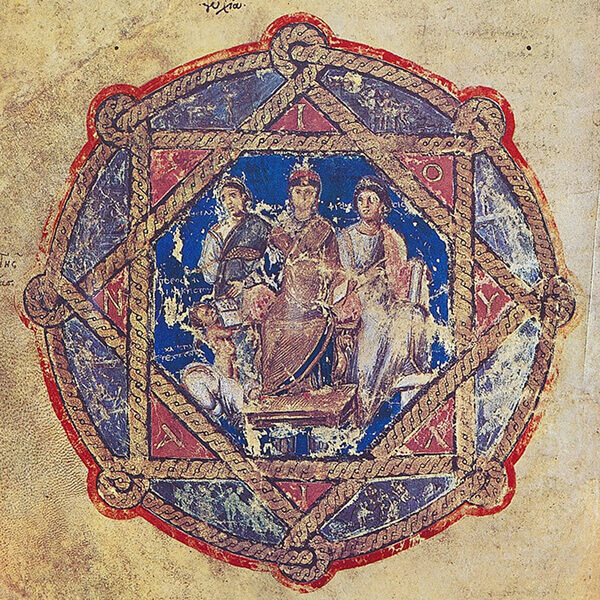
Anicia Juliana was the daughter of Flavius Anicius Olybrius, briefly emperor of the West in 472. Through her mother she descended from Theodosius II and Valentinian III. In the Constantinople of Anastasius I and Justin I she was the living link to the old dynasty, immensely rich and known for her piety. Her husband Areobindus was once acclaimed emperor by rioters in 512, and her son married into the imperial family. She was also a great patron: the Vienna Dioscurides was made for her around 512.
Saint Polyeuktos replaced an earlier, small church built by Empress Eudokia, wife of Theodosius II (see Athenais-Eudokia), to house the martyr’s skull. Juliana was rebuilding her great-grandmother’s foundation on a vastly grander scale, next to her own palace.
A church built against an emperor?
The dedicatory poem is the key to reading the building. It celebrates Juliana as the heir of a line of imperial builders and claims she has surpassed Solomon, whose Temple the new church was said to imitate. Large parts of the poem were carved on the entablature around the nave, and the rest stood at the entrance. The full text survives because a Byzantine anthologist copied it (Anthologia Graeca I.10).
Modern historians have mostly read the church as a political statement. Juliana’s family had been passed over for the throne in 518, when Justin I, a soldier from the Balkans, became emperor with his nephew Justinian behind him. Gregory of Tours tells a story that dramatises the rivalry. Soon after his accession, Justinian asked the elderly Juliana to give part of her fortune to the treasury. She had her gold made into plates and fixed to the church’s roof, so that when the emperor came she could show him that her wealth now belonged to the martyr. Gregory wrote in Gaul and had the story second-hand, so it shows how the rivalry was remembered rather than proving it happened.
Debate: how far should the “challenge to Justinian” go?
It is often said that Hagia Sophia was Justinian’s reply to Saint Polyeuktos, and that his reported boast that he had outdone Solomon answered Juliana’s poem. The parallel is attractive, but the boast comes from a much later text, the Diegesis on Hagia Sophia. Some scholars warn against reducing either building to a duel between two patrons. The date also matters: if the brickstamps put construction around 518–522, the church belongs to the years of Justin’s accession, not to Justinian’s reign.
Was it a new Temple of Solomon?
R. Martin Harrison, who directed the excavation, argued that the church was laid out as a replica of Solomon’s Temple. He thought it used the biblical proportions and the royal cubit as its unit of measurement, and he presented the idea in his popular book A Temple for Byzantium (1989). The idea fits the poem, and the decoration includes motifs such as palm trees and pomegranates that recall the Temple. The measurements are less secure. Later studies have questioned whether the foundations really give biblical proportions. Jonathan Bardill re-read the Solomonic theme through the gilded ceiling rather than the plan.
The shape of the building is also disputed. Harrison proposed a domed church, which made Saint Polyeuktos look like a forerunner of Hagia Sophia. The reconstruction now most widely accepted is a five-aisled basilica with a wooden roof, the only one that fits the archaeological evidence. The poem describes columns standing on columns, that is, a basilica with galleries.
The decoration
The fragments recovered at Saraçhane show an interior of extraordinary richness. The walls were faced with marble and the roof was gilded. The narthex is said to have shown the baptism of Constantine. The excavators found ivory, amethyst, gold and coloured glass, which had been inlaid into the marble. The carving is the real revelation. It includes deeply undercut vine scrolls, peacocks with spread tails in niches, and monograms, and it combines Sasanian Persian motifs with the classical repertoire, which was new in Constantinople. It anticipates the carving of Justinian’s churches, including the capitals of Little Hagia Sophia, whose inscription is often read as answering Juliana’s.
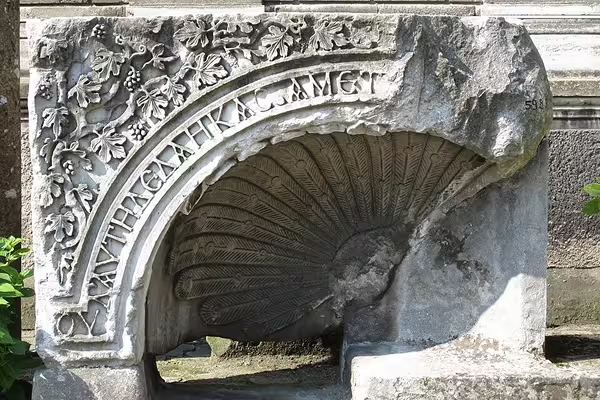
Peacock niche. @ Vetkin, CC BY-SA 3.0 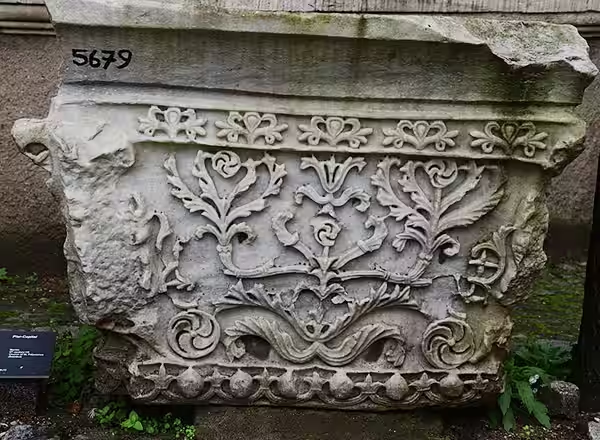
Pier capital. @ Anthémios de Tralles, CC BY-SA 4.0 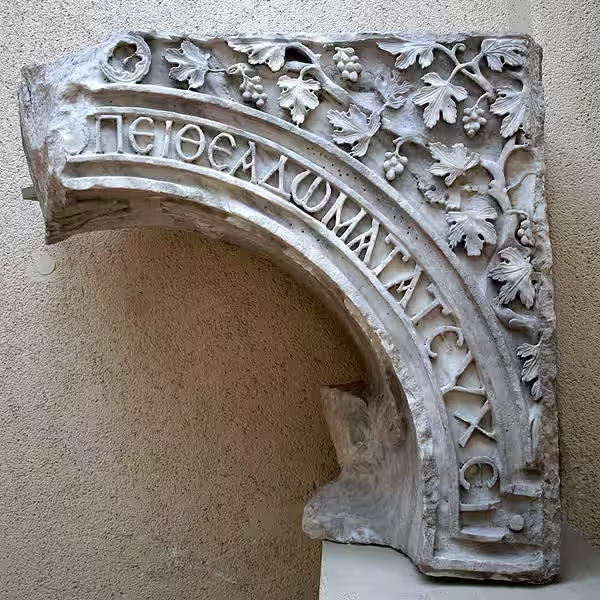
Greek epigram. @ Anthémios de Tralles, CC BY-SA 4.0
Abandonment, plunder and the pillars in Venice
The church was still standing at the end of the tenth century. It seems to have been abandoned by the eleventh or twelfth century, and it was then plundered for sculpture and other building material. Its marble ended up across the city and the Mediterranean. Pieces were reused in the Pantokrator monastery in the 1130s. After 1204 the Venetians shipped marbles to the West. The most famous are the two carved piers outside the south façade of San Marco in Venice, long called the “Pilastri Acritani” because they were believed to be trophies from Acre. The excavation showed where they came from: a monogram on one of the Venice piers also occurs at Saraçhane. They probably stood on the church’s lower storey. The wider story of the Venetian loot is in The Sack of Constantinople (1204).
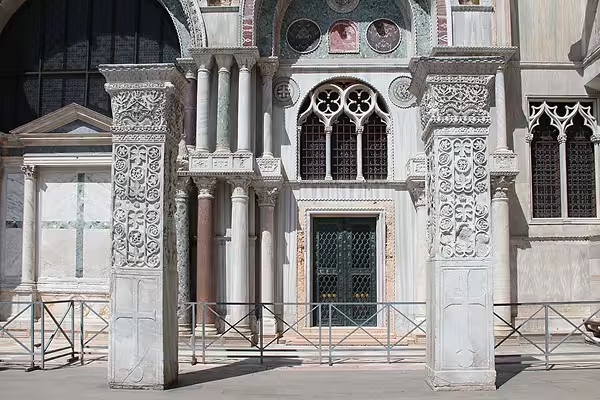
@ Jean-Pol-GRANDMONT, CC BY-SA 4.0
Rediscovery and excavation
The road works of 1960 were the start of the modern story, but not of the whole one. Fabian Stroth has traced the identification back to manuscript studies begun in Heidelberg some 350 years earlier, on the text of the poem. When the blocks were found, Ihor Ševčenko and Cyril Mango recognised them as belonging to the dedicatory inscription. Harrison and Fıratlı excavated the site for six seasons, from 1964 to 1969, under Dumbarton Oaks and the Istanbul Archaeological Museum. It was the first major excavation in Istanbul to follow modern stratigraphic practice. The excavation also produced a reference series of pottery and brickstamps that is still used to date other sites.
The site is being studied again. New excavations began in June 2022 as part of the Saraçhane Archaeological Park project, which is redesigning the site. Bardill’s long-announced monograph and Stroth’s 2024 study have reopened the main questions.
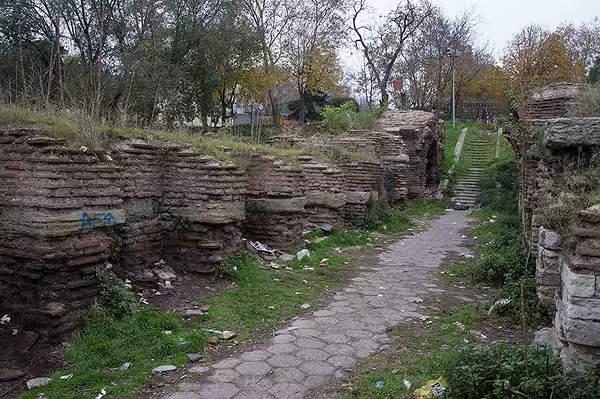
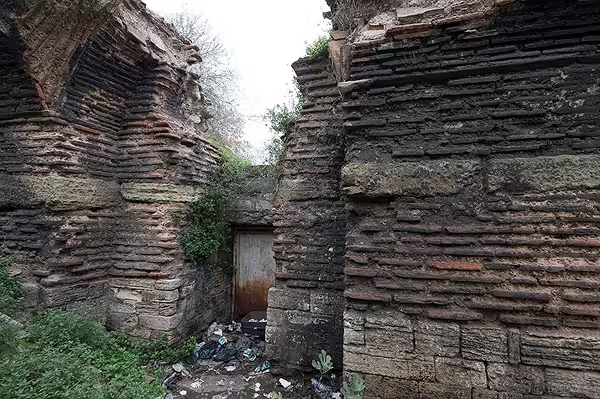
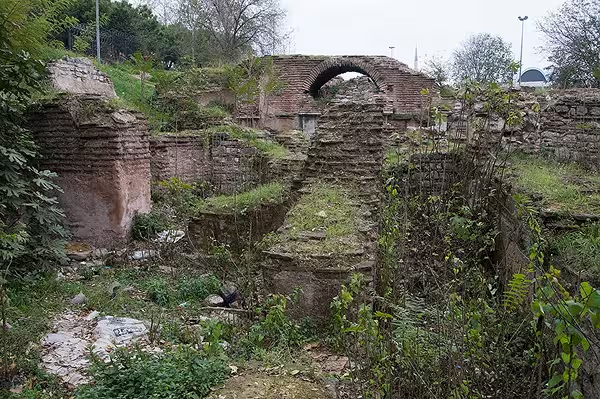
Visible remains of the church in the Saraçhane Archaeological Park. @ Dosseman, CC BY-SA 4.0
What we know, and what we don’t
We know who built the church, roughly when, on whose foundation and with what message, because her poem survives. We know its plan from foundations and its decoration from thousands of fragments. We don’t know its date to within a few years (518–522 or 524–527), whether it had a dome (probably not), whether its proportions really followed the biblical Temple, or how literally to take the story of the gold. Treat confident claims that it was “a copy of Solomon’s Temple” or “the model for Hagia Sophia” with caution.
See the proposed reconstructions of the building on Byzantium1200.
Visiting Saint Polyeuktos today
Where it is. Saraçhane Park, at the corner of Atatürk Boulevard and Şehzadebaşı Caddesi, next to the Istanbul Metropolitan Municipality building.
Getting there. Get off the M2 metro at Vezneciler or walk from the Aqueduct of Valens (five minutes). Tram T1 to Laleli-Üniversite, then ten minutes’ walk.
What to expect. The foundations, substructures and some reused blocks are visible from the park, which is free. Access may be restricted while the archaeological park works are under way ⚠ CHECK current access. The finest sculpture is in the Istanbul Archaeological Museums, and the Pilastri Acritani are on the Piazzetta in Venice.
Combine it with. The Aqueduct of Valens, the Pantokrator and the Pantepoptes in Zeyrek. Our guide to Byzantine Istanbul includes a Fatih route.
FAQ
Who built the church of Saint Polyeuktos?
Anicia Juliana, a Constantinopolitan aristocrat descended from the Theodosian dynasty and daughter of the western emperor Olybrius, in the 520s. It replaced a smaller church founded by Empress Eudokia.
Was Saint Polyeuktos bigger than Hagia Sophia?
No. It was the largest church in Constantinople until Justinian rebuilt Hagia Sophia (532–537), which far exceeded it.
Was Saint Polyeuktos modelled on Solomon’s Temple?
Its inscription claims that Juliana surpassed Solomon. Its excavator argued that the plan copied the Temple’s biblical proportions, but that reading of the measurements is debated.
What are the Pilastri Acritani in Venice?
Two carved marble piers outside San Marco, once thought to come from Acre. The Saraçhane excavations showed they came from Saint Polyeuktos and were taken to Venice after 1204.
Can you visit Saint Polyeuktos?
Yes. The excavated foundations lie in Saraçhane Park, next to Istanbul’s city hall, and many sculpted fragments are in the Istanbul Archaeological Museums.
Sources and further reading
- Anthologia Graeca I.10. The dedicatory poem in Greek.
- R. M. Harrison, Excavations at Saraçhane in Istanbul, vol. 1, Princeton, 1986. The excavation report.
- R. M. Harrison, A Temple for Byzantium: The Discovery and Excavation of Anicia Juliana’s Palace-Church in Istanbul, London, 1989.
- J. Bardill, Brickstamps of Constantinople, Oxford, 2004. The 518–522 dating.
- J. Bardill, “A New Temple for Byzantium: Anicia Juliana, King Solomon, and the Gilded Ceiling of the Church of St. Polyeuktos in Constantinople”, Late Antique Archaeology 3.1 (2006), 339–370.
- F. Stroth, The Church of St. Polyeuktos at Constantinople (Elements in the History of Constantinople), Cambridge, 2024.
- Gregory of Tours, Glory of the Martyrs 102. The story of the gilded roof.
Cover picture credits (from top left to bottom right):
@ Anthémios de Tralles, CC BY-SA 4.0
@ Vetkin, CC BY-SA 3.0
@ Dosseman, CC BY-SA 4.0
@ Dosseman, CC BY-SA 4.0
@ Anthémios de Tralles, CC BY-SA 4.0
@ Dosseman, CC BY-SA 4.0