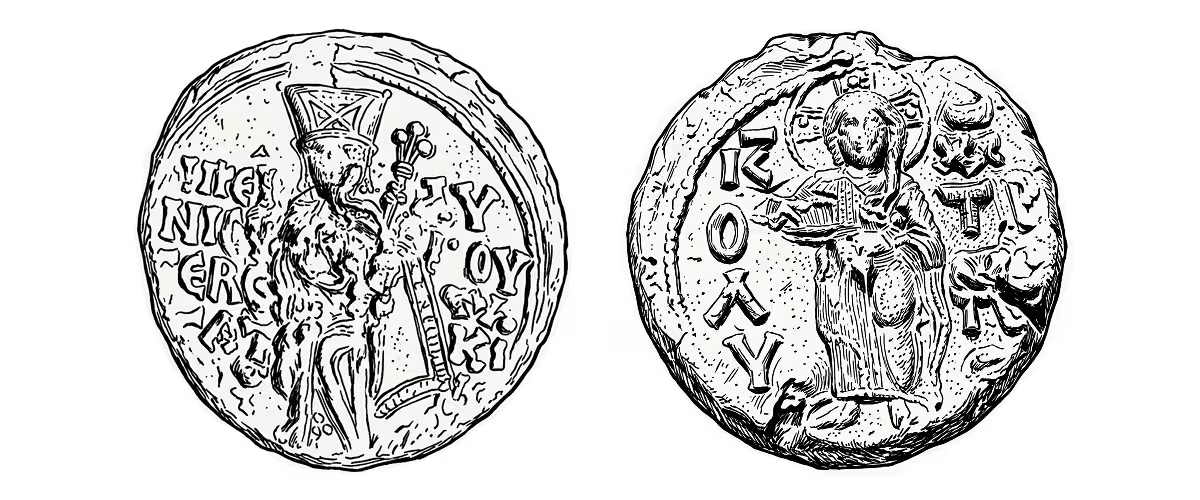
Unique seal of Empress Irene Laskarina discovered at Perperikon, Bulgaria
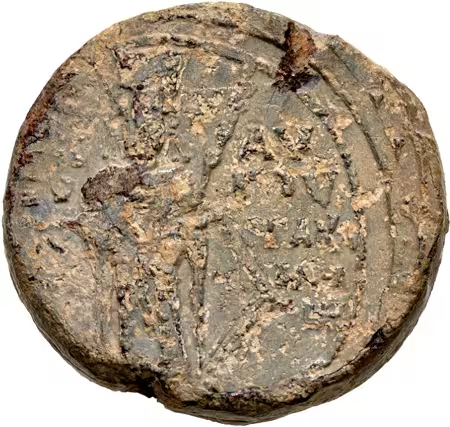
Archaeological excavations at the ancient rock city of Perperikon in southern Bulgaria have yielded a exceptional medieval discovery: a 13th-century personal lead seal belonging to Empress Irene Komnene Doukaina Laskarina. The announcement was made by excavation director Prof. Nikolay Ovcharov, while the seal’s Greek inscription was deciphered by sigillography specialist Dimitar Stoimenov.
While five other lead seals of Empress Irene are preserved in major global collections—including the Hermitage Museum in St. Petersburg and Dumbarton Oaks in Washington, D.C.—the specimen found at Perperikon is the only known example recovered directly from an controlled archaeological context. This provenance provides vital historical evidence of direct top-level administrative and diplomatic communication sent to the fortress in the Eastern Rhodopes during a critical period in Balkan history.

@ Vislupus, CC-BY-SA 4.0
Iconography of the seal: A rare depiction of Christ Redeemer
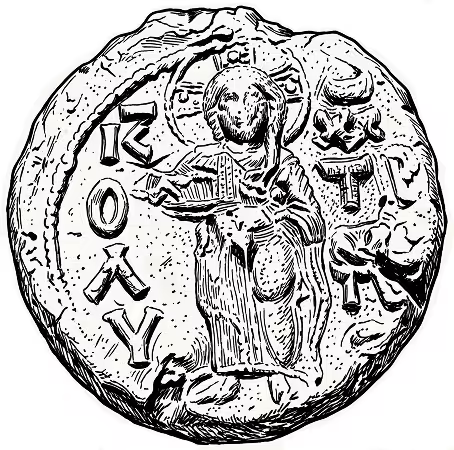
The newly discovered artefact is exceptionally well preserved, retaining detailed relief work on both faces. The lead bulla served to authenticate an official document issued directly by the empress. Although the document itself has decayed over eight centuries, the seal retains its key structural details.
On the obverse, Empress Irene is portrayed full-length, standing upon an oval platform. She wears the ceremonial imperial loros and a high crown known as a modiolus, while holding an imperial sceptre in her hand. The surrounding inscription identifies her as “Irene Komnene, most pious Augusta.”
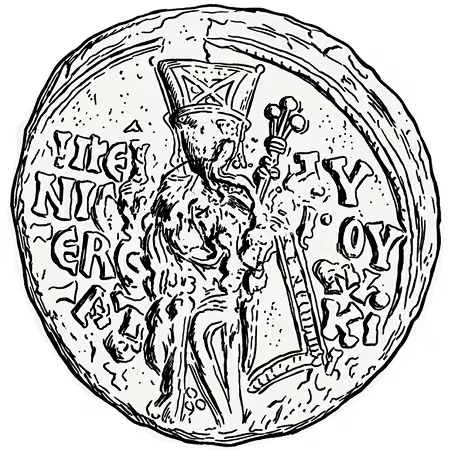
The reverse features a rare iconographic type in Byzantine sigillography. It depicts Jesus Christ standing frontally with a cruciform halo, raising his right hand in blessing and holding the Gospel in his left.
The inscription designates this specific representation as Lytrotes—”The Redeemer”. While images of Christ were standard on imperial Byzantine seals, the Lytrotes composition is extraordinarily uncommon, marking this issue as a deliberate choice for the empress’s personal chancery.
Empress Irene Laskarina and the Nicaean dynasty.
Irene Laskarina occupied a central position within the dynastic network of the Empire of Nicaea, the principal Byzantine successor state formed after Western Crusaders captured Constantinople during the Fourth Crusade in 1204. She was the daughter of Theodore I Laskaris, the founder of the Empire of Nicaea, and descended on her mother’s side from Emperor Alexios III Angelos.
In late 1221 or early 1222, Irene married John III Doukas Vatatzes upon his accession to the throne. Her imperial heritage fortified his legitimacy as ruler, and together they governed during a era of territorial expansion. The couple had one son, the future Emperor Theodore II Laskaris. Shortly after his birth, Irene suffered a severe injury in a riding accident, which left her unable to bear further children.
Byzantine chronicler George Akropolites documented Irene’s intellect and political standing, writing that she possessed a courageous character, conducted herself with imperial majesty, and actively participated in state governance. Akropolites noted her fondness for intellectual debates and her respect for scholars, portraying her as an active partner in imperial policy rather than a passive consort.
Read our dedicated article about the Laskarid-Vatatzes dynasty, which ruled the Empire of Nicaea.
Diplomatic background: The Nicaean-Bulgarian alliance of 1234-1235
The strategic landscape of the Balkans shifted in 1230 when Bulgarian Tsar Ivan Asen II defeated Theodore Komnenos Doukas of Epirus at the Battle of Klokotnitsa. This victory established the Second Bulgarian Empire as a dominant power in southeastern Europe. To counter Latin control of Constantinople and secure his northern frontier, Emperor John III Vatatzes sought a formal alliance with Tarnovo.
Empress Irene played a direct role in the ensuing negotiations between 1233 and 1235. The alliance was finalized through two major diplomatic agreements:
- Dynastic Marriage: The betrothal of Irene’s 11-year-old son, Theodore Laskaris, to Elena Asenina, the young daughter of Tsar Ivan Asen II. Following their marriage at Lampsacus in 1235, Elena was brought to the Nicaean court, where Empress Irene personally oversaw her education and upbringing.
- Ecclesiastical Recognition: The restoration of the independent Bulgarian Patriarchate. At the Council of Lampsacus in 1235, Ecumenical Patriarch Germanos II officially recognized Archbishop Joakim I as Patriarch of the Bulgarians, formally ending the ecclesiastical union with Rome that had been established under Tsar Kaloyan in 1204.
Historical sources do not record a precise date for Empress Irene’s death, though traditional scholarship places it around 1239 or 1240. This places the creation and dispatch of her personal lead seal within the narrow chronological window of active Nicaean-Bulgarian statecraft in the mid-1230s.
Hypotheses on the Perperikon correspondence
The discovery of the seal at Perperikon confirms that official correspondence bearing Irene’s authority reached the settlement, though the precise text of the letter remains lost. During the 13th century, Perperikon functioned as a major fortified center controlling the region of Achridos in the Eastern Rhodope Mountains—a contested border area between the Byzantine region and the Bulgarian state.
Prof. Nikolay Ovcharov has advanced two primary hypotheses regarding the contents of the missing document:
- Ecclesiastical Consultation: Perperikon had been an episcopal seat since Late Antiquity. The letter may have contained instructions or requests for support addressed to local church officials regarding the negotiation to recognize the Bulgarian Patriarchate and break ties with the Papacy.
- Dynastic and Administrative Orders: The letter may have concerned logistical preparations, security, or administrative arrangements for the marriage between Theodore Laskaris and Elena Asenina, requiring local military or civilian authority cooperation along the frontier route.
Perperikon as an administrative hub
The discovery of Empress Irene’s seal adds to a series of sigillographic finds at Perperikon, confirming the site’s role within medieval diplomatic and military communications.
| Ruler / Figure | Artifact Type | Historical Period |
| Anastasius I | Lead Seal | 491-518 |
| Constantine IX Monomachos | Lead Seal | 1042-1055 |
| Andronikos II Palaiologos | Lead Seal | 1282-1328 |
| Tsar Ivan Alexander | Gold Chrysobull | 1331-1371 (Issue date 1344) |
| Empress Irene Laskarina | Lead Seal | c. 1234-1239 |
Previous excavations at the site have unearthed lead seals of Eastern Roman emperors Anastasius I, Constantine IX Monomachos, and Andronikos II Palaiologos, alongside a rare gold seal (chrysobull) issued by Bulgarian Tsar Ivan Alexander in 1344 during the Bulgarian-Byzantine conflict over the region.
The recovery of Irene Laskarina’s seal confirms that Perperikon was integrated into the high-level communications of both the Bulgarian Kingdom and the Empire of Nicaea, serving as a key point of authority in the medieval Balkans.