The Laskarid Dynasty: How a provincial family kept Byzantium alive (1204–1261)
In April 1204, the Fourth Crusade took Constantinople. The Byzantine state broke into pieces. Crusader leaders founded the Latin Empire in the capital and divided much of its territory among themselves. Byzantine elites founded rival states in Epirus, on the Black Sea coast and in western Anatolia.
The Anatolian state, known as the Empire of Nicaea, outlasted the others as a credible claimant to the Byzantine throne. Its rulers came from the Laskaris family. They governed for about fifty-five years, rebuilt the institutions of the empire in exile and prepared the reconquest of Constantinople. They did not complete it. A rival from within the court did, and he ended their dynasty.
In short & Quick facts
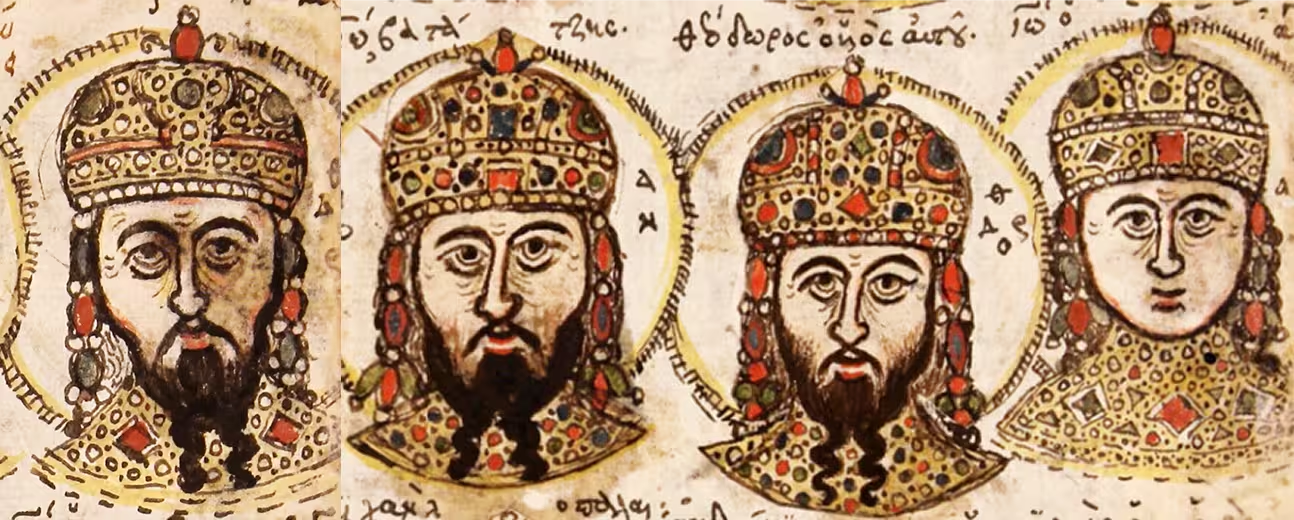
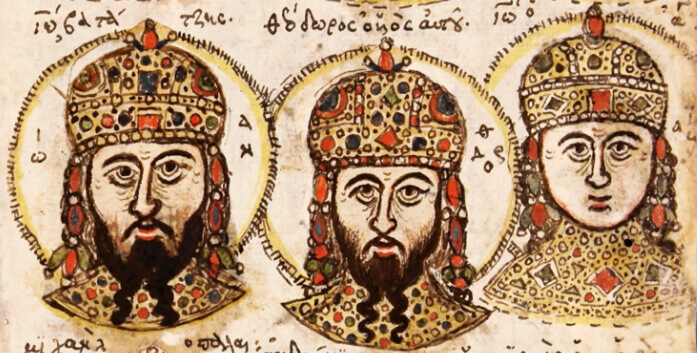
The Laskarid dynasty ruled the Empire of Nicaea from about 1205 to 1261. Four emperors held the throne: Theodore I Laskaris, John III Vatatzes, Theodore II Laskaris and John IV Laskaris. This article follows their rise, their family, the people around them and the places that carry their memory.
Dynasty
Laskarid (Laskaris), with the Vatatzes line by marriage
State
Empire of Nicaea, a Byzantine successor state after 1204
Period
c. 1205–1261 (Theodore I took the imperial title in 1205 and was crowned in 1208)
Capital and residences
Nicaea (modern İznik); Nymphaion (Kemalpaşa) and Magnesia (Manisa) as favoured residences
Emperors
Theodore I (1205–1221), John III Vatatzes (1221–1254), Theodore II (1254–1258), John IV (1258–1261)
Founder
Theodore I Laskaris
Greatest territorial gains
John III Vatatzes: Thrace, much of Macedonia, Thessalonica (1246)
End
Usurpation by Michael VIII Palaiologos (1258–1261)
Successor
Palaiologan dynasty (1261–1453)
Before 1204: origins of the Laskarids
The Laskarids were not an imperial house before 1204. They were not a great house either. Historians describe them as a provincial aristocratic family of limited prominence. Dimiter Angelov notes that no member of the family is known to have reached the upper tier of the Byzantine aristocracy before Theodore I.
The name
The surname first appears in 1059, in the will of Eustathios Boilas. The people named there were peasants, and nothing links them to the later dynasty. A Michael Laskaris appears in Thessalonica in 1180 and another in 1246. Their relation to the imperial family is unclear. The origin of the name is debated. The Oxford Dictionary of Byzantium considers a derivation from the Persian lashkari, “soldier”, the most probable.
Where the family’s roots lay
The sources do not locate the family’s estates with precision. Two points are secure. First, the family had ties to western Asia Minor. Seals of Theodore and Constantine show Saint George with the epithet Diasorites. The epithet points to the monastery of Saint George Diasorites at Pyrgion, in the valley of the Kaystros river in Lydia. Second, the family had ties to Constantinople, where Theodore rose through his relatives. The Maeander valley is sometimes named as the family’s homeland. Firm evidence is lacking.
A possible Komnenian link and an imperial marriage
Theodore was born around 1175. The sources do not record his parents’ names. He and his brothers used the double name Komnenos Laskaris. Scholars usually read this as a sign that their mother came from a branch of the imperial Komnenos clan, a link the brothers chose to advertise. This is an inference from the name. No source names the mother or the branch. A study of Komnenian double surnames on lead seals (Volkoff 2015) discusses the methodological problems of such readings. Many families of the period also traced some link to the Komnenoi, so the connection did not make the Laskarids prominent by itself.
Theodore later named his eldest son Nicholas. By Byzantine custom, this suggests that his own father bore the name. Theodore had several brothers: Constantine, Manuel, Michael, George, Alexios and Isaac. Pachymeres gives Manuel and Michael the extra surname Tzamantouros, which suggests a different mother.
Around 1200, Theodore married Anna Angelina, daughter of the emperor Alexios III Angelos. In or around 1203 he received the court title of despot. The title placed him first in line to succeed his father-in-law. The ceremonial and legal framework of this status is described in our article on imperial power in Byzantium.
Theodore therefore came from a family of limited prominence, with a probable but unproven Komnenian link. He entered the imperial family by marriage. Whether the Laskarids count as obscure depends on the date. Before 1200 they stood outside the top tier. After the marriage they did not. Other families, the Angeloi and the Komnenoi, still had stronger claims to the throne. The events of 1203–1204 changed the odds.
1204: the empire breaks apart
The Fourth Crusade reached Constantinople in 1203, diverted by a dynastic dispute and by debts owed to Venice. The city fell on 12–13 April 1204. The crusaders looted churches, palaces and monasteries over several days. The full chain of events appears in our article on the sack of Constantinople in 1204.
On 12 April 1204, an assembly in Hagia Sophia chose a new emperor. According to Niketas Choniates, the choice lay between Constantine Laskaris and Constantine Doukas. The assembly elected Laskaris, Theodore’s brother. He refused the insignia, urged resistance and left for the Asian shore the next day. Some historians think Theodore, not Constantine, received the nomination. Accounts also differ on whether Theodore left the city before or after the fall. In either case, both brothers ended up in Asia Minor. Theodore began to build a power base in Bithynia and on the Aegean coast.
Three Byzantine successor states
The empire did not disappear. It split into three principal states, each with its own claim to continuity:
- The Empire of Nicaea, in north-western Anatolia, under the Laskarids.
- The Despotate of Epirus, centered around Arta in north-western Greece, under a branch of the Angelos family.
- The Empire of Trebizond, on the south-eastern Black Sea coast, under the Grand Komnenoi.
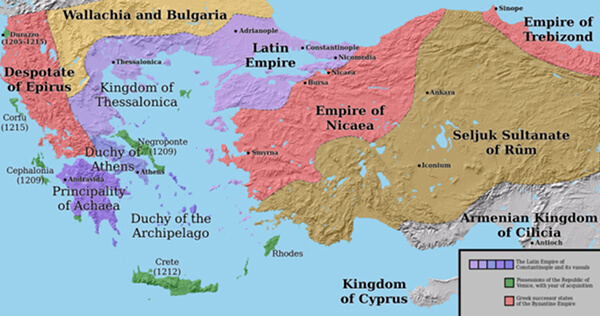
The Latin Empire held Constantinople and parts of Thrace. Bulgaria and the Seljuk Sultanate of Rum added pressure from the north and east. Nicaea started this contest with fewer resources than Epirus. It ended it as the leading state.
Why Nicaea?
Nicaea offered several practical advantages. Its walls were among the strongest in Anatolia. The surrounding plain supported agriculture. The city sat on routes linking the Marmara coast to the interior. It lay about a hundred kilometres from Constantinople, close enough to serve as a base for reconquest. It also carried symbolic weight: the First Council of Nicaea had met there in 325, and the Seventh Ecumenical Council in 787.
After 1204, Nicaea first kept an independent position and accepted Theodore’s authority later. His coronation there in 1208 made it the seat of the patriarchate and the centre of the state’s ceremonial life. Nicaea was not the only centre of Laskarid power, however. The emperors governed from several places, as the section below explains.
The four Laskarid emperors
Modern historians call these rulers “Laskarid emperors”. The label is conventional. John III Vatatzes did not belong to the family by blood. He married Theodore I’s daughter Irene, and later sources and some modern historians sometimes speak of a Laskarid–Vatatzes sequence. The following sections use the traditional grouping.
Theodore I Laskaris (c. 1205–1221): the founder
Theodore I took the imperial title around 1205. The patriarchate of Constantinople, now in exile, was re-established in Nicaea in 1208. The new patriarch, Michael IV Autoreianos, crowned Theodore in that year. The coronation gave the state a formal claim to the legacy of Constantinople.
The early years were hard. In October 1205 the Latin emperor Henry of Flanders defeated Theodore at Adramyttion and took part of the Troad and Bithynia. Theodore had to fight the Latins on one front and the Seljuks on another. In 1211 he defeated the Seljuk sultan Kaykhusraw I at Antioch on the Maeander. Kaykhusraw died in the battle. That result secured the southern frontier. In the same year the Latins won again at the Rhyndacus. Theodore then negotiated. The Treaty of Nymphaion (1214) fixed a border with the Latin Empire in north-western Anatolia and ended open war for a decade.
Theodore died in 1221. He left an organised state, a coronation tradition, a patriarch and an army. He had not retaken any major city from the Latins. His achievement was survival and institution-building.
John III Doukas Vatatzes (1221–1254): the expander
John III Vatatzes came from a military family and rose in the army. He married Irene Laskarina, daughter of Theodore I, and succeeded his father-in-law in 1221. He first faced a rebellion by Theodore’s brothers Alexios and Isaac Laskaris. They had Latin support. In 1224 Vatatzes defeated them and their allies at Poimanenon. That victory ended the Latin threat in Anatolia and opened the way to Europe.
Vatatzes then expanded in three directions. He took islands and coastal towns in the Aegean. He crossed to Thrace in the 1220s and again in the 1230s. In 1235–1236 he allied with the Bulgarian tsar Ivan Asen II and besieged Constantinople, without success. In 1246 he took Thessalonica from the rulers of Epirus. By 1254 Nicaea controlled most of Thrace and Macedonia.
He also reshaped the economy. Contemporary and later historians report that he promoted self-sufficiency on imperial estates, supported agriculture and discouraged the import of foreign luxury goods. He founded hospitals and charitable houses. After his first wife’s death he married Constance, also called Anna, a daughter of the Western emperor Frederick II. That marriage linked Nicaea to the Hohenstaufen court and gave the Laskarid state a diplomatic card against the pope and the Latins.
Vatatzes died on 3 November 1254 at Nymphaion, which he had made his favourite residence. Local tradition honoured him as a saint, known as John the Merciful. The architecture of his residence is discussed in our article on the Byzantine palace of Nymphaion.
Theodore II Laskaris (1254–1258): the scholar-emperor
Theodore II was the son of Vatatzes and Irene Laskarina. He was a trained writer who studied under Nikephoros Blemmydes and George Akropolites. His surviving works include letters, rhetorical pieces and philosophical and theological writing. His reign was short.
He fought Bulgaria in 1255–1256 and recovered territories that his father had held. He tried to limit the power of old aristocratic families. He promoted men of lower origin, among them George Mouzalon, and he did so openly. The aristocracy resented this policy. His health, probably affected by epilepsy, declined during his short reign. He died at Magnesia in August 1258.
Theodore II is often described as a gifted but unstable ruler. His reign left the court divided. The aristocracy had reasons to act when he died and his son was a child.
John IV Laskaris (1258–1261): the child emperor
John IV was born on 25 December 1250 and became emperor at the age of seven. His regent George Mouzalon was murdered by aristocratic conspirators during a memorial service for Theodore II. The nobles then entrusted the regency to Michael Palaiologos, a leading general.
Within months Michael became despot and then co-emperor. He was crowned in January 1259. John IV remained as the formal junior emperor. In 1259 Nicaean forces under Michael’s brother John Palaiologos defeated an alliance of Epirus, Achaea and Sicily at Pelagonia. This victory made Michael’s position at court nearly unassailable.
How the Empire of Nicaea worked
A state without a single centre
The Laskarid state had no Constantinople. In the old empire, one city held the court, the bureaucracy, the treasury, the mint and the patriarch. Nicaea did not replace it. The Laskarids spread these functions across several places and governed by travelling.
| Place | Function |
|---|---|
| Nicaea (İznik) | Formal capital. Coronations. Seat of the patriarch from 1208. Imperial school. Seat of the early mint. |
| Nymphaion (Kemalpaşa) | Palace and favoured winter residence, above all under John III Vatatzes. |
| Magnesia (Manisa) | Imperial treasury. The mint moved here from Nicaea in the course of the thirteenth century. |
| Lampsakos | Summer residence on the Dardanelles. |
| Pegai | Residence used by the court at other times of the year. |
The distances were large. Nicaea and Nymphaion lie about 400 kilometres apart. Under Vatatzes, the emperor sat in the Aegean region while the patriarch and the imperial school stayed in Nicaea. Imperial authority travelled with the court, through officials and through the emperor’s presence in the provinces.
Geography explains part of this choice. The Aegean coast lay far from the Latins and the Seljuks. It was safer than Bithynia, and it was richer. The Laskarid emperors also needed to be near the frontiers they defended, in the north-west against the Latins and in the south against the Seljuks.
Historians read this pattern in different ways. Angelov saw a seasonal movement between Nymphaion and Nicaea. Julia Jedamski argues for a wider network of residences, among them Magnesia, Lampsakos and Philadelphia. Some historians go further and call Magnesia the effective capital under Vatatzes. All agree that the state worked without a fixed centre. Our article on the palace of Nymphaion describes the network of residences in more detail.
Army and frontier
Nicaea relied on a mix of regular troops, mercenaries and frontier soldiers who held land in return for service. Vatatzes strengthened the Anatolian frontier and the Maeander valley. The army defeated the Latins and the Seljuks in the field, and it coped with a new factor after 1243: the arrival of the Mongols, who broke Seljuk power at Köse Dağ.
Administration and economy
The Laskarids rebuilt a smaller version of the Byzantine bureaucracy. Imperial estates, taxation and a mint at Magnesia supported the state. Agriculture formed the base of the economy, with trade through Aegean ports. Michael Angold analysed this system in his study of Nicaea as a “Byzantine government in exile”.
Church and ideology
The Orthodox Church provided legitimacy. The patriarch resided in Nicaea from 1208. Patriarch Germanos II (1223–1240) became a major voice in negotiations with Rome. Dimiter Angelov has shown how Laskarid writers developed a political theory around imperial legitimacy, Hellenic identity and the memory of Constantinople.
Culture and learning
Nicaea preserved Byzantine education. Nikephoros Blemmydes taught and wrote in Ephesus and Nicaea. George Akropolites wrote the main contemporary history of the period. Theodore II patronised both. The dynasty therefore left a literary record as well as a military one.
1258–1261: the end of the dynasty
Michael VIII Palaiologos had strong ties to the court. His wife Theodora Vatatzina was a grand-niece of John III Vatatzes. He used his military reputation and his position as regent and co-emperor to isolate the child emperor.
The key events followed in quick order:
- March 1261: Michael VIII signed the Treaty of Nymphaion with Genoa. The treaty gave Genoese merchants trading privileges in return for naval support against Venice.
- 25 July 1261: the general Alexios Strategopoulos entered Constantinople with a small force and found it lightly defended. Michael VIII entered the city in August and was crowned again in Hagia Sophia, without John IV.
- 25 December 1261: Michael VIII had John IV blinded on the boy’s eleventh birthday and then imprisoned him in a fortress at Dakibyze. John IV lived there for decades.
Patriarch Arsenios Autoreianos excommunicated Michael VIII over the blinding. Michael deposed Arsenios in 1265. The “Arsenite” schism that followed divided the Byzantine Church for decades. The Laskarid story therefore did not end in 1261. It continued as a moral and political problem for the Palaiologoi. For the later history of the empire, see our overview of the late Byzantine period.
After 1261: what happened to the Laskarids?
The dynasty lost the throne in 1261. The family did not disappear. John IV and his supporters remained a political problem for the Palaiologoi. Other Laskarids served the restored empire. Relatives and descendants lived on in Hungary, the Rus’ principalities, Italy, France and Aragon.
John IV and Laskarid loyalism
John IV lived in confinement for decades. Historians place his death around 1305. In 1273, a rescript of Charles of Anjou mentions a report that John had escaped and invites him to the Angevin court. The report proved false, but it shows that the blinded emperor still counted in Western diplomacy.
The blinding caused reactions in Asia Minor, where the Laskarids were popular. In 1295, Laskarid supporters backed the revolt of Alexios Philanthropenos against Andronikos II. The Arsenites, the followers of Patriarch Arsenios, did not reconcile with the Palaiologoi until 1310. In the fourteenth century, a cult of John IV existed at the monastery of Saint Demetrios in Constantinople. A cult of John III Vatatzes had grown up in western Asia Minor even earlier.
Laskarids in Palaiologan Byzantium
The surname survived for two centuries. Under the Palaiologoi, Laskarids held a lower rank than before. They served as provincial governors and courtiers, and as wealthy landowners. Manuel Laskaris held the post of domestic of the schools around 1320. Alexios Laskaris was megas hetaireiarches around 1370.
The Laskaris Leontares family left unusual records. Demetrios Laskaris Leontares (died 1431) advised the emperor John VII and travelled as an envoy to the Ottoman sultan Mehmed I. His family kept chronicles of births and deaths over several generations. John Laskaris Kalopheros (1325/30–1392) was a wealthy aristocrat who converted to Catholicism and served Cyprus, the papacy and Venice. His exact link to the imperial family is unclear. In the fifteenth century, Laskaris Kananos wrote an account of his travels in northern Europe.
The Laskarid blood also ran through the Palaiologan house. Theodora Vatatzina, the wife of Michael VIII, was a grand-niece of John III. Her descendants include Andronikos II and the later Palaiologan emperors.
Descendants abroad
Hungary. Maria Laskarina, daughter of Theodore I, married Béla IV of Hungary around 1218–1220. She was queen from 1235 to 1270 and bore ten children. Her son Stephen V became king. Her daughters Kinga and Margaret became saints of the Catholic Church, and Yolanda became a blessed. Her daughter Constance married Leo I of Galicia. Through these marriages, Theodore I’s descendants entered several royal houses of central and eastern Europe.
Rus’. Two daughters of Maria Laskarina married into Rurikid families. Constance married Leo I of Galicia, who ruled Galicia-Volhynia and held Kiev. Their son Yuri I of Galicia continued the line. Anna married Rostislav Mikhailovich, a Rurikid prince from Chernigov who held the Hungarian ban of Macsó. Their daughter Kunigunda became queen of Bohemia as the wife of Ottokar II. These links reach the south-western Rus’ principalities, in what is now western Ukraine. No direct Laskarid line to the princes of Moscow is documented.
Italy. Eudokia Laskarina, daughter of Theodore II, married Guglielmo Pietro I of Ventimiglia in the 1260s. Sources differ on the exact year. Guglielmo had fought against the Nicaeans at Pelagonia. The sources report that John IV’s sisters were married off in haste to foreigners. This kept their descendants away from any claim to the throne. The Lascaris of Ventimiglia descended from the couple. They ruled the County of Tende until 1501. That year Anne Lascaris married René of Savoy and brought the county to a cadet branch of the House of Savoy. The most famous member of this line was Giovanni Paolo Lascaris, Grand Master of the Knights of Malta from 1636 to 1657. He built the Lascaris towers on the island.
France. Branches of the Lascaris-Vintimille settled in the County of Nice, which belonged to the dukes of Savoy. Charles Emmanuel II of Savoy regarded them as the foremost noble family of the county. Their main monument is the Palais Lascaris in Nice. Jean-Baptiste Lascaris (1600–1650), lord of Castellar and field marshal of the duke of Savoy, began the palace in 1648. The family kept it until the revolutionary period. The city of Nice bought it in 1942, and it now houses a museum of musical instruments. The Lascaris-Vintimille traced their line to Eudokia’s marriage and took the name and arms of the Lascaris. The palace stairway carries busts of imperial ancestors. Tende itself lies in France today.
Aragon. Eudokia Laskarina spent her last years in the Crown of Aragon. She died there around 1309–1311 and went by the name Irene Lascaris. Her descendants married into the Aragonese and Catalan nobility, among them the counts of Pallars-Sobirà and the Montcada and Ayerbe families.
The Renaissance scholars. After the fall of Constantinople in 1453, two scholars bearing the name, Constantine Lascaris and Janus Lascaris, found refuge in Italy. They taught Greek and copied manuscripts. The sources do not establish a direct line from the imperial dynasty to either man, and historians treat the connection with caution.
Other key figures of the era
The emperors have their own sections above. This list covers the people around them: the women of the dynasty, its rivals and officers, and the churchmen and scholars of Nicaea.
Women of the dynasty
| Figure | Role | Why she matters |
|---|---|---|
| Anna Angelina | Wife of Theodore I (c. 1200–c. 1212) | Her marriage linked Theodore to the Angelos house. His claim rested on it. |
| Irene Laskarina | Daughter of Theodore I; empress as wife of John III | Her marriage secured the succession of Vatatzes. She was the mother of Theodore II. |
| Marie de Courtenay | Third wife of Theodore I (m. 1219) | Her marriage tied the dynasty to the Latin imperial milieu. |
| Maria Laskarina | Queen of Hungary (1235–1270) | Mother of Stephen V and of Saints Kinga and Margaret. Her descendants entered several royal houses. |
| Constance (Anna) of Hohenstaufen | Second wife of John III | A daughter of Frederick II. Her marriage opened a channel to the Western emperor. |
| Elena Asenina | Wife of Theodore II | A Bulgarian princess and the mother of John IV. Her marriage sealed an alliance with Ivan Asen II. |
| Eudokia Laskarina | Daughter of Theodore II | Married into the Ventimiglia family. Ancestor of the Lascaris counts of Tende. |
| Theodora Vatatzina | Wife of Michael VIII Palaiologos | A grand-niece of John III. She linked the Vatatzes line to the Palaiologoi and mothered Andronikos II. |
Rivals, officials and commanders
| Figure | Role | Why he matters |
|---|---|---|
| Constantine Laskaris | Brother of Theodore I | Elected emperor in April 1204 and refused. Helped his brother’s campaigns. |
| Alexios and Isaac Laskaris | Brothers of Theodore I | Contested the succession of Vatatzes in 1224 and lost at Poimanenon. |
| George Mouzalon | Regent, 1258 | Favourite of Theodore II. Murdered by nobles within days of the emperor’s death. |
| Michael VIII Palaiologos | Regent, co-emperor, then emperor | Took the throne, recovered Constantinople and blinded John IV. |
| John Palaiologos | General; brother of Michael VIII | Won the battle of Pelagonia in 1259. |
| Alexios Strategopoulos | General | Entered Constantinople in July 1261. |
Churchmen and scholars
| Figure | Role | Why he matters |
|---|---|---|
| Michael IV Autoreianos | Patriarch (from 1208) | Crowned Theodore I in 1208. |
| Germanos II | Patriarch, 1223–1240 | Led Orthodox negotiations with Rome. |
| Arsenios Autoreianos | Patriarch, 1254–1260 and 1261–1265 | Co-guardian of John IV. Excommunicated Michael VIII. Origin of the Arsenite schism. |
| Nikephoros Blemmydes | Monk and scholar | Taught Theodore II. Left an autobiography. |
| George Akropolites | Official and historian | Author of the main contemporary history of the period. |
| Niketas Choniates | Historian and refugee | Recorded the sack of Constantinople and lived in Nicaea afterwards. |
Laskarid sites: cities, palaces, monasteries
The Laskarid state left traces across western Anatolia and beyond. Some sites survive. Others are lost, ruined or identified only through texts. The list below follows the dynasty from its first capital to its last campaigns.
Nicaea (İznik)
Nicaea was the formal capital. It held the patriarchate, the coronation ritual and the imperial school. The emperors spent much of their time elsewhere, above all Vatatzes. The Roman and Byzantine walls remain among the best preserved in Turkey. The church of Hagia Sophia in Nicaea, linked to the council of 787, hosted important ceremonies. The Church of the Koimesis (Dormition), often cited in Laskarid sources, was destroyed in the early twentieth century. Clive Foss’s study remains the standard survey of the city.
Nymphaion (Kemalpaşa)
Nymphaion became the favourite residence of Vatatzes, who died there. Two major treaties carry its name: the one with the Latins in 1214 and the one with Genoa in 1261. Read more in our articles on the city and its role, the imperial palace and the castle of Nymphaion (Nif).
Magnesia ad Sipylum (Manisa)
Magnesia held the imperial treasury and, from the reign of Vatatzes, the main mint. Theodore II used it as a base and died there in 1258. It lay on the road between the Aegean coast and the interior. Some historians describe it as the effective capital under Vatatzes.
Smyrna, Ephesus and the Aegean coast
Smyrna and Ephesus anchored Laskarid control of the Aegean coast. Nikephoros Blemmydes founded a monastery near Ephesus dedicated to Saint Gregory the Wonderworker, where he taught and wrote. Hélène Ahrweiler’s study of the Smyrna region remains the basic reference for the coast under Laskarid rule.
Monasteries linked to the dynasty
- Sosandra: a monastery near Magnesia, founded by Vatatzes. Sources associate it with the burial of the emperor. Its exact location remains debated.
- Lembiotissa: a monastery near Nymphaion. Its surviving documents are a rich source for landholding in the region.
- The monastery of Blemmydes near Ephesus: a centre of teaching and writing in the mid-thirteenth century.
Frontier and expansion sites
- Adramyttion and Lampsakos: contested with the Latins in the early years.
- Poimanenon: site of the victory of 1224; its exact location is uncertain.
- Antioch on the Maeander: site of the victory over Kaykhusraw I in 1211.
- Philadelphia (Alaşehir) and Tripolis: frontier cities in the Maeander and Hermos valleys.
- Thessalonica: taken in 1246; the high point of Vatatzes’ expansion in Europe.
- Constantinople: reconquered in 1261 by a Palaiologan emperor.
- Dakibyze (Gebze region): the fortress where John IV was confined.
Legacy and historiography
Historians debate the meaning of the Laskarid state. Four questions recur in the literature.
Continuity or reinvention? Angold presents Nicaea as a functioning government in exile, which kept the institutions of the old empire alive. Angelov stresses that its writers also invented new arguments for legitimacy in response to the crisis.
Greek identity. Several scholars see in the Nicaean court an early sharpening of Hellenic identity, expressed in Theodore II’s writing and in the court’s rhetoric. Others warn against reading later nationalism back into the thirteenth century.
Why Nicaea and not Epirus? The Epirote state expanded fast in the 1220s and took Thessalonica in 1224. Nicaea won through stronger finances, better administration and the prestige of the patriarchate. The Bulgarian defeat of Epirus at Klokotnitsa in 1230 shifted the balance further.
A missed opportunity? The Laskarid state was strongest around 1254. Its collapse four years later raises the question of whether a stable succession could have preserved the dynasty. Historians usually answer that the policies of Theodore II, the age of John IV and the ambitions of the aristocracy combined to make a change of dynasty likely.
The Palaiologoi governed the restored empire until 1453. Their regime inherited the institutions that the Laskarids had rebuilt, and also the guilt of the blinding of John IV. The late Byzantine empire was in this sense a Laskarid creation, run by a different family.
Frequently asked questions
Who were the Laskarids?
The Laskarids were a Byzantine noble family from Asia Minor. They ruled the Empire of Nicaea, the main Byzantine successor state after the Fourth Crusade, from about 1205 to 1261.
How many Laskarid emperors were there?
Traditionally four: Theodore I Laskaris, John III Vatatzes, Theodore II Laskaris and John IV Laskaris. John III was Theodore I’s son-in-law, so he belonged to the dynasty by marriage.
Where did the Laskarid emperors rule from?
Nicaea was the formal capital and the seat of the patriarch from 1208. It had strong walls, fertile land and symbolic weight as the city of the First Council of 325. The court did not stay there. It moved between Nicaea, Nymphaion, Magnesia, Lampsakos and Pegai. Magnesia held the treasury and the mint, and Nymphaion was the favoured winter residence.
How did the Laskarid dynasty end?
Michael VIII Palaiologos became regent in 1258 and co-emperor in January 1259. His forces recovered Constantinople in July 1261. In December 1261 he had the eleven-year-old John IV blinded and imprisoned.
Did the Laskarids recapture Constantinople?
No. The city fell on 25 July 1261 to the general Alexios Strategopoulos, who served Michael VIII Palaiologos. The Laskarid state had prepared the reconquest, but a Palaiologan emperor completed it.
What happened to the Laskarid family after 1261?
John IV stayed in confinement until about 1305. The name survived in Byzantium for two centuries. Maria Laskarina founded a line in Hungary, and Eudokia Laskarina founded the Lascaris of Ventimiglia, who ruled the County of Tende until 1501.
Sources and further reading
Primary sources
- George Akropolites, The History, trans. Ruth Macrides (Oxford: Oxford University Press, 2007).
- Nikephoros Blemmydes, A Partial Account, trans. Joseph A. Munitiz (Louvain: Spicilegium Sacrum Lovaniense, 1988).
- Niketas Choniates, O City of Byzantium: Annals of Niketas Choniatēs, trans. Harry J. Magoulias (Detroit: Wayne State University Press, 1984).
- George Pachymeres, Relations historiques, ed. and trans. Albert Failler (Paris: Les Belles Lettres, 1984–2000).
- Nikephoros Gregoras, Byzantina Historia.
Modern studies
- Ahrweiler, Hélène. “L’histoire et la géographie de la région de Smyrne entre les deux occupations turques (1081–1317).” Travaux et Mémoires 1 (1965): 1–204.
- Angelov, Dimiter. Imperial Ideology and Political Thought in Byzantium, 1204–1330. Cambridge: Cambridge University Press, 2007.
- Angelov, Dimiter. The Byzantine Hellene: The Life of Emperor Theodore Laskaris and Byzantium in the Thirteenth Century. Cambridge: Cambridge University Press, 2019.
- Angold, Michael. A Byzantine Government in Exile: Government and Society under the Laskarids of Nicaea (1204–1261). Oxford: Oxford University Press, 1975.
- Foss, Clive. Nicaea: A Byzantine Capital and Its Praises. Brookline, MA: Hellenic College Press, 1996.
- Jedamski, Julia. “Nymphaion: A Byzantine Palace in Exile.” Annual of Medieval Studies at CEU (2007).
- Korobeinikov, Dimitri. Byzantium and the Turks in the Thirteenth Century. Oxford: Oxford University Press, 2014.
- Nicol, Donald M. The Last Centuries of Byzantium, 1261–1453. 2nd ed. Cambridge: Cambridge University Press, 1993.
- Puech, Vincent. “The Aristocracy of the Empire of Nicaea.” In Identities and Allegiances in the Eastern Mediterranean after 1204, ed. Judith Herrin and Guillaume Saint-Guillain, 69–80. Farnham: Ashgate, 2011.
- Theodoridis, Dimitri. “Die Herkunft des byzantinischen Familiennamens Λάσκαρις.” Revue des études byzantines 62 (2004): 269–273.
- Volkoff, Angelina Anne. “Komnenian Double Surnames on Lead Seals: Problems of Methodology and Understanding.” Dumbarton Oaks Papers 69 (2015): 197–208.
- The Oxford Dictionary of Byzantium, ed. Alexander Kazhdan. New York: Oxford University Press, 1991 (entries on Laskaris, Theodore I and II, John III Vatatzes, John IV, Nicaea, Nymphaion).