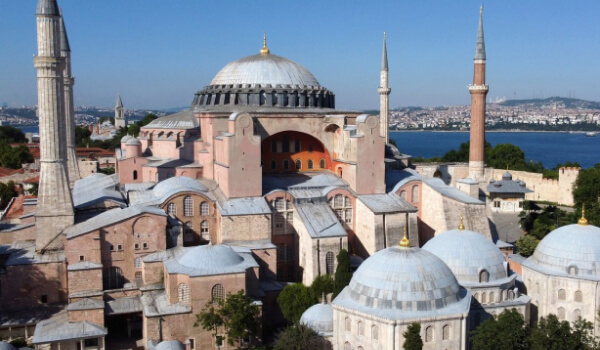
Hagia Sophia: A Complete History of the Great Church
Hagia Sophia — the Great Church of Constantinople — is the most enduring symbol of Byzantine art and architecture, and one of the most remarkable buildings on earth. For nearly a thousand years it was the largest cathedral in Christendom; for nearly five centuries it was a mosque; for most of the last century it was a museum; and since 2020 it is a working mosque once more. Across all of those lives, one thing stays constant: almost every power that has held Hagia Sophia has claimed not to be changing it, but restoring it. This is the story of that endlessly contested masterpiece — and, at the end, everything you need to visit it today.
Planning a visit? Skip straight to the practical info →
Visiting Istanbul? See our complete guide to discover its Byzantine heritage →
Curious about the Byzantine Empire? Discover its complete history →
Plan your visit — the essentials
What it is:
a working mosque — free to enter and pray. Tourists pay €25 to visit the upper galleries, where some of the famous Byzantine mosaics are.
Buy tickets only from the official site:
the Turkish Ministry of Culture’s (seller: DEM Museums). The many near-identical “hagiasophia-…” sites are resellers, not official.
The audio guide is included in the €25 (an AR app in 23 languages) — install it before you go. No paid in-person guides operate inside.
Two queues:
booking online skips the ticket line (walk-up can be 60–90 min in summer) — but everyone still passes through security.
Hours:
summer (Apr–Oct) 08:00–19:00 for tourists; winter from 09:00. Closed to tourists during the five daily prayers; the long closure is Friday 12:00–14:30. Best time: early morning, and avoid Friday midday.
Dress code: shoulders and knees covered (leggings or a long skirt are fine); women cover their hair — free scarves are provided, or bring your own; shoes off on the carpet, so bring socks.
Family & access: under-8s free with ID; strollers folded; the galleries are up a ramp/stairs — check current lift access if needed.
Good to know:
photos allowed (no flash); ignore anyone at the door selling “tours” or scarves — the scarves inside are free. Allow ~30 minutes for a quick look, 60–75 with the audio guide.
Quick facts:
built 537 · architects Anthemius of Tralles & Isidore of Miletus · dome ~31 m, +50 m high · church → mosque 1453 · museum 1935 · mosque again 2020.
Why Hagia Sophia is famous: the dome and the idea of holy light
When the envoys of Prince Vladimir of Kyiv visited Constantinople in the tenth century, they reported back that inside the Great Church they “knew not whether we were in heaven or on earth.” That single sentence — preserved in the Russian Primary Chronicle, and said to have helped decide the conversion of the Rus to Orthodox Christianity — is the most famous testimony to what Hagia Sophia does to the people who stand inside it.
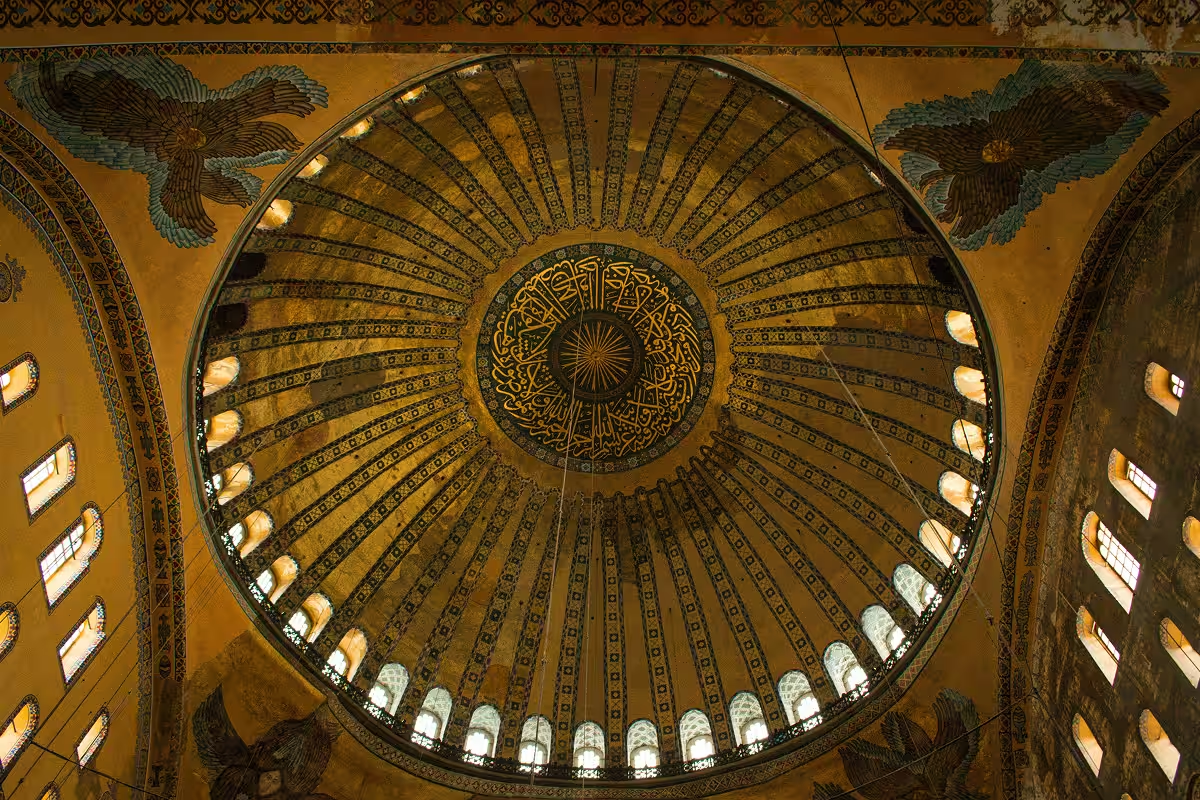
The reason is the dome. It is enormous — roughly 31 metres across (in fact slightly elliptical, about 31.24 by 30.86 metres) and its crown floats more than 50 metres above the floor. But size is not the real achievement. The Romans had built a bigger dome centuries earlier at the Pantheon, where a heavy concrete dome sits on a continuous circular wall, like a lid on a bucket. Hagia Sophia’s architects did something far harder: they set a round dome over a square space, using curved triangular sections called pendentives to carry its weight down onto four great piers. The dome no longer needs a solid ring of wall beneath it. It can hover over open, light-filled space.
And light is the point. A ring of about forty windows runs around the dome’s base, so that the masonry seems to dissolve and the dome appears, in Procopius’s famous image, “to be suspended from heaven by a golden chain.” This was not a happy accident but a deliberate theology, drawing on Christian Neoplatonic ideas of the divine made present as uncreated light. The building is an argument, made in stone and gold, about how heaven touches earth.
Building the Great Church: Justinian’s vision — and the hands that raised it
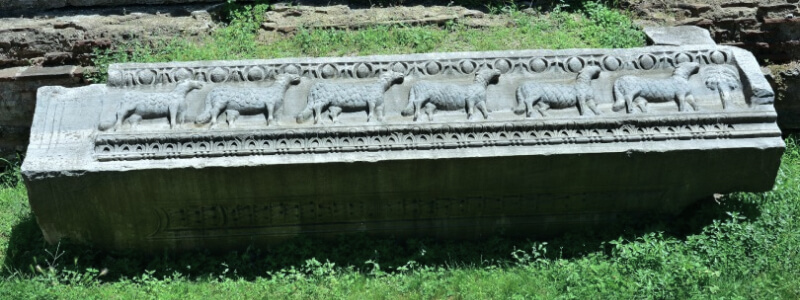
There were two churches on this spot before the one we see. The first, a more traditional basilica known as the Megale Ekklesia (“Great Church”), was most likely completed under Emperor Constantius II around 360. It burned in the riots of 404 that followed the exile of the popular patriarch John Chrysostom. A second church, built under Theodosius II, was dedicated in 415 — and it was this building that was destroyed in the catastrophe that gave us the Hagia Sophia of today.
In January 532 the Nika riots tore Constantinople apart. What began as a quarrel between chariot-racing factions became a week-long uprising against Emperor Justinian I; by the time it was crushed, tens of thousands lay dead and much of the city centre — the Theodosian church among it — was ash. Rather than simply rebuild, Justinian seized the moment to raise something unprecedented. He turned not to a builder but to two thinkers: Anthemius of Tralles, a mathematician, and Isidore of Miletus, a geometer. Our main eyewitness, the historian Procopius, lavished praise on the result — though the same Procopius, in his scandalous Secret History, privately savaged Justinian as a demon in human form, a reminder to read even our best source with care.
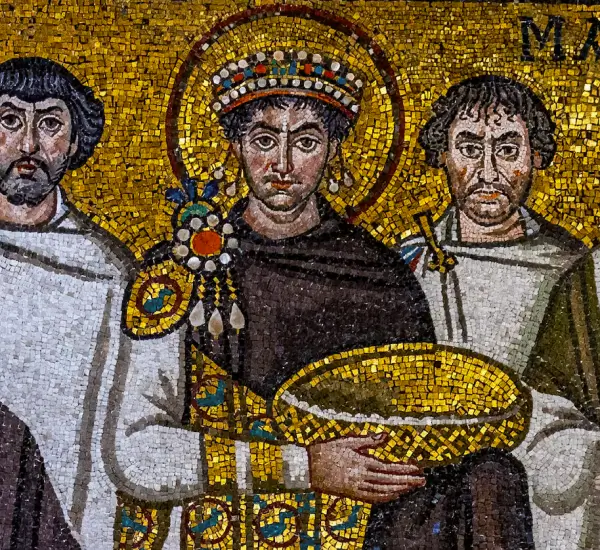
The pace was staggering: the church was raised in under six years and dedicated on 27 December 537. That speed demanded an army of labour and a mountain of money — Procopius speaks of some ten thousand workers. They are almost entirely faceless to us.
The histories name the emperor and his two architects; the men who hauled the stone, mixed the mortar, and set the millions of glass cubes are anonymous, as are the worshippers who would later stand at the back or in the segregated upper galleries reserved for women. The Great Church was built to glorify God and emperor, but it was made by hands history did not bother to record.
Built from the finest materials of the empire
Justinian did not simply build a church; he emptied the Mediterranean into a single room. Imperial agents gathered the rarest stone the empire could quarry, and the effect was a deliberate statement: the whole Roman world, concentrated beneath one dome. Procopius compared walking in to entering a meadow in flower.
The palette was chosen for colour as much as strength. White-and-grey Proconnesian marble from the Sea of Marmara clad the walls and paved the floor; against it ran bands of green verde antico from Thessaly, the imperial purple of Egyptian porphyry, golden giallo antico from Roman North Africa, and the purple-veined white pavonazzetto of Phrygia. The great slabs were sawn and “book-matched” — opened like the pages of a book so their veins mirrored across the wall in patterns that seem almost liquid. Tradition claimed some columns were spoils of the pagan past, the green shafts taken from the Temple of Artemis at Ephesus, the porphyry from a Temple of the Sun.
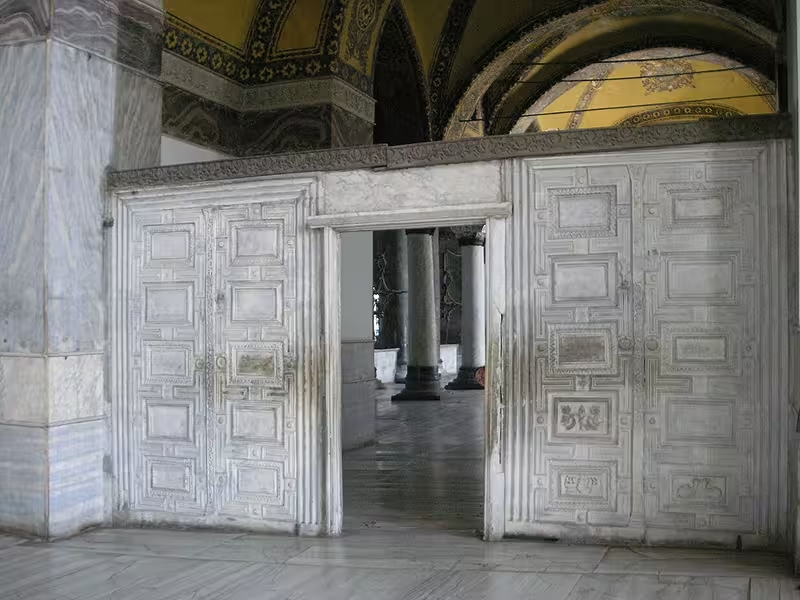
These origin stories are later legends rather than fact, but they capture how the building was understood — the Christian empire absorbing and outshining all that came before. Above the marble, the surfaces dissolved into gold mosaic, and the sanctuary itself was sheathed in silver, so that the holiest part of the church burned brightest of all.
A building that argues with gravity
Hagia Sophia’s audacity came at a price, and its biography is, in large part, a story of earthquakes. The first dome was shallower and even more daring than the one we see; weakened by tremors, it partially collapsed in 558. The rebuilt dome, overseen by Isidore the Younger, was made steeper and ribbed to better resist the outward thrust, and was finished in 562. It would not be the last repair. A major quake in 989 brought down part of the structure again — it was restored by the Armenian architect Trdat, who also worked at the medieval Armenian capital of Ani — and another collapse was repaired in the 1340s.
The building we admire, in other words, is an average of its own catastrophes. Modern engineers, from Rowland Mainstone to teams running computer simulations, have shown that its north and south sides were chronically under-buttressed, and that the dome is measurably no longer a true circle, deformed by centuries of stress. This is not merely historical: Istanbul sits beside the North Anatolian fault, and the next great earthquake is a matter of when, not if. The question of how to safeguard Hagia Sophia is the same whether you call the building a mosque, a museum, or a monument — which is exactly why its stewardship is so fiercely contested.
The heart of Orthodox Christendom: cathedral, patriarchate, and coronations
For most of its Byzantine life — close to nine hundred years — Hagia Sophia was not one church among many but the church: the cathedral of Constantinople and the seat of the Ecumenical Patriarch, the senior bishop of the Eastern Christian world. To stand here was to stand at the centre of Orthodox Christianity, the place from which its liturgy, art, and authority radiated outward to Kyiv, the Balkans, and beyond.
It was also the stage on which the empire performed itself. Emperors were crowned beneath the dome, and a great disc of coloured marble set into the nave floor — the omphalion, the “navel” — is traditionally identified as the spot where the new ruler stood to receive the crown. Coronations, imperial processions, and victory liturgies all moved through this space in a choreography that fused church and state into a single act: in Byzantium, the sacred and the political were never truly separate, and Hagia Sophia was where the two met. Its turning points were world-historical. In 1054, legates of the Pope laid a bull of excommunication on the high altar — an act that came to symbolise the great schism between the Catholic and Orthodox churches. And on the night of 28–29 May 1453, as Ottoman troops breached the walls, the last Christian liturgy ever sung in Hagia Sophia rose from a church packed with the terrified faithful.
Iconoclasm: images erased, then restored
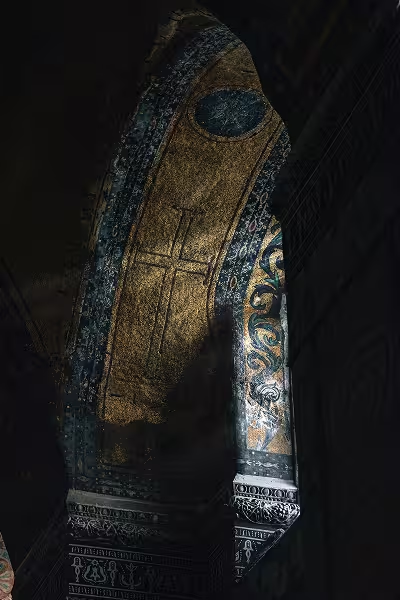
The interior decoration we picture today — gold grounds crowded with sacred figures — was not Justinian’s. His sixth-century mosaics were largely non-figurative: crosses, geometric patterns, and great fields of plain gold. That restraint partly reflected a deep unease within Christianity about religious images, which erupted in the eighth and ninth centuries into the crisis of Iconoclasm, when imperial decree ordered figural images destroyed. The Iconoclasts did not see themselves as vandals; they called the stripping of images a purification — a restoration of true worship. It is the first instance of the pattern that runs through this building’s whole history.
Read more about a unique example of iconoclastic art in Hagia Irene, another Byzantine church near Hagia Sophia.
When the image-venerators finally won, in 843, Hagia Sophia became the showcase of their victory. The great mosaic of the Virgin and Child in the apse, unveiled in 867, was celebrated in a sermon by the Patriarch Photios as the return of the holy images — and it survives, high above the sanctuary, as a monument to the end of iconoclasm.
The mosaics, in short, are not just decoration. They are the visible record of an argument about the nature of the divine that nearly tore the empire apart.
Inside the Great Church: liturgy, space, and the imperial mosaics
Hagia Sophia takes first place in our guide to the most beautiful Byzantine mosaics you can still see — the only building where the art’s entire history survives under one dome.
To understand the interior you have to put the vanished liturgy back into it. Byzantine worship was processional and theatrical: clergy moved through the nave in the Great Entrance, along a raised walkway (the solea) between the pulpit (the ambo) and the sanctuary, chanting into an acoustic built for reverberation. The space was designed to overwhelm — and recent scholarship, notably by Bissera Pentcheva, has reconstructed how sound and shifting light made the whole interior feel alive, less a room than an event.
Onto this Justinianic shell, later centuries added the figural masterpieces visitors come to see. Over the Imperial Gate, an emperor — generally identified as Leo VI — bows before Christ in humility. In the south gallery, the Zoe panel shows the empress Zoe and her husband flanking Christ, the husband’s face and name notoriously altered as Zoe changed spouses. Nearby, the Komnenos panel presents John II and the empress Eirene with the Virgin, and the Deesis — Christ between the Virgin and John the Baptist, probably from the thirteenth century — counts among the supreme achievements of Byzantine art, its faces rendered with an almost unbearable tenderness. These were never mere portraits; they were arguments about sacred kingship, the emperor shown as God’s deputy on earth.
-
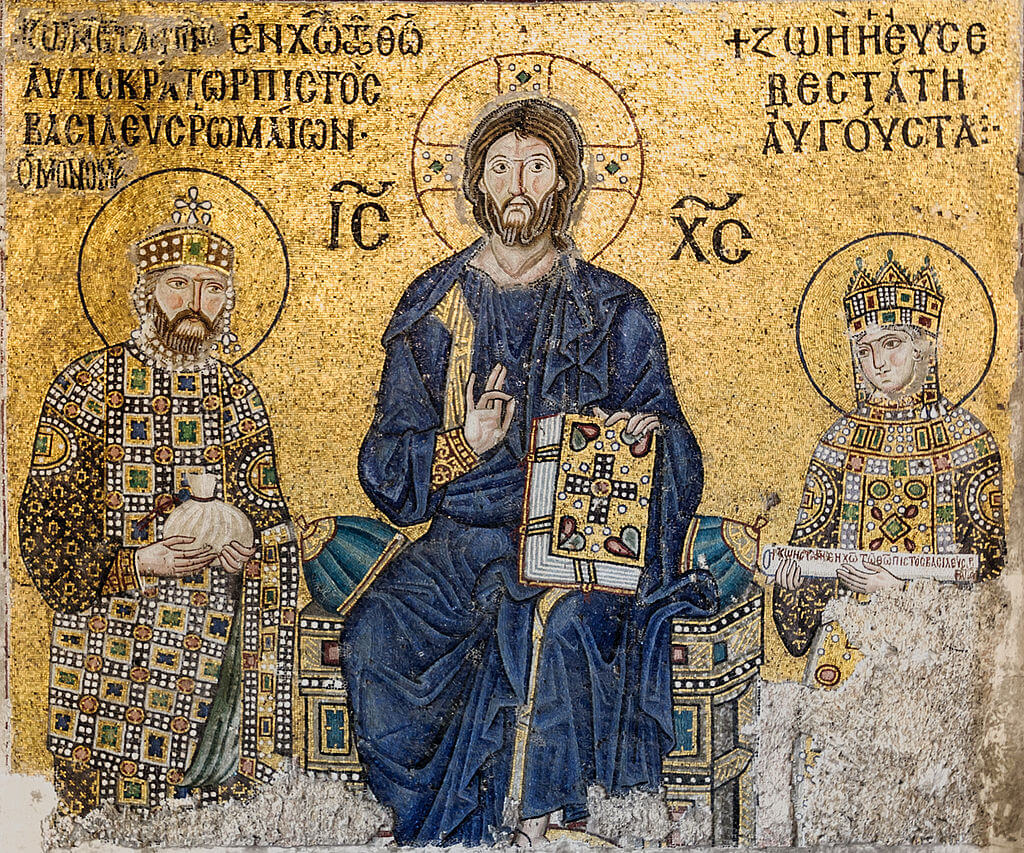
The mosaic of Zoe Porphyrogenita and her husbands with Christ in Hagia Sophia
Discover the mosaic of Zoe Porphyrogenita and her husbands with Christ in Hagia Sophia, a testament to the end of the Macedonian dynasty.
-
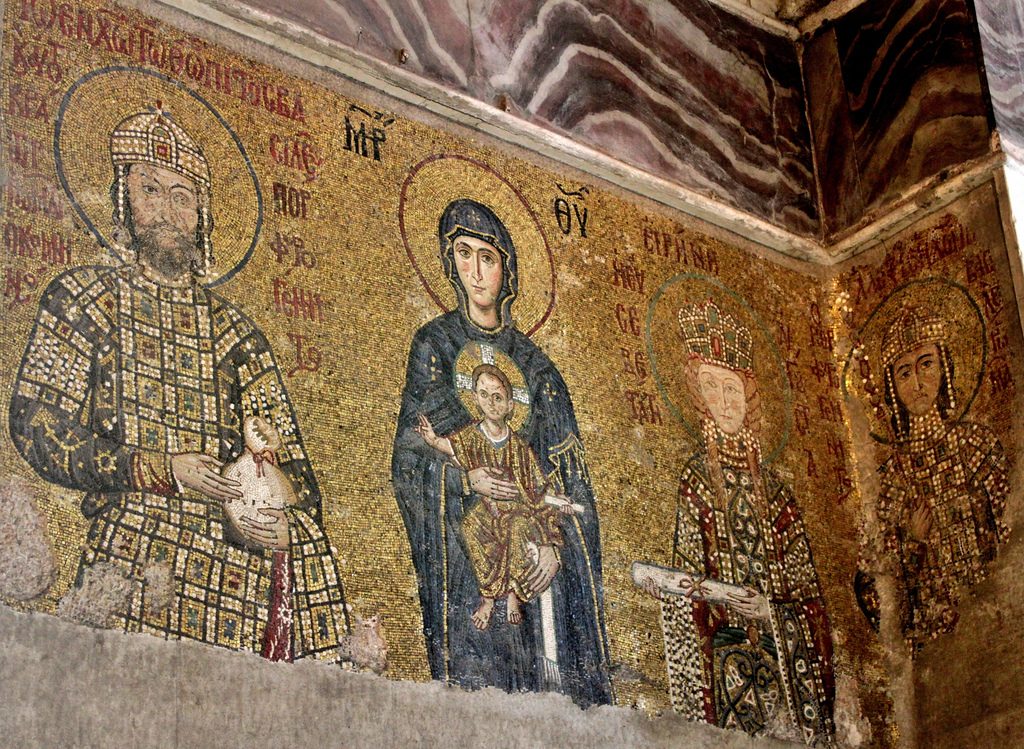
The Komnenos mosaic in Hagia Sophia : John II, Irene, Alexios, the Theotokos and Child
The Komnenos mosaic in Hagia Sophia is the only 12th-c. mosaic surviving in Istanbul, and shows prominent members of the dynasty with the Theotokos.
What was lost: relics, treasury, and the sack of 1204
Before the thirteenth century, Hagia Sophia was not only a building but a treasury of holy things — among the richest reliquary churches in all of Christendom, holding fragments said to come from the True Cross and drawing pilgrims from across the Christian world. To feel the scale of what happened next, you have to picture that wealth intact.
In 1204 the soldiers of the Fourth Crusade — Western Christians who never reached the Holy Land — turned instead on Constantinople and sacked the greatest Christian city on earth. Hagia Sophia was stripped and desecrated; its treasures were carried west, and to this day Venice is in part a museum of that plunder, from the enamels worked into the Pala d’Oro of St Mark’s to the bronze horses looted from the city’s Hippodrome. A Latin regime ruled Constantinople until 1261. The most startling physical trace of all sits in the south gallery: a tomb marker for Enrico Dandolo, the blind Doge of Venice who steered the crusade onto the city — the one man buried inside the church he helped to ravage.
From church to mosque: the Ottoman dialogue
When Mehmed II took Constantinople in 1453 and converted Hagia Sophia into a mosque, he too framed the act as preservation rather than destruction — the building’s rescuer, not its conqueror. And the Ottomans did far more than repurpose it: they spent centuries in conversation with it. The greatest of all Ottoman architects, Sinan, treated Hagia Sophia as the rival to beat, and his masterpieces — the Süleymaniye in Istanbul, and arguably the Selimiye at Edirne, where he finally surpassed its dome — are answers to it. Sinan also shored it up, adding buttresses that helped keep the ancient structure standing.
The Ottoman layer is part of what makes the interior so extraordinary. A mihrab marks the direction of Mecca, set slightly off the building’s axis (which points to the old Christian east); a minbar (pulpit), a sultan’s gallery, and four minarets added across different reigns reframed the church as a mosque.
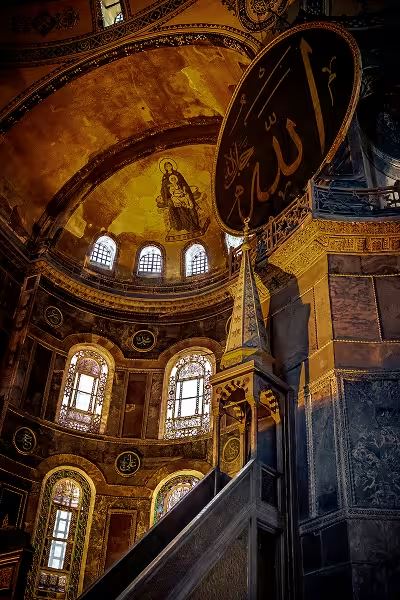
Above all hang the colossal calligraphic roundels, among the largest in the Islamic world, inscribed with the names of God, Muhammad, and the early caliphs — added in the nineteenth century during the great restoration by the Swiss-Italian Fossati brothers. The building is a true palimpsest, and the Ottoman centuries are not an interruption in its story, just another of its rich chapters.
Lost and rediscovered: how the mosaics came back to light
Here is a fact that surprises most visitors: the Byzantine mosaics you can see today are, in large part, a twentieth-century rediscovery.
Over the Ottoman centuries the figural images were gradually plastered over, and many would have been lost to memory entirely but for two acts of documentation and recovery. When the Fossati brothers restored the building in 1847–49, they recorded mosaics they then covered again — and their drawings are, for some images, our only record. Then, from 1931, Thomas Whittemore and the Byzantine Institute of America began carefully removing plaster to reveal the Deesis, the imperial panels, and the apse Virgin, a campaign made possible by a delicate arrangement with the new Turkish Republic.
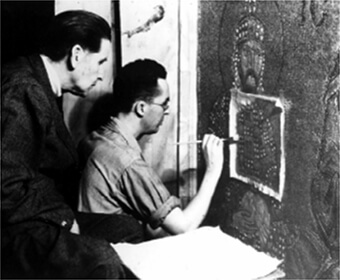
This is why the mosaics survive at all. What you see is original Byzantine work, cleaned and uncovered by the Institute and documented as they went — though some of it is fragmentary, with portions lost over the centuries. The Deesis is the clearest case: its lower half is gone, leaving a genuine thirteenth-century masterpiece that simply survives in part.
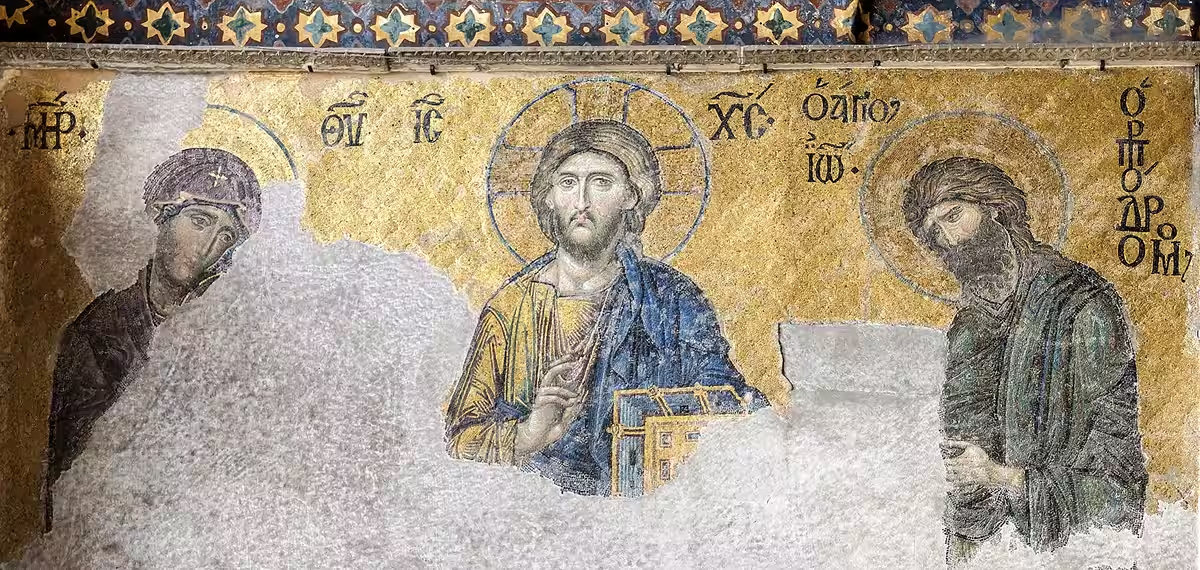
And the uncovering is far from finished. A good deal of mosaic almost certainly still lies hidden beneath Ottoman plaster and paint, waiting to be revealed. The most tantalising gap of all is the dome itself, which once carried a colossal image at its summit — a cross in Justinian’s day, and most probably a figure of Christ added in later centuries — now concealed beneath the great calligraphic inscription that crowns it today. Exactly what survives up there, no one yet knows.
Museum and reconversion: 1934 to today
In 1934 the government of Atatürk‘s new secular republic issued a decree turning the mosque into a museum, which opened to the public in 1935; Atatürk, too, cast the change as a kind of restoration — a gift of the monument to humanity. For eighty-five years Hagia Sophia stood as a museum, a meeting point of two faiths and a symbol of a secular Turkey, drawing millions of visitors a year.
In July 2020, a Turkish court annulled the 1934 decree and the building was reconverted into a working mosque. The decision is best understood honestly, holding several truths at once: it was within Turkey’s sovereign rights; it was experienced by many around the world as a heritage loss; and it was, unmistakably, a political act — the move of President Erdoğan’s conservative government to chip away at the secular legacy of Atatürk, who had made the museum one of the founding gestures of his republic. Pretending the building was ever not political would be the real naïveté. One detail captures the deep strangeness of its layered history: during Muslim prayer, the figural Christian mosaics are now veiled with curtains — a practice that, as art historians have pointed out, echoes Byzantine traditions of curtaining holy icons far more than any Ottoman custom. Today Hagia Sophia is once again a place of living prayer, as it was for most of its history before 1934. Its preservation, however, remains a real concern: the sheer flow of visitors is proving difficult for the old building to sustain.
The afterlife: a dome that reorganised the world
Few buildings have cast a longer shadow. Sinan’s lifelong contest with the pendentive dome reshaped the skyline of the entire Ottoman world, and through it the form of the mosque itself. Beyond Turkey, Hagia Sophia became an idea as much as a place. For centuries Russians dreamed of restoring the cross to its dome and called Constantinople “Tsargrad,” the imperial city; Greek nationalism nursed the Megali Idea of recovering it; and from the nineteenth century a wave of Neo-Byzantine architecture — from Westminster Cathedral in London to great cathedrals in Russia and the United States — borrowed its domes and its glittering interiors. Hagia Sophia is a building that three modern nations have each claimed as a piece of their own soul.
Tombs, legends, and curiosities
A building this old gathers stories, and part of Hagia Sophia’s spell lies in the small, strange traces left by the people who passed through it.
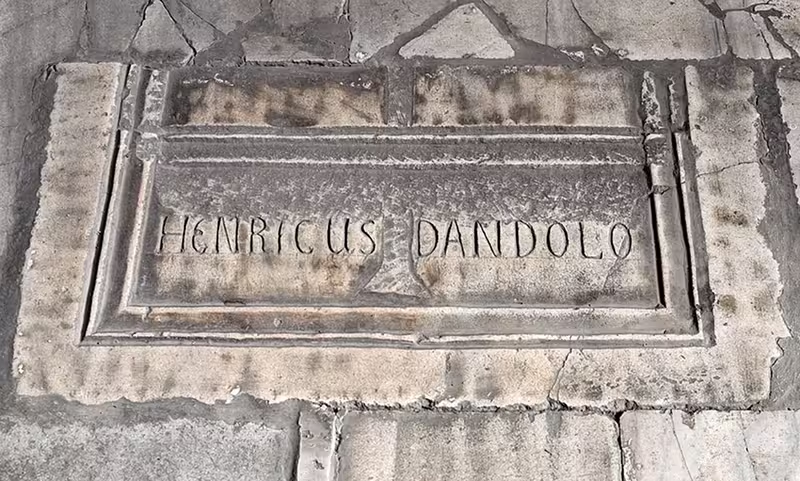
In the upper south gallery, a plain marble marker carries a single name: Henricus Dandolo — the grave of the very Doge who sacked the church in 1204, the only person ever buried inside it.
Legend has it that after the reconquest of the city by the Byzantines in 1261, his bones were dug up and scattered, even thrown to the dogs.
Near the northwest of the nave stands the weeping column, sheathed in bronze and pierced by a worn hole said to be perpetually damp. For centuries visitors have pressed a thumb into it and turned their hand, making a wish or hoping for healing — a small, very human ritual worn into the stone of an imperial cathedral.
The most haunting legend belongs to 1453. As Ottoman soldiers broke in during the final liturgy, a priest is said to have walked into the sanctuary wall, which opened to receive him and sealed shut — and he waits there still, to step out and finish the interrupted service on the day the city becomes Christian again. The story tells us less about history than about how deeply the loss of the Great Church was felt. In a lighter key, tradition has it that Justinian, entering his finished church in 537, cried out “Solomon, I have surpassed thee!” — almost certainly a later invention, but a perfect snapshot of the building’s ambition. (Both tales are legend, not record.)
And high in the south gallery, a line of runic graffiti — best read as “Halfdan was here” — was scratched, most likely, by a bored Norse soldier of the Varangian Guard, the emperor’s elite Scandinavian mercenaries: medieval tourist graffiti, and a reminder of just how far Constantinople’s reach extended.
Visiting Hagia Sophia today
All practical details verified June 2026 — prices and hours can change, so check the official site before you travel.
Tickets and avoiding the resellers
Hagia Sophia is a working mosque: entering to pray is free. Tourists buy a €25 ticket to the upper galleries, which includes an AR audio guide app in 23 languages — there is no extra charge for it and no paid in-person guides operate inside. Buy only through the official channel, the Ministry of Culture’s muze.gen.tr (online seller: DEM Museums). Be wary of the many lookalike “hagiasophia-…” sites, which are resellers adding a markup; legitimate platforms such as GetYourGuide are a reasonable third-party option if you want a packaged skip-the-line ticket, but they are not the official seller. Official tickets are typically non-refundable, while third-party tours often allow cancellation up to 24 hours ahead.
Hours, prayer closures, and the two queues
Tourist hours run roughly 08:00–19:00 in summer (April–October) and from 09:00 in winter. As an active mosque, Hagia Sophia closes to tourists during the five daily prayers, and the longest closure is the Friday midday prayer, about 12:00–14:30, when no tourists are admitted at all. Aim for early morning and avoid Friday lunchtime. Note that booking online only skips the ticket queue (which can run 60–90 minutes in peak summer) — everyone still passes through a security check.
What you can — and can’t — see now
Since 2024, tourists visit the upper gallery, while the ground floor is reserved for worship. The good news is that the gallery is where the great surviving mosaics are: the Deesis, the Zoe and Komnenos panels, and the view across to the apse Virgin, all uncovered during tourist hours. The Leo VI mosaic over the Imperial Gate, on the ground floor, is not on the tourist route.
Dress code, families, and etiquette
Cover shoulders and knees; leggings or a long skirt are fine. Women cover their hair — free scarves are available at the entrance, or bring your own to save time. You’ll remove your shoes on the carpeted areas, so bring socks. Children under 8 enter free (carry ID), strollers should be folded, and the galleries are reached by a ramp/stairs — check current lift access if anyone in your group has limited mobility. Photography is allowed without flash; be discreet during prayer, and ignore anyone outside offering “guides” or selling scarves.
While you’re there
Hagia Sophia sits in Sultanahmet (tram stop of the same name), and three of Istanbul’s other great sights are a few minutes’ walk away: the Blue Mosque across the square, Topkapı Palace, and the Basilica Cistern — easily a half-day together. If you only compare two, note that the Blue Mosque is the younger, purpose-built Ottoman answer to the church you’ve just seen.
Frequently asked questions
Who built Hagia Sophia?
The present building was commissioned by Emperor Justinian I and designed by Anthemius of Tralles and Isidore of Miletus, completed in 537. Two earlier churches stood on the site before it.
What does “Hagia Sophia” mean?
“Holy Wisdom.” It is dedicated not to a saint named Sophia but to Christ as the Wisdom (Logos) of God.
Is Hagia Sophia a mosque or a museum?
It is a working mosque. It was a church (537–1453), a mosque (1453–1934), a museum (1935–2020), and a mosque again since 2020.
Do I need a ticket, and where do I buy it?
Praying is free; tourists pay €25 for the upper galleries. Buy only from the official site, muze.gen.tr (DEM Museums) — most “hagiasophia-…” sites are resellers.
Is the audio guide free?
Yes — AR audio guide app is included in the €25 ticket.
Can tourists still see the mosaics?
Yes. The major mosaics are in the upper gallery, open to tourists and uncovered during visiting hours; the ground floor is reserved for worship.
Can women enter without a headscarf?
Hair should be covered; free scarves are provided at the entrance if you don’t have your own.
Is it open on Fridays?
Yes, but not to tourists during the midday prayer, roughly 12:00–14:30.
How big is the dome?
About 31 metres across (slightly elliptical, ~31.24 × 30.86 m) and over 50 metres high.
Further reading and sources
For those who want to go deeper, the essential modern authorities include Cyril Mango and Robert Ousterhout on Byzantine architecture, Rowland Mainstone on the structure of the dome, and Bissera Pentcheva and Nadine Schibille on the building’s light and sensory experience. The two great primary descriptions are Procopius‘s Buildings and Paul the Silentiary‘s ekphrasis, composed for the rededication of 562.