Paliachora, Aegina: The Byzantine and Post-Byzantine Ghost Town, Church by Church
Above the modern monastery of Agios Nektarios, on a hill overlooking Aegina town and the Saronic Gulf, a scatter of roofless churches marks the site of an entire abandoned town. This is Paliachora, sometimes written Palaiochora or Paleochora — Aegina’s main settlement for close to nine hundred years, nicknamed the “Mystras of the Saronic Gulf.” Thirty-five churches still stand on the hillside today, and it is tempting, walking among them, to call the whole site Byzantine. The reality refects a more complicated – and tragic – history. In fact, very few of the churches preserved on the hill of Paliachora date from before the middle of the 15th century. This guide decrypts for you what is genuinely Byzantine and medieval, from the much larger, later layer of Venetian and Ottoman-period rebuilding that makes up most of what you actually see.
Palaichora in brief
Location
Hill above the monastery of Agios Nektarios, north Aegina, summit at 355 m
Founded
Probably late 9th century, after repeated Arab/Saracen raids emptied Aegina’s coastal town
Inhabited until
Early 19th century (final abandonment by around 1826–1830)
Churches surviving today
35 (popular legend claims 365; the real historical total is estimated closer to 50)
Genuinely Byzantine-period core
A small group with 13th-century origins: the twin church of Agios Georgios & Agios Dimitrios (1292–93), the Taxiarchs below the castle, the original phase of Panagia Episkopi, and the earliest fresco layer at Agios Nikolaos
Castle
Built 1462, funded by Venice in exchange for the skull relic of St. George, now held at San Giorgio Maggiore, Venice
Nickname
“The Mystras of the Saronic Gulf”
Major destructions
1537 (Hayreddin Barbarossa); 1654 (Francesco Morosini)
After abandonment
Population resettled around Aegina’s harbor, briefly the first capital of the modern Greek state (1826–1828)
Getting there
Paliachora sits inland, in the north of Aegina, on a hill rising to 355 meters — a location chosen precisely because it could not be seen from the sea. The easiest approach is from the monastery of Agios Nektarios, a major pilgrimage site in its own right, a short drive or taxi ride from Aegina town; a signposted path climbs from there into the ruins. There is no entrance fee and no fixed opening hours, since the site is an open hillside rather than an enclosed archaeological park, but it is exposed and shadeless — go with water, sturdy shoes, and, in summer, an early start.
Visiting Paliachora today
Most of what a visitor actually walks through and photographs at Paliachora — the standing walls, the great majority of its 35 churches, the layered defensive rings of the castle — dates from the 15th century onward, and much of it from the 17th and 18th. The Byzantine period gave the site its reason for existing and its earliest core, but left comparatively little of what is physically visible today: that is mostly the product of Venetian money, repeated Ottoman and Venetian destruction, and repeated rebuilding after each one. If it’s specifically the Byzantine and immediately post-Byzantine layer you want to see, the churches worth deliberately seeking out are the twin church of Agios Georgios and Agios Dimitrios on the acropolis, the Taxiarchs below the castle, Panagia Episkopi, and — outside the walls, near the Mesagros road — Agios Nikolaos of the Mavrikas family, whose fresco layers alone span from the 12th century to the 16th.
Byzantine origins: why the town exists
Paliachora’s earliest story is genuinely unknown. The Aeginetans most likely began settling this steep, inland hill toward the end of the 9th century, after repeated raids by Arab pirates made the island’s coastal town untenable. The site itself was not new: Early Christian marble architectural fragments found there point to continuous building activity going back to antiquity, so the 9th-century settlers were reoccupying and building over ground that already had a long history, not founding a town from nothing. Two natural springs near the site of the later castle, together with wells, cisterns, and natural rock-cut reservoirs known locally as souvales, secured a reliable water supply — a decisive practical advantage for a hilltop refuge.
It is worth stating plainly what the sources do, and do not, tell us about the centuries that followed. No direct documentary evidence survives from the Middle Byzantine period down to 1204, and very few of the 35 churches still standing on the hill today date from before the middle of the 15th century. In other words: Paliachora’s founding and its earliest purpose belong squarely to Byzantium, but most of what a visitor actually sees standing on the hillside was built, rebuilt, or repainted long after Byzantine rule over the island had ended.
After Byzantium: the castle and five centuries of sieges
Paliachora’s stone castle was built in 1462, during the first period of Venetian rule over Aegina (1451–1540), with money the Venetians provided in a striking exchange: the town’s relic, the skull of St. George — kept at Agios Georgios Katholikos, and originally brought to Aegina from the castle of Livadia, probably in the 14th century, during a period of Catalan rule when the Catalans held St. George in particular veneration — was handed over and transported to the church of San Giorgio Maggiore in Venice, where it remains today. Every noble family of Paliachora is said to have received 100 ducats from these funds, money used to fortify the summit of the hill.
The fortress did not save the town from catastrophe. In 1537, Suleiman the Magnificent sent the corsair Hayreddin Barbarossa to destroy Venetian bases across Greece in retaliation against the Republic; Barbarossa took Paliachora and left nothing standing. The following year, the French Baron Blancard visited and found not a single living soul. In 1540 Venice formally ceded Aegina to the Ottomans, and the town began to be rebuilt almost immediately: churches were repaired, new houses went up, and by 1555, when the French traveler André Thevet passed through, Paliachora was reconstructed and well inhabited again.
In 1654, disaster struck a second time. The Venetian senate sent the admiral Francesco Morosini to clear the Aegean archipelago of piracy — in which Aegina’s own inhabitants had become entangled — and when the island did not surrender easily, Morosini captured Paliachora, badly damaged its fortifications, plundered and destroyed the town, and carried off a number of its people as prisoners of war. When the English traveler George Wheler visited in 1676, little remained standing inside the castle beyond five cisterns, sixty houses, and the twin church of Agios Georgios and Agios Dimitrios described below, though he reports some 800 houses, mostly ruined, surviving in the wider settlement outside the citadel.
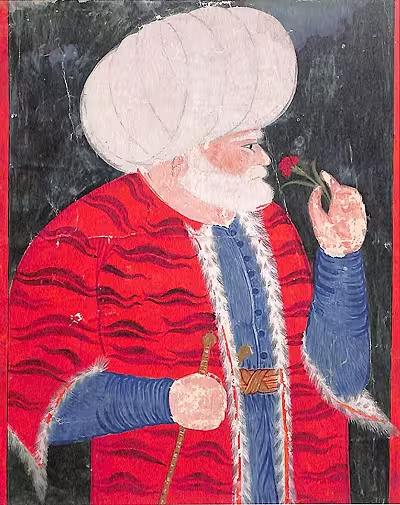
Admiral Hayreddin Barbarossa, painted by Haydar Reis c. 1540. 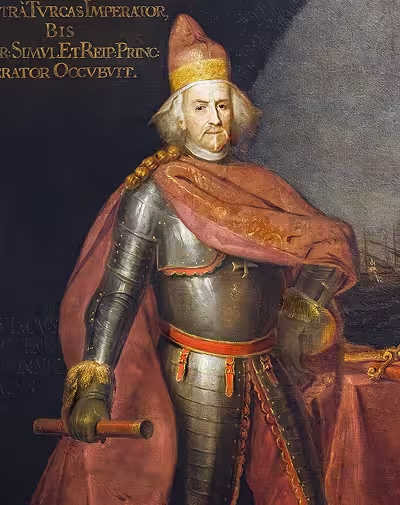
Portrait of the doge Francesco Morosini, Museo Correr, Venice.
A second period of Venetian rule, from 1687 to 1715, brought a real if partial recovery. A second, longer period of Ottoman rule followed, from 1715 to 1825, with mixed fortunes: at one point, an Ottoman traveler identified in the sources as Evliya Çelebi gave an admiring account of the fortress and its roughly 500 surviving stone houses, most belonging to the town’s non-Muslim (reaya) population. A note on this date: the historical Evliya Çelebi is documented as active in the 17th century (he died around 1682), so an account of him visiting Paliachora “about the middle of the 18th century” — as our source states — cannot be correct as written. We flag this as a likely date error in the transmitted account rather than silently correct it, since we cannot currently confirm which detail (the traveler’s identity or the date) is mistaken.
By the early 19th century, the picture had turned decisively bleak. In 1817, the French officer and traveler Puillon de Boblaye described Paliachora as ruined, with only around 80 houses remaining; by 1830, the British traveler Thomas Abercromby Trant found the settlement entirely abandoned. After Greek independence, the town’s last remaining residents moved down to Aegina’s ancient coastal capital — which, only a few years earlier, had briefly served as the first capital of the modern Greek state, from 1826 to 1828.
Against that backdrop of relic ransoms, sieges, and repeated rebuilding, the handful of buildings below matter precisely because they are the exceptions — what can still be traced back to Paliachora’s Byzantine beginnings, underneath everything that came after.
The genuinely Byzantine monuments
These are the buildings at Paliachora with a documented or architecturally clear connection to the Byzantine period — mostly the late 13th century, when the island was nominally under Frankish rule but its churches were still being built, inscribed, and endowed by families of unmistakably Byzantine background.
The twin church of Agios Georgios and Agios Dimitrios, and the Bryennios inscription
On Paliachora’s acropolis, alongside the remains of a water reservoir and traces of settlement, stands a twin-aisled church known today as Agios Georgios and Agios Dimitrios. Built into its exterior south wall is a marble inscription dated 1292–1293, recording the erection of “the venerable church of the Archangel Michael” by a patron named Konstantinos Bryennios. The Bryennioi were one of the great aristocratic families of the Byzantine world; their presence on Aegina nearly a century after the Fourth Crusade is strong evidence that prominent Byzantine families continued to live on the island, or kept ties to it, despite Frankish rule. The same conclusion follows from an almost exactly contemporary case: the Samalas, or Zygomalas, family name inscribed at Omorphi Ekklisia in Aegina town, just three or four years earlier, in 1289.
The Church of the Taxiarchs, below the castle
Not to be confused with the Church of the Taxiarchs on Mount Oros, a separate building also on Aegina, with its own dedicated article. Both share the same dedication, to the Archangels, but are different churches in different parts of the island.
Descending from the acropolis toward the castle, a domed cruciform church dedicated to the Taxiarchs is possibly the earliest surviving church at Paliachora. It is dated to the end of the 13th century on comparative grounds, by analogy with the Bryennios inscription of 1292–93 at the twin church above. An early Byzantine colonnette, reused in the building’s fabric, adds further, if circumstantial, support for an early date. Beyond its dating and this piece of spolia, little further architectural or painted detail is currently documented — this is a genuine Byzantine monument, maybe the oldest on site.
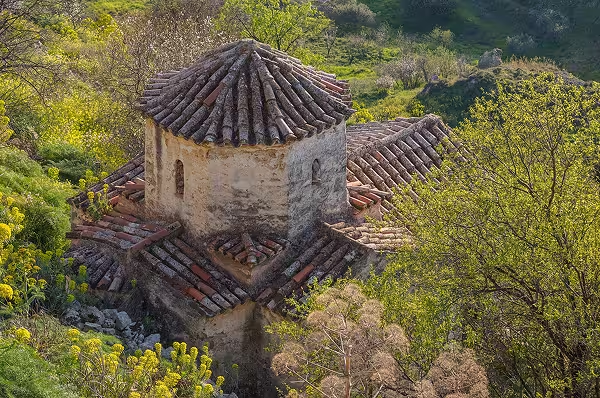
@ C Messier, CC-by SA 4.0
Panagia Episkopi (Agios Dionysios)
On the hill’s west slopes stands the church known today as Agios Dionysios, or Panagia Episkopi. Its present form is a long, narrow, domed church with a single side aisle, but the building’s earlier history is more interesting than its current shape suggests. Strong morphological evidence points to an original phase, before the 14th century, as a tetrastyle domed cross-in-square church — a genuinely Middle or Late Byzantine architectural type. Three niches in the present east wall likely correspond to the sanctuary apse, prothesis, and diakonikon of that original building, and of the four columns that once supported the dome, only the eastern pair survive in place; the present elliptical dome now rests on a rectangle measuring just 2.6 by 3.4 meters. At some point, probably following a structural collapse, the church was converted into its current three-aisled form; its original west aisle no longer survives, its site now occupied by an open viewing balcony.
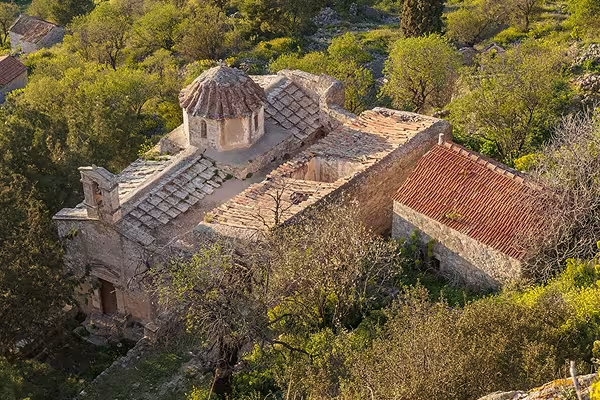
The original Byzantine-period church was most likely destroyed under the Caopena dynasty, in the first half of the 15th century. It was rebuilt in the second half of the 15th and into the 16th century, and restored again in 1610, when its wall paintings were completed by the painter Dionysios of Athens, according to a surviving inscription. Sculpted architectural elements from the 5th century — including a Corinthian capital with four acanthus leaves — are reused in the church’s masonry, evidence that this stretch of hillside carried Early Christian buildings long before Paliachora itself existed.
In the 18th century the church was rededicated to St. Dionysios, Metropolitan of Aegina from 1576 to 1579 and canonized in 1703; most of the paintings visible today date from the 1610 restoration, not from the church’s Byzantine origin.
Agios Nikolaos “of the Mavrikas family”
Aegina has at least three churches called Agios Nikolaos: this one, outside Paliachora’s walls near the Aegina–Mesagros road; a separate, minor Agios Nikolaos within the Paliachora settlement itself (see below); and Agios Nikolaos Moulos, near Souvala, covered in our main Byzantine Aegina article.
Outside Paliachora’s settlement proper, on the fringes of the hill next to the modern road to Mesagros, stands a domed cruciform church that belonged to the medieval Mavrikas family of Aegina. Its exterior was noticeably altered, probably in 1522 — changes to the sanctuary, a new west-entrance frame, and the addition of the present, low dome — but its heavy proportions, small window openings, plain rubble masonry, and total absence of decorative architectural sculpture all point to a considerably earlier original building.
That early date is confirmed by the church’s oldest surviving layer of wall painting, of notably fine quality, dated by specialists to either the 12th or the 13th century (scholars are divided). From this phase survive a bust of Christ Pantokrator on the north wall and, in the north arm of the cross, St. George on horseback slaying the dragon — a scene handled, by specialist accounts, with real technical sophistication: a sense of movement in the faces, careful attention to the fall of hair and the rendering of the horse’s head in perspective, and an overall grace unusual for a subject as violent as dragon-slaying.
A second, securely dated layer follows: painted in 1330, according to an inscription, during the rule of the Catalan lord Alfonso Fadrique of Aragon (1317–1338). Surviving scenes from this phase include the Raising of Lazarus, the Birth of the Virgin, Pentecost, the hierarch Basil, and a Virgin in a stance of supplication. A third and final layer, firmly post-Byzantine and dated by inscription to 1522, covers the east end of the church and its templon: the Virgin Platytera in the apse, Christ in the templon, and standing figures of St. John the Baptist, St. Nicholas, and St. Peter.
Agios Georgios Katholikos (Panagia Phoritissa)
This church dominates Paliachora’s only square, known as Phorou (or “forum”) square — the settlement’s marketplace, from which the church’s alternative name, Panagia Phoritissa, derives. From the historical sources, we can assume that it was already standing before the end of the Byzantine time in 1453. It is the church that once held the skull relic of St. George, later removed to Venice to help fund the town’s 1462 castle (see below). Despite its central role in Paliachora’s history, little of its own fabric can be confidently dated to before the 16th century on current evidence. An inscription carved into a poros slab above the entrance records an inspection carried out in April 1533 by the Venetian governor of Nafplio, Antonio Barbaro — proof the church was already standing and functioning by that date. It is a simple, aisleless building, roughly 11 by 4 meters inside, covered by a slightly pointed barrel vault reinforced with two strainer arches.
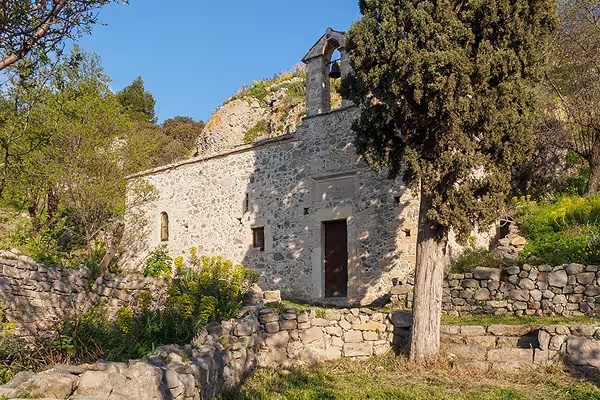
Its wall paintings survive in four distinct phases: an earliest layer dated only broadly to before the 17th century, a second phase from the 17th century itself, a third close to it in date, and a final phase probably from the 18th century. These post-Byzantine frescoes are, by specialist assessment, among the most significant surviving anywhere at Paliachora — but it should be said plainly that what survives to see here is a Venetian- and Ottoman-period decorative programme, layered onto a church whose own founding date remains less precisely documented than its later history.
The post-Byzantine churches
The remaining churches at Paliachora make up the great majority of what still stands on the hill — the Venetian and Ottoman-period core the sources are explicit about. We don’t have, and don’t need, the same level of individual dating for each of these; a brief, honest mention of what each one is and what, if anything, survives of its decoration is enough.
The walking route up from the site entrance passes the Church of the Stavros, where the main path begins, and shortly after, the ruined two-aisled Panagia Yannouli. At the easternmost point of the site, the monastery complex of Agia Kyriaki — its twin churches of Agia Kyriaki and Zoodochos Pigi built into the fortification’s east wing — is squarely post-Byzantine: a 2003 excavation, based on glazed pottery and Frankish coins, dated the earliest surviving building phase to the second half of the 15th century, “already out of the Byzantine timeframe,” in the excavators’ own words. Its wall paintings date to the 17th century (Agia Kyriaki) and after 1589 (Zoodochos Pigi); the monastery’s katholikon survived in good condition because it remained in use until 1803. Just outside the walls to the east, a small cemetery church of the Archangel Michael carries reused Frankish-period sculpture around its south entrance, decorated with crosses and Solomon’s-knot motifs.
South of the acropolis, the domed cruciform church of Agios Ioannis Theologos was probably built during the period of Catalan rule over Aegina (broadly the first half of the 14th century) — firmly a Frankish-era, not a Byzantine, building, whatever its Byzantine-derived architectural style. A cluster of small, plain, aisleless barrel-vaulted churches rounds out the hillside without much individual documentation: Agios Eleftherios, Agios Minas, Agia Markrina, a modest Agios Nikolaos and Agios Efthymios and Agios Dimitrios within the settlement itself (distinct from the Mavrikas church of the same name discussed above), and, further downhill to the southwest, Agios Athanasios and the two-aisled Agios Charalambos.
Frequently Asked Questions
Is Paliachora a Byzantine site?
Its origins are: the town was founded around the late 9th century as a refuge from Arab raids. But very few of the 35 churches still standing today date from before the mid-15th century — most of what survives is Venetian- and Ottoman-period rebuilding, layered onto a Byzantine-era settlement plan.
Which churches at Paliachora are genuinely Byzantine?
A small core with 13th-century origins: the twin church of Agios Georgios and Agios Dimitrios on the acropolis (dated by inscription to 1292–93), the Church of the Taxiarchs below the castle, the original phase of Panagia Episkopi (Agios Dionysios), and the earliest fresco layer at Agios Nikolaos “of the Mavrikas family,” dated to the 12th or 13th century.
How many churches survive at Paliachora?
Thirty-five, by the most detailed specialist count. Popular legend claims 365 — one for each day of the year — and the real historical total across the site’s whole history is estimated at closer to 50.
What happened to Paliachora’s castle?
It was built in 1462 with Venetian funds, given in exchange for the relic skull of St. George (now in Venice). It was destroyed by Barbarossa in 1537, rebuilt, then largely destroyed again by the Venetian admiral Francesco Morosini in 1654 while suppressing piracy based on the island.
When was Paliachora abandoned?
Gradually, in the early 19th century. French and British travelers describe it as nearly ruined by 1817 and completely abandoned by 1830, as residents resettled around Aegina’s coastal town.
Why is Paliachora called the “Mystras of Aegina” (or “of the Saronic Gulf”)?
Both forms of the nickname appear in the sources, used more or less interchangeably. It refers to the density of churches and fortified medieval structures packed onto a single defensible hill, following the same three-tier “castle-state” layout used at Mystras in the Peloponnese and at Servia — a comparison of character and layout, not of scale: Mystras was a far larger imperial and despotic seat, while Paliachora was always a modest island refuge
Sources
- “Paleochora of Aegina,” Kastra.eu (Greek Castles).
- Charalambos Pennas, Byzantine Aigina, Athens, 2005
- Xeni Petritou-Triantafillou, Paleochora – The Medieval Acropolis of Aegina, Perpinia Publications, Athens, 2011.
2 Comments