The Varangian Guard: Byzantium’s Viking Bodyguard
Sometime in the ninth or tenth century, during a long liturgy in Hagia Sophia, a guardsman with nothing better to do took out a blade and scratched his name into the marble parapet of the upper gallery. The Greek clergy around him would not have understood a word of it: the letters were runes, and what survives today — worn down to a few legible strokes — reads, as best anyone can tell, Halfdan. It is one of the few traces a Varangian ever left in his own hand, in the very heart of the empire he served.
For nearly five centuries, men like Halfdan stood closer to the Byzantine emperor than almost anyone else in Constantinople, and most of them did not speak Greek as a first language. They were Norsemen from Scandinavia and Kievan Rus’, and later Anglo-Saxons who had lost everything to the Normans — soldiers Byzantine writers called Varangians, or simply “the axe-bearing barbarians.” Emperors recruited them precisely because they had no stake in the empire’s factional politics, and that single fact shapes almost everything that follows: their reputation for loyalty, their occasional entanglement in the palace coups that loyalty was supposed to prevent, and the slow way they were absorbed into Byzantine society until “Varangian” stopped meaning anything genuinely Norse at all. Their story runs alongside the broader military history traced on our Byzantine military history hub, and it is also one particular case of a much wider pattern — Byzantium’s long history of absorbing outsiders into its army, its court, and eventually its imperial bloodline, covered more broadly in our piece on ethnic and cultural minorities in Byzantium.
Quick Facts
Byzantine name
Τάγμα τῶν Βαράγγων (Tagma tōn Varangōn)
Founded
c. 988, under Basil II — though the earliest Rus’ mercenaries had served Byzantium since at least 874
Founding contingent
6,000 warriors sent by Vladimir I of Kiev
Core recruits
Rus’ and Scandinavians (10th–11th c.); increasingly Anglo-Saxons and Danes from the 1080s
Signature weapon
The two-handed Dane axe (Byzantine writers called them pelekyphoroi, “axe-bearers”)
Commander
The akolouthos — typically a native Byzantine officer
Most famous alumnus
Harald Hardrada, future King of Norway
Last recorded
Fighting alongside Greek defenders at the fall of Constantinople, 1453
Origins: from Rus’ mercenaries to an imperial tagma
Norse and Rus’ warriors were fighting for Byzantium long before anyone called them Varangians. A treaty between Rus’ and Emperor Basil I in 874 already obliged the Rus’ to supply men for imperial service, and a renewed agreement after further hostilities in 907–911 confirmed their right to serve. Through the early 10th century these mercenaries appear scattered across Byzantine campaign records: some 700 fought as marines alongside Dalmatians against the Emirate of Crete in 902, a force of 629 returned to Crete under Constantine VII in 949, 415 took part in the Italian expedition of 936, and contingents fought the Arabs in Syria in 955. At this stage they were absorbed into the wider corps of foreign guardsmen known as the Hetaireia, the “Great Companions,” rather than forming a distinct unit of their own.
The formal, permanent guard dates to 988. Facing the rebellions of Bardas Phokas and Bardas Skleros, Emperor Basil II invoked the old treaty obligation and asked Vladimir I of Kiev for troops. Vladimir sent 6,000 warriors — and, not incidentally, rid himself of some of his most unruly retainers in the process — in exchange for the hand of Basil’s sister, Anna Porphyrogenita, and his own conversion to Christianity.
In 989 these men, led by Basil II in person, landed at Chrysopolis and crushed Bardas Phokas’s rebellion; Phokas himself reportedly died of a stroke in full view of his opponent, and the pursuing Varangians were noted for the brutality with which they cut down his fleeing troops.
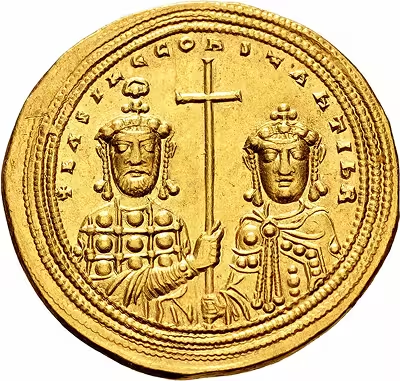
A note on the name: The institution predates its own name by decades. The Oxford Dictionary of Byzantium notes that the term “Varangian” itself is first securely attested in Byzantine sources only with reference to events of 1034, in John Skylitzes’s chronicle. Before and alongside it, Byzantine writers used “Rhos,” “Tauroscythians,” or simply “axe-bearers” for the same men — ethnic and institutional labels in Byzantine sources rarely arrived at the same moment as the people they described.
Recruitment: Scandinavia, Rus’, and the Anglo-Saxon influx
For its first century the Varangian Guard drew almost entirely on Scandinavia and Kievan Rus’, with Sweden supplying the largest share, alongside Danes and Norwegians. The pull of imperial pay was strong enough that a medieval Swedish law code, the Västgötalagen, barred anyone who lingered in “Greece” — the Old Norse term for Byzantium — from inheriting property back home, an attempt to stem an emigration that competed directly with two other Scandinavian recruiters of the same period: the Kievan Rus’ druzhina and the Anglo-Danish royal guard in London known as the Þingalið (1013–1051). Recruits travelled the river network later commemorated on dozens of Scandinavian runestones as the road “east” (Austr) to Garðaríki, and on to Miklagarðr — “the Great City,” Constantinople.
The composition shifted decisively after 1066. As the Norman Conquest displaced English fighting men who shared the Norse tradition of oath-bound service unto death, many looked east for new masters. One report puts more than 5,000 Anglo-Saxons and Danes arriving by sea in 1088 in 235 ships; those who did not join the Guard outright were settled at Helenopolis on the Black Sea coast, built to garrison the town for Alexios I Komnenos. Those who did enter the Guard became so central to it that the unit was informally nicknamed the Englinbarrangoi — the “Anglo-Varangians.” Writing in the 1080s, the historian and princess Anna Komnene calls them “axe-bearing barbarians… from Thule,” and decades later John Kinnamos still describes the emperor’s axe-bearing guards as belonging to “the British nation” — suggesting the Anglo-Saxon character of the corps held well into the 12th century.
A final, smaller wave arrived after 1110, when King Sigurd I of Norway ended his crusade to the Holy Land in Constantinople and released the bulk of his army — originally some 6,000 men — to join the Guard, sailing home himself with fewer than a hundred followers. Scandinavian recruitment on this scale never entirely stopped: as late as 1195, Emperor Alexios III Angelos sent emissaries to Denmark, Norway, and Sweden asking for 1,000 warriors from each kingdom — proof that a distinct Norse recruiting channel to Constantinople still existed on the very eve of the Fourth Crusade, alongside the by-then-dominant English and Danish presence in the corps.
Equipment: the Dane axe and the “axe-bearers”
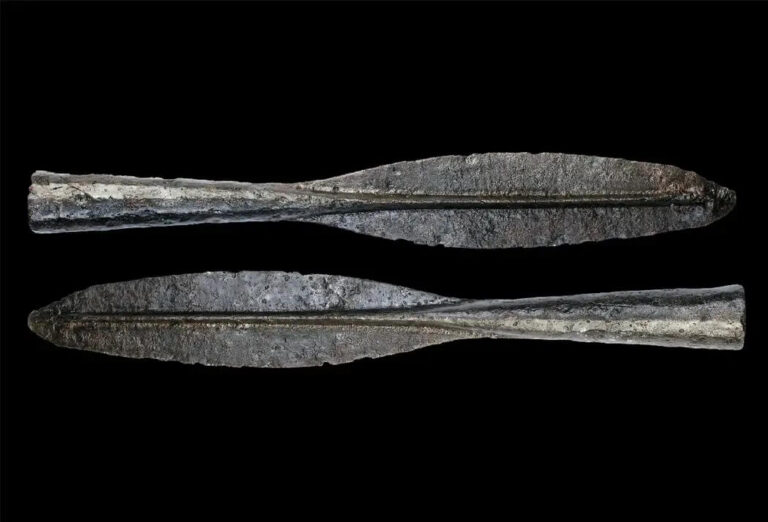
The Varangian Guard’s signature weapon was the broad-bladed, two-handed Dane axe, wielded with enough visual impact that Byzantine writers routinely called its bearers pelekyphoroi — “axe-bearing” — rather than by their ethnic name. The 11th-century official and historian Michael Psellos described the whole unit as carrying shields and brandishing “a certain single-edged, heavy-iron weapon” on their shoulders.
A correction worth flagging. Some later writers and modern popularisations render the Varangians’ weapon as a rhomphaia, a term properly belonging to an older, curved Thracian blade. Specialists (notably Timothy Dawson) trace this to Atticising Byzantine authors reaching for an archaic-sounding word rather than describing a different weapon — the Dane axe, not the rhomphaia, remains the better-supported identification.
Alongside the axe, Varangians were often capable swordsmen and archers, and — despite normally fighting on foot in the Norse and Anglo-Saxon manner — some sources, including Anna Komnene’s Alexiad, describe them mounted for strategic mobility. As the Guard’s membership shifted over the centuries and intermarried locally, its equipment blended: Byzantine mail shirts and helmets alongside Scandinavian and Anglo-Saxon weapon traditions, rather than a static “Viking” kit frozen in time. Contemporaries agreed on the effect, if not always the cause: chroniclers describe the Scandinavians as terrifying in “appearance and equipment,” attacking with a reckless disregard for wounds — a description sometimes linked, cautiously, to the Norse berserker tradition, though that connection itself remains debated among historians rather than settled fact.
Structure: rank, quarters, and command
The Varangian Guard sat within, and eventually stood apart from, the Hetaireia, the palace’s broader corps of foreign guard units. Its commanding officer bore the title akolouthos and was, as far as the sources allow us to tell, normally a native Byzantine rather than a Varangian — the corps’ loyalty was prized precisely because it lacked local political ambition, and its command structure was built to keep it that way. Individual Varangians could nonetheless rise through standard Byzantine court ranks: Harald Hardrada himself is recorded holding the ranks of manglavites and later spatharokandidatos, titles that placed a foreign mercenary inside the same honorific hierarchy as native courtiers.
The Guard was quartered within the Great Palace complex, likely including the Bucoleon palace, and moved with the imperial residence itself — under the Komnenoi, additional quarters existed at the Mangana and Blachernai palaces. Its institutional footprint extended into ordinary administration: surviving documents record specific monasteries exempted from the obligation to billet Varangian troops on their property, a small but telling sign of how widely the corps needed housing across the empire. The Guard also maintained its own churches dedicated to the Virgin, attested in Constantinople, on Crete, and near Taranto in southern Italy — evidence of a corps embedded enough in imperial life to need its own religious infrastructure wherever it served.
On campaign: the Guard in battle
Byzantine commanders held the Varangians back and committed them only at a battle’s most critical moment — a tactic that produced an outsized reputation relative to the unit’s actual numbers. Their combat record spans the empire’s geography. Beyond Chrysopolis in 989, detachments fought in southern Italy through the 11th century: at the Battle of Cannae in 1018, sent by Basil II to help the catepan Basil Boioannes crush the Lombard revolt of Melus of Bari, in a decisive Byzantine victory; and in 1038, alongside Norman and Lombard troops under Arduin, in George Maniakes’s partial reconquest of Sicily from the Arabs — a campaign that collapsed when Maniakes publicly humiliated Arduin and the Lombards, Normans, and Varangians alike abandoned him. Byzantine authority in southern Italy nonetheless eroded steadily against the rising Normans over the following decades, and at the catastrophic Battle of Manzikert in 1071, virtually the entire imperial Guard is reported to have fallen around Emperor Romanos IV Diogenes. Under John II Komnenos, Varangians broke a Pecheneg wagon-laager to win the Battle of Beroia in 1122, and in 1203–1204 they mounted a fierce, ultimately unsuccessful defence of Constantinople’s walls against the Fourth Crusade, described by chroniclers as violent hand-to-hand fighting with axes and swords on the ramparts themselves.
Guardians of the throne: coups, plots, and palace politics
The Guard’s reputation for loyalty was not a myth invented by later admirers — it was a working political fact, tested repeatedly at the moments Byzantine imperial power was most likely to change hands violently. But loyalty to the office of emperor is not the same thing as loyalty to whoever currently occupies it, and the difference between those two ideas runs through nearly every recorded episode below.
The principle was set early. When conspirators murdered Emperor Nikephoros II Phokas in 969, a servant managed to summon the Varangian guard before the emperor died — but only just. Finding him already dead, the guards knelt before his killer, John Tzimiskes, and hailed him as the new emperor without hesitation. Anna Komnene later described this exact devotion to the imperial office, rather than the man on the throne, as “a kind of sacred trust.”
That trust could be turned against an absent emperor as easily as it protected a present one. In 1071, with Romanos IV Diogenes a prisoner of the Seljuks after his defeat at Manzikert, Caesar John Doukas used the Varangian guard itself to seize the palace, arrest Empress Eudokia Makrembolitissa, and proclaim her stepson Michael VII emperor in Romanos’s place — the Guard defending the throne exactly as designed, just not on behalf of the man who currently sat on it.
Seven years later the loyalty nearly broke down altogether. After Nikephoros III Botaneiates ordered the blinding of the general Nikephoros Bryennios the Elder in 1078, the historian Joannes Zonaras reports the Guard turning on the emperor himself, in what other sources describe outright as an attempted assassination; loyal troops suppressed the mutiny, and the Varangians involved were pardoned rather than punished — itself a sign of how carefully emperors had to handle a corps they could not easily replace or discipline. That same year, in a reminder that “Varangian” mercenaries also fought outside the palace corps proper, the rebel general Nikephoros Basilakes hired his own Varangian contingent, alongside Frankish and Pecheneg troops, in his failed uprising against Botaneiates — put down by a young general named Alexios Komnenos.
Three years after that, the same Alexios Komnenos marched on Constantinople to overthrow Botaneiates himself, and the Varangian Guard’s reputation shaped the coup before a single blow was struck. One of the emperor’s own supporters, Nikephoros Palaiologos, urged Botaneiates to hand him command of the Varangians and make a stand inside the Great Palace; Botaneiates refused and abdicated instead. Anna Komnene records that her father’s own advisors had separately warned him not to provoke the Varangians guarding the old emperor, for precisely the reason set out above — their devotion to the imperial office ran too deep to test. The coup of 1081 succeeded, in other words, partly because both sides understood that fighting the Guard was a risk neither wanted to take.
Saga tradition vs. Byzantine recordThe 13th-century Icelandic chronicler Snorri Sturluson describes a custom called polutasvarf — a supposed Varangian right, on an emperor’s death, to run to the treasury and carry off as much gold as they could hold. It is a vivid detail, plausibly one that fuelled recruitment back in Scandinavia through tales of Miklagarð riches — but it appears nowhere in Byzantine sources, and modern historians treat it as saga embellishment rather than documented practice.
How the Byzantines saw them
Byzantine writers rarely describe the Guard in only one register. Anna Komnene’s own account praises their incorruptibility in the same breath that calls them barbarians — barbaroi being the standard Byzantine term for any non-Greek-speaking outsider, a label of cultural distance more than open hostility, but a label all the same. The quality prized above all was precisely the one that made them foreign and unassimilated: no local family, faction, or property to protect meant no plausible reason to betray the throne, and that calculation, made explicitly by Basil II when he first distrusted his native guardsmen, held for the better part of three centuries.
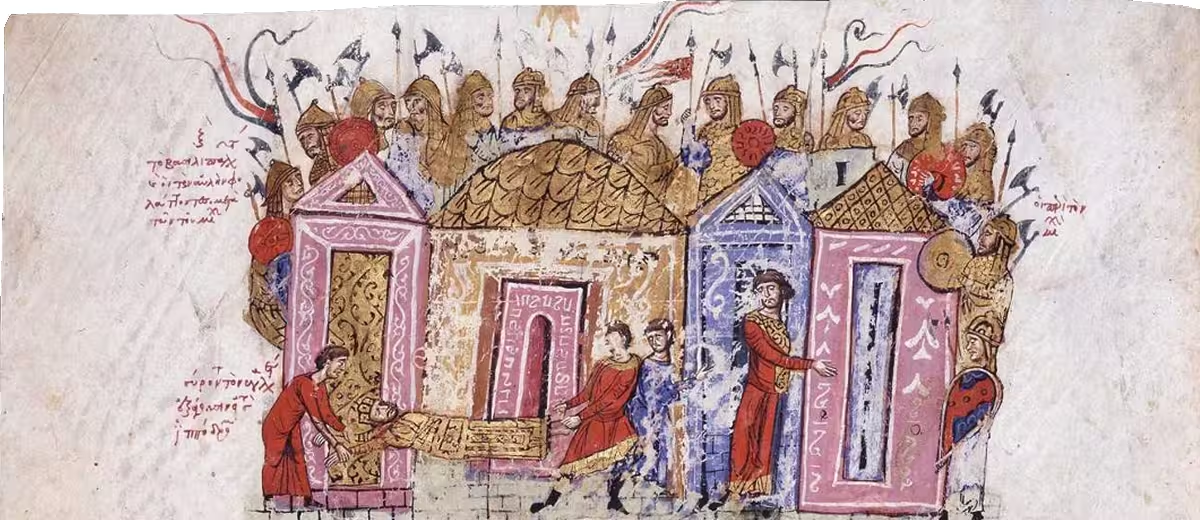
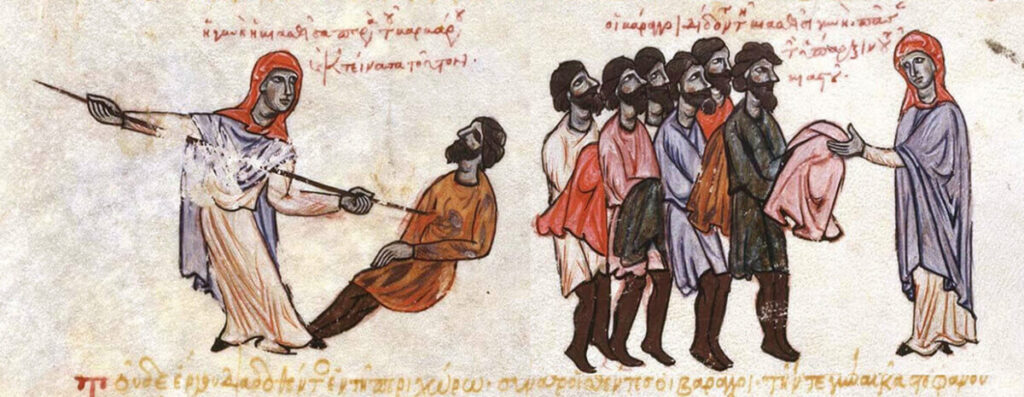
That same foreignness had a harder edge in ordinary city life. Byzantine sources describe Varangians drunk and brawling in the streets, and imperial authorities seem to have tolerated a real amount of this disorder as the price of a loyalty they could not get from native troops. One incident, though, shows where even the Guard’s own tolerance stopped. Around 1034–38, during Michael IV’s reign, a Varangian contingent wintering in the Thracesian Theme — a military district covering part of western Asia Minor, not the Balkan region of Thrace, despite how often the two get confused in retellings of this story — produced a case the chronicler John Skylitzes himself flagged as “worth narrating.” One soldier tried to rape a local woman; she wrested his own sword from him and killed him with it. His comrades did not retaliate. Instead, by Skylitzes’s account, they praised her, handed over the dead man’s possessions as compensation, and left his body without burial — among the gravest insults available in Byzantine military culture, reserved for cowards and oathbreakers. The episode survives today as one of the better-known illuminations in the Madrid Skylitzes manuscript, and it is as close as the sources come to showing the Guard’s “traditional code of discipline” actually being enforced, rather than simply praised in the abstract.
Famous Varangians
Harald Hardrada (c. 1015 – 1066)
No member of the Guard is better documented, or had a stranger life, than Harald Hardrada — its single most famous alumnus, and a man whose career reads less like a soldier’s résumé than the plot of a novel someone would reject as too implausible. Fleeing Norway after the Battle of Stiklestad in 1030, Harald Sigurdsson reached Constantinople by way of Kievan Rus’ in 1035. Byzantine and saga sources together credit him with roughly eighteen battles over his service, fighting Arabs in Anatolia and Sicily under George Maniakes and campaigning in southern Italy and Bulgaria. He rose through the ranks of manglavites and spatharokandidatos before falling foul of accusations that he had withheld imperial plunder, and was imprisoned. Released amid the palace revolution that toppled Michael V Kalaphates in 1042, Harald is said — in saga tradition, not Byzantine chronicle — to have been among those who blinded the fallen emperor after he and his uncle took refuge at the altar of the Stoudios Monastery. He escaped Constantinople in 1043, returned home, and became King of Norway (1046–1066) before dying in his own invasion of England at the Battle of Stamford Bridge — the same year, and not far from where, the Guard’s next great recruiting wave would begin. A Byzantine palace guardsman who ends his life as a king, killed trying to conquer the same island that would soon refill his old regiment’s ranks: it is hard to invent a tighter piece of historical irony than the one he lived.
Bolli Bollason (b. c. 1006)
According to the Icelandic Laxdæla saga, Bolli was the first known Icelander to serve in the Guard, travelling to Constantinople via Denmark and spending years in imperial service, where he was “thought to be the most valiant in all deeds that try a man.” The saga lingers on his return home in scarlet cloak and gilded helmet, riding a gilt saddle and carrying a sword named Footbiter given him by the “Garth-king” — a portrait less of a soldier than of a man whose Byzantine service had transformed his social standing back in Iceland.
Kolskeggr (10th–11th century)
Njáls saga records Kolskeggr’s journey east to Holmgard (Novgorod) and on to Miklagarð, where he entered imperial service, eventually rose to command Varangian troops, married locally, and remained in Byzantium until his death — one more thread in the saga literature’s consistent, admiring image of the Guard as a place where an Icelander could make good.
Eudokia Ingerina — the assimilation the sagas never told (c. 840 – c. 882)
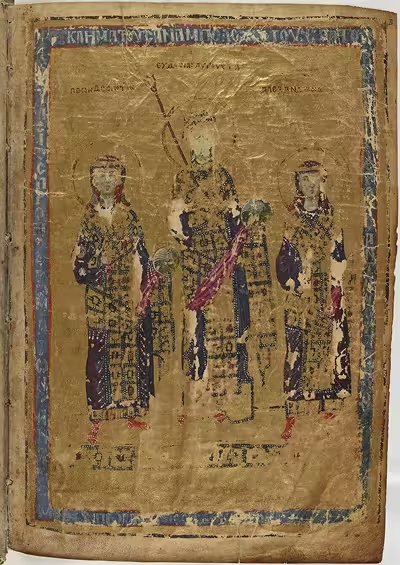
Not every trace of Norse blood in the palace belonged to a soldier standing guard. Eudokia Ingerina’s father, Inger, was a Byzantine courtier and soldier active in Constantinople decades before Basil II’s guard existed — his name struck several modern historians (Dimitri Obolensky and Cyril Mango among them) as suspiciously close to the Norse Ingvar, and they read it as a sign of Scandinavian ancestry, though this rests on the name alone rather than any source that calls him a Varangian outright. What is not in doubt is his daughter’s trajectory: mistress to Emperor Michael III, then wife of Basil I, and mother of Emperor Leo VI and Emperor Alexander. If the identification of Inger’s origins holds, the entire Macedonian dynasty that followed — Byzantium’s most celebrated imperial line — carried a thread of the same Norse presence that would later fill the ranks of the Guard, a full century before that Guard was formally founded. It would be, by some distance, one of the most successful cases of assimilation in Byzantine history: not a soldier absorbed into the army, but a bloodline absorbed into the throne itself.
Vanishing: assimilation, 1204, and the last stand of 1453
The Guard never disappeared in a single moment; it dissolved gradually, through demographic assimilation and institutional attrition. By the 1080s it was already predominantly Anglo-Saxon and Danish rather than Scandinavian in the older sense, and Kinnamos’s description of “the British nation” guarding the emperor in the later 12th century suggests that character persisted almost to the Fourth Crusade. During the siege of 1203–1204 the Guard fought hard on the walls, but Constantinople fell anyway — the first time the capital had ever fallen to a Western army rather than an eastern one.
What happened after 1204 is genuinely uncertain. Institutional continuity through the Latin occupation of Constantinople (1204–1261) is not well documented. The Greek version of the Chronicle of the Morea records a unit identified with the Guard escorting the captured Prince of Achaia to prison after the Battle of Pelagonia in 1259, but the historian D. J. Geanakoplos has suggested this may reflect a reconstitution of the corps under Theodore I Laskaris at Nicaea — a claim to imperial legitimacy expressed partly through reviving an old imperial institution — rather than an unbroken survival of the pre-1204 Guard.
By the late 13th century the Varangians were, by most accounts, largely assimilated into the wider Byzantine Greek population, though the name and the unit persisted in a much-diminished, more ceremonial form — the same slow absorption that, as the Eudokia Ingerina case suggests, had actually been under way since long before the Guard was even founded, and that runs through the wider story of how Byzantium folded outsiders — Armenians, Slavs, Arabs, and others — into itself over the centuries. Occasional references to the Guard continue into the 14th century — in 1329, “Varangians with their axes” are recorded guarding the keys to whichever city the emperor was currently occupying — and people were still identifying themselves as Varangians in Constantinople around 1400, by which point the label likely marked an inherited corporate identity more than any genuine Norse or Anglo-Saxon descent. The line closes, fittingly, at the end: up to 3,000 men described as Varangians are reported to have remained in the city in 1453, fighting alongside their Greek fellow-citizens in the last stand against the Ottoman army during the fall of Constantinople — nearly five centuries after the first 6,000 Rus’ warriors landed at Chrysopolis.
Legacy: runestones, sagas, and runes
Greek Runestones of Scandinavia
The Guard’s clearest physical legacy survives not in Byzantium but in Scandinavia, in the roughly 30 Greece Runestones — memorial stones raised across Sweden, concentrated above all in Uppland (18 stones) and Södermanland (7), for men who travelled the “eastern route” (Austrvegr) to Garðaríki and Miklagarð. Their inscriptions use a small, repeated vocabulary for the journey — Grikkland (“Greece”) three times, Grikkjar (“Greeks”) twenty-five times, grikkfari (“traveller to Greece”) twice, and Grikkhafnir (“Greek harbours”) once — and range wildly in scale, from a whetstone barely 8.5 cm long to the Ed boulder, 18 metres in circumference, raised on the orders of Ragnvaldr, a former officer of the Guard who survived to come home and commission it himself. Most are carved in the Ringerike or Urnes decorative styles typical of the 11th century, and they form the largest single group of Viking-Age “expedition” runestones anywhere in Scandinavia — comparable in number only to the England runestones and the Ingvar runestones commemorating a separate, disastrous expedition toward Persia.
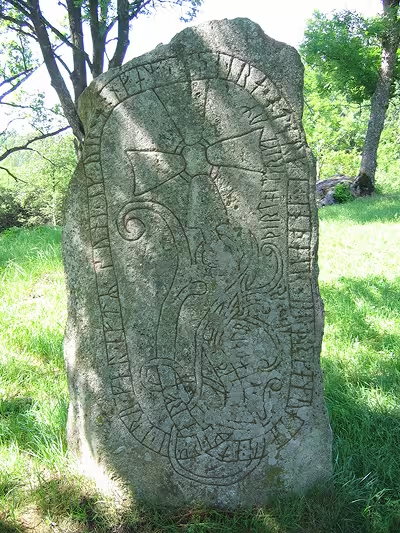
A smaller cluster, the Italy Runestones, commemorates guardsmen who died specifically in the southern Italian campaigns. The oldest Greece stones predate 1015; the youngest date to roughly 1080–1130, after which the custom of raising runestones fell out of fashion across Scandinavia generally — a chronology that tracks closely with the Guard’s most heavily Scandinavian decades. Not every stone necessarily commemorates a guardsman rather than a merchant or pilgrim on the same route — one, raised by a woman named Ingirún Harðardóttir for herself before she set out for Jerusalem, is a reminder that “the road to Greece” carried more than soldiers, even if most of the Greece stones were, as Blöndal and Benedikz conclude, memorials to men who never came back from Varangian service.
Carved runes in Byzantium
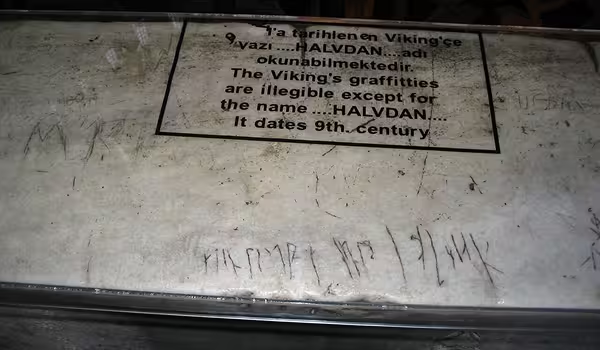
Byzantium itself preserves one rare trace in its most iconic monument: the Hagia Sophia in Istanbul. There are at least two runic inscriptions carved into the marble parapets the upper gallery, both attributed to members of the Guard. The first, discovered in 1964 in the southern gallery, is worn down to a handful of legible strokes read as the Norse name Halfdan, probably once followed by a formula such as “Halfdan carved these runes” — the medieval equivalent of “X was here.”
A second, found in 1975 by the Swedish researcher Folke Högberg, is read by most specialists as the name Ári or Árni. Both were, in all likelihood, cut by a bored guardsman during a long service — an oddly human footnote from men who otherwise appear in the record only as soldiers, officers, or political actors. Further afield, the ancient marble Piraeus Lion — later carried off to Venice, where it still stands outside the Arsenal — bears runic graffiti generally credited to Scandinavian mercenaries, though runologists continue to debate the precise reading and the identity of whoever carved it.
Further afield, the ancient marble Piraeus Lion — originally standing guard over the harbour of Piraeus for over a thousand years before any Norseman touched it — carries two separate runic inscriptions, cut on different occasions and now badly worn by three centuries of weathering and, before that, target practice: the lion still bears visible bullet scars, probably from the same 1687 Venetian assault on Ottoman-held Athens that damaged the Parthenon and in which the Venetian commander Francesco Morosini carried the lion off as war booty. The older inscription, on the lion’s left side, is stylistically close to a dated Uppland runestone of the 1020s and preserves only a fragment — something like “…they carved, the men of the Helming clan…” A second, more elaborate band on the lion’s chest and right side, carved in a style typical of the later 11th century, is fragmentary in the same way but keeps one legible name, Åsmund, alongside traces of others. Both are generally read as Varangian memorials, consistent with the well-documented presence of Norse troops around Piraeus in the later 11th century, including fighting against the Normans in the region — but that is closer to the limit of what the runes can actually support.
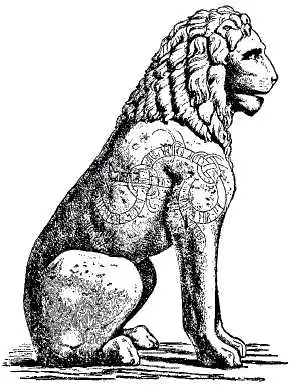
Nineteenth-century readers, working from more visible letterforms than survive today, produced far more colourful translations — feuds, a captive named Dalk, a “revolt of the Greek people,” even a specific leader called Harold the Tall — but modern runology (notably Thorgunn Snædal’s on-site study, published in 2014) treats these older reconstructions as considerably overreached, and there is no convincing link between the lion and any named historical figure, Harald Hardrada included, however often the connection is suggested informally.
Sagas
The Guard’s most durable legacy, though, is literary. Norse and Icelandic works — Heimskringla, Laxdæla saga, Njáls saga, and the dedicated saga tradition around Harald Hardrada — preserve a consistently admiring, almost aspirational West Norse image of Byzantium, composed mostly in 13th-century Iceland, long after the events they describe and long after the Guard itself had ceased to be recognisably Scandinavian. That the sagas kept telling these stories for two centuries after the fact says something about how deep an impression Miklagarð and its Varangian service had made on the Norse world — whatever the gap between saga colour and Byzantine record on any given detail.
Frequently Asked Questions
Who were the Varangians?
Byzantine sources used “Varangian” for Norse warriors — mostly from Sweden, Denmark, and Norway, via Kievan Rus’ — serving in the Byzantine army, and from the late 11th century the term extended to cover Anglo-Saxons as well.
Why did Byzantine emperors trust foreign guards over their own soldiers?
Foreign recruits had no local family, faction, or political ambition inside the empire, making their loyalty to the emperor’s office more reliable than that of native aristocratic guard units, whose loyalties had repeatedly shifted with fatal consequences for earlier emperors.
Did the Varangian Guard ever turn against an emperor?
Twice on record, yes. In 1071 the Guard was used by a usurper to depose the absent Romanos IV Diogenes, and in 1078 it came close to killing Nikephoros III Botaneiates outright after he ordered a general blinded — though in both cases the underlying loyalty was to the throne itself rather than personal treachery.
What weapon is most associated with the Varangian Guard?
The two-handed Dane axe, distinctive enough that Byzantine writers often called the guardsmen pelekyphoroi (“axe-bearers”) rather than by their ethnic name.
Was Harald Hardrada really a member of the Varangian Guard?
Yes — this is one of the better-documented cases, corroborated across saga and general historical tradition, though the specific claim that he took part in blinding Emperor Michael V rests on saga sources rather than Byzantine chronicles.
When did the Varangian Guard cease to exist?
There is no single end date. It was largely assimilated into the Byzantine Greek population by the late 13th century, but the name and a much-reduced unit persisted into the 14th century, with Varangians recorded fighting at the fall of Constantinople in 1453.
Sources and further reading
- Oxford Dictionary of Byzantium, s.v. “Varangians” (Oxford University Press)
- Sigfús Blöndal, rev. Benedikt S. Benedikz, The Varangians of Byzantium (Cambridge University Press, 1978)
- Raffaele D’Amato, The Varangian Guard 988–1453 (Osprey Publishing, 2010)
- Anna Komnene, The Alexiad (trans. Penguin Classics, 2003)
- John Kinnamos, The Deeds of John and Manuel Comnenus (trans. Charles M. Brand, Columbia University Press, 1976)
- Michael Psellos, Chronographia
- Joannes Zonaras, Epitome Historiarum
- Cyril Mango, “Eudocia Ingerina, the Normans, and the Macedonian Dynasty,” Zbornik radova Vizantoloskog Instituta XIV–XV (1973), 17–27
- Elisabeth Svärdström, “Runorna i Hagia Sofia,” Fornvännen 65 (1970), 247–49
- Sven B. F. Jansson, Runes in Sweden (Gidlunds, 1987)
- Laxdæla saga; Njáls saga; Snorri Sturluson, Heimskringla
- Sverrir Jakobsson, The Varangians: In God’s Holy Fire (Palgrave Macmillan, 2020)