Little Metropolis (Panagia Gorgoepikoos): The Athens Church built from 1,500 years of spolia
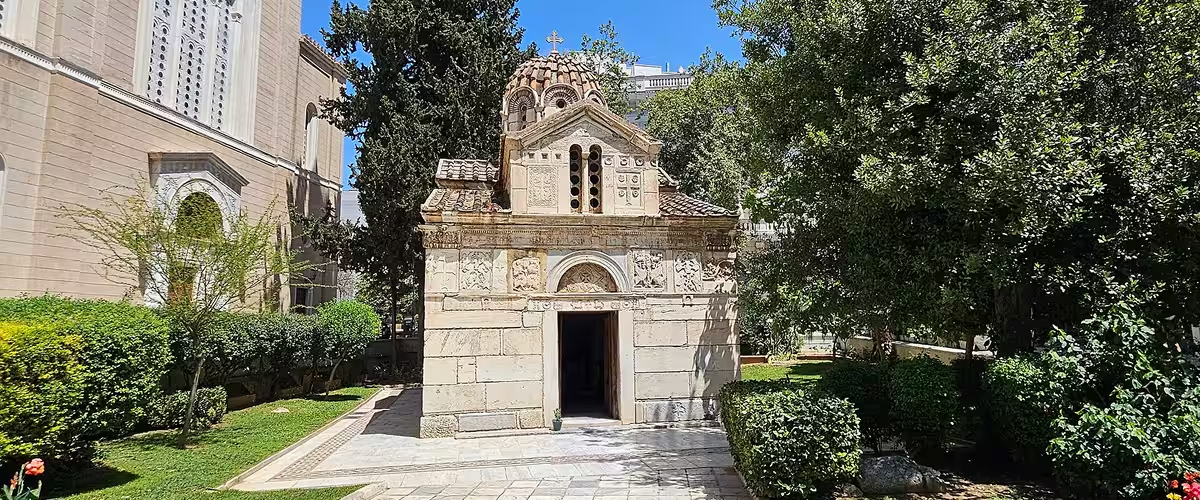
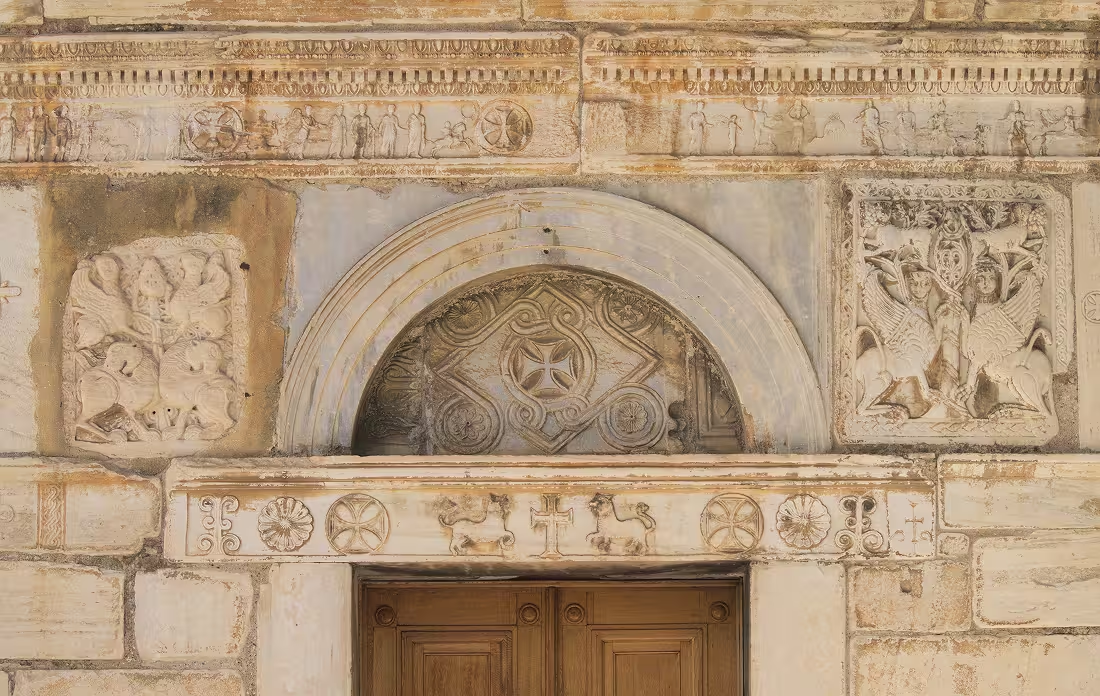
On Mitropoleos Square, the 19th-century Metropolitan Cathedral of Athens towers over a church a fraction of its size. Step closer to the smaller building and its marble walls turn into a gallery. A Roman grave stele, a satyr framed by crosses, sphinxes guarding a Tree of Life and, above the main door, an ancient calendar of Athenian festivals are all set into the masonry.
Some ninety reused carvings, spanning roughly a millennium and a half, make the Little Metropolis unique in Byzantine architecture. Yet nobody can say for certain who gathered them, or when. This page looks at the building, its spolia, its famous calendar frieze and the long debate over its date. It is part of our Byzantine Athens hub; for another survivor a few streets away, see Kapnikarea.
Quick facts
Names: Little Metropolis (Mikri Mitropoli); Panagia Gorgoepikoos, “the Virgin swift to hear”; Agios Eleftherios
Location: Mitropoleos Square, Athens, next to the Metropolitan Cathedral. Nearest metro
Syntagma or Monastiraki, a short walk.
Date disputed: late 12th century, after 1204, or after 1436
Type: Semi-composite, four-columned cross-in-square church with an eight-sided “Athenian” dome
Walls: Marble throughout, with about ninety carved spolia
Highlight: An ancient Athenian calendar frieze over the west door, with 41 surviving figures
Feast day: St Eleftherios, 15 December
Today: A chapel of the Metropolis of Athens
A church with three names
The church goes by three names, and each records a chapter of its history.
Panagia Gorgoepikoos means “the Virgin who is swift to hear”: the Mother of God who answers prayers quickly. The Greek gorgos can mean both swift and fierce. The same epithet was attached to the Panagia Atheniotissa, the Virgin of Athens who was venerated for centuries in the Parthenon, a link that matters for one theory of the church’s origin. The name first appears in written sources in the 17th century, when the church was also called the katholikon.
Little Metropolis comes from its setting. The church stood within the residence of the Metropolitan of Athens, and once the new cathedral rose next door from 1842, the small church became the “Little” or “Old” Metropolis. Despite the name, there is no proof that it ever served as the city’s cathedral. It may have been the metropolitan’s private chapel.
Agios Eleftherios is the dedication it received after Greek independence, and the one used by the Church today. St Eleftherios is celebrated on 15 December.
A tradition repeated in many guidebooks holds that the church stands on the site of a temple of Eileithyia, the ancient goddess of childbirth. It is a neat story, since St Eleftherios is invoked by women in labour, but no excavation has confirmed it.
The building: a small cross-in-square in marble
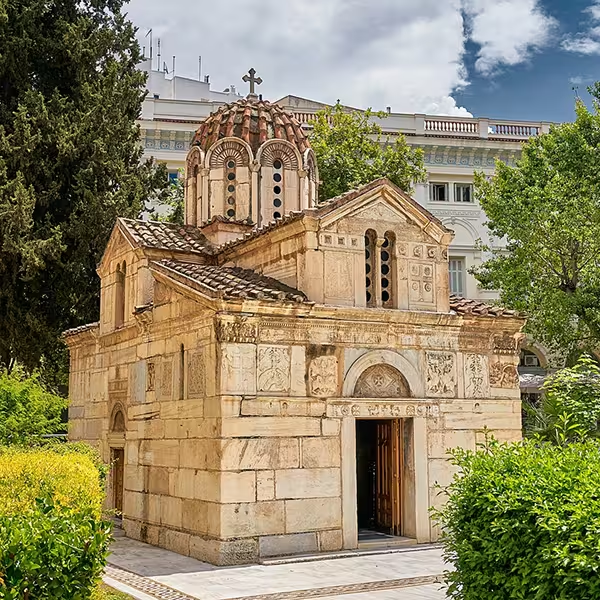
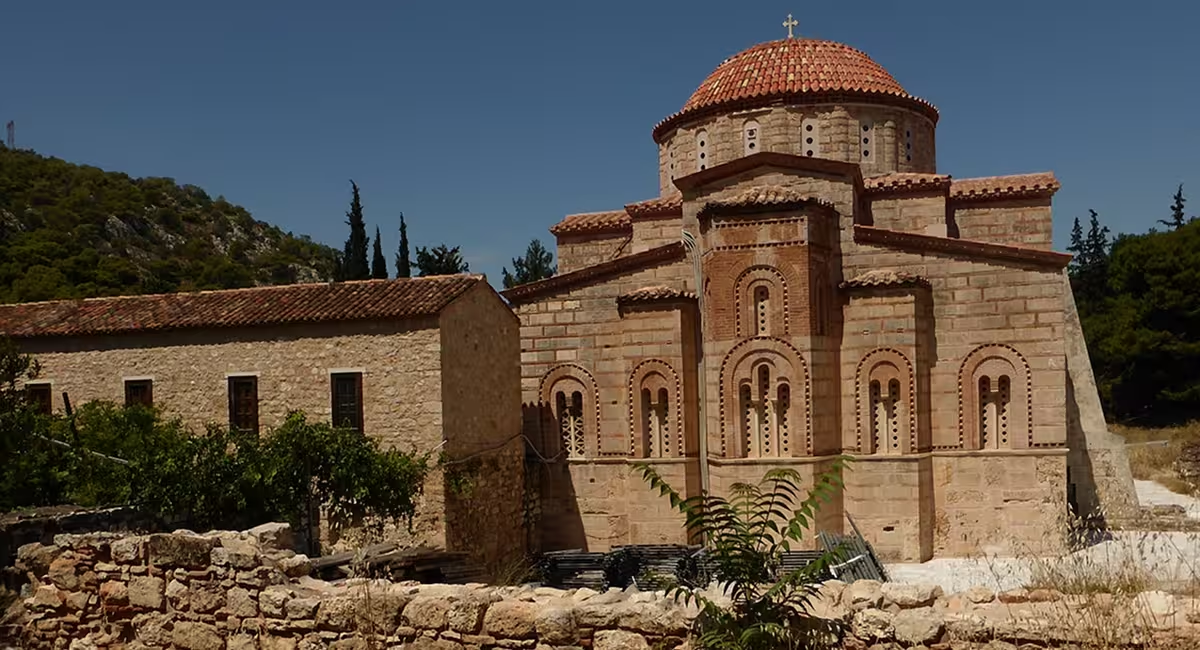
In plan, there is nothing unusual about the Little Metropolis. It is a semi-composite, four-columned cross-in-square church with a dome, a type found widely in Greece. A cross-vaulted narthex lies to the west, a three-sided apse projects at the east, and side doors open onto the transverse axis.
The materials are another matter. Apart from the arches around the dome windows, no brick was used anywhere. On every side except the east, the lower walls are built to a height of about 4.30 m from large marble ashlars, fitted with very little mortar in the manner of ancient masonry. Whether all of these blocks came from ancient buildings is unclear: they lack the cuttings for the metal clamps that ancient builders used. The walls rise from a projecting base that throws a strong shadow line and anchors the whole building.
The builder showed the same eye for reuse in the openings. Windows and doors are crowned by arches carved from single blocks, and over the three entrances he set three Roman arches of Hymettian marble. At the corners of the west façade, two Corinthian pilaster capitals, probably of Hadrian’s time, do the job they were made for.
The dome belongs to the familiar eight-sided “Athenian” type, with single-light windows and marble colonnettes at the corners. Instead of the usual mix of stone and brick, though, it is built of shaped marble blocks. Its slightly horseshoe-shaped arches look back, across a long gap in time, to the dome of the Panagia church at Hosios Loukas.
Inside, little original fabric can be seen. The marble columns that carried the dome were replaced by masonry piers in 1839, and the later wall paintings were stripped in the 1860s (see the timeline below).
@ George E. Koronaios, CC BY-SA 4.0 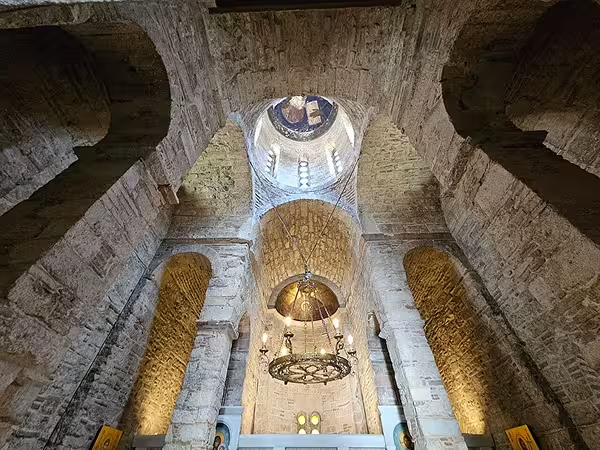
@ John Samuel, CC BY-SA 4.0
A wall of spolia
Reusing old stones was routine in Byzantine building. What makes the Little Metropolis unique is the scale and the display: here the spolia are not filler but the defining feature of every wall.
The German scholars Michel and Struck numbered the stones in 1906, and their list runs to 99, including some plain blocks. Recent counts of the carved pieces hover around ninety. Contrary to the usual description of “ancient temple stones”, most are medieval. Only about a quarter predate the Herulian sack of Athens in 267; the rest are Byzantine reliefs from the 9th to the 12th century or later, many of them closure slabs from church screens.
How the pieces were placed
The carvings sit high on the walls, mostly in a frieze-like band of large slabs, with extra weight on the gables, the doors and the central axes. Hardly any are within reach, yet almost all can be seen clearly. Many pieces share a similar size, and the builder plainly aimed at symmetry and rhythm.
There is a pattern in where the pagan sculptures go. On the west, south and east façades the ancient pieces frame the walls: at the edges, at the apex of the gables and over the doors. That may carry meaning, but it may also be practical. Thick ancient blocks were better suited than thin Byzantine slabs to strengthen corners and edges.
Some ancient pieces on the east wall were turned 90 degrees or set upside down, including an inscription recording a choregic victory. Was this a way of cancelling their power, or did the mason simply need an upright block at that spot? Both explanations have been proposed.
Crosses on pagan stones
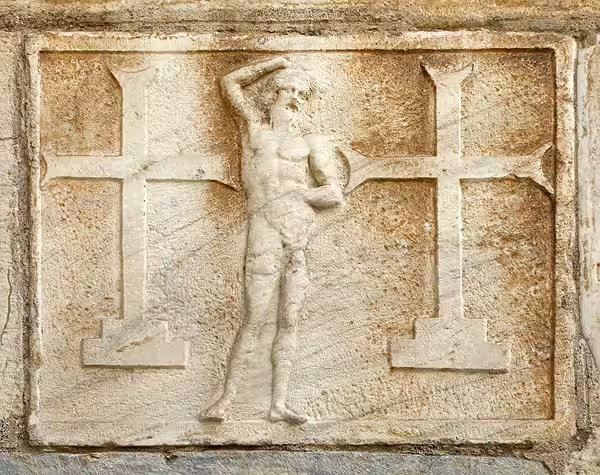
Several ancient reliefs were “baptised” with crosses carved on or beside them, a practice known as sphragis (sealing). A satyr is framed by two large crosses; a small cross sits between the heads of two women on a Roman grave stele; crosses punctuate the calendar frieze. In all, the cross appears more than fifty times on the exterior.
The crosses are of several different types, and not every pagan figure received one: the small reliefs on the east wall were left untouched. Some crosses may therefore have been carved during an earlier reuse, long before the stones reached this church.
A façade-by-façade tour
West façade. The calendar frieze runs above the door (see the next section). Around it are a high-relief panel of two sphinxes flanking a Tree of Life, one of the finest pieces on the church; a lintel with two lions flanking a cross; the Hadrianic corner capitals; and an ancient grave relief of a woman in profile, with a double cross cut beside her.
South façade. This side has no human figures at all. Over the door runs part of a Doric frieze carved with the symbols of Demeter’s cult at Eleusis, torches and poppies among them. Near the east end, an eagle seizes a hare. In the western half, a large block carries a two-line ancient inscription with Athenian names, so discreet that most visitors walk past it. It plays a starring role in the dating debate.
North façade. A naked satyr stands between two stepped crosses, and a relief shows two wine jugs on shields marked with crosses. A Roman grave stele of around AD 200 shows two women facing the viewer. The central axis of this side is marked by no fewer than seven crosses of different designs.
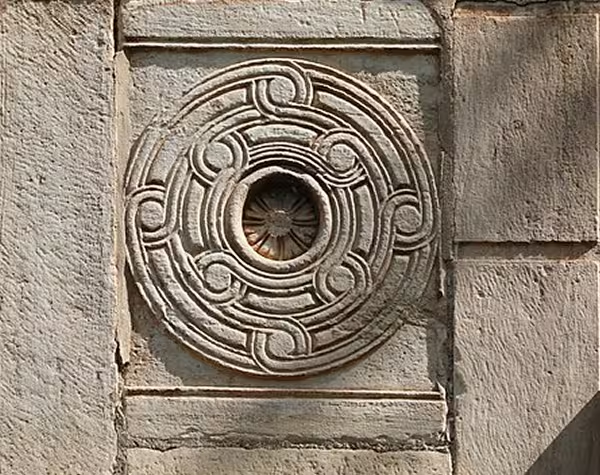
East end. The apse is the most densely decorated part. In the gable, the mother goddess Kybele sits in a small shrine, flanked at the ends by two reliefs of Nike and a woman with a tripod, carved in the manner of the Parthenon frieze. Below come reliefs of victory wreaths, a large slab listing prizes, a lion attacking a spotted animal, and a Byzantine slab with an interlaced cross between sphinxes and peacocks.
@ Francesco Bini, CC BY-SA 3.0 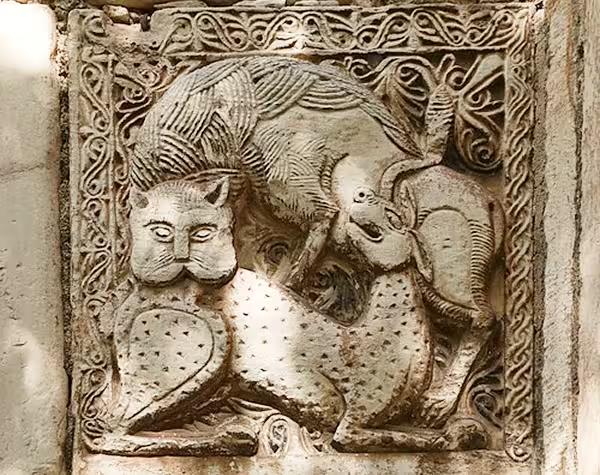
Relief featuring a lion attacking its prey.
@ Francesco Bini, CC BY-SA 3.0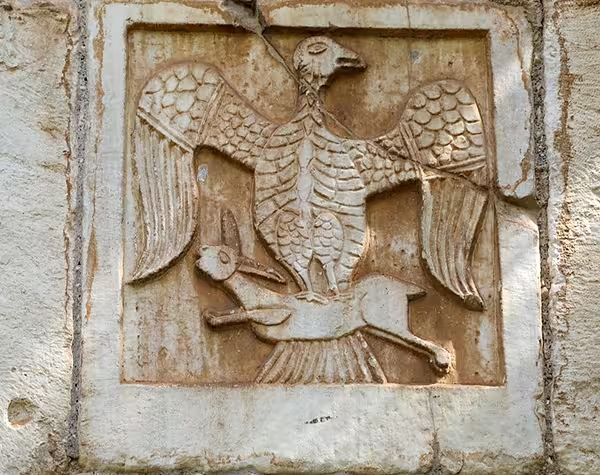
Relief featuring an eagle capturing a hare, a common representation in Byzantine times.
@ Francesco Bini, CC BY-SA 3.0
Were some carvings made for the church?
Not everyone agrees that every piece is reused. Charalambos Bouras argues that three panels on the west façade, all about 1.08 m high and close in style, were carved especially for the church, with motifs borrowed from ancient art such as griffins, sphinxes and sirens. If he is right, the founder did not only collect old sculpture but added new pieces in the same spirit. Bente Kiilerich, by contrast, treats the whole ensemble as spolia.
The calendar frieze
The most famous piece on the church is a long marble frieze set high above the west door. It is the only carved Athenian calendar known to survive from antiquity, and it has puzzled scholars since the mid-19th century.
What it shows
The frieze is made of two blocks, each about 3 m long and just over half a metre high; at least a metre of the middle is lost. Forty-one figures survive. Most move to the right, so the frieze reads from left to right, as a progression through the year rather than a single procession.
Three kinds of figures share the band. The signs of the zodiac appear in their natural order, the earliest known linear zodiac. Between them stand draped men personifying the Attic months, and small scenes from the festivals held in each month. A boy carries the eiresione, the branch hung with wool and fruit paraded at the autumn Pyanopsia. A wheeled ship recalls the Panathenaic procession, in which Athena’s robe was carried like a sail.
How it has been read
Ludwig Deubner’s 1932 study gave the figures the numbers still used today, and Erika Simon, Olga Palagia and Monica Haysom have since proposed new identifications. The most complete reading so far is Amy Claire Smith’s open-access article of 2025.
Smith argues that the frieze combines three calendars in one. The zodiac and other constellations, such as Boötes, Orion and Perseus, track the year by the stars. Personified seasons track the solar year. The months and their festivals track the Athenian civic calendar. Details such as the claws of the Scorpion standing where we would expect Libra’s scales point to a Hellenistic date. Smith suggests the frieze once decorated the gateway of a gymnasium in Athens, most likely the Ptolemaion.
Others have dated it later. Proposals have ranged from the 3rd century BC to the 3rd century AD, and Bouras describes it as Late Roman.
What the Christian builders did with it
The frieze was not simply dropped into the wall. According to Smith, the builders switched its two ends, so that the year began with Aries, and they placed the added crosses where they fitted the Christian calendar. Placing a zodiac over a west door also echoes Romanesque churches in Western Europe.
Kiilerich reads the same evidence differently. Three crosses sit on the left part of the frieze and none on the right, an uneven pattern that, for her, suggests the builders were not much concerned with Christianising pagan images. The frieze thus remains a live test case for how the church’s makers saw the past.
Who built it, and when?
No inscription and no medieval text mentions the Little Metropolis. The earliest written references date from the 17th century. Its date therefore rests on the building itself, above all on the youngest carving in its walls, since the church cannot be older than the stones it reuses.
| Position | Main argument | Held by |
|---|---|---|
| Late 12th centuryunder Michael Choniates | The founder must have admired antiquity, and the learned metropolitan fits | Chatzidakis (1956), long the Greek consensus |
| Late 12th centurybefore 1204 | Style of the latest Byzantine carvings; no Gothic or Romanesque pieces | Bouras (2017) |
| 13th centuryafter the events of 1204 | Spolia from buildings destroyed around 1204 | Frantz (1979), among others |
| After 1204date left open | Some time after the Fourth Crusade | Smith (2025) |
| After 1436probably after c. 1460 | Cyriacus of Ancona saw one of its inscriptions elsewhere in 1436 | Kiilerich (2005) |
The Michael Choniates theory
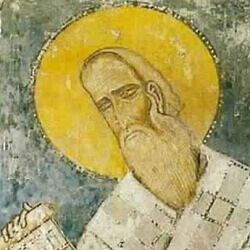
In 1956 Manolis Chatzidakis linked the church to Michael Choniates, Metropolitan of Athens from 1182 to 1204. A learned man from Constantinople, Choniates admired ancient Athens and lamented in his letters how little was left of its glory. Who better to build a church that displays the city’s past?
The idea has two weaknesses. First, nothing connects him to the church. Second, as both Bouras and Kiilerich note, his love of antiquity was literary. His letters cite Homer and Demosthenes at every turn but hardly mention a single work of art. Kiilerich adds that an admirer of antiquity would hardly have set ancient inscriptions upside down, and that most spolia are Byzantine, the very Athens Choniates found so disappointing.
The case for the late 12th century
Bouras dates the church before 1204 on the style of its latest Byzantine carvings. Their two-level relief, rich floral decoration and certain motifs belong, he argues, to the late 12th century. Just as telling is what is missing: there is no Gothic or Romanesque sculpture, which appears in Athens after the Frankish conquest.
Bouras also rejects the idea, proposed by Alison Frantz, that the stones came from buildings wrecked when the warlord Leo Sgouros attacked Athens in 1204. According to Niketas Choniates, Sgouros burned houses in the lower town and left for Thebes after a few days. He had no time to demolish churches.
The case for the 15th century
Kiilerich turns the argument around. Some of the latest spolia date from around 1200 or even later, and carvings only become available for reuse once the buildings that held them have been damaged or dismantled. That points well past 1200.
Her key witness is Cyriacus of Ancona, the Italian antiquarian who visited Athens in April 1436 and copied its inscriptions, noting where he found each one. He recorded the two-line inscription now on the south wall as being on a large marble base. He does not mention a church, although he was keenly interested in reused ancient carvings. In his notes, the inscription also falls among those he copied around the Areopagus and the ancient Agora. For Kiilerich, the stone was still lying there, and the church did not yet exist.
She proposes a context: the years after the Ottoman conquest of Athens in 1456, when the Parthenon, for nearly a thousand years the church of the Panagia Atheniotissa, became a mosque. The Little Metropolis, dedicated to a Virgin whose epithet was shared with the Atheniotissa, could then have been a new home for the Virgin expelled from the Acropolis. Its walls, studded with crosses, would have declared Orthodox identity in an Ottoman city.
Where the debate stands
Bouras dismisses Kiilerich’s thesis as unsupportable, pointing out that Cyriacus is known to have made errors elsewhere, for example with an inscription at Messene. Others have found her case persuasive, and the most recent specialist study of the frieze dates the church only to some time after 1204. The honest conclusion is that both cases are circumstantial. The Little Metropolis may belong to the last decades of Middle Byzantine Athens, to the period of Frankish rule after 1204, or to the first years of Ottoman Athens, and the evidence does not yet allow a choice.
Why reuse so much? Five readings
Over the past century, the explanations offered for the Little Metropolis have changed as much as scholarly fashions. In 1906 the answer seemed simple; today historians look for messages woven into the masonry.
1. Decoration. Paul Steiner, writing in 1906, concluded that the purpose was mainly decorative. Many reliefs are of high quality, and the walls are certainly handsome. But pure decoration does not explain why some pieces were set upside down.
2. Economy. Builders used whatever good blocks were at hand. Yet if thrift had been the point, the carvings could have been turned to face inwards. Selecting, transporting, trimming and fitting so many pieces took real effort, which suggests the carvings mattered.
3. Protection. Henry Maguire saw the walls as a “cage of crosses”. Crosses, fierce beasts and magic patterns of squares and circles protected the church, and the cross neutralised the potentially dangerous power of pagan images. The idea is attractive, but a few crosses would have been enough for protection, and here there are dozens.
4. Nostalgia. For Cyril Mango, Bouras and Amy Papalexandrou, the spolia are relics of a past the builders admired: an open-air museum of Athens’s glory. Bouras sees a founder from an educated elite, able to value the artistic worth of ancient sculpture at a time when most people still feared it.
5. Identity. Kiilerich proposes a loose thematic pattern. The west front, with its calendar and Trees of Life, speaks of birth, life and time; the south, with the Eleusinian frieze, of death and resurrection; the north, where pagan figures received crosses, of baptism; and the east, with its wreaths, prizes and Nikai, of victory. Together they proclaim the triumph of Christ and his Church. In her Ottoman-era scenario, the many crosses were aimed less at pagan spirits than at the new rulers, as markers of Orthodox identity.
Not everyone sees a programme at all. Bouras, following André Grabar and Mango, finds no stylistic or iconographic link between neighbouring pieces, only a clear taste for symmetry.
How unusual is it?
Very. Other Greek churches reuse old stones, but mostly as building material. At Skripou in Boeotia (873/874), the spolia are mainly column drums. At Merbaka in the Argolid, ancient blocks and a few grave reliefs are set discreetly into the walls. In Athens itself, the lost church of Ioannes o Magoutes displayed a handful of reliefs on its west front, recorded by Paul Durand in 1843, some closely matching pieces on the Little Metropolis. Nowhere else, however, do spolia cover the walls as they do here. See our page on Byzantine religious architecture for the wider context.
After Byzantium: from parish church to library
Whatever its date of birth, the church’s later life is better documented, thanks to travellers, drawings and the busy decades of the new Greek capital.
- 17th century: the church is called Gorgoepikoos and katholikon. It is thought to have been the main church of a small monastery that became a dependency of the Kaisariani monastery.
- 1674: the English traveller George Wheler records the two-line inscription in the church wall.
- 1745: the Kyiv-born monk and traveller Vasily Barskij draws the church inside the metropolitan’s residence, topped by a bell tower over the west arm.
- Ottoman period: the interior is painted with post-Byzantine frescoes.
- 1834: after the War of Independence, the church becomes a storeroom for antiquities.
- 1839: a drastic restoration replaces the fire-cracked marble columns with masonry piers and pulls down the bell tower.
- 1841: the church houses the public library of Athens.
- 1842: work begins on the new Metropolitan Cathedral next door, and the small church becomes the “Little Metropolis”.
- 1862–63: the plaster with the post-Byzantine paintings is removed, provoking protest at the time. Sixteen drawings by Paul Durand preserve a record of them.
- Early 1970s: restoration by the Ephorate of Antiquities.
- 2003–05: conservation of the sculptures, followed by a tidying of the monument in 2004.
Traces of the fire that cracked the columns can still be seen in the northwest corner bays and the narthex.
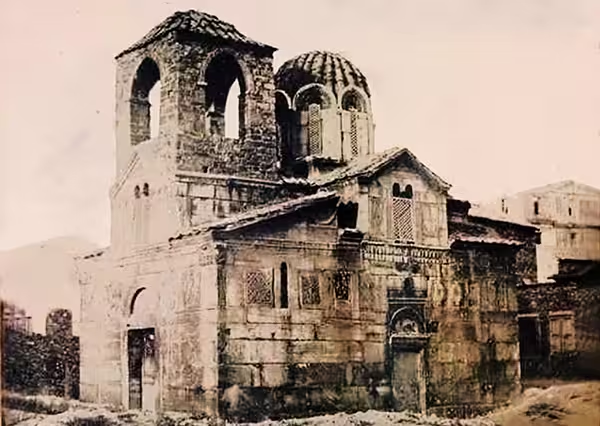
Picture of the church in 1842, featuring its bell tower. 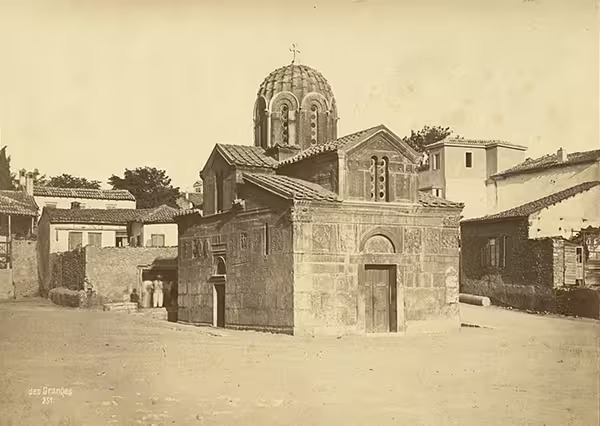
Late 19th century picture (maybe 1881), the bell tower was removed.
Visiting the Little Metropolis
The church stands on the south side of Mitropoleos Square, next to the Metropolitan Cathedral, between Syntagma and Monastiraki. It is an active chapel of the Metropolis of Athens, so opening times vary and it is often closed outside services.
The real attraction is the outside, which can be seen at any time. Walk slowly around all four sides and bring binoculars or use your phone’s zoom: the carvings sit high, and some, like the two-line inscription on the south wall, are easy to miss. Morning light suits the east end, afternoon light the west front with the calendar frieze.
A short walk links the church to other Byzantine Athens: west along Ermou Street to Kapnikarea, then on to the Roman Agora and the Tower of the Winds.
Frequently asked questions
Why is it called the Little Metropolis?
The church stood within the residence of the Metropolitan of Athens. When the much larger Metropolitan Cathedral was built beside it from 1842, the old church became the “Little” Metropolis. It is not certain that it was ever the city’s cathedral.
When was the Little Metropolis built?
Nobody knows for sure. Most Greek scholars date it to the late 12th century, before the Frankish conquest of 1204. Bente Kiilerich has argued for a date after 1436, perhaps after the Parthenon became a mosque, and a 2025 study dates it only to some time after 1204.
Are the carvings on the walls ancient Greek?
Only some. About a quarter of the roughly ninety carvings are ancient or Roman, including grave stelae, inscriptions and the calendar frieze. The majority are Byzantine reliefs, many of them from church screens.
What is the calendar frieze?
It is an ancient frieze above the west door showing the Athenian year: the signs of the zodiac, personified months and scenes from festivals. Forty-one figures survive. The latest study dates it to the Hellenistic period and suggests it came from a gymnasium gateway.
Did Michael Choniates build the church?
It is possible but unproven. Choniates, Metropolitan of Athens from 1182 to 1204, loved the city’s ancient past, which made him an attractive candidate. No source links him to the church, and his interest in antiquity seems to have been literary rather than visual.
Can you go inside?
Sometimes. The church is an active chapel and often closed outside services. The interior has lost its original columns and wall paintings, so the exterior is the main sight.
Sources and further reading
- Bouras, Charalambos. Byzantine Athens, 10th–12th Centuries, Routledge, 2017, pp. 176–184.
- Kiilerich, Bente. “Making Sense of the Spolia in the Little Metropolis in Athens”, Arte Medievale n.s. IV, 2005, no. 2, pp. 95–114.
- Smith, Amy Claire. “Re-Reading the Little Metropolis Calendar Frieze”, The Cambridge Classical Journal 71, 2025, pp. 115–154.
- Kaldellis, Anthony. The Christian Parthenon: Classicism and Pilgrimage in Byzantine Athens, Cambridge University Press, 2009, pp. 212–214.
- Maguire, Henry. “The Cage of Crosses: Ancient and Medieval Sculptures on the ‘Little Metropolis’ in Athens”, in Thymiama stē mnēmē tēs Laskarinas Boura, Athens, 1994, pp. 169–172.
- Michel, K., and A. Struck. “Die mittelbyzantinischen Kirchen Athens”, Athenische Mitteilungen 31, 1906, pp. 279–324.
- Haysom, Monica. Time and Religion in Hellenistic Athens: An Interpretation of the Little Metropolis Frieze, PhD thesis, Newcastle University, 2016.



One Comment