Byzantine Religious Art: Faith in the Church, at Home and on Pilgrimage
A Byzantine church was not a gallery. Its images belonged to the liturgy: icons were kissed and carried in processions, the decoration placed the worshipper inside a vision of the heavenly order, and the vessels on the altar were as carefully made as the walls around them. But Byzantine religious art was never confined to churches. It also lived in the home, in small ivories and icons used for private prayer, and on the road, in the flasks and reliquaries that pilgrims carried. This guide explains what the images were for, how a church was meant to be read, and the three worlds of objects that carried the faith: the church, the home and the pilgrimage. Each section points to our detailed guides on icons, mosaics, frescoes, manuscripts and architecture.
What was Byzantine religious art for?
It did four jobs. It served worship: images, vessels and textiles were part of the liturgy, not decoration around it. It taught: most people could not read, and the scenes on church walls told them the story of salvation. It mediated: the Virgin and the saints were asked to intercede, and the image was the place where the believer addressed them. And it remembered: emperors, founders and donors had themselves recorded in the buildings and objects they paid for. Patrons ranged from the emperor to monasteries and private families, which is why the same themes appear in a gold-ground apse mosaic and in a pocket-sized ivory. Much of what survives comes from churches, monasteries and church treasuries, which is why religious art dominates our picture of Byzantium. For the other side, see Byzantine secular art.
The theology behind the images
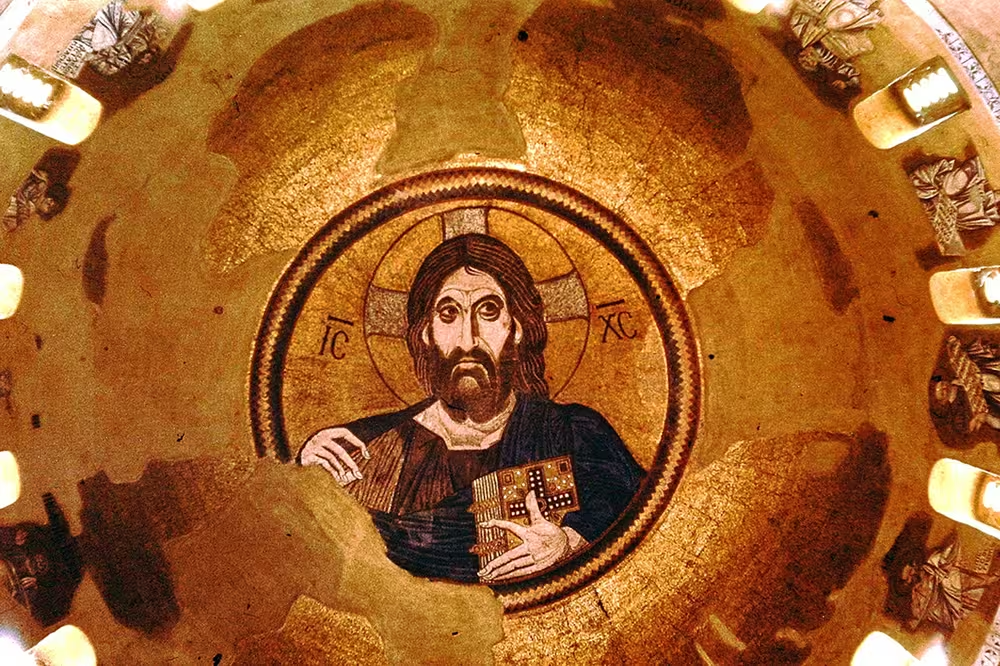
The images rested on a theological idea: since God became man in Christ, he could be shown. An icon was therefore a window to the divine, not an idol, and the Byzantines distinguished veneration (proskynesis), given to images, from worship (latreia), reserved for God alone.
The distinction was fought over during Iconoclasm, when emperors from Leo III in 726 banned the veneration of images, and was defined at the Second Council of Nicaea in 787. Images returned for good in 843, an event celebrated as the Triumph of Orthodoxy. After that the image was central to devotion, teaching and imperial display. For the full story, see our guides to Byzantine icons and the Iconoclast Controversy. The rare iconoclast decoration of Hagia Irene shows the alternative: a plain cross in place of figures.
The church as a picture of the heavenly order
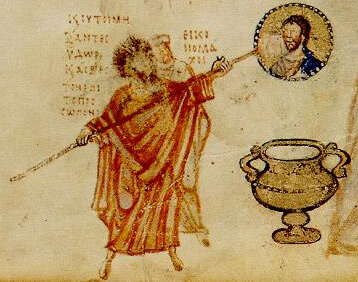
After 843 the decoration of a Middle Byzantine church followed a program that changed little over the centuries. Christ Pantokrator looked down from the dome, with the apostles below him; the Virgin, usually with the Child, filled the apse; scenes tied to the great feasts of the liturgical year ran across the vaults; and saints stood at eye level, facing the worshipper, who greeted them with a prostration and a kiss. The narthex, where funerals could be held, often carried the Last Judgment. The templon screen in front of the sanctuary carried icons that grew in number from the 10th century. The program adapted to context: funerary chapels such as the parekklesion of the Chora Church concentrated on resurrection and judgment. The plan itself helped: the central dome drew the gaze up towards heaven. To read this in detail, see the Byzantine church; to see it best, visit Daphni, Hosios Loukas or Nea Moni in Greece. For the techniques, see mosaics and monumental painting.
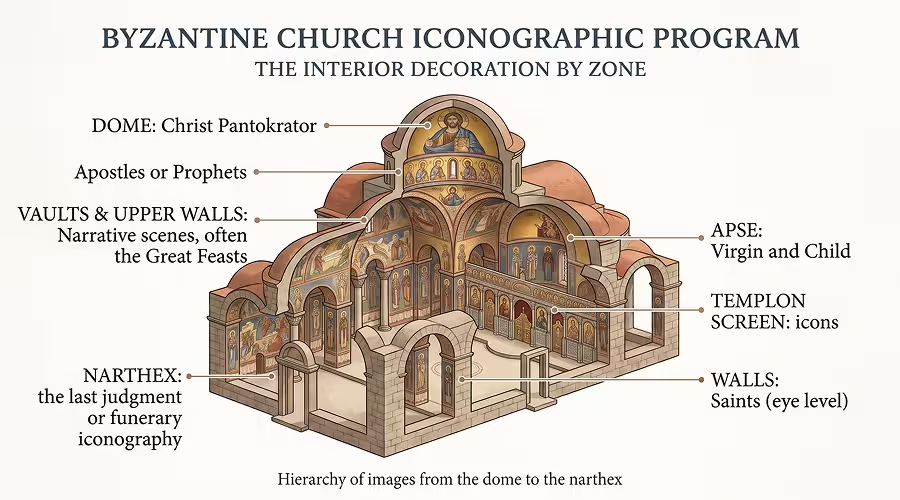
Three worlds of objects
Wall images were only part of the story. Byzantine religious art also filled three settings, each with its own objects: the liturgy inside the church, private prayer at home, and the journey to holy places. The sections below separate them.
Liturgical art: the objects of the service
The liturgy needed vessels for bread and wine, books, lights, incense, fans and cloths, and many were made in precious materials as gifts to God. In the 6th century bishops and donors gave church silver, often gilded, worked in repoussé and inscribed in niello; imperial control stamps show that some came from state-supervised workshops. The decoration often shows the rite the object served. Textiles such as altar cloths, vestments and the epitaphios carried images too. See goldsmithing and metalwork and textiles; are three curated objects illustrating the different realms of artifacts produced in a liturgical context.
Saint Sergius Paten from the Beth Misona Treasure (c. 500)
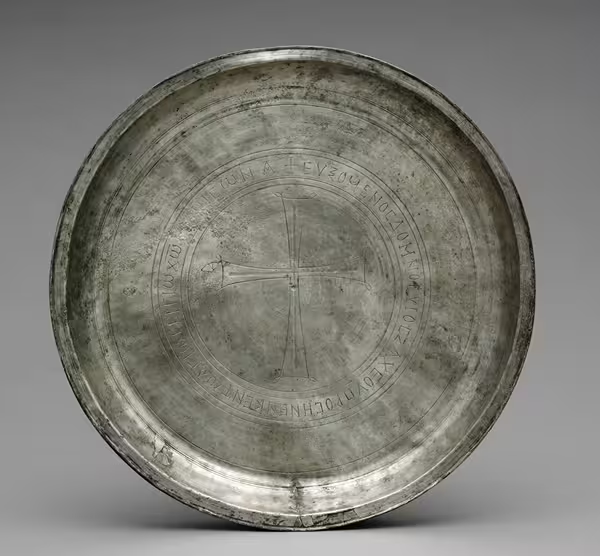
Housed at The Cleveland Museum of Art, this paten was found alongside three chalices in what is now called the Beth Misona Treasure—named after a village in northern Syria for which the objects were made. The exact location and circumstances of the hoard’s discovery remain unknown. The people of Beth Misona, like other Christian communities in Syria and Palestine, likely buried their church silver to protect it from Persian or Arab conquests in the first half of the seventh century.
The paten was used to hold pieces of Eucharistic bread during the Liturgy. It is decorated with an engraved Latin cross encircled by a dedicatory inscription naming its donor, Domnos, and its original location, the Church of Saint Sergios in Beth Misona.
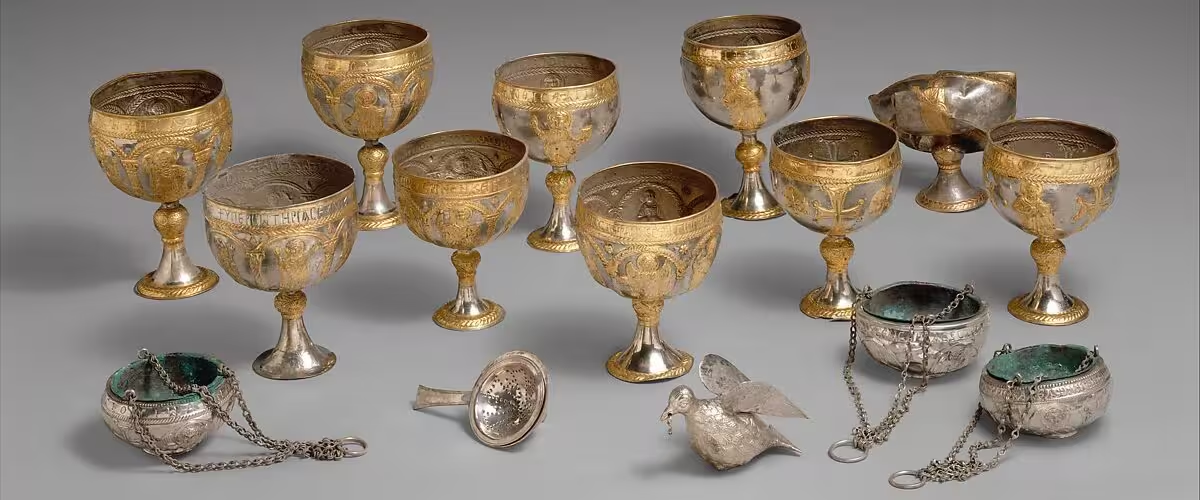
The Attarouthi Treasure (c. 500-650)
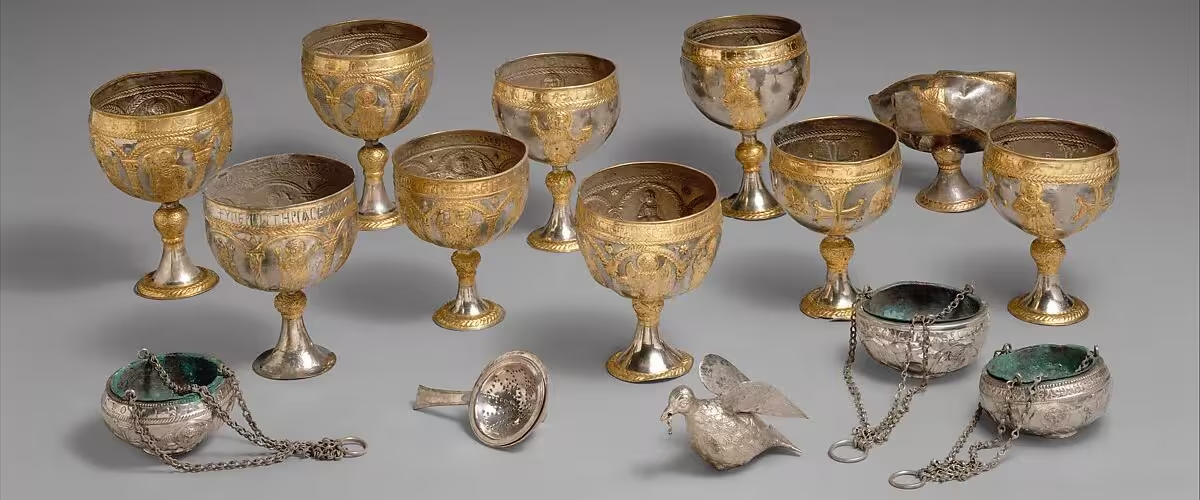
This treasure provides a fascinating glimpse into the precious liturgical objects that churches held for the Divine Liturgy, in which bread and wine were consecrated in commemoration of the Last Supper and Christ’s death. It contains ten chalices, three censers, a strainer, and a representation of the dove of the Holy Spirit. These objects belonged to two churches in the affluent Syrian town of Attarouthi: the main church, dedicated to Saint Stephen, and a smaller one dedicated to Saint John. Crafted between 500 and 650, their decoration is worked in relief (repoussé) with engraved detail. Inscriptions show that many of the objects were offerings from local citizens. As with the Beth Misona treasure, these artifacts were likely buried in haste within a protective container when the Byzantine army retreated during regional attacks by the Sasanian Persians or the Arabs.
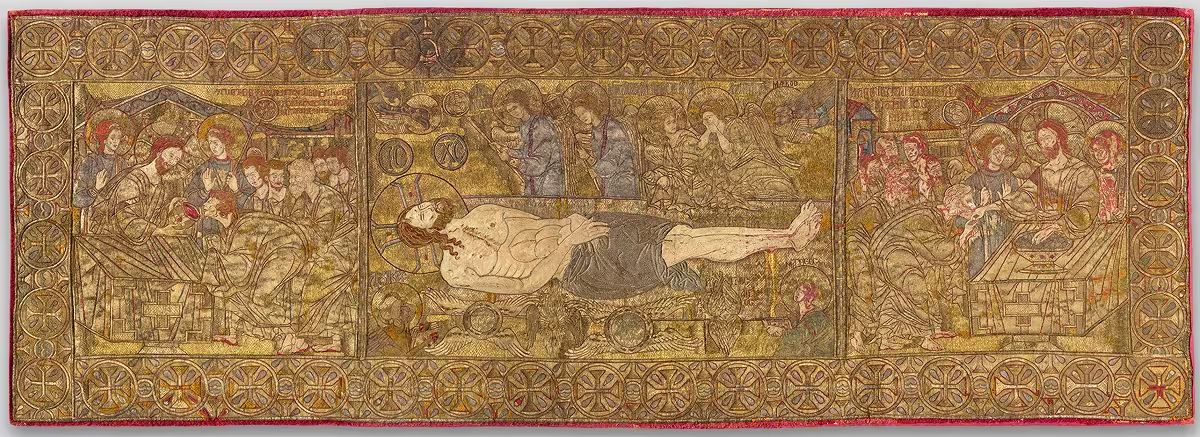
The Thessaloniki Epitaphios (about 1300)
This rectangular cloth of silk and linen, embroidered with gold and silver thread, is about two metres long and 70 centimetres wide. It was used in the Good Friday service. The dead Christ lies at the centre surrounded by angels, and the sides show the Communion of the Apostles. It was probably made in a Thessaloniki workshop, was found in 1900 in a small church in the city, and is now in the Museum of Byzantine Culture in Thessaloniki. Embroidered epitaphioi were carried in procession, and the cloth is the finest surviving example of Byzantine needlework.
Devotional art: the objects of private prayer
Not all religious art was public. Icons stood in homes and were carried on journeys; as our Icons guide explains, they were treasured in households and used as protective talismans. Wealthy owners also commissioned small portable objects in costly materials: ivory triptychs, icons carved in steatite, icons in enamel or mosaic, and crosses worn on the chest. They let a believer address the same figures as in church, and they showed status as well as piety. See Byzantine icons and ivory, bone and wood, and here are three objects in focus.
The Harbaville Triptych (mid-10th century)
This hinged ivory triptych in the Louvre measures about 24 by 28 centimetres when open. Its centre shows the Deesis: Christ enthroned between the Virgin and John the Baptist, who intercede for humanity, with apostles and saints below and on the wings, all identified by inscriptions. Closed, the wings protected the images; opened, it became a private altar for prayer. Traces of colour survive. It gives its name to the Harbaville group of 10th-century ivories and is considered the finest of them.
A steatite icon of Christ Pantokrator (14th century)
Steatite, a soft stone that carves easily, was used for small relief icons that could be held in the hand. The Metropolitan Museum’s Late Byzantine steatite Pantokrator, shown in our Icons guide, is typical: a miniature version of the dome image, made for use outside the church.
A double-sided icon in Athens (9th to 16th century)
A devotional image could outlive its first painters. The double-sided icon of the Crucifixion and the Hodegetria in the Byzantine and Christian Museum in Athens carries three layers on the front: the 9th-century cross and angels, 10th-century inscriptions and starry background, and a 13th-century repainting of the Virgin, John and Christ’s head. X-rays show that Christ was first painted alive, with open eyes, and later repainted with closed eyes. On the back, an earlier Virgin was overpainted in the 16th century. It records how sensibilities changed over seven centuries.
Pilgrimage: the art of the journey
Pilgrims travelled to the Holy Land, to Sinai, to Abu Mena in Egypt, to the shrine of Saint Demetrios in Thessaloniki, and to the relics of Constantinople. They sought contact with holy places, saints and relics, and brought home blessings in the form of water, oil or earth. That created a distinct set of objects: small flasks and tokens that carried the blessing, and reliquaries that enshrined the relic itself. Many are modest, mass-produced and found far from their source, which makes them useful evidence of how far belief travelled.
Souvenirs of holy places
Around forty small lead and pewter ampullae, most kept in the Cathedral Treasury of Monza and at Bobbio, were brought from the Holy Land in the late 6th and early 7th centuries. Many show the Women at the Tomb or the cross, linking the flask to the holy places a pilgrim had visited.
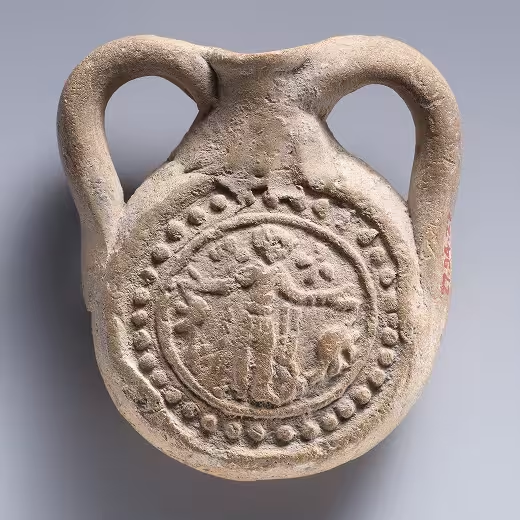
Pottery flasks showing Saint Menas between two kneeling camels were made at Abu Mena, near Alexandria, from the 5th to the 7th century. Pilgrims filled them with water from the spring or oil from the lamp above the saint’s tomb. Hundreds have been found across Europe and Byzantine lands, from Nubia to Britain. The shrine declined after the Persian and Arab invasions of the 7th century.
Relics and reliquaries: the Limburg Staurotheke (10th century)
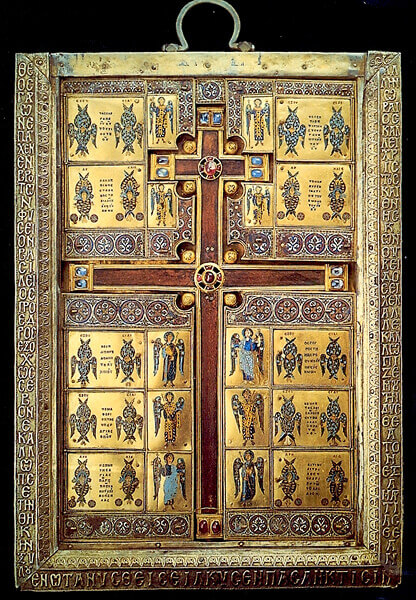
A staurotheke (from the Greek for “container of the cross”) holds a fragment of the True Cross. The Limburg Staurotheke has a central cross of sycamore wood holding seven fragments, made between about 945 and 959, as an inscription naming Constantine VII and Romanos II shows. The larger case, decorated with cloisonné enamel and with Christ, the Virgin and John the Baptist on its lid, was commissioned between 963 and 985 by Basil Lekapenos, a powerful eunuch at court. Brought to the Rhineland by Henry of Ulmen in 1207, after the sack of 1204, it served as a model for local goldsmiths and is now in the Cathedral Treasure of Limburg an der Lahn.
How Byzantine religious art changed
| Period | What changed | Objects and examples |
|---|---|---|
| Early (4th to 7th century) | Basilicas and mosaics; first icons at Sinai; church silver; pilgrim flasks | Riha paten, Attarouthi Treasure, Sion Treasure, Menas and Monza ampullae |
| Iconoclasm (726 to 843) | Figures banned; crosses replace them | Hagia Irene apse |
| Middle (843 to 1204) | Fixed church program; Communion of the Apostles; ivory triptychs; enamel reliquaries | Harbaville Triptych, Limburg Staurotheke, Daphni |
| Late (1204 to 1453) | More emotional style; embroidery; fresco cycles | Thessaloniki Epitaphios, Chora |
For the full story by period, see our Byzantine art overview.
Where to see Byzantine religious art
| Place | What to look for |
|---|---|
| Saint Catherine’s Monastery, Sinai | The oldest surviving icons |
| Ravenna, Istanbul, Daphni, Nea Moni, Mystras | Church decoration in place (see our travel guides) |
| Museum of Byzantine Culture, Thessaloniki | The Thessaloniki Epitaphios |
| Dumbarton Oaks, Washington | Riha paten and Sion Treasure silver |
| Antalya Museum, Turkey | Other Sion Treasure pieces |
| Louvre, Paris | Harbaville Triptych |
| Byzantine and Christian Museum, Athens | The double-sided Crucifixion and Hodegetria icon |
| Cathedral Treasury, Limburg | The Staurotheke |
| Cathedral Treasury, Monza | Holy Land ampullae |
See also our guide to Byzantine art museums.
Frequently asked questions
What is Byzantine religious art?
Art made for worship, devotion and pilgrimage: church mosaics and frescoes, icons, and objects such as vessels, textiles, ivories and reliquaries. It was based on the idea that God became man and could therefore be shown.
What were liturgical objects?
The vessels, books, cloths, fans and lights used in worship, such as the chalice and paten for the Eucharist and the epitaphios used on Good Friday.
Were icons worshipped?
In theory, no. The Byzantines distinguished veneration of images from worship, which belongs to God alone; the distinction was defined at the Second Council of Nicaea in 787.
What did Byzantine pilgrims bring home?
Small flasks of oil or water from holy places, tokens, and, for the wealthy, reliquaries holding relics.
Why are Byzantine religious images so formal?
Frontal, controlled figures conveyed spiritual authority and invited contemplation rather than narrative drama.
Where can I see it?
In churches such as Daphni and Hosios Loukas, in Ravenna and Istanbul, and in museums including Dumbarton Oaks, the Louvre and the Museum of Byzantine Culture in Thessaloniki.
Further reading
- The Oxford Handbook of Byzantine Art and Architecture, Ellen C. Schwartz, ed. (Oxford University Press; check the current edition): the up-to-date overview.
- Likeness and Presence: A History of the Image before the Era of Art, Hans Belting (University of Chicago Press, 1994): the classic study of sacred images.
- The Glory of Byzantium, Helen C. Evans and William D. Wixom, eds. (Metropolitan Museum of Art, 1997): free to read on MetPublications; covers liturgical objects, ivories and icons.
- Early Byzantine Pilgrimage Art, Gary Vikan (Dumbarton Oaks; check the revised edition): the standard study of pilgrim objects.
- The Byzantine Rite: A Short History, Robert F. Taft (Liturgical Press, 1992): the liturgy these objects served.