Byzantine Secular Art: Treasures of the Court and the Home
Most people picture Byzantine art as gold mosaics and icons. Yet the court also commissioned silver dishes, woven silks, carved ivory caskets and floor mosaics full of hunters, animals and acrobats. These objects were not secular in the modern sense: emperors appear in them as God’s chosen rulers, and classical myths sit beside Christian symbols. They show how the empire’s elites lived and what they valued. This page walks through the main kinds of Byzantine secular art, the masterpieces that survive, and where you can see them today.
What counts as Byzantine secular art?
The split between ancient and Byzantine art is modern too. The Byzantines did not see classical art as foreign: it was their own inheritance, and it was part of daily life. Constantine filled his new capital with statues brought from cities across the empire, and the forums, the Baths of Zeuxippos and the Hippodrome displayed Greek and Roman works, among them the bronze Serpent Column from Delphi, which still stands in Istanbul. Writers described these statues with admiration, and later texts such as the Patria credit some of them with magical powers. Ancient sculptures and carved stones were also reused in new buildings, and classical subjects such as myth, personification and the hunt remained a living visual language, as the Veroli Casket and the Great Palace mosaics show.
Secular art produced in the Byzantine period should be read against that background. It was art made for the court and the home rather than for worship: tableware, textiles, boxes, jewellery, manuscripts, and the decoration of palaces and villas. The category is modern and blurry. Emperors presented themselves as God’s representatives, so a silver dish or a silk could carry biblical scenes and still work as political display, while classical myths, hunts and circus scenes stayed popular throughout the empire’s history. Buildings such as palaces and city walls are covered on separate pages, linked near the end of this one.
Why so little survives
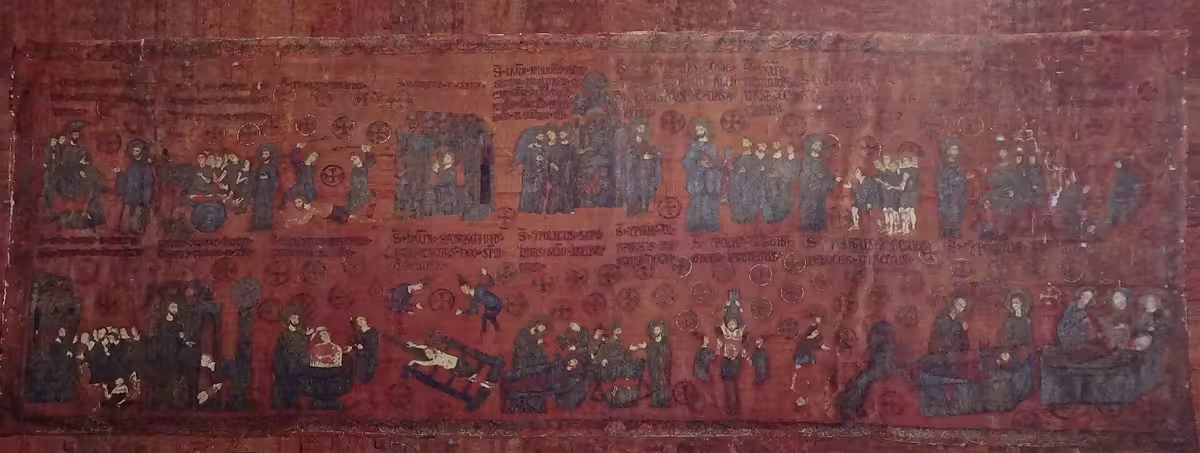
Far more Byzantine secular art has been lost than preserved. Objects in precious metal were easy to melt down, textiles decay, and palaces were looted, rebuilt or abandoned; the Crusader sack of Constantinople in 1204 and the fall of Constantinople in 1453 scattered much of what remained. What survives mostly did so by leaving circulation: buried in a hoard, like the David Plates in Cyprus; kept in a church treasury, like the Veroli Casket; or buried with a bishop, like Gunther’s silk. That is why museum and treasury collections matter so much for this subject.
For whom was it made?
Byzantine secular art served the top of society and the people who worked for it. The emperor commissioned the most prestigious pieces, such as stamped silver and court silks, to display authority and reward loyalty; see imperial power in Byzantium.
Around him, the aristocracy of landowners and court dignitaries used luxury goods to mark rank, and clothing was a clear signal: the finest silk was legally reserved for the imperial family and the highest aristocracy (see Byzantine fashion).
Women were owners and patrons as well as subjects of this art. The Vienna Dioscorides was made for the princess Anicia Juliana, who also funded churches in Constantinople, and rings and other jewellery marked family occasions (see women in Byzantium).
High-ranking Eunuchs, some of whom controlled the treasury and had close access to the emperor’s household, also moved in this world.
Behind every object stood an artisan. Craftsmen in Constantinople worked within a guild system that fixed prices and wages, and the tenth-century Book of the Eparch placed silk manufacture under state supervision, so much court art came from regulated workshops. Few makers are named; see artisans and merchants and Byzantine artists, known and anonymous. Not all of this art was elite, since glazed pottery and simpler objects reached ordinary households, but the masterpieces that survive were mostly made for the court. For the wider picture, see Byzantine society.
Where this art was displayed
Secular art was made for rooms as much as for hands, and those rooms are covered elsewhere on the site. Imperial residences, from the Great Palace to the Blachernae, are the subject of Byzantine imperial palaces. Baths, forums, cisterns and public buildings are in civil and imperial architecture, and walls such as the Theodosian Walls are in Byzantine fortifications.
Precious metalwork: silver, gold and jewellery
Precious metal was the language of imperial favour. From late antiquity emperors gave coins, belts, brooches and silver dishes to officials, soldiers and foreign rulers, objects that marked rank as much as they stored wealth. In the 6th and early 7th centuries the state stamped silver with control marks that guarantee its purity and help to date it. Gold jewellery marked family occasions, as in early Byzantine marriage rings from Cyprus with nielloed Greek inscriptions and Christian scenes. Many pieces survive because they were buried in times of danger: the Krategos-Mytilene Treasure from Lesbos, buried after 630, shows what a well-off household owned, with 17 silver vessels, 22 pieces of gold jewellery and 32 coins. In the Middle Byzantine period the great court technique was cloisonné enamel, in which gold walls hold coloured glass, used for crowns, jewellery and diplomatic gifts. After the sack of 1204 much treasure left for the West, and a good part of what we can see today comes from church treasuries such as San Marco in Venice. For more on the craft, see our page on Byzantine goldsmithing and metalwork; here, we focus on three striking examples.
The David Plates (early 7th century)
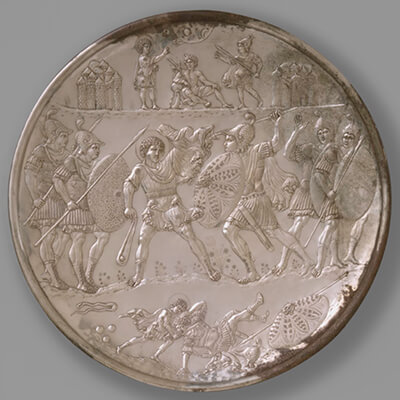
Nine silver plates found at Karavas, Cyprus, in 1902 show scenes from the life of King David, from his anointing to his fight with Goliath. They come in three sizes, and the stamps date them to the reign of Emperor Heraclius, between 613 and 629/30. Six are now in the Metropolitan Museum of Art in New York and three are in Cyprus.
They were display pieces rather than everyday tableware, and they may be the earliest surviving example of biblical scenes used for this purpose. Many scholars read David as a model for the ruling emperor, and the timing is suggestive: Heraclius defeated Persia in 628 and returned the True Cross to Jerusalem in 630. How far the plates can be tied to specific events is still debated.
The same Karavas find also contained gold jewellery, now partly in the Metropolitan Museum, including heavy bracelets decorated with gold grapevines. Personal jewellery tells a more intimate story: Cyprus holds early Byzantine gold marriage rings with octagonal hoops, nielloed Greek inscriptions and Christian scenes such as the Annunciation.
Constantinople work, 7th century.
The Monomachos Crown (mid-11th century)
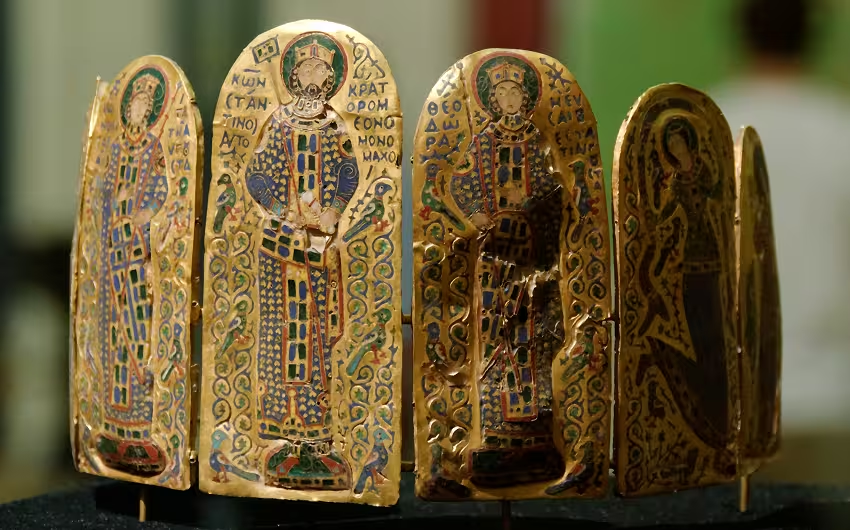
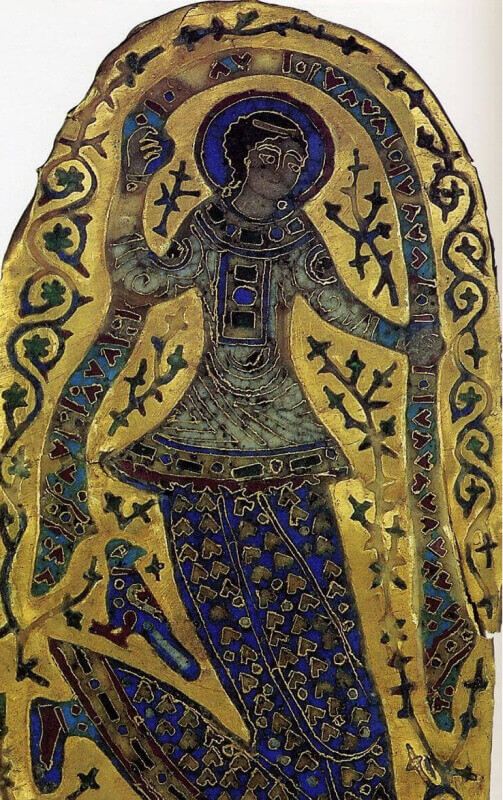
Seven gold plaques decorated with cloisonné enamel, found in 1860 near Nyitraivánka in present-day Slovakia, are known as the Monomachos Crown. They show Emperor Constantine IX Monomachos (r. 1042 to 1055), Empress Zoe and her sister Theodora, two dancing women, and the personifications of Truth and Humility, and were made in Constantinople around the middle of the 11th century.
The name is a convenience: the plaques may not have formed a crown at all, and may have decorated a belt or another object sent from the court as a gift. They are now in the Hungarian National Museum in Budapest, and the dancers beside the imperial portraits show that court art could be festive as well as solemn.
Luxury vessels in the San Marco treasury
Much of the treasury of San Marco was built from the spoils of Constantinople. Among its Byzantine vessels is a bowl of deep purplish-red glass, made in Constantinople in the 10th century and decorated with gilding and enamel: large medallions with figures, small medallions with heads, pseudo-Kufic inscriptions and arabesques, all in a silver-gilt mount with two handles. The pseudo-Kufic lettering, which imitates Arabic script as decoration, shows how Byzantine craftsmen borrowed ornament from the Islamic world. The treasury also holds a hexagonal rock-crystal vessel among other luxury vessels.
For more on the craft, see our page on Byzantine goldsmithing and metalwork.
Silks: wealth, diplomacy and propaganda
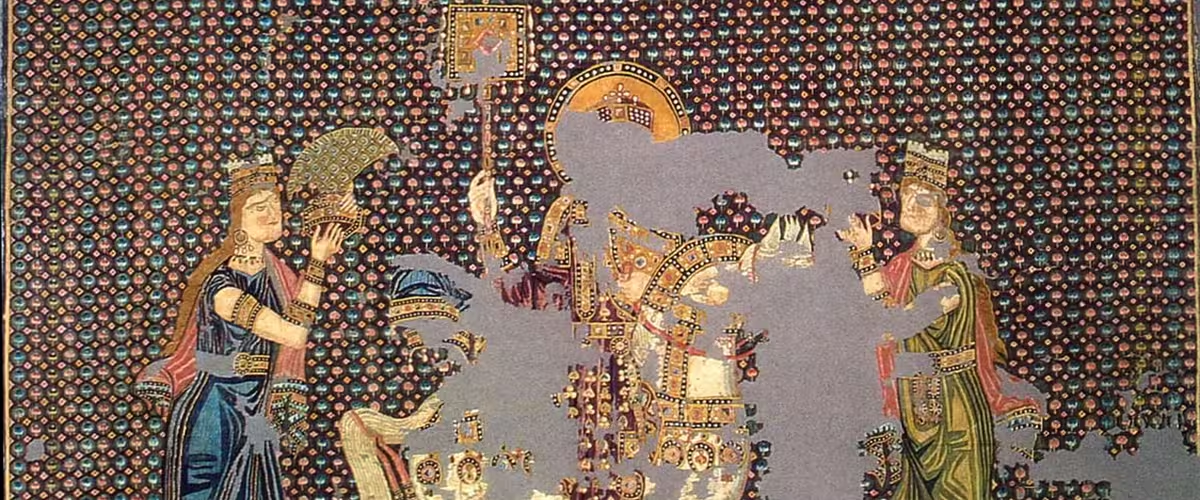
Silk was the empire’s most prestigious luxury. State-controlled workshops in Constantinople wove cloth with griffins, lions and imperial eagles for court robes, for adorning imperial spaces and for diplomatic gifts that carried a message of power. An 11th-century silk with paired griffins in roundels, now in the Valère Basilica in Sion, Switzerland, shows the kind of pattern that reached Western treasuries.
Silk weaving in the empire grew from the 6th century, when, according to tradition, monks smugged silkworm eggs from China and brought them back to Constantinople under Justinian. The workshops of the capital worked under state supervision, and the finest silks were reserved for the emperor and his circle. They wove cloth for court robes, to adorn imperial spaces and as diplomatic gifts, often in patterns of paired animals in roundels that drew on Persian models. In the middle byzantine period, other centers of production appeared in Greece, especially around Thebes. See Byzantine textiles and the silk industry for the wider picture, , and discover below some iconic examples of silkwork that have stood the test of time

Ivory and bone: diptychs, caskets and horns for the elite
Ivory carving was a court art from late antiquity to the 12th century. The earliest dated secular objects are consular diptychs, pairs of hinged ivory panels that a newly appointed consul gave to friends and supporters; a law of 384 reserved them for consuls, and the series made in Constantinople fades after the middle of the 6th century. After Iconoclasm, workshops in Constantinople made caskets and plaques in the 10th and 11th centuries, often with classical or hunting scenes, alongside boxes, combs and other personal objects. Ivory also travelled: horns and boxes were made across the Mediterranean in workshops where Byzantine, Islamic and Western taste overlapped. For the technique, see our page on Byzantine ivory, bone and wood work.
The consular diptych of Anastasius (517)
One leaf of the diptych made for the consul Flavius Anastasius in 517 is in the Victoria and Albert Museum in London and measures about 36 by 13 centimetres. The consul sits on a lion-legged throne and raises the cloth, the mappa, with which the games were started. Medallion portraits above show the emperor Anastasius I, the late empress Ariadne and a fellow consul or relative; below, women lead horses, alluding to the circus races, and two scenes show a farce. At least four diptychs survive for this single consul, which shows how widely such gifts were distributed.
The Veroli Casket (10th century)
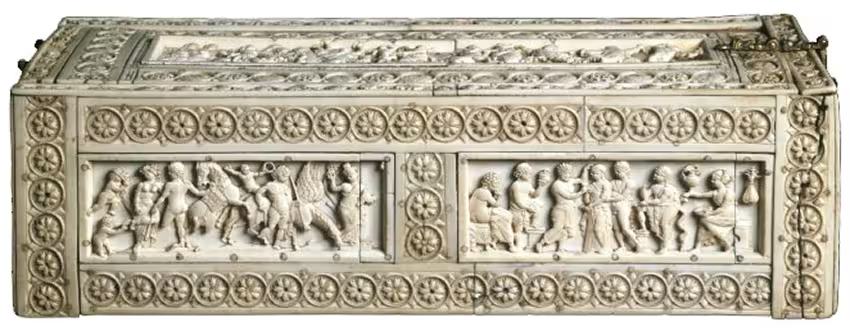
Made in Constantinople in the second half of the 10th century, the Veroli Casket is a wooden box overlaid with carved ivory and bone plaques, about 40 centimetres long. Its lid shows the Rape of Europa; the front shows Bellerophon and Iphigenia; one end shows Bacchus, the other a nymph riding a sea horse. Rows of carved rosettes frame the scenes, which gives this group of more than forty caskets its name, the “rosette caskets”. The humour and classical learning on show suggest an educated audience that enjoyed ancient myth long after the empire became Christian. The casket stayed in the cathedral treasury at Veroli, southeast of Rome, until 1861, and is now in the Victoria and Albert Museum.
The ivory hunting horn in the Bode Museum (11th to 12th century)
A hollow elephant tusk in the Museum for Byzantine Art in Berlin’s Bode Museum was carved in stages by different hands. The narrow ornamental bands beside the suspension rings show the influence of Fatimid Egypt around 1100; a broader band near the mouth points to Sicilian work of the 12th century; and the central hunting scenes, in deeper relief, show a lion hunt, a stag hunt and a bear hunt among trees, with a crane, by a later carver who knew Byzantine models. Horns of this kind were luxury objects for display as much as for hunting, and this one records how court taste crossed the Mediterranean.
Wall paintings and mosaics for palaces and villas
Palaces and villas were richly painted and decorated with mosaic, but almost no secular monumental painting survives, and what we know of it comes from texts. Procopius describes the ceilings of the Chalke, the ceremonial gate of the Great Palace, covered in mosaics of Justinian and Theodora with the senate and of Belisarius’ victories over the Vandals and Goths. In the 12th century Manuel I Komnenos had a chamber in the Blachernae Palace decorated with a mosaic showing him among personified virtues, and the traveller Benjamin of Tudela reported that the emperor’s palace showed the wars of the ancients and Manuel’s own wars in pictures. What survives is mostly floor mosaics, which were buried and so protected, plus one wall mosaic cycle from just outside the empire. For the techniques, see our page on Byzantine mosaics, while
The Great Palace mosaics
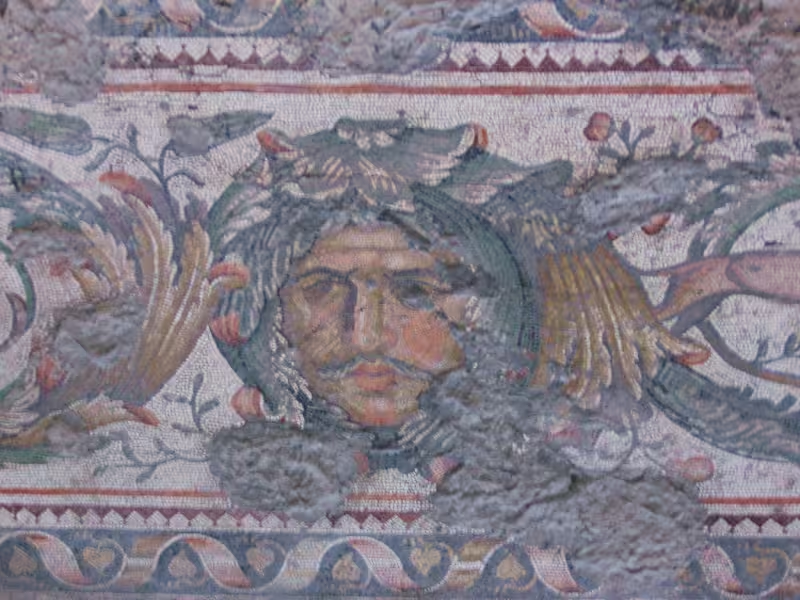
The floor mosaics of the Great Palace of Constantinople, dating to the 6th century, are the best surviving view of how an imperial residence was decorated. They show around ninety scenes with some 150 figures: hunters and wild animals, mythical beasts, children playing and a boy driving geese, with no religious image among them.
They were found beneath the Arasta Bazaar behind the Blue Mosque in Istanbul; reports say the museum that protects them is closed for restoration in 2026, so check before travelling.
Read about the Great Palace of Constantinople.
The Sala di Re Ruggero in Palermo (12th century)
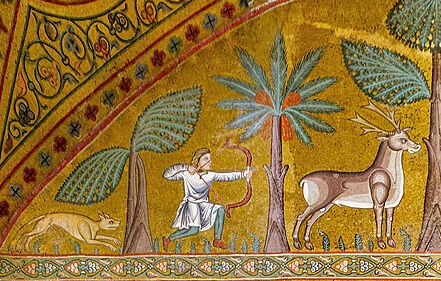
© Holger Uwe Schmitt, CC by SA 4.3
In the Norman Palace in Palermo, the Sala di Re Ruggero is covered in gold-ground wall mosaics of hunting scenes, leopards, deer, peacocks and palm trees. It was made for the Norman kings of Sicily in the 12th century, not for a Byzantine emperor, but in the Byzantine mosaic technique, and it is the best surviving idea of what a secular wall mosaic looked like.
Illustrated manuscripts
Secular manuscripts cover medicine and botany, treatises on hunting and war, histories and romances. Illustrated copies were costly and were made for the court and the aristocracy. They also preserve images of daily life that survive almost nowhere else. Most Byzantine manuscripts survived in monastery libraries, where the focus was on sacred texts, which helps explain why so few secular manuscripts have survived. See Byzantine manuscripts and illuminations for the full picture.
The Vienna Dioscorides (about 512)
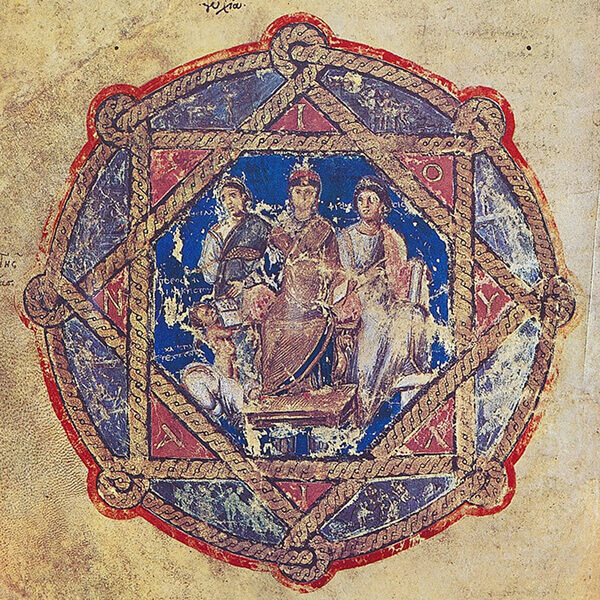
Made in Constantinople for the aristocrat Anicia Juliana, this is the oldest surviving illustrated copy of Dioscorides’ De Materia Medica, a guide to medicinal plants. The parchment codex has 491 folios, measures about 37 by 30 centimetres and carries over 400 illustrations of plants and animals.
Folio 6 verso holds a dedication portrait of Juliana enthroned between personifications of virtues. It is now in the Austrian National Library in Vienna. Read more in our article on the Vienna Dioscurides.

The Madrid Skylitzes (mid-12th century)
The Madrid Skylitzes is the only surviving illustrated Greek chronicle, with 574 miniatures illustrating John Skylitzes’ history of the emperors from 811 to 1057. It was produced in Sicily in the 12th century by two scribes and seven miniaturists, and is now in the National Library of Spain in Madrid. Its pictures of sieges, ceremonies, ships and daily life are a main source for how Byzantium saw itself, and show Byzantine, Western and Islamic influences side by side.
Other examples include an 11th-century copy of Oppian’s hunting poem, the Cynegetica, in the Marciana Library in Venice, and illustrated copies of the Alexander Romance, such as a 14th-century one also in Venice.
Ceramics, glass, jewellery and everyday objects
Pottery shows how secular imagery reached beyond the elite. From the 12th century, glazed tableware with sgraffito decoration, scratched through the surface to reveal the clay underneath, was made in workshops across the empire, with animals, hunters and scenes from popular stories; a mid-12th-century plate with a cheetah attacking a deer, found at Nea Anchialos in Greece, is typical. Bronze lamps, engraved silver and ceramic vessels from excavations complete the picture of household taste. See Byzantine ceramics and goldsmithing and metalwork.
Sculpture
In early Byzantine Constantinople, statues of emperors stood in forums, on columns and in the Hippodrome, where the reliefs on the base of the Obelisk of Theodosius, about 390, show the emperor and his court watching the races. Justinian’s bronze equestrian statue stood on a column in the Augustaion, in front of Hagia Sophia, and was described by Procopius; it was later lost. From the 7th century freestanding statuary became rarer as attitudes to images changed, and carving moved into relief, ivory and architectural ornament. Many bronzes were melted down by the Crusaders in 1204, and rare survivals include the bronze colossus of an emperor at Barletta in southern Italy, whose subject is debated. See Byzantine sculpture.
The “Carmagnola” head in Venice (probably 6th century)
A porphyry head of an emperor with a diadem is set into the balustrade at the south-west corner of the upper terrace of St Mark’s Basilica in Venice. It is widely thought to show Justinian I and was probably brought to Venice as loot after 1204; it may have stood in the Philadelphion in Constantinople, and a headless porphyry statue in Ravenna may be its body. Venetians nicknamed it the “Carmagnola” after a general beheaded in 1432.
The griffin panel in the Metropolitan Museum (1250 to 1300)
This marble panel in low relief shows a griffin in a roundel, arranged like a Byzantine silk, with fleurs-de-lis on its shoulder and haunch that point to contact with Western and Islamic art. It is an exceptionally fine example of Late Byzantine stone carving; its original setting is not known and it may have belonged to a tomb. It shows how designs from textiles and court art moved into stone.
How Byzantine secular art changed
| Period | Taste and patronage | Typical objects | Examples |
|---|---|---|---|
| Early (4th to 7th century) | Roman continuity; villas and palaces; classical myth, hunting and circus scenes | Floor mosaics, stamped silver, gold jewellery, ivories, manuscripts | Great Palace mosaics, Antioch villa floors, David Plates, Mytilene Treasure, Vienna Dioscorides |
| Middle (9th to 12th century) | Court ceremony, silk as diplomacy, classical revival, Islamic motifs | Silks, ivory caskets, enamels, glass, glazed ceramics | Gunther’s Shroud, Veroli Casket, San Marco glass bowl |
| Late (13th to 15th century) | Smaller courts, portable luxury, exchange with the West | Jewellery, enamels, textiles, illuminated manuscripts | See goldsmithing and textiles |
Where to see Byzantine secular art today
| Place | What to look for |
|---|---|
| Metropolitan Museum of Art, New York | Six of the David Plates and gold jewellery from the same find |
| Cyprus | The other three David Plates and early Byzantine gold rings (check the current display location) |
| Victoria and Albert Museum, London | Veroli Casket |
| Bamberg Diocesan Museum, Germany | Gunther’s Shroud |
| Austrian National Library, Vienna | Vienna Dioscorides (original in the collections; check exhibitions and digital copies) |
| Great Palace Mosaic Museum, Istanbul | Floor mosaics in place (reported closed for restoration in 2026; check before visiting) |
| Treasury of San Marco, Venice | Byzantine glass and other luxury objects |
| Valère Basilica, Sion | Byzantine silk with paired griffins |
| Museum of Byzantine Culture, Thessaloniki | Ceramics, jewellery and metalwork across all periods |
| Byzantine and Christian Museum, Athens | Gold jewellery from the Krategos-Mytilene Treasure (check which pieces are on display) |
For more, see our guide to Byzantine art museums.
Frequently asked questions
What is Byzantine secular art?
Art made for purposes other than worship: tableware, textiles, ivory boxes, jewellery, manuscripts and palace decoration. The line with religious art was blurred, since emperors presented themselves as God’s representatives.
Did the Byzantines make non-religious art?
Yes, throughout the empire’s history, though more of it was lost because churches protected their treasures while palaces were looted or abandoned.
What are the best-known examples?
The David Plates, the Monomachos Crown, the Veroli Casket, Gunther’s Shroud, the Great Palace mosaics in Istanbul, the Vienna Dioscorides and the Madrid Skylitzes.
Where can I see it?
Mainly in museums and treasuries such as the Met, the V&A and the Museum of Byzantine Culture in Thessaloniki. The Great Palace mosaics stay where they were found, in Istanbul.
Who commissioned it?
Emperors, the court and wealthy families, with state workshops making silk and silver.
Further reading
- Other Icons: Art and Power in Byzantine Secular Culture, Eunice Dauterman Maguire and Henry Maguire (Princeton University Press, 2007): the first comprehensive study of this “unofficial” art, and the best place to start.
- The Glory of Byzantium: Art and Culture of the Middle Byzantine Era, A.D. 843 to 1261, Helen C. Evans and William D. Wixom, eds. (Metropolitan Museum of Art, 1997): exhibition catalogue covering luxury objects of the period.
- Byzantine Art (Oxford History of Art), Robin Cormack (Oxford University Press; check the current edition): a compact overview.
- Reconstructing the Reality of Images: Byzantine Material Culture and Religious Iconography (11th to 15th centuries), Maria G. Parani (Brill, 2003): dress, furniture and objects as shown in Byzantine art; specialist.
- Byzantine Court Culture from 829 to 1204, Henry Maguire, ed. (Dumbarton Oaks, 1997): the ceremonial world these objects belonged to.