Michael Keroularios: The Patriarch Who Defied Rome and Made an Emperor
Michael I Keroularios (Cerularius) was patriarch of Constantinople from 25 March 1043 to 2 November 1058. In the West he is remembered for one summer: the papal legates excommunicated him on 16 July 1054, and he anathematised them four days later. In Constantinople, that confrontation was the start of his power, not its peak. Keroularios came out of 1054 stronger than the emperor who had wanted a deal with Rome. He resisted one empress, effectively governed under her successor and helped put Isaac I Komnenos on the throne in 1057. Isaac then turned on him. Keroularios died on 21 January 1059 on his way to a trial at which the philosopher Michael Psellos was to accuse him of heresy and treason.
Quick facts
Born: Between 1005 and 1010, Constantinople, into a senatorial family
Died: 21 January 1059, on the Hellespont, on the way to his trial
Patriarch: 25 March 1043 – 2 November 1058
Predecessor/Successor: Alexios Stoudites / Constantine III Leichoudes
Emperors: Constantine IX Monomachos, Theodora, Michael VI, Isaac I Komnenos
Known for: The mutual excommunications of 1054; making and breaking emperors
Opponent at home: Michael Psellos, his accuser in 1058
Family: Uncle of the future empress Eudokia Makrembolitissa
Michael Keroularios’s family
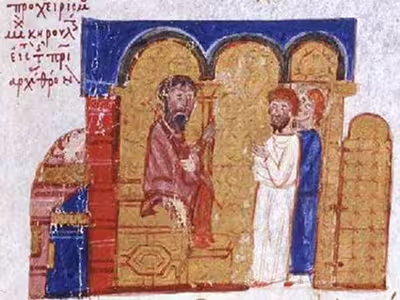
Keroularios came from a senatorial family whose members were closely tied to the politics of his time. Next to his personal successful career in the Church, two nephews rose to high office under Isaac I Komnenos, and his niece Eudokia married two emperors.
A failed conspirator turned monk
Keroularios did not start out as a churchman. He came from a senatorial family of Constantinople and seemed headed for a career in government. In 1040 he was involved in a plot against Michael IV, the Paphlagonian emperor whose family controlled the court. Both his brother and his brother-in-law John Makrembolites joined him in the conspiration, whose aim is not certain. Some later accounts say it was meant to bring Keroularios himself to the throne. Whatever its ambition, the plot failed. To escape a harsher punishment, Keroularios became a monk, but the monastic vows ended his political career only for a while.
A rigorist patriarch
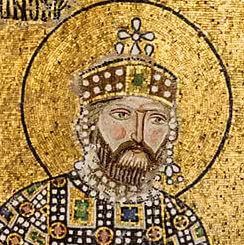
Constantine IX Monomachos, who came to the throne in 1042, restored him to favour. Some sources suggest that the new emperor had been part of the conspiration of 1040 ; true or not, he certainly saw Keroulianos as an ally. He first promoted him as synkellos, a senior post in the Byzantine clergy and patriarch’s household, often held by the expected successor, and kept him close as an adviser. When Patriarch Alexios Stoudites died in 1043, Constantine appointed Keroularios to succeed him. He was enthroned on 25 March 1043.
Scholars consider that Keroularios placed himself in the tradition of Symeon the New Theologian, the mystic who died in 1022 and whose followers, Niketas Stethatos among them, favoured monastic austerity and spiritual authority over learning. That set him against the liberal intellectuals of Constantine IX’s court, above all Michael Psellos and his friends Constantine Leichoudes and John Xiphilinos, who valued classical education and held high office. The patriarch’s strength lay elsewhere: he had the strong support of the Constantinopolitan population. The rivalry between these two milieux, the patriarch’s and the philosophers’, runs through his whole career and ends with Psellos as his accuser.
1054: the confrontation with Rome
In the early 1050s, tension with Rome grew, centred on the question of the azymes, the unleavened bread the Latins used in the Eucharist. Keroularios’s ally Leo of Ohrid attacked Latin customs in a letter of 1053. The papacy tried to win over Patriarch Peter III of Antioch, but Peter, though more moderate than Keroularios, sided with Constantinople. When Cardinal Humbert of Silva Candida arrived as papal legate early in 1054, Constantine IX wanted an agreement, because he needed the pope as an ally against the Normans in southern Italy. Neither Humbert nor Keroularios was willing to give ground. Humbert’s letters, his treatises against Byzantine liturgical customs and his reply to Niketas Stethatos inflamed the patriarch and his clergy.
Keroularios refused to deal with the legates except before a synod, and he suspected that their letters had been tampered with. Niketas Stethatos acted as his spokesman until Humbert forced Niketas to retract. On 16 July the legates laid a bull excommunicating Keroularios on the altar of Hagia Sophia. A synod he convened on 20 July anathematised them in return, and the sentence was read in Hagia Sophia on 24 July. The full story, and the debate over what these sentences meant, is told in our article on the Great Schism of 1054.
Debate: what did Keroularios actually write?
The anti-Latin dossier known as the Panoplia was attributed to Keroularios by Anton Michel, who edited the texts of the controversy (Humbert und Kerullarios, 1924–1930). Franz Tinnefeld (1989) has argued against the attribution. Jean Darrouzès (1967) showed that the treatise On the Azymes once ascribed to the patriarch is not his. What certainly survives from him are his letters to Peter of Antioch and the synodal decree of July 1054. Much of the “Keroularios” of older textbooks is in fact a composite of texts produced in his circle.
A key figure under Theodora and Michael VI
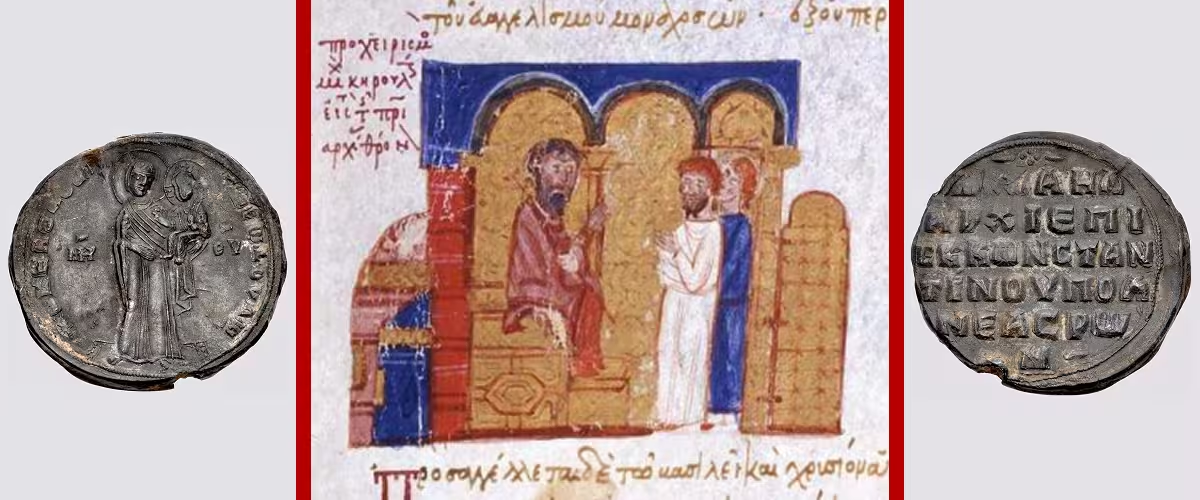
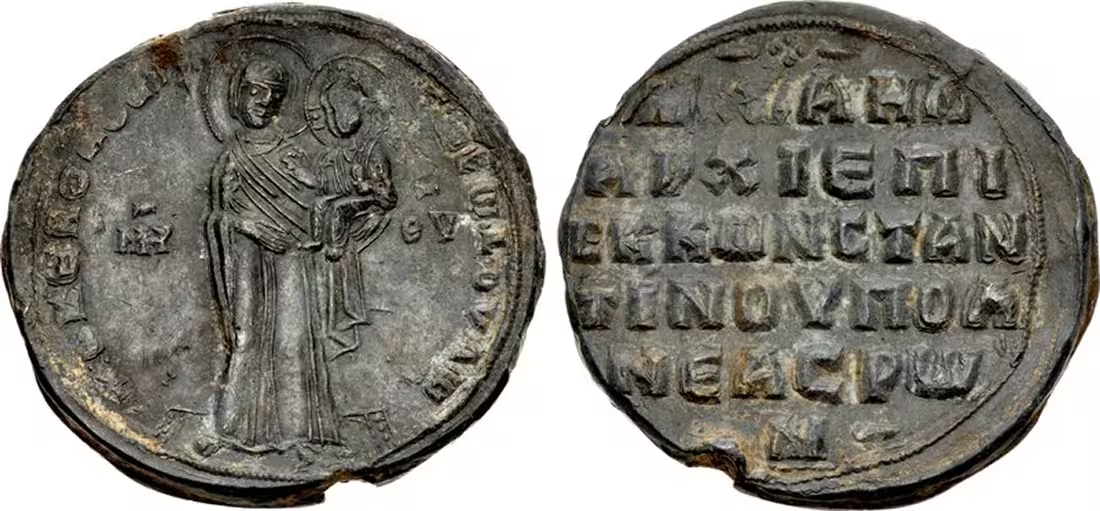
Through his victory over Constantine IX in 1054, Keroularios gained exceptional influence in Constantinople. The emperor had sided with the legates, and the riot that followed forced him to give way. After the rupture, Keroularios began to use the title “ecumenical patriarch” on his seals, which Rome had long resented.
Constantine IX died in January 1055. His sister-in-law Theodora, the last of the Macedonian dynasty, ruled alone and wanted to depose the patriarch, who reportedly objected to a woman governing the empire. She did not have the time. After her death in 1056, under the elderly Michael VI Bringas (Stratiotikos), Keroularios effectively ran the government.
The patriarch who made an emperor
In 1057 the generals of Asia Minor, slighted by Michael VI, rose in revolt. They proclaimed Isaac Komnenos emperor in Paphlagonia on 8 June and defeated the loyalist army near Nikomedia.
In Constantinople the patriarch was decisive. With crowds gathered in Hagia Sophia, he declared for Isaac and persuaded Michael VI to abdicate and become a monk on 31 August. On 1 September 1057 he crowned Isaac I Komnenos in Hagia Sophia.
Isaac rewarded him. The emperor reportedly handed the full control of the Constantinoplitan church to the patriarch, including the nomination of its officials and the control of its finances, so that the palace no longer interfered much in their affair.
Debate: the Dumbarton Oaks cross
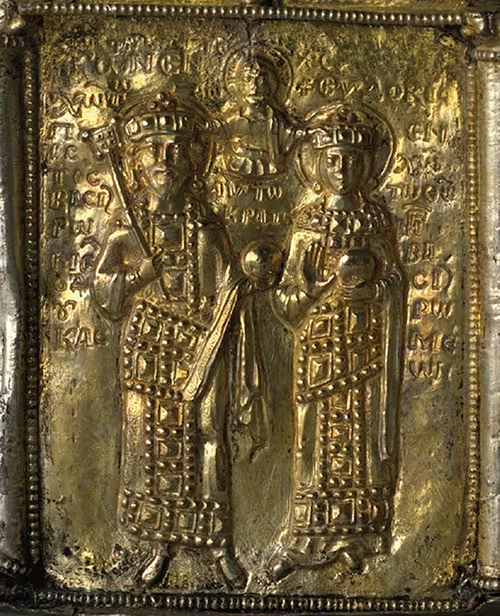
A processional cross with silver revetment in the Dumbarton Oaks collection in Washington bears an inscription naming a Michael. In 1967 Romilly Jenkins and Ernst Kitzinger proposed that it was commissioned by Keroularios, which would make it the only surviving object linked to him. Nonetheless, their demonstration for this attribution was thin, and Cyril Mango rejected the hypothesis in 1988. The attribution is best treated as an unproven, and somewhat improbable, suggestion.
Fall and death
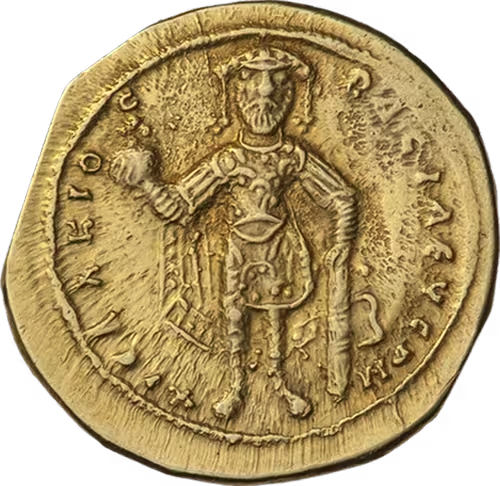
The alliance lasted barely a year. Isaac had the backing of the army and quickly won over the intellectuals who had long been at odds with the patriarch, Psellos first among them. Keroularios, for his part, seems to have regarded the emperor as his own creation. When Isaac refused his requests, he threatened to put him off the throne, adding the vulgar proverb recorded by the chronicler: “I built you, oven; I can pull you down.” He is also said to have worn purple boots, the emperor’s own insignia. According to Skylitzes Continuatus, he defended them as an old practice of the priesthood and argued that there was little difference between priesthood and empire, or that the priesthood had the greater share of honour. Psellos, writing as his accuser, put it more bluntly: Keroularios had joined empire and priesthood, making the sign of the cross with his hand while his tongue spoke like an emperor’s.
Debate: imperial ambition or papal model?
What did the boots mean? Isaac’s side, and Psellos’s indictment, read them as a claim to imperial power. A century later the canonist Theodore Balsamon offered another explanation. The Donation of Constantine granted the pope imperial honours, purple boots among them, and since the Second Ecumenical Council had given Constantinople the privileges of Rome, some patriarchs, “such as the celebrated Michael Keroularios,” had tried to claim the same honours. In 1967 Romilly Jenkins and Ernst Kitzinger built on Balsamon to argue that Keroularios deliberately asserted, on the basis of the Donation, a patriarchal supremacy over the emperor. The timing makes the idea tempting, since the papal legates had quoted the Donation to him in 1054. But no source from his own lifetime mentions it. Balsamon was writing with his own canonical agenda, and the Jenkins–Kitzinger reading was part of an attribution of the Dumbarton Oaks cross that Cyril Mango rejected in 1988. The boots are well attested. Their meaning, and even whether the episode was exaggerated or entirely created by the patriarch’s enemies, remains open.
The patriarch’s strength lay in the Constantinople crowd, so Isaac moved against him where his supporters could not protect him. In November 1058, while Keroularios was visiting a monastery outside the walls, the emperor sent the Varangian Guard to arrest him. He was deported from the capital, probably first to Prokonnesos.
The ending was oddly conciliatory. According to Psellos, Isaac mourned the patriarch and rehabilitated his family. Psellos himself, the man who had written the indictment, delivered a laudatory funeral oration for him. Keroularios’s successor was Constantine Leichoudes, one of the circle of intellectuals he had opposed.
The family’s influence survived him through his niece, Eudokia Makrembolitissa, who married the future emperor Constantine X Doukas and later ruled as regent.
One patriarch, two portraits
Almost everything we know about Keroularios’s personality comes from Psellos, who wrote both the Accusation and the funeral oration. The first portrays a proud, ambitious would-be tyrant; the second a stern ascetic and a pillar of the Church. Neither is a neutral portrait: one was written to convict him, the other to honour him after his death. Historians have to read each against the other.
FAQ
Who was Michael Cerularius?
Michael I Keroularios (Cerularius) was patriarch of Constantinople from 1043 to 1058. He was excommunicated by the papal legate Cardinal Humbert in July 1054, an event remembered as the start of the Great Schism, and later helped bring Isaac I Komnenos to power.
Did Michael Cerularius excommunicate the pope?
No. After the legates’ bull of 16 July 1054, the synod he convened on 20 July anathematised the legates and their document, not the pope, who had in any case died in April 1054.
Why was Keroularios arrested?
He clashed with Emperor Isaac I Komnenos, whom he had helped crown in 1057, and was accused of claiming a share of imperial power. Isaac had him arrested in November 1058 and prepared to put him on trial.
How did Michael Keroularios die?
He died on 21 January 1059 on the Hellespont, while being taken to a trial in Thrace at which Michael Psellos was to act as his accuser.
Was Keroularios the uncle of Empress Eudokia?
Yes. His niece Eudokia Makrembolitissa married Constantine X Doukas and later ruled as empress and regent.
Sources and further reading
- A. Kazhdan (ed.), The Oxford Dictionary of Byzantium (1991), “Michael I Keroularios”, “Schism” and “Humbert”.
- V. Grumel, Les Regestes des actes du patriarcat de Constantinople, fasc. 3, nos. 856–886.
- C. Will (ed.), Acta et scripta… saeculo undecimo (1861).
- Michael Psellos, Chronographia; Accusation of the Patriarch and funeral oration (ed. Sathas; Dennis, Orationes forenses; Polemis).
- A. Michel, Humbert und Kerullarios, 2 vols. (Paderborn 1924–1930).
- E. Amann, “Michel Cérulaire,” Dictionnaire de théologie catholique 10 (1929), 1677–1703.
- J. Darrouzès, Revue des études byzantines 25 (1967), 288–291.
- R. Jenkins and E. Kitzinger, Dumbarton Oaks Papers 21 (1967), 233–249; C. Mango, Cahiers archéologiques 36 (1988), 41–49.
- M.H. Smith, And Taking Bread… (Paris 1978).
- J.N. Ljubarskij, Michail Psell (Moscow 1978), 79–90.
- F. Tinnefeld, “Michael I. Kerullarios, Patriarch von Konstantinopel (1043–1058),” JÖB 39 (1989), 95–127.
- V. Laurent, Le Corpus des sceaux de l’empire byzantin 5.1, no. 16.
Cover credit (lead seal): Classical Numismatic Group, Inc., CC BY-SA 2.5


2 Comments