Athenais-Eudokia: From Athens to the Throne, and from the Throne to Jerusalem
In 438 an empress on her way to Jerusalem stopped at Antioch and addressed the city council. She praised the city as a Greek orator would. Then she closed with a line of Homer, changed by a single word: ὑμετέρης γενεῆς τε καὶ αἵματος εὔχομαι εἶναι, “of your race and blood I claim to be”. The line reworks a formula Homer gives twice to heroes proclaiming their lineage, Glaukos (Iliad 6.211) and Aeneas (Iliad 20.241). The Antiochenes answered by setting up a golden statue of her in their council chamber and a bronze one in the Mouseion.
She had been born Athenais, the daughter of an Athenian sophist. She died as Aelia Eudokia, Augusta of the Roman Empire. Along the way she was wife of Theodosius II for twenty-nine years, mother of a Western empress, and rival of the formidable Pulcheria. She was also patron of churches and baths from Athens to the Jordan valley, and the author of more than 3,000 surviving lines of hexameter verse. From 443 until her death in 460 she was an empress living apart from her husband, in Jerusalem.
Her life was told, above all, by others. A century after her death the chronicler John Malalas turned it into a Cinderella romance, which every later Byzantine historian repeated. Yet she is also one of the very few Byzantine empresses whose own words survive in quantity. This article tests the legend against her own voice. Where the sources simply fall silent, it says so. Where modern historians disagree, it sets out the debate.
Athenais-Eudokia at a glance
Lived: c. 400–405 – 20 October 460
Born: Athenais, probably in Athens, daughter of the sophist Leontios
Married: Theodosius II, 7 June 421; Augusta from 2 January 423
Children: Licinia Eudoxia (born 422), later empress in the West; Flacilla (died 431); possibly a son, Arcadius
Rival: her sister-in-law Pulcheria, Augusta since 414
Left the court: 443, for Jerusalem, where she lived until her death
Works: a Homeric cento on the life of Christ; the Martyrdom of Saint Cyprian; the Hammat Gader bath poem; lost biblical paraphrases
Buried: in the basilica of St Stephen, outside Jerusalem’s northern gate
Main sources: Socrates, Marcellinus Comes, Evagrius, Malalas, the Chronicon Paschale, and her own poems
Which Eudokia?
“Eudokia, empress, daughter of Leontios, child of a noble father”
The empress’s signature line, as quoted by Photius (Λεοντιὰς εὐπατέρεια)
This article covers Athenais-Eudokia (c. 400–460), wife of Theodosius II. Do not confuse her with:
- her mother-in-law Aelia Eudoxia, wife of Arcadius;
- her daughter Licinia Eudoxia, wife of Valentinian III;
- her granddaughter Eudokia, who married the Vandal prince Huneric;
- the later empresses named Eudokia: Fabia-Eudokia, first wife of Heraclius; Eudokia Dekapolitissa, wife of Michael III; Eudokia Ingerina, wife of Basil I; Eudokia Baïana, third wife of Leo VI; Bertha-Eudokia, first wife of Romanos II (see Theophano); and Eudokia Makrembolitissa in the 11th century.
Key dates
c. 400–405 Athenais born, probably in Athens
421 Baptised by Patriarch Atticus; marries Theodosius II on 7 June
422 Birth of Licinia Eudoxia; Eudokia’s poem on the Persian war
2 Jan. 423 Proclaimed Augusta; her uncle Asklepiodotos is consul
425 Public teaching posts at Constantinople regulated by law
431 Death of her daughter Flacilla
29 Oct. 437 Licinia Eudoxia marries Valentinian III in Constantinople
438–439 First pilgrimage: speech at Antioch, Jerusalem, return with relics of St Stephen
c. 440–441 Fall of the magister officiorum Paulinos; disgrace of Cyrus of Panopolis (441)
443 Leaves Constantinople for Jerusalem
444 Affair of Saturninus; loses her imperial retinue
28 July 450 Death of Theodosius II; Pulcheria and Marcian take power
451–453 Council of Chalcedon; Palestinian monks revolt with her support
453 Pope Leo I urges her to accept Chalcedon; death of Pulcheria
455 Vandal sack of Rome: her daughter and granddaughters taken to Carthage
c. 455–456 Reconciled with Chalcedon through Euthymios
20 Oct. 460 Dies in Jerusalem
Who tells her story? Sources and their limits
Very little was written about Eudokia while she was alive. Socrates Scholasticus, who finished his Ecclesiastical History in the early 440s, gives the essentials in a single sentence. She was the daughter of the sophist Leontios and had been educated by her father in every kind of learning. When the emperor wished to marry her, Bishop Atticus made her a Christian and baptised her Eudokia in place of Athenais. Socrates also records her poem on the Persian war and her vow to visit Jerusalem. That is almost all the contemporary narrative there is. Two other church historians writing in the same years, Sozomen and Theodoret, do not mention her at all, perhaps because they wrote after her disgrace.
The rest comes in layers, each further from the events:
- Chronicles. The Latin chronicle of Marcellinus Comes (6th century, drawing on earlier city annals) gives dry, datable entries: the birth of her daughter, the death of Flacilla, the arrival of St Stephen’s relics, the deaths of Paulinos and Saturninus. Fragments of the 5th-century historian Priscus add the Saturninus affair.
- Saints’ lives. These cover her years in Palestine: Gerontius’ Life of Melania the Younger, Cyril of Scythopolis’ Life of Euthymios, and the Syriac Life of Barsauma, a fiercely anti-Chalcedonian text.
- Later historians. Evagrius (late 6th century) gives the Antioch speech and the Jerusalem buildings. John Malalas (6th century) and the Chronicon Paschale (7th century) tell the romance. The Patria of Constantinople (10th century) and Nikephoros Kallistos Xanthopoulos (14th century) embroider it further.
- Her own voice. Alongside all this stand her poems and two inscriptions, one in the Athenian Agora and one in the baths of Hammat Gader.
Open question: how far can we trust the romance?
For each famous episode, ask the same three questions used for Theophano: who reports it first, how long after the event, and who gains from the story. The bride hunt and the apple first appear in Malalas, more than a century after the events, and they are built from folk-tale motifs. They are not worthless, as we shall see, but they are not history either.
Athens: the philosopher’s daughter
Around 400, Athens was a provincial town of modest size and immense prestige. It was still the university city of the Mediterranean. Its rhetoric chairs drew students from across the East, and its Platonic school, led by Plutarch of Athens and then Syrianus, was the last great centre of pagan philosophy; Proclus would arrive around 430. Athenais grew up inside this world. Her father Leontios was a sophist, a professional teacher of rhetoric. The historian Olympiodorus, preserved in Photius’ summary, mentions a sophist Leontios at Athens in the 410s. Her name honoured the city’s goddess, or the city itself.
She received the classical education her father could give: Homer above all, rhetoric and metre. The 14th-century Nikephoros Kallistos credits her with Latin, philosophy, astronomy, geometry and arithmetic beyond all her contemporaries. Her surviving poems show a solid literary schooling, but not the technical polish of a professional poet. The family she left behind is unusually well attested for a late antique bride. Her brothers Valerios and Gessios later held high office. Her uncle Asklepiodotos became consul and praetorian prefect, and maternal aunts are said to have taken her in after her father’s death.
Debate: where, and when, was she born?
Athens. This is the tradition of all the Byzantine sources, and it is defended by Alan Cameron, who saw “no call to doubt” it, and by Tatiana Aleksandrova (2017). Her building activity in Athens in the 420s and the honorary epigram in the Agora point the same way. Cameron, following the 12th-century scholar Tzetzes, also suggested that she spent part of her youth studying in Alexandria. Aleksandrova answers that the Alexandrian grammarian Orion compiled an anthology of maxims for the empress, which is more likely a commission than evidence of schooling.
Antioch. Kenneth Holum (1982) argued that she was born in Antioch and named after Athens. His evidence is her poem on the Antiochene saints Cyprian and Justina and her claim of “race and blood” before the Antiochene council.
The date. Most accounts give c. 400–401, assuming she was the emperor’s age. Nikephoros Kallistos says she was in her twentieth year at the wedding. Aleksandrova argues this is simply Theodosius’ own age transferred to the bride. A woman of twenty was old for a first marriage at the time, and the earliest coins show her with an unusually small, delicate bust. She proposes a birth around 405, which would make her fifteen or sixteen in 421.
What we can say: Athens is the best-supported birthplace. The Homeric line at Antioch reads more naturally as an orator’s compliment to a fellow Greek city than as a statement of birth. The date remains anywhere between about 400 and 405.
From Athenais to Eudokia: the marriage of 421
Malalas tells the story as a fairy tale. When Leontios died, he left his whole estate to his sons Valerios and Gessios, and to his daughter only a hundred gold coins. He explained that her luck would be enough for her. When Athenais asked her brothers for a fair share, they threw her out of the house. An aunt took her to Constantinople, to another aunt, and the two women won an audience with the Augusta Pulcheria. At that moment Pulcheria was searching the empire for a bride for her brother, beautiful and a virgin. Struck by the girl’s beauty and eloquence, Pulcheria described her to Theodosius. The emperor and his friend Paulinos watched Athenais from behind a curtain, and Theodosius fell in love at once. The brothers, hearing that their sister was empress, fled in terror. She had them brought back and gave them high office, Gessios as prefect of Illyricum and Valerios as magister.
The tale is built from folk-tale material: the disinherited daughter, the wicked brothers, the hidden prince. Yet one detail can be checked, and it holds. The imperial prosopography confirms both brothers in exactly the careers Malalas gives them. Valerios became count of the sacred largesses, master of the offices and consul in 432, and Gessios became praetorian prefect of Illyricum. Whatever their quarrel over the inheritance, the family evidently rose with her.
The baptism is firmer ground, since it comes from Socrates. Atticus, bishop of Constantinople, baptised her before the wedding and gave her the name Eudokia, “good will” or “God’s favour”. Aleksandrova argues the name carried a message. It recalled a martyr Eudokia venerated in Persia, at the very moment the empire was going to war with Persia on behalf of persecuted Christians. It may also echo a commentary on the Song of Songs in which the beloved who comes to Christ from the nations is “fair as Eudokia”. On that reading, the converted Athenian bride embodied the “faith from the Gentiles” that the reign claimed to welcome. The wedding took place on 7 June 421 and was celebrated with races in the Hippodrome. A daughter, Licinia Eudoxia, followed in 422, and on 2 January 423 Theodosius proclaimed his wife Augusta.
Debate: who chose Athenais?
Pulcheria, as matchmaker. This is Malalas’ version. Jaakko Burman (1994) calls it a legend “par excellence” but notes that no imperial marriage could have gone ahead against the will of the all-powerful Pulcheria.
A court faction. Holum (1982) found it unthinkable that Pulcheria would bring in her own future rival. He saw instead a party of “traditionalists” (officials such as Asklepiodotos, with access to the court through Paulinos) who promoted a cultivated Hellene against the pious Augusta. The Oxford Dictionary of Byzantium follows this reading.
Chance. Cameron (1982) took the core of Malalas’ story at face value: an orphan with relatives at court, a lucky introduction, nothing more.
Theodosius himself. Historians now rate the emperor far higher than the old picture of a weak, manipulated ruler (Millar 2006; Kelly, ed., 2013). Van Nuffelen (2013) points out that he deliberately avoided marriage alliances with the great families: his sisters stayed unmarried, and he chose a wife from outside the elite. Aleksandrova adds that he was a scholar by temperament, a calligrapher with an interest in astronomy. On her reading, the match was the choice of a well-read emperor, steered by a circle of court intellectuals who were fully Christian but classically educated, and drawn to a bride who shared his interests. In this view, Pulcheria’s role was inflated after 450, when she held power and the histories were rewritten in her favour.
What we can say: the marriage needed Pulcheria’s consent and very probably the backing of Athenais’ own relatives at court. That the emperor chose a non-aristocratic, highly educated bride looks increasingly like policy rather than accident.
Eudokia and Athens
Her marriage reached back to her native city almost at once. Gessios’ prefecture of Illyricum covered Greece, and the 420s saw new building in an Athens still recovering from the Herulian sack of 267 and the Visigothic raid of 396. The most direct trace of the empress is an inscription. Two fragments of a round base of Pentelic marble, found in the Agora and dated shortly after 421, carry a verse epigram in elegiac couplets (SEG 40.184):
ε[ἵνε]κα φ[…] βασιληΐδος Εὐδ[οκίης τε]
Θευδόσι[ος βασιλε]ὺς στῆσεν ἄγαλ[μα τόδε]
πιστοτα[τ…] θεραποντ[…]
“For the sake of … and of Empress Eudokia, Emperor Theodosius set up this statue … most faithful … servant …”. About half the words are lost, and the empress’s name is partly restored (Εὐδ[οκίης]), though the restoration is accepted by the editor and by the Supplementum Epigraphicum Graecum. Even so, this is the strongest piece of evidence linking her to Athens. It is a statue base erected in the emperor’s name, in the heart of the city, within months or a few years of the wedding.
Open question: whom did the statue show?
The epigram’s first editor, Erkki Sironen, published it as an honorary epigram for Eudokia, and Aleksandrova assumes the statue showed the empress herself. But the surviving words, “for the sake of … Empress Eudokia … most faithful servant”, could also describe a statue of someone else. That might be a loyal official honoured by the emperor on his wife’s account, conceivably one of her own relatives. The fragments cannot settle it.
On the site of the ruined Odeon of Agrippa, in the middle of the Agora, a vast complex rose in the early 5th century. It had courtyards, baths and gardens behind a monumental porch, and that porch reused colossal 2nd-century statues of Giants and Tritons, three of which still stand. Visitors know it as the “Palace of the Giants”. The Foundation of the Hellenic World presents it as the palace Eudokia built for herself and her brother Gessios. It also suggests she may have commissioned the tetraconch church inside the Library of Hadrian.
Open question: Eudokia’s palace?
No inscription or text connects the Palace of the Giants to Eudokia. The attribution rests on the date, the scale and the political moment. The Agora excavators long interpreted the complex as a late Roman gymnasium, and others see it as the residence of a governor or of a wealthy family. The dating of the tetraconch is also debated. Both buildings are best described as possible, not proven, foundations of the empress’s family.
Today both sites can be visited on a walk through Byzantine Athens: see our Athens visitor guide and the history of Byzantine Athens.
Augusta at the court of Theodosius II (421–438)
The court Athenais entered had been shaped by Pulcheria. Two years older than Theodosius, she had been proclaimed Augusta in 414 at fifteen. She vowed perpetual virginity together with her sisters and made the palace something close to a convent, with fasting, psalms and charity. Contemporaries credited her with the emperor’s piety. The newcomer was not, however, her subordinate. Once both women were Augustae, protocol named Eudokia first when the two were addressed together (Aleksandrova 2016). Eudokia also made her public debut early, as a poet in her husband’s cause. In 422 she celebrated the victory over Persia in hexameter verse, which Socrates notes because she was learned.
The first years of the marriage coincided with a visible shift in policy, and her family was at the centre of it. Her uncle Asklepiodotos, count of the sacred largesses in 422, was praetorian prefect of the East from February 423 to February 425 and consul in 423. Laws addressed to him ordered Christians not to harass Jews or seize their synagogues. They also made Christians who robbed law-abiding pagans and Jews repay two or three times what they had taken (CTh 16.8.26; 16.10.24). In the preceding years, under Pulcheria’s influence, legislation had pointed the other way. Evagrius and the Syriac Life of Symeon tell how the prefect ordered the synagogues seized at Antioch to be restored to the Jews. Symeon the Stylite then wrote from his column to rebuke the emperor, and Theodosius revoked the order and dismissed Asklepiodotos. The story has a hagiographical flavour, and the 19th-century orientalist Theodor Nöldeke already doubted it, but Asklepiodotos’ prefecture did end early in 425. In 425 a law organised public teaching at Constantinople, with salaried chairs of Greek and Latin grammar and rhetoric, philosophy and law (CTh 14.9.3). It is often called the founding of the capital’s “university”, and her role in it is traditionally assumed rather than attested. In 429 work began on the Theodosian Code. The poet Cyrus of Panopolis, a protégé of the empress, rose through these years to become both praetorian and city prefect.
Personal sorrow came too. Her second daughter, Flacilla, died in 431, and a son, Arcadius, may also have died in infancy. Only Licinia Eudoxia survived. Betrothed from birth to her cousin Valentinian III, she married him in Constantinople on 29 October 437. That made Eudokia the mother of the Western empress.
Debate: how pagan was the empress?
A pagan heart under a Christian crown. Holum’s “traditionalists” have found their boldest heirs in Markos Dendrinos and Anna Griva. They read her as a free spirit and the pagans’ longa manus at court, and take the Antioch line as a declaration that she belonged to a fading Hellenic world. They also hold that her doctrinal choices (sympathy for Nestorius, then for the miaphysites) reflected a philosopher’s unease with Christian dogma, and that her final acceptance of Chalcedon may have been diplomatic. For them, the Martyrdom of Cyprian preserves the vanishing mysteries with evident fascination.
A Christian Hellenist. Cameron, Aleksandrova and Brian Sowers answer that every surviving line she wrote is Christian in subject. Her Confession of Cyprian attacks the mysteries and magic outright. The “Hellenes” of her circle were educated Christians who loved classical culture, not crypto-pagans; Cameron showed that even Cyrus, accused of paganism, was a Christian who ended as a bishop. Aleksandrova places her in the world of Synesius of Cyrene: Greek aristocrats raised in the old culture, loyal to a Christian state, relaxed about fine points of doctrine. She argues the strongest influence on Eudokia was Theodosius himself. As for Nestorius, the evidence for her sympathy is thin, resting on a single recent article (Gierlach-Walker 2017).
What we can say: Eudokia was baptised, built churches, venerated relics and wrote Christian poetry for forty years. Her Christianity was that of a classically trained Greek, comfortable with Homer and the gods of healing on a bath-house wall. Calling her a pagan goes well beyond the evidence. Calling her a narrow zealot ignores what she chose to write.
The first pilgrimage and the height of power (438–441)
Socrates says Eudokia had vowed to go to Jerusalem if she lived to see her daughter married. In 438, with Licinia Eudoxia settled in the West, she set out, with Melania the Younger as her companion and guide. Melania was the Roman heiress turned ascetic who had founded monasteries on the Mount of Olives. At Antioch Eudokia made the speech that ended with Homer’s line. The city honoured her with statues. According to Evagrius, the emperor at her request extended Antioch’s walls to take in a large suburb and gave 200 pounds of gold to restore the fire-damaged baths of Valens, though Evagrius notes that some credited the walls to Theodosius I. In Jerusalem she visited the holy places and met the formidable Syrian monk Barsauma and Cyril of Alexandria. On 15 May 439, in her presence, Cyril deposited relics of St Stephen in a newly built shrine. Melania’s biographer places that shrine at Melania’s monastery on the Mount of Olives. The Life of Peter the Iberian says it was the empress’s own church and monastery north of the city. Elizabeth Clark (1982) showed that the two accounts reflect rival claims on the martyr’s bones by the partisans of the two women. Later that year she returned to Constantinople with relics of the protomartyr, which Marcellinus records being placed in the church of St Laurence. A later tradition adds that she brought back the chains of St Peter and sent half of them to her daughter in Rome. The church of San Pietro in Vincoli was rebuilt in this period as the titulus Eudoxiae, but the chain story itself is late.
The years after her return were her zenith. Cyrus of Panopolis held the praetorian and city prefectures at the same time, and in 441 he was consul. Pulcheria’s influence waned. Eudokia, crowned and honoured, had the emperor’s ear as never before. In Constantinople she also founded the first church of St Polyeuktos, which her great-granddaughter Anicia Juliana rebuilt on a vast scale in the 520s. Juliana’s dedicatory epigram, preserved in the Palatine Anthology (1.10), opens by recalling that the empress Eudokia was the first to build a temple to the martyr. The fall, when it came, was fast.
The apple of discord (441–443)
Malalas tells it this way. On the feast of the Theophany, as Theodosius rode to church, a poor man presented him with a Phrygian apple of extraordinary size. The emperor paid him 150 gold coins and sent the apple to the empress. Eudokia sent it on to Paulinos, the master of the offices and the emperor’s boyhood friend, who was ill at the time. Paulinos, not knowing where it came from, sent it back to the emperor as a gift worthy of him. Theodosius hid the apple and asked his wife what she had done with his present. “I ate it,” she said, and she swore to it. He showed her the apple. Paulinos was executed. Eudokia, humiliated, asked leave to go to Jerusalem and the emperor let her go.
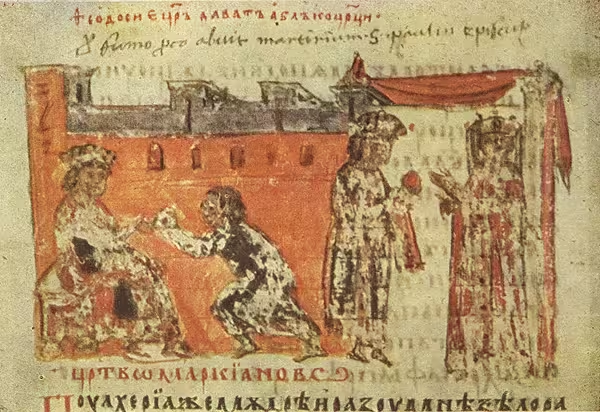
Behind the tale stands a real political crisis. Paulinos did fall: exiled to Caesarea in Cappadocia, he was put to death there, in 440 according to the chronicle of Marcellinus. Malalas’ story, by contrast, implies that Paulinos died just before the empress left in 443, and modern accounts vary between the two. Cyrus of Panopolis fell in 441. The Hippodrome crowd had chanted that Constantine built the city and Cyrus rebuilt it, and the emperor took offence. Cyrus was accused of paganism, stripped of his offices and sent to be bishop of the small Phrygian town of Kotyaeion. The man who profited was the eunuch Chrysaphios, who dominated the court until 450. Theophanes tells how Chrysaphios first set Eudokia against Pulcheria, who withdrew from the palace, and then turned the emperor against his wife. Both Augustae, in other words, lost the same struggle.
Open question: adultery, or court politics?
No early source accuses Eudokia of adultery. Malalas himself presents her as the innocent victim of a jealous husband. The Patria of Constantinople, four centuries later, is the first to say plainly that she loved Paulinos. Evagrius treats the accusations as slander. What is certain is that the two men closest to her, Paulinos and Cyrus, were destroyed in 440–441, and that the empress left the capital soon afterwards. A conflict over influence, which Chrysaphios won, explains the facts without the apple.
How, then, was the romance born? Aleksandrova (2017) proposes that the story took shape after 450, once Pulcheria and Marcian, the champions of Chalcedon, held power. In works of that period Pulcheria’s role in her brother’s reign grows steadily larger. A first version, she suggests, aimed to discredit Eudokia. It surfaces in the Patria, where pagan philosophers arrive in Constantinople with her and the apple story becomes outright adultery. It also matches the spirit of the fragmentary “Euthymian History”, written in the 490s under the zealously Chalcedonian patriarch Euphemios. Malalas, writing under Justinian, softened it in a spirit of reconciliation. Pulcheria and Eudokia both become heroines, Theodosius is weak-willed, and Eudokia is the wronged innocent. That gentler version is the one Byzantium remembered.
Jerusalem and Chalcedon (443–460)
Eudokia left in 443 and never returned. She was not deposed: she kept her title, her wealth and, at first, her imperial household. The Constantinople mint went on striking her gold: a solidus in the Berlin Münzkabinett showing her crowned by the hand of God is dated by Wolfgang Hahn to 444 (Roman Imperial Coinage X places the type in 441–450). The break came in 444. Theodosius sent Saturninus, count of the domestics, to Jerusalem, where he put to death the priest Severus and the deacon John of the empress’s household. Eudokia had Saturninus killed in return. Holum reads Marcellinus’ terse entry as saying she struck him down with her own hands. The emperor then stripped her of her imperial retinue.
She remained, for sixteen years, the greatest patron in Palestine. The Piacenza pilgrim, around 570, says the pool of Siloam lay inside the city because Eudokia herself had added walls to Jerusalem, extending them south around Mount Zion. Evagrius credits her with monasteries, the restoration of the walls, and above all “a very great sanctuary” of St Stephen less than a stadium from the city. Other sources add a church at Siloam, hospices for pilgrims and the poor, and an episcopal palace. The Syriac Life of Barsauma, hostile to her, says the Jews of Galilee claimed she had allowed them to pray again on the Temple Mount, with violent results. The story is impossible to verify. Her travels also took her to the great baths of Hammat Gader, by the Yarmouk east of the Sea of Galilee, where her poem was set into the floor of the Hall of Fountains.
Debate: founder of St Stephen’s?
Eudokia’s basilica. Evagrius and the Piacenza pilgrim credit the great church north of the Damascus Gate to the empress, and say she was buried there. In 1882 the Dominicans bought the site, and their excavations uncovered the 5th-century foundations and mosaic floors; the present basilica (1900) follows the ancient plan.
Juvenal’s shrine. Hugo Méndez (2022) argues that it was Juvenal, bishop of Jerusalem, who in the 430s secured funds for a dedicated martyr shrine of Stephen outside the main gate, the core of what became the city’s largest church complex. On this reading, Eudokia enlarged or completed an existing project rather than founding it.
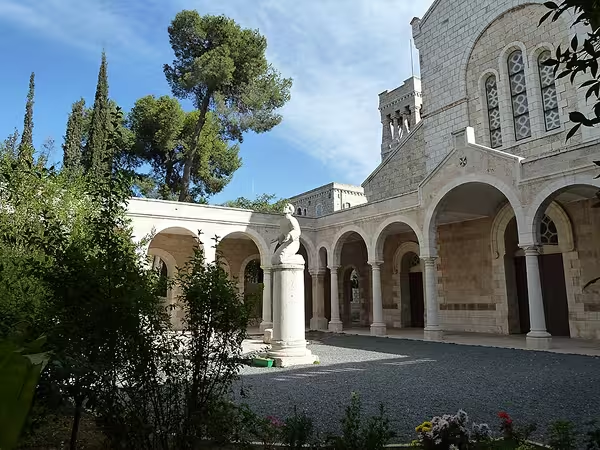
What we can say: a first shrine with relics existed by 15 May 439. The great basilica as pilgrims knew it was the empress’s work: Cyril of Scythopolis says she had it consecrated, still unfinished, on 15 June 460, four months before her death, and she chose it for her tomb. Whether the idea, and the first foundations, were hers or the bishop’s is open.
In 451 the Council of Chalcedon defined Christ as one person in two natures, and Juvenal of Jerusalem signed. The monks of Palestine revolted. Led by a monk named Theodosios, they drove Juvenal out and held the city until imperial troops restored him in 453. Eudokia sided with them, and the ODB says this was in 452. Pope Leo I wrote to her in 453 urging her to accept the council. In that same year Pulcheria died, and in 455 news came from the West that Vandals had sacked Rome and carried her daughter and granddaughters to Carthage. Shaken, she consulted Symeon the Stylite by letter. Cyril of Scythopolis, Euthymios’ biographer, tells how Symeon sent her to the desert father Euthymios. Euthymios told her to break with Dioscorus of Alexandria and seek communion with Juvenal, and she made her submission to the patriarch through two envoys, the priests Cosmas and Anastasios. Many laymen and monks followed her example. Cyril’s chronology places this probably in 455 or 456. Even so, the miaphysite churches, which rejected Chalcedon, kept her memory with reverence (Drake 1979). The Orthodox Church venerates her as a saint, with a feast on 13 August.
She died in Jerusalem on 20 October 460 and was buried in St Stephen’s. The Piacenza pilgrim saw her tomb twenty paces from the martyr’s. The basilica was wrecked by the Persians in 614, restored, and ruined again after the Crusades. Nothing of the tomb survives.
The poet-empress
Eudokia is one of the best-preserved women poets of antiquity, with more than 3,000 surviving lines. Photius, the 9th-century patriarch and the most demanding reader Byzantium ever had, praised her verse. He names only two women writers in his Library, Eudokia and the historian Pamphile. Her works fall into four groups.
Lost poems. These include the Persian victory ode of 422 and verse paraphrases of the Octateuch (the first eight books of the Bible), Zechariah and Daniel. Photius admired the Octateuch paraphrase for keeping faithfully to the biblical text.
The Homeric cento. A cento is a poem made entirely of lines borrowed from another poet. Eudokia told the story of salvation, from the Fall to the Resurrection, in lines taken from the Iliad and the Odyssey. She did not invent the idea. In a verse preface she explains that she revised and completed the cento of a certain Patricius, and the Latin Christian Proba had done the same with Virgil a century earlier. Christ speaks in the words of Homer’s heroes, and the paradise of Eden borrows the landscape of Calypso’s cave. The cento circulated widely in Byzantium and survives in several versions, edited by Rey (1998) and Schembra (2007).
The Martyrdom of Saint Cyprian. This three-book epic is her longest undisputed work, and it versifies a popular Antiochene legend. Book one, the Conversion, tells of the Christian virgin Justa (renamed Justina), whom the young Aglaidas tries to win through the magician Cyprian. Every demon Cyprian sends against her is put to flight by the sign of the cross. Book two, the Confession, is Cyprian’s own account of his past: initiated as a child into all the mysteries of Greece, he roamed every centre of occult knowledge. He converts, becomes bishop of Antioch and dies a martyr with Justina in book three, which is lost. About 900 lines survive: all 421 lines of book one and the first 479 of book two.
The survival of the poem is a small adventure in itself. Around 1760, Angelo Maria Bandini, librarian of the Laurentian Library in Florence, found it in an 11th-century manuscript (Laur. VII.10), bound by mistake inside Nonnus’ paraphrase of the Gospel of John. He published it twice, in 1761 and 1764, but the first 99 lines were missing. They had been torn out of the codex in 1674 by the Dutch scholar Philippus Rulaeus and carried to the Netherlands. Claudio Bevegni found them in Leiden (BPG 95) and published them in 1982, completing book one.
Dendrinos and Griva draw attention to how the poem actually works. Cyprian is not converted by a moral awakening but by the discovery that the cross is the stronger power. His Confession is driven by a hunger for knowledge, and they call him “a Faust before Faust”. Justina’s resistance is told in a striking erotic idiom of burning desire for Christ. The legend of Cyprian and Justina did feed directly into the Faust tradition, through Calderón’s play El mágico prodigioso (1637).
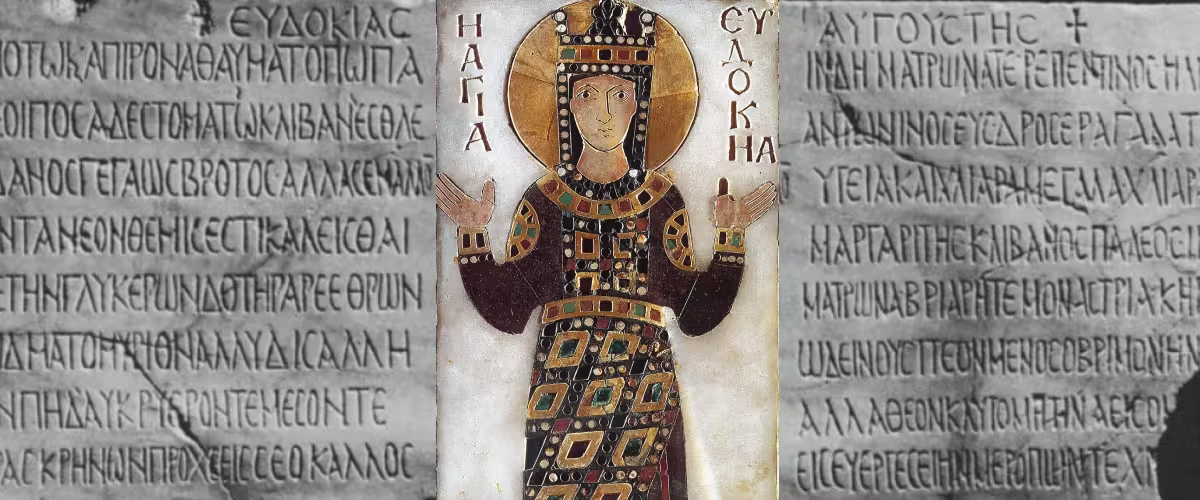
The Hammat Gader poem. During the excavations of the Roman baths at Hammat Gader, begun in 1979, a slab of grey-white marble came to light in the floor of the Hall of Fountains. It is about 1.8 m long, carries sixteen hexameters in two columns of eight under a heading framed by two crosses, Εὐδοκίας Αὐγούστης, “by Eudokia Augusta”, and is now in the Israel Museum. Judith Green and Yoram Tsafrir published it in 1982. It must date from her years in the East, between 438 and 455.
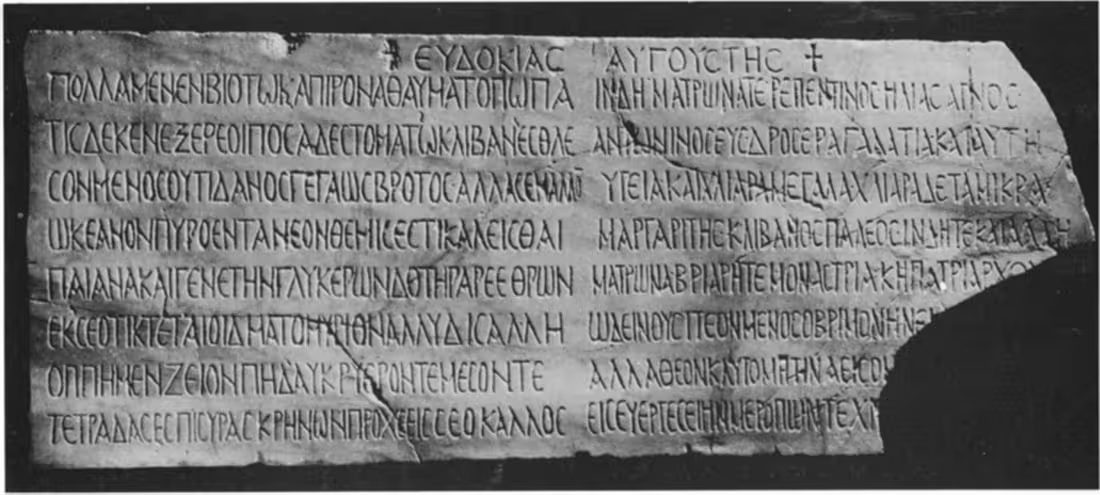
The poem opens with the poet’s own wonder: Πολλὰ μὲν ἐν βιότῳ κἀπείρονα θαύματ᾽ ὄπωπα, “many and boundless wonders have I seen in my life”. It then asks who, born a worthless mortal and however many mouths he had, could tell the strength of the “noble furnace” (klibanos). The question echoes the opening of Homer’s catalogue of ships. She hails the furnace as a new fiery ocean, a Paian (healer) and the source of sweet streams, pouring out boiling, cold and tepid water into “four tetrads” of springs. She then names the sixteen pools one by one:
- two “Indian” pools and two “Matrona” pools;
- Repentinus, holy Elijah, Antoninus the good, dewy Galatea and Hygieia herself;
- the large and the small lukewarm pools, the Pearl and the old furnace;
- Briara, the Nun, and the pool of the Patriarch.
The last, damaged lines turn to God, whom the poet promises to sing “for the benefit of mortals”. The goddess of health, the healer’s title and a sea-nymph share the list with a prophet and a nun, without the slightest embarrassment. As Sowers notes, it stands in contrast to the outright polemic against pagan religion in the Confession. It is a rare piece of contemporary evidence for her travels, set into the very floor she walked on.
Debate: how good a poet was she?
A clumsy versifier. Cameron (1982) was scathing. Next to Nonnus and the polished poets of her age, he judged that Eudokia could only seem crude and uneducated, without even the charm of simplicity. Her metrical mistakes are real.
A capable and original poet. Michael Whitby (2013) and Aleksandrova argue that her lapses in classical prosody, by then a dead feature of spoken Greek, are no worse than average for her period. They suggest her formal training ended early, and note that her verse reads well in Byzantine pronunciation, which is why Photius liked it. Mark Usher (1998) showed that the cento is not mere “stitching” but a dense dialogue with Homer and his commentators. Sowers (2020) reads her whole corpus as the work of a deliberate author moving between registers: empress, benefactor, pilgrim and poet.
What we can say: no one would rank her with Homer’s best imitators. But the old verdict judged her by classical rules she had little reason to follow, and recent scholarship has made her one of the most studied women writers of late antiquity.
The face of Eudokia
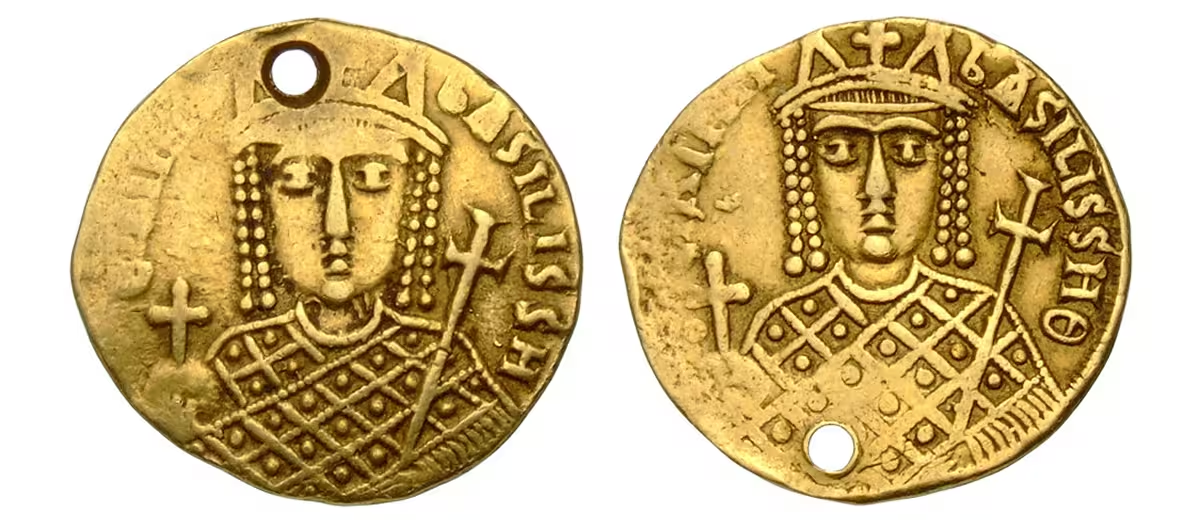
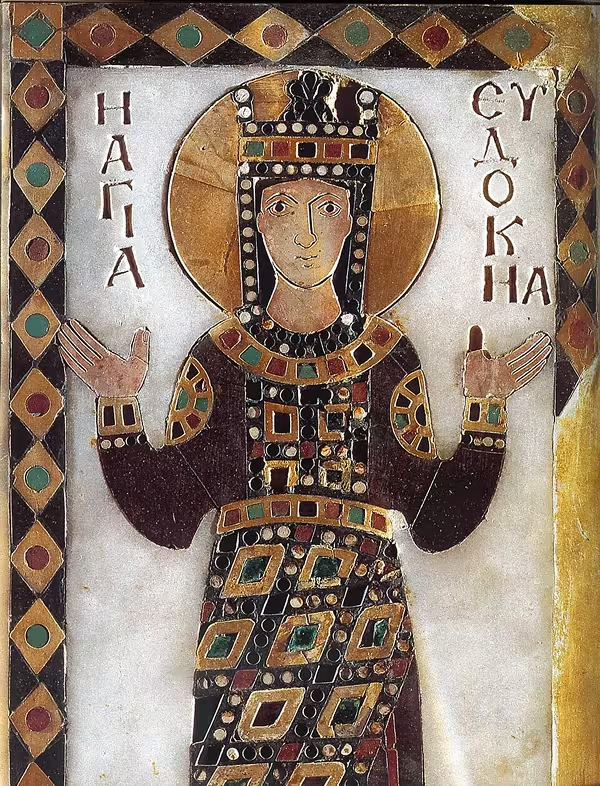
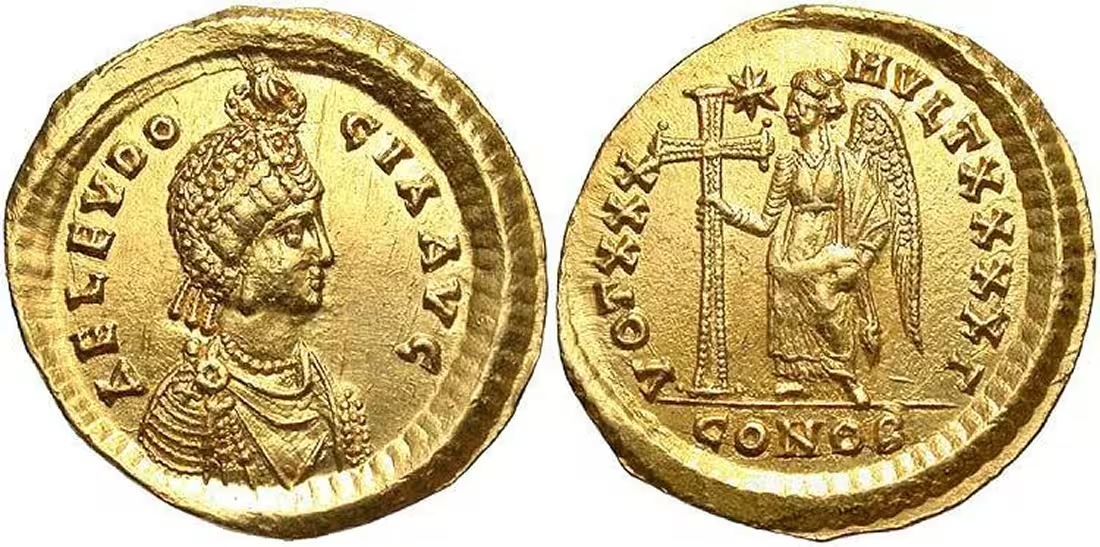
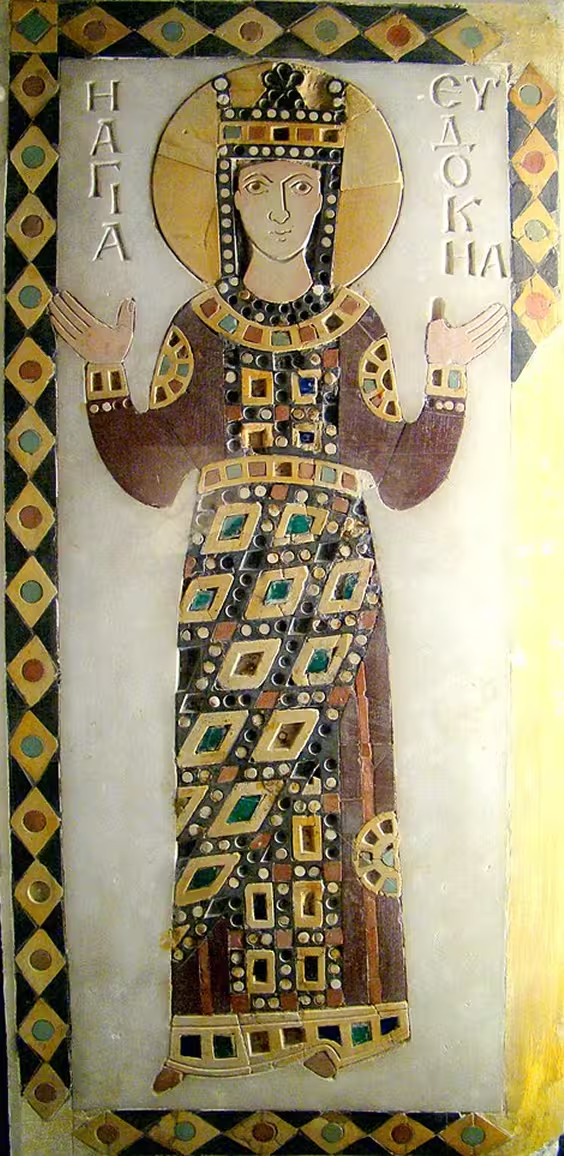
Her face is known first from her gold coins. The early solidi of the 420s show her with an unusually small, delicate bust, which Grierson and Mays note and Aleksandrova reads as the image of a very young bride. Later issues show the hand of God holding a wreath over her head. In Athens, the Acropolis Museum catalogues a portrait head of Pentelic marble (NMA 5257) as Empress Eudokia. It is attributed to an Attic workshop, dated 421–430, and shown in the museum’s Excavation Museum. If the identification holds, it is the only sculpted portrait of her, made in her native city in the first decade of her reign, at the time of the Agora statue base. The inlaid marble icon of “Saint Eudokia” in the Istanbul Archaeological Museums is a different matter. It is a panel of coloured stone and glass showing a crowned figure in prayer, found in 1929 at the monastery of Constantine Lips (Fenari İsa Camii). It is usually dated to the early 10th century, although its first publisher allowed anything from the 10th to the 14th. Its inscription names a saint, and whether that saint is our empress is not certain. Her best-known image is a much later one: the apple scene in the 14th-century Slavonic Manasses Chronicle.
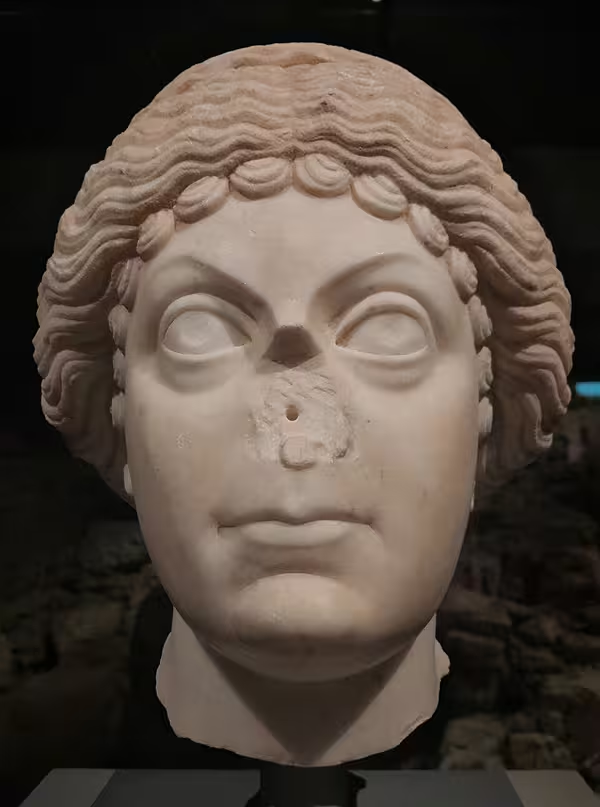
IMAGE PLACEHOLDER
Solidus of Aelia Eudocia (obverse, hand of God). Berlin Münzkabinett 18217904, or a CNG/Wikimedia image under CC BY-SA. Separate alt text from the hero image.
The evidence table
The famous stories, and what the sources offer for each.
| Story | Earliest source | Assessment |
|---|---|---|
| Disinherited by her brothers (a hundred gold coins) | Malalas, 6th c. | Folk-tale frame. The brothers’ names and careers are confirmed. |
| Chosen by Pulcheria for her brother | Malalas | Contested. Pulcheria’s role was probably inflated after 450. |
| Baptised by Atticus and renamed Eudokia | Socrates, contemporary | Secure. |
| Seven pagan philosophers came with her to Constantinople | Patria, 10th c. | Legend, probably hostile in origin. |
| Honoured by a statue in the Athenian Agora | Inscription, shortly after 421 | Secure that an inscription names her. Whom the statue showed is unclear. |
| Built the “Palace of the Giants” in Athens | Modern attribution | Hypothesis. |
| Brought the chains of St Peter from Jerusalem | Later Roman tradition | Unverified. |
| The apple and adultery with Paulinos | Malalas (apple); Patria (adultery) | The fall of Paulinos is real; the apple is legend; adultery is unattested early. |
| Had Saturninus killed (444) | Marcellinus, Priscus | Credible. Whether she struck him herself is a matter of reading one line. |
| Extended the walls of Jerusalem to include Siloam | Evagrius; Piacenza pilgrim, c. 570 | Well attested in texts; the archaeology is debated. |
| Founded the basilica of St Stephen | Evagrius | Great builder of it, certainly. Founder, debated (Méndez). |
| Allowed Jews to pray on the Temple Mount | Life of Barsauma (hostile, Syriac) | Uncertain. |
| Sent Pulcheria an icon of the Virgin painted by St Luke | Later Byzantine tradition | Legend. |
How historians judge her
The modern Eudokia was born romantic. Ferdinand Gregorovius’ Athenaïs (1882) made her the last flower of pagan Athens, sacrificed to a pious court. Holum (1982) recast her as the figurehead of a “traditionalist” party in a long struggle with Pulcheria. Cameron (1982) deflated both views: no pagan faction, a courtier’s fall rather than a cultural defeat, and a mediocre poet. Since then the pendulum has swung back towards Eudokia herself. Aleksandrova sees her as a young Christian Hellenist formed by her husband and in tune with his reign. Sowers recovers a deliberate author with a voice of her own. Dendrinos and Griva hear a subversive, half-pagan poet in a Christian empire.
Our personal take
Strip away the apple and the wicked brothers and a remarkable life remains. Eudokia was a sophist’s daughter who married the emperor and held her own beside Pulcheria for twenty years. She left Athens, Antioch and Jerusalem visibly marked by her patronage, and she survived the destruction of her allies by keeping her title and her independence to the end. She was wilful enough to kill the officer sent to watch her, and stubborn enough to defy Chalcedon until her own family’s tragedy brought her back. Above all, she wrote. Few Byzantine empresses can be heard at all; Eudokia can still be read, praising a bath-house furnace in the language of the Iliad. Overall, she stands out as a remarkable woman in Byzantine history
Frequently asked questions
Who was Empress Eudocia?
Aelia Eudocia (Eudokia), born Athenais (c. 400–460), was the wife of the Eastern Roman emperor Theodosius II and Augusta from 423. The daughter of an Athenian sophist, she became a patron of building in Athens and Jerusalem and one of the best-preserved women poets of antiquity. She spent her last seventeen years in Jerusalem.
Was Eudocia a pagan?
She was born into a pagan, classically educated family and was baptised just before her marriage in 421. Everything she later wrote is Christian. Most historians see her as a sincere Christian with a Greek classical culture, though some scholars still argue she kept pagan sympathies.
What is Eudocia’s Homeric cento?
It is a poem on the Bible story, from the Fall to the life of Christ, composed entirely of lines borrowed from Homer’s Iliad and Odyssey. Eudokia revised and completed an earlier cento by a certain Patricius.
Why did Eudocia leave Constantinople?
The legend blames a Phrygian apple and a suspected affair with the official Paulinos. In reality, her allies Paulinos and Cyrus of Panopolis were destroyed in a court struggle won by the eunuch Chrysaphios in 440–441. In 443 she left for Jerusalem, keeping her imperial title.
Where is Eudocia buried?
In the basilica of St Stephen, which she built or enlarged outside Jerusalem’s northern gate. Her tomb is lost, but the modern basilica of Saint-Étienne stands on the 5th-century foundations.
Was Eudocia really from Athens?
Almost certainly. All the Byzantine sources say so, and an honorary epigram naming her was found in the Athenian Agora. One historian, Kenneth Holum, argued for Antioch, but few have followed him.
Further reading and sources
- Primary sources in translation: Socrates, Ecclesiastical History VII; Evagrius, Ecclesiastical History, trans. M. Whitby (Liverpool, 2000); The Chronicle of John Malalas, trans. E. Jeffreys, M. Jeffreys and R. Scott (Melbourne, 1986); Chronicon Paschale 284–628 AD, trans. M. and M. Whitby (Liverpool, 1989); The Chronicle of Marcellinus, trans. B. Croke (Sydney, 1995).
- Her works: A. Ludwich (ed.), Eudociae Augustae, Procli Lycii, Claudiani carminum graecorum reliquiae (Leipzig, 1897); C. Bevegni, “Eudociae Augustae Martyrium S. Cypriani I, 1–99”, Prometheus 8 (1982), 249–262, and Storia di san Cipriano (Milan, 2006); A.-L. Rey (ed.), Centons homériques (Sources Chrétiennes 437, Paris, 1998); R. Schembra (ed.), Homerocentones (CCSG 62, Turnhout, 2007); J. Green and Y. Tsafrir, “Greek Inscriptions from Hammat Gader: A Poem by the Empress Eudocia and Two Building Inscriptions”, Israel Exploration Journal 32 (1982), 77–96.
- B. P. Sowers, In Her Own Words: The Life and Poetry of Aelia Eudocia (Washington, DC, 2020), the best modern study, with the first full English translation of the Martyrdom of Cyprian.
- K. G. Holum, Theodosian Empresses: Women and Imperial Dominion in Late Antiquity (Berkeley, 1982).
- Al. Cameron, “The Empress and the Poet: Paganism and Politics at the Court of Theodosius II”, Yale Classical Studies 27 (1982), 217–289; revised in Wandering Poets and Other Essays on Late Greek Literature and Philosophy (Oxford, 2016).
- T. L. Aleksandrova, “The Empress Athenais-Eudocia: The Path to the Throne” (in Russian), Problemy istorii, filologii, kul’tury 1 (2017), 75–87.
- M. Dendrinos and A. Griva, “Neoplatonic and Gnostic Resonances in the Martyrdom of Cyprian of Athenais Eudocia”, Dia-noesis: A Journal of Philosophy 14 (2023), 19–38 (doi 10.12681/dia.37767).
- J. Burman, “The Athenian Empress Eudocia”, in P. Castrén (ed.), Post-Herulian Athens: Aspects of Life and Culture in Athens, A.D. 267–529 (Helsinki, 1994).
- E. A. Clark, “Claims on the Bones of Saint Stephen: The Partisans of Melania and Eudocia”, Church History 51 (1982).
- T. Macridy, “The Monastery of Lips and the Burials of the Palaeologi”, Dumbarton Oaks Papers 18 (1964), 253–278 (the Eudokia icon).
- E. Sironen, “An Honorary Epigram for Empress Eudocia in the Athenian Agora”, Hesperia 59 (1990), 371–374.
- H. Méndez, The Cult of Stephen in Jerusalem: Inventing a Patron Martyr (Oxford, 2022).
- M. Usher, Homeric Stitchings: The Homeric Centos of the Empress Eudocia (Lanham, 1998).
- F. Millar, A Greek Roman Empire: Power and Belief under Theodosius II (408–450) (Berkeley, 2006); C. Kelly (ed.), Theodosius II: Rethinking the Roman Empire in Late Antiquity (Cambridge, 2013).
- H. A. Drake, “A Coptic Version of the Discovery of the Holy Sepulchre”, GRBS 20 (1979), 381–392.
- F. Gregorovius, Athenaïs. Geschichte einer byzantinischen Kaiserin, 3rd ed. (Leipzig, 1892).