Church of the Taxiarchs, Mount Oros, Aigina : Byzantine frescoes above the sanctuary of Zeus Hellanios
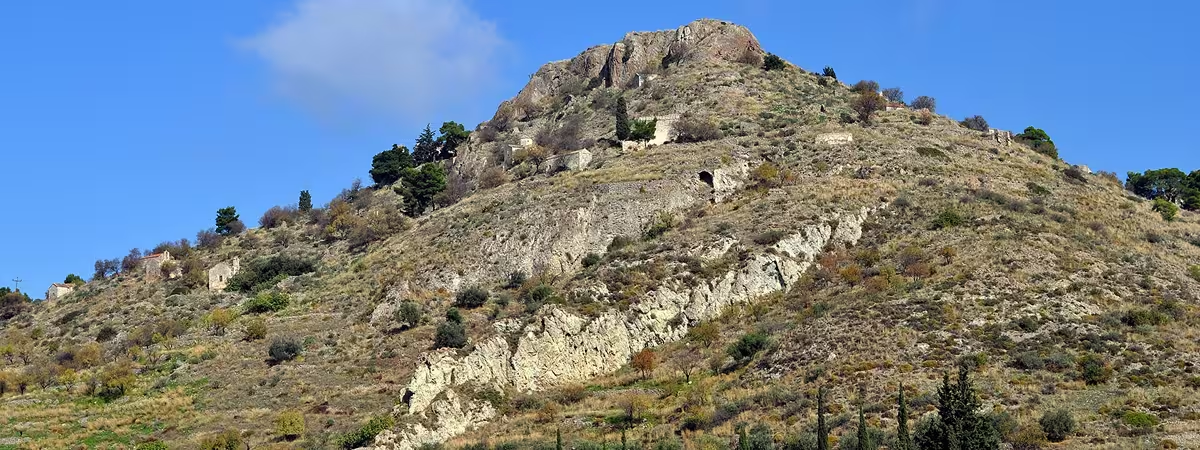
On the north slope of Mount Oros, Aegina‘s highest point, a small Byzantine church stands below the ruined summit sanctuary of Zeus Hellanios, amid a scatter of ancient remains known locally as Sphyrichtres. It is dedicated to the Taxiarchs, the Archangels Michael and Gabriel, and it holds two distinct campaigns of wall painting, a century apart, built almost entirely from the stones of the Hellenistic building it replaced. Neither the church nor its frescoes are widely known outside specialist literature, but the quality of the painting — and one genuinely rare scene from the life of the Archangel Michael — make it one of the more rewarding Byzantine monuments on the island.
Location and history
The church stands on Mount Oros’s north side, on the same mountain whose summit once carried the ancient sanctuary of Zeus Hellanios — later itself rebuilt as a 13th-century Byzantine church on the ruins of the ancient temple. The Taxiarchs occupies a lower terrace, amid the remains of Sphyrichtres, reached by a wide stone staircase climbing between two retaining walls that create two artificial terraces on the slope. On the upper terrace, the foundations of a Hellenistic stoa survive in a Π-shaped plan, built of the dark local trachyte; the church itself was raised directly over the stoa’s north-west corner, reusing its stone.
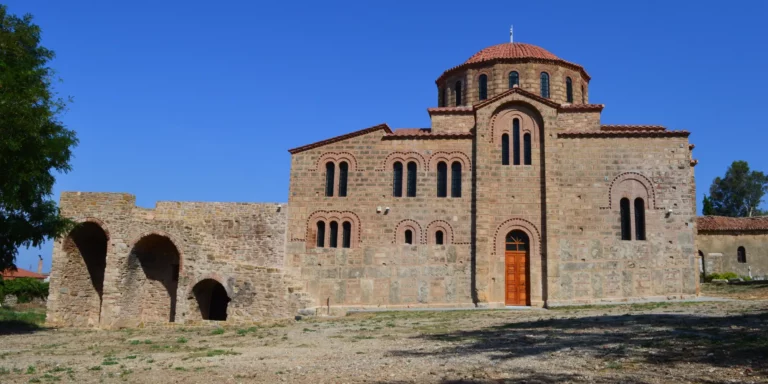
No founding inscription survives, so the church’s date rests on its architecture. Features on the exterior of the sanctuary apse point to the 12th century, while the overall proportions and massing of the building suggest construction around the turn of the 12th to 13th century — squarely within the period, elsewhere on Aegina, when the island’s withdrawal to Paliachora was already generations old and its ecclesiastical life was again active enough to fund new rural churches. A narthex was added at the west end at some later, undocumented point. Close by, low wall foundations mark the cells and perimeter wall of a later monastery dedicated to Agios Nikolaos — a community about which no other record survives.
Exterior and architecture
The Taxiarchs is a small, aisleless, domed cross-in-square church, its cross-arms compressed to fit within a plain rectangular footprint — a compact, economical plan typical of rural Middle Byzantine building. Its masonry makes the church’s history legible at a glance: the lower courses of the north wall are built of carefully dressed stone laid in tight, almost invisible joints, salvaged directly from the Hellenistic stoa, while the upper courses mix undressed stone with brick far more loosely, in a visibly different, later technique. The sanctuary and the octagonal dome are built of roughly squared poros blocks, imperfectly finished, with brick set into the gaps between them. Above the west entrance, a shallow niche is crowned by a simple dentil band of brick — a modest but deliberate decorative touch on an otherwise plain exterior.
Interior and wall paintings
The church’s paintings belong to two separate campaigns, one considerably finer than the other.
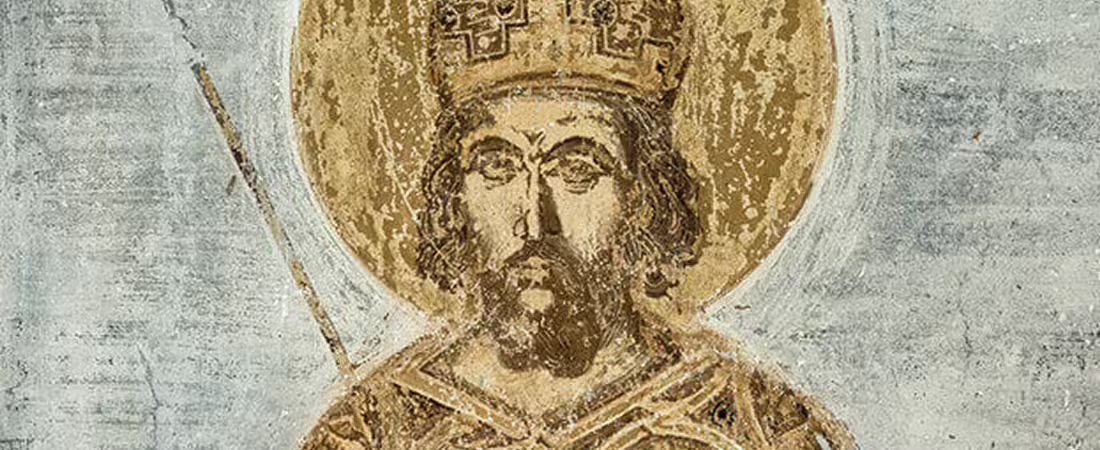
The earlier layer, confined to the sanctuary, was substantially revealed only during restoration work in 2002. It shows four hierarchs, preserved from the waist down, painted in brown-red and ochre against a dark blue ground, standing above a decorated dado of alternating brown and green wavy lines. The drapery, the soft palette, and the careful floral ornament on the hierarchs’ epitrachelia are, by specialists’ account, well above the level of ordinary provincial painting for a church of this size — likely work of the very end of the 12th or the start of the 13th century.
The dome carries the later, more extensive campaign. At its center, a bust of Christ Pantokrator — inscribed “the Philanthropist” — blesses and holds a closed gospel book, enclosed within a wide circular band of pseudo-kufic ornament, a decorative motif paralleled in other 13th- and 14th-century Byzantine monuments. Around the drum, in the four spaces between the windows, sit four narrative scenes tied directly to the church’s dedication to the Archangel Michael: the Miracle at Chonae, in which the archangel splits open a rock to divert a river and save his shrine at Chonae, in Asia Minor, from being deliberately flooded by hostile “pagan men” — a subject almost unique in surviving monumental painting; Joshua before Jericho, in which the archangel appears to the Israelite commander before the city’s fall, his shield decorated with the same pseudo-kufic motifs seen around the Pantokrator above; Jacob’s Ladder, showing the patriarch asleep with a stone for a pillow beneath a band of angels ascending and descending toward God, a scene read as a meditation on the connection between heaven and earth; and the Expulsion of Adam and Eve from Paradise. This dome cycle is attributed, on stylistic grounds, to a provincial workshop of the Palaiologan period, in the 14th century — a full century or more after the sanctuary paintings below it. A still later layer, showing the Archangel Michael alongside St. Anthony, survives in the north-east corner of the nave.
Significance
The Taxiarchs earns its place on any tour of Byzantine Aegina for two reasons. First, its masonry preserves an unusually clear record of how a Middle Byzantine builder dismantled and reused a still-standing ancient structure — the shift from the Hellenistic stoa’s tightly-jointed lower courses to the looser Byzantine work above is visible without any specialist training. Second, its dome cycle includes one of the very few surviving monumental depictions of the Miracle at Chonae anywhere in Byzantine art, a genuinely rare choice of subject that rewards the climb up the mountain on its own. Together with the ruined summit sanctuary of Zeus Hellanios above it, the church shows the same hilltop serving, in turn, as pagan and Christian sacred ground across more than a thousand years — a pattern repeated, in smaller ways, across much of Byzantine Aegina.
Frequently Asked Questions
Where is the Church of the Taxiarchs on Aegina?
On the north slope of Mount Oros, the island’s highest point, below the ruined ancient sanctuary of Zeus Hellanios, reached by a stone staircase from the ruins known as Sphyrichtres.
When was the Church of the Taxiarchs built?
Its architecture points to a date around the turn of the 12th to 13th century, based on the style of the sanctuary apse and the overall massing of the building. No founding inscription survives.
What is depicted in the dome of the Church of the Taxiarchs?
A 14th-century Palaiologan fresco cycle centered on a bust of Christ Pantokrator, surrounded by four scenes tied to the Archangel Michael’s cult: the Miracle at Chonae, Joshua before Jericho, Jacob’s Ladder, and the Expulsion from Paradise.
Sources
- Charalambos Pennas, The Byzantine Aegina, Athens, 2004.
- Nikolaos Moutsopoulos, Η Παλιαχώρα της Αιγίνης. Ιστορική και μορφολογική εξέτασις των μνημείων, Athens, 1962.
- Restoration report, Church of the Taxiarchs, Mount Oros, Aegina, 2002.
One Comment