Saint Luke of Steiris: Healer, Prophet and Wandering Saint of Byzantine Greece
For more than five centuries, the Venetians venerated a body in the church of San Giobbe as that of Luke the Evangelist. It belonged to another Luke: a hermit of central Greece who died on 7 February 953 near the ruins of ancient Steiris, in Phocis. Luke the Younger, as Byzantium called him to tell him apart from the Evangelist, never held office, never went to Constantinople and left no writings. Yet his tomb produced one of the great monasteries of the Byzantine world, Hosios Loukas, and his story survives in one of the most detailed saints’ Lives of the 10th century. It is a story of movement. In life, Luke fled from refuge to refuge ahead of Bulgarian and Hungarian raids. After death, his body travelled further still, to Serbia, Bosnia and Venice, before returning to his monastery in 1986.
Quick facts
Names: Luke the Younger (ὁ νέος), Luke of Steiris (Steiriotes), Luke of Hellas; in Greek Hosios Loukas, “the Blessed Luke”
Born: Before 900, probably 896, at Kastorion in Phocis, the modern village of Kastri near Delphi
Died: 7 February 953, in his cell near Steiris, aged about 56
Known for: Healing, prophecy (above all the reconquest of Crete in 961) and posthumous miracles at his tomb
Main source: An anonymous Life in 87 chapters, written by a disciple after 961
Feast days: 7 February (death); 3 May (translation of the relics, kept only at his monastery)
Relics: At the Monastery of Hosios Loukas since 13 December 1986, after more than five centuries in the West
The source: a Life and its genre
The Life of Luke the Younger
Nearly everything known about Luke comes from a single text, whose full title calls it the “Life and conduct, with a partial account of the miracles, of our holy father and wonder-worker Luke the Younger, who lies in Hellas” (Βίος καὶ πολιτεία καὶ μερικὴ θαυμάτων διήγησις τοῦ ὁσίου πατρὸς ἡμῶν καὶ θαυματουργοῦ Λουκᾶ τοῦ νέου τοῦ ἐν Ἑλλάδι κειμένου). Its author was an anonymous monk of the community who had known the saint. He wrote after 961, since he knows that Crete was retaken, and probably under Basil II (976–1025). The text runs to 87 chapters: the saint’s life, then a long series of miracles at his tomb, which take up chapters 68 to 84.
The Life has an unusual horizon. Its author looks at the provinces. He mentions monks travelling to Italy, but Constantinople never comes into view. That makes the text a rare window on 10th-century Hellas, its raids, its roads and its peasants, as much as on the saint. Around the year 1000, Symeon Metaphrastes rewrote it in shorter form for his great collection of saints’ Lives, under 8 February. Luke is the only near-contemporary to whom Metaphrastes devoted a text, a sign of how quickly his fame had spread.
The full Life survives in only a few manuscripts. Georgios Kremos published it in his Phokika (1874), the Metaphrastic version appears in the Patrologia Graeca (vol. 111), and Emidio Martini added supplements in 1894. The standard edition today, with English translation, is that of Carolyn and Robert Connor (1994).
What is a Byzantine saint’s Life?
A bios, or Life, was not a biography in the modern sense. It was written to be read aloud, often on the saint’s feast, and to prove that its hero was holy. The genre had fixed stages that readers expected: a child unlike other children, a break with family and the world, ascetic feats, struggles with demons, miracles and prophecies, a foretold death, and finally the wonders worked at the tomb. Luke’s Life follows this pattern closely. Its posthumous miracles also had a practical purpose: they advertised the shrine to pilgrims, and the community lived from their visits. The 9th and 10th centuries produced a whole family of such Lives for the “new” saints of southern Greece and Italy, among them Nikon Metanoeite and Elias the Younger.
Historians therefore read these texts in two layers. The conventional frame, the precocious child or the miracle, tells us what holiness meant. The details that serve no convention, a harbour master refusing a boat, a governor paying for a church, a raid that empties a valley, tell us about the world in which the saint lived. The genre deserves its own treatment, which we will give it in a future article on Byzantine hagiography.
A peasant boy from Kastorion
Luke’s family came from the island of Aegina, in the Saronic Gulf. In the first half of the 9th century, Arab raids drove his grandparents from the island to the mainland, and they settled at Kastorion, on the north shore of the Gulf of Corinth. His parents, Stephen and Euphrosyne, were farmers of some means; Luke was the third of their seven children. The Life fills his childhood with the signs the genre required: he fasted, worked for his parents, and gave away so much to the poor that he clashed with his relatives. His mother once saw him raised above the ground in prayer, which makes him one of the earliest Byzantine saints said to have levitated.
After his father’s death he tried twice to leave. On the first attempt, heading for Thessaly, he was taken by soldiers hunting runaway slaves and sent home. On the second, he joined two monks travelling from Rome to Jerusalem, who brought him to Athens, where he received the first monastic habit in a monastery of the Mother of God. He was about fourteen. His mother’s prayers, the Life says, brought him back once more, but soon afterwards she let him go.
A hermit on the run
Luke began his solitary life on Mount Ioannitza, near his native village. There he spent seven years, received the great habit from two more monks bound for Rome, and became known for his charity and his prophecies. Then the Bulgarians came. During the wars of Tsar Symeon (893–927), raids reached deep into central Greece, and Luke fled with the villagers, first to Corinth, then to the region of Patras, where he served a stylite, a hermit living on a column, before withdrawing again into solitude. He spent about ten years in the Peloponnese. When he wanted to go home, a harbour master refused him passage for fear of the raids.
He returned to Ioannitza with the other refugees, probably after the peace of 927–928 between Byzantium and Symeon’s son Peter. Visitors crowded round him, so he moved to Kalamion on the coast, where he stayed three years. Then came the Hungarians. With the local population he took refuge on the islet of Ampelon in the Gulf of Corinth, where he spent another three years. Finally, around 946, he settled near Steiris, in a place where he would spend the last seven years of his life. Read for its details rather than its miracles, this part of the Life is one of the best accounts of what the raids of the 10th century meant for the people of Hellas: whole villages on the move, islands as refuges, and roads that could close overnight.
An unconventional monk
Luke was a hermit, not a monk of an organised community, and the Life does not hide the friction this caused. One abbot criticised his “rustic” (agroikikos) manners and his avoidance of church structures. Luke enrolled for a time in a school at Corinth but left, finding the pupils insufficiently serious. He asked an archbishop of Corinth for permission to celebrate the Eucharist in his cell without a priest. These details, which do little for a conventional portrait of holiness, are among the most credible in the text.
The hagiographer also insists on Luke’s freedom from desire. In one dream, an angel relieves him of temptation for good. In another episode, during a winter storm, he lets two women shelter in his cave with his disciple Pankratios and himself, and remains, in the text’s words, as unmoved as a stone. Such scenes are a familiar device of the genre: they prove that the saint has risen above the body, and they answer in advance any suspicion about a holy man who received women for healing.
Healer and prophet
Luke’s reputation rested on two gifts. He healed people and animals, and he foresaw events. His most famous prophecy announced that Crete, held by the Arabs since the 820s, would be retaken by an emperor named Romanos. The island fell in 961 to Nikephoros Phokas, in the reign of Romanos II, about twenty years after the prophecy. It is not clear whether Luke had meant Romanos I, the emperor at the time, but the fulfilment fixed his fame, and later tradition used it to tie his monastery to the imperial family.
His renown reached the governors of the theme of Hellas at Thebes. The strategos Krenites (perhaps of the Arotras family) began building a church dedicated to St Barbara beside his cell, and another governor, Pothos, also honoured him. Phocis lay on the route that pilgrims and monks took between Italy and the Holy Land, through Athens, since the Via Egnatia was then too dangerous. The Life is full of these travellers: the monks who took young Luke to Athens, those who gave him the great habit, a ship from Italy saved by his prayers off Ampelon. Nicolas Oikonomides saw in this road one reason why the fame of a provincial hermit spread so fast.
Death and the making of a cult
Luke died in his cell on 7 February 953. According to the Life, he told the priest Gregorios that the bricks he wanted on his grave lay beneath the very spot where he was lying, and he was buried there, in his cell. Six months later, a eunuch monk named Kosmas, travelling from Paphlagonia to Rome, heard in a dream near Krisa that he should serve “the new Luke”. He found the neglected grave, raised it above the ground, faced it with local stone, fenced it, and vowed to stay for the rest of his life.
Two years later the disciples, who had witnessed many healings, began to build. They completed and decorated the church of St Barbara, then cells for the brothers and lodgings for visitors, and finally a cruciform oratory over the cell and its tomb. The sick came for the myrrh said to flow from the relics, for the oil of the lamp above the grave, and for the dreams in which the saint appeared to those who slept beside it. The miracle stories show who they were: ordinary people from Phocis, Attica, Boeotia, Phthiotis and the nearby islands, rarely the rich or powerful. Where the healings took place in the later monastery is debated. Carolyn Connor placed them in the crypt around the original tomb; others look to the shrine in the church above. The buildings themselves are described in our article on the Monastery of Hosios Loukas.
Two feasts: which mattered more?
On 3 May, probably in 1011 and on the feast of the Ascension, Abbot Philotheos moved Luke’s relics into the newly built Katholikon. The monastery has celebrated two feasts ever since: the saint’s death on 7 February and the translation on 3 May. Scholars disagree on their weight. Manolis Chatzidakis judged the translation at least as important as the death, and Nicolas Oikonomides saw it as a second inauguration of the monastery and its main feast. Nano Chatzidakis ranked it second in one study and first in another. Outside the monastery, the question did not arise: the calendars of the Church recorded only 7 February.
How Byzantium pictured him
A fixed portrait type
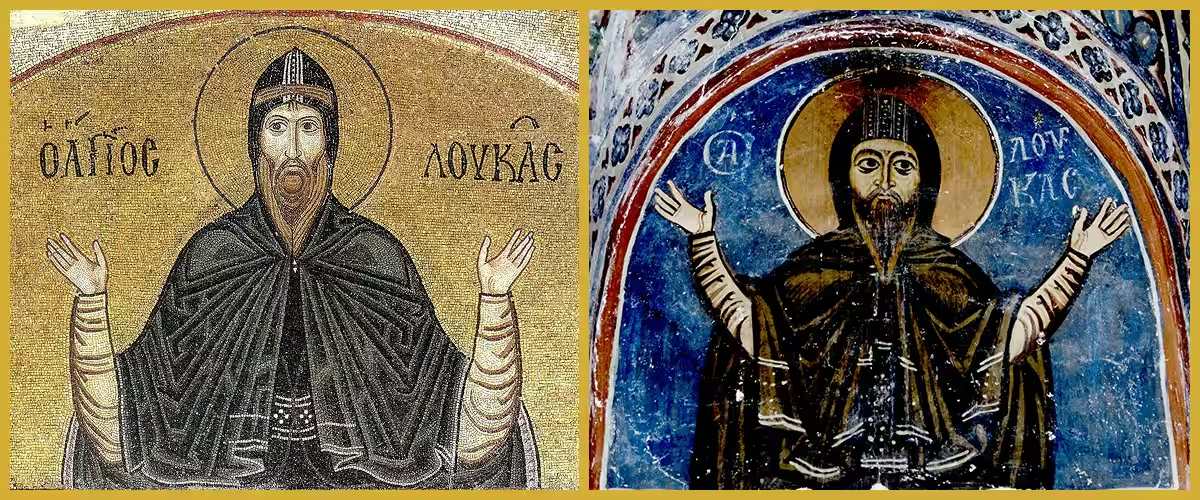
Saints were recognised by their faces and dress as much as by their names, and Luke’s appearance was fixed very early, probably in his own monastery in the first half of the 11th century. Every surviving portrait shows the same man: a straight, mid-length brown beard ending in a point, sometimes with a few grey hairs; the hood of a monk of the great habit, the koukoulion, usually dark, often with an embroidered vertical band and a ribbon tied across the forehead; a tunic, a cloak (mandyas) and the analabos, the monastic scapular. Most often he prays with both hands raised before his chest; more rarely his arms are spread wide, as an orant; occasionally he blesses with his right hand and holds a scroll in his left. Only one image breaks the type: a manuscript miniature in Messina, where he appears bareheaded, with short thick hair.
At Hosios Loukas itself his inscriptions read simply “St Luke”: there was no need to say where he lived. Elsewhere, painters added “of Steiris”, in several spellings, and only the Messina miniature calls him “the Younger”. No medieval icon of him is known, though Tatjana Starodubcev suggests that icons must have existed to carry so stable an image from Phocis to Cyprus and Serbia.
Where his portraits survive
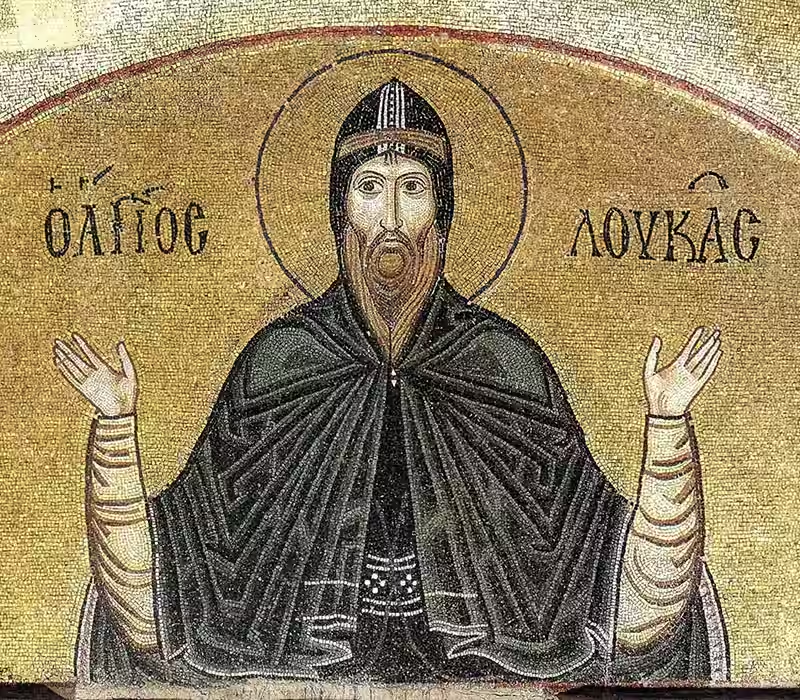
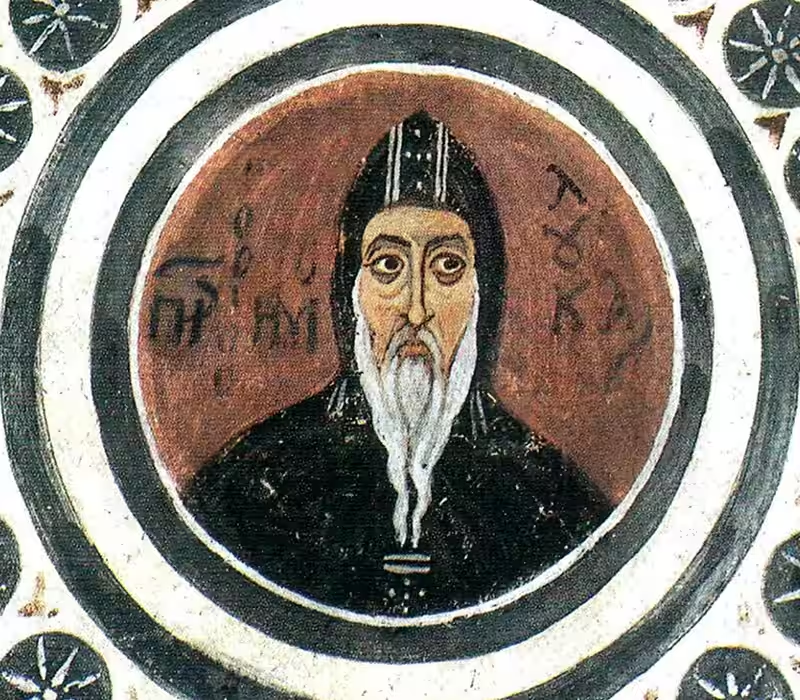
Compared to other Byzantine saints, Luke was rarely depicted. In his own monastery he appears at least four times around his shrine in the Katholikon. A fresco in the north-west chamber and a mosaic above the door into the north arm face each other on either side of the same wall. Two frescoes in the north-east chamber show him above his relic chest and receiving the model of the church from Abbot Philotheos. In the crypt, painted around the middle of the 11th century, he appears in a vault medallion beside his namesakes and at the entrance blessing a group of monks. Later, on the west wall, he intercedes before Christ for a monk named Basil. His mosaic, mentioned in our future guide to the mosaics of Hosios Loukas, is the model for all the others.
Beyond his monastery, the surviving images known so far are these:
| Date | Place | Inscription and notes |
|---|---|---|
| Early 2nd quarter of the 11th c. | Exultet roll “Bari 1”, Bari, southern Italy | Bust in a medallion in the margin, “of Esterion”; one of the few monks among 36 saints. The earliest image outside Greece. |
| Late 11th – early 12th c. | Menologion of Symeon Metaphrastes, Messina, Bibl. Univ., San Salvatore 27, fol. 58v (perhaps made in Sicily) | Full figure, bareheaded, “Hosios Loukas the Younger”. The only image without the hood. |
| 1092–1117 | Holy Trinity, monastery of St John Chrysostomos, Koutsovendis, Cyprus | Among four monks in a niche, “of Steirion”. Inaccessible since 1974; known from photographs of the 1960s. |
| 12th c. | Basilica of St Demetrios, Thessaloniki, south colonnade | Full figure, damaged; inscription only partly legible. |
| c. 1200 | Episkopi, Stavri, Mani | Bust preserved, “Luke the Steiriote”, in the sanctuary. |
| c. 1320 | Gračanica monastery, Kosovo | Full figure, arms spread in prayer; Serbian inscription “St Luke”. |
| 1320–1321 (repainted 1803–1804) | Katholikon of Hilandar, Mount Athos | “St Luke of Steirion”, with a rolled scroll; the 19th-century repainting kept the programme. |
| 1334–1343 | Treskavac monastery, near Prilep | Long read as “Luke the Stylite”; identified by Starodubcev as Luke of Steiris from his appearance. |
| 2nd quarter of the 16th c. | Refectory of the Great Lavra, Mount Athos | A late image. |
The list is short, and it is uneven. The images before 1204 are scattered across the Byzantine world, from Italy and Cyprus to Thessaloniki and the Mani, which shows how fast the cult travelled in the 11th and 12th centuries. After that, Luke appears almost only in Serbian foundations of the time of King Milutin (1282–1321) and his successors. Starodubcev suggests the model reached Serbia through Thessaloniki or Mount Athos, while noting that the evidence is too thin for certainty.
Rise and decline of a cult
Luke’s cult started modestly, among the peasants of a province that people in the capital regarded as poor and battered by invasions. It grew quickly. The Synaxarion of Constantinople, the calendar of saints of the Great Church compiled in the 10th century, already commemorated “Luke who lies in Hellas” on 7 February. The synaxarion of the monastery of the Theotokos Evergetis near Constantinople, in the 11th century, did the same, and so did the Serbian synaxarion of Lesnovo in 1330. None of them recorded the translation of 3 May, a feast that remained local to his monastery and its dependencies.
Starodubcev reads the pattern of the portraits as the trace of a cult that flourished and then faded. Luke’s fame depended on his healing relics. Once the Latins took the monastery after 1204 and the relics left Greece, his name survived in the calendars but his glory slowly declined. His later revival in Serbian churches came from the calendar, not from the shrine. In the West, despite the presence of his body, he never entered the Roman calendar in the Middle Ages and no Western church is known to have painted him.
The wandering relics
The aftermath of the Fourth Crusade broke the link between the saint and his tomb. In 1204 Boniface of Montferrat, king of Thessalonica, expelled the monks, and the following year the monastery passed to the De la Roche family, the new lords of Athens and Thebes. At some point in the 13th century, the relics were taken away.
Their next secure appearance is in Serbia. From 12 January 1453 to 20 June 1459, a body venerated as that of Luke the Evangelist was kept at Smederevo, the fortress-capital of the Serbian despots. How the relics travelled from Phocis to Serbia is not recorded. When the Ottomans took Smederevo, Mara, daughter of the Despot Lazar Branković and wife of Stefan Tomašević, heir to the Bosnian throne, took them to Bosnia as part of her dowry. In 1463, as Bosnia fell in its turn, they were sold to Venice, received with ceremony, placed first in the church of San Nicolò and then in the Franciscan church of Santi Giobbe e Bernardino. Padua, which claimed to hold the true body of the Evangelist, protested at once.
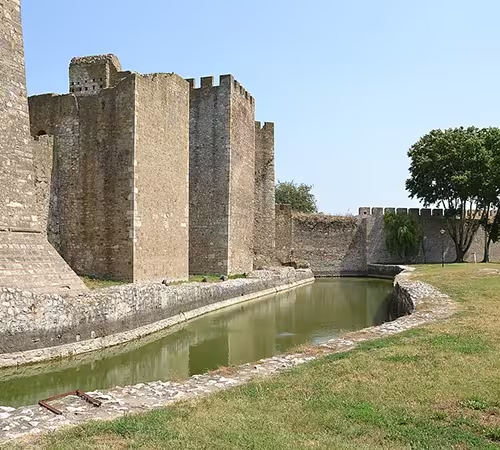
The fortress of Smederevo. @ Pudelek, CC BY-SA 3.0 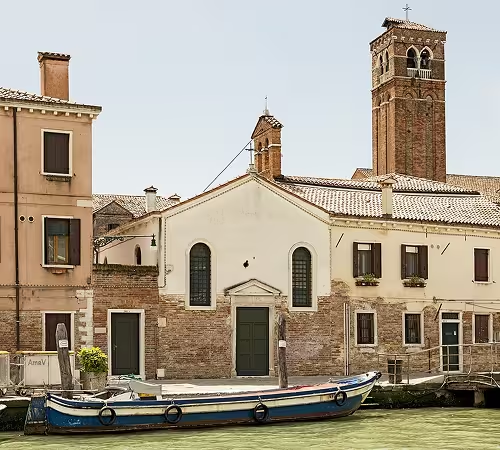
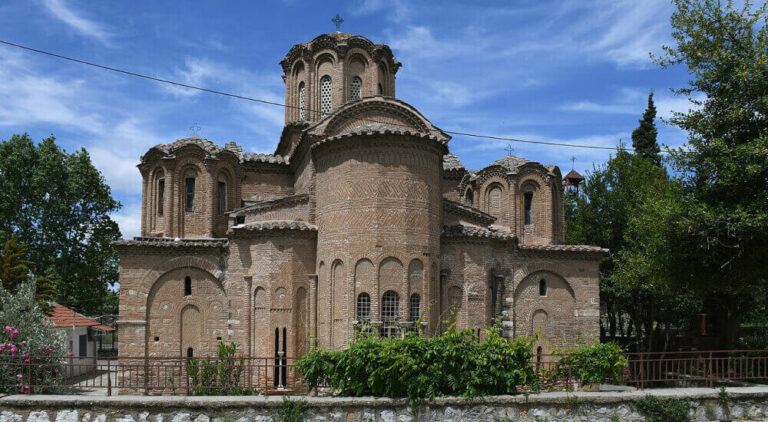
San Giobbe Church in Venice. @ Didier Descouens, CC BY-SA 4.0
The body stayed in San Giobbe for more than five centuries. In December 1986, after it had been identified as that of Luke of Steiris, a delegation of the Metropolis of Thebes and Levadeia received it in Venice and brought it back to the monastery on 13 December, a date now kept as a third feast there (see a picture of the translation). The return did not settle every question: the monastery of Philotheou on Mount Athos also venerated a head attributed to the saint.
Frequently asked questions
Is Saint Luke of Steiris the same as Luke the Evangelist?
No. Luke of Steiris was a 10th-century hermit of central Greece, called “the Younger” to distinguish him from the Evangelist. The two were nonetheless confused: his body was venerated in Serbia and Venice as the Evangelist’s until it was identified and returned to Greece in 1986.
When did Saint Luke of Steiris live?
He was born before 900, probably in 896, at Kastorion in Phocis, and died on 7 February 953 near Steiris, where the Monastery of Hosios Loukas grew around his tomb.
What did Saint Luke prophesy?
His most famous prophecy announced that an emperor named Romanos would retake Crete from the Arabs. Nikephoros Phokas reconquered the island in 961, in the reign of Romanos II.
How do we know about his life?
Through an anonymous Life in 87 chapters, written by one of his disciples after 961, probably under Basil II. Symeon Metaphrastes later produced a shorter version.
Where are his relics today?
In the Katholikon of the Monastery of Hosios Loukas, near Delphi. They were returned on 13 December 1986 from the church of San Giobbe in Venice, where they had been kept since 1463.
When is his feast day?
7 February, the day of his death. His monastery also celebrates the translation of his relics on 3 May and their return from Venice on 13 December.
Sources and further reading
- Connor, Carolyn L., and W. Robert Connor. The Life and Miracles of Saint Luke of Steiris: Text, Translation and Commentary, Hellenic College Press, Brookline, 1994.
- Kremos, Georgios P. Phokika, vol. I, Athens, 1874.
- Patrologia Graeca 111, cols. 441–480 (Metaphrastic Life); E. Martini, “Supplementum ad Acta S. Lucae iunioris”, Analecta Bollandiana 13, 1894, pp. 81–121.
- Kazhdan, Alexander, and Nancy Patterson Ševčenko. “Loukas the Younger”, in The Oxford Dictionary of Byzantium, vol. 2, Oxford, 1991, p. 1254.
- Oikonomides, Nicolas. “The First Century of the Monastery of Hosios Loukas”, Dumbarton Oaks Papers 46, 1992, pp. 245–255.
- Connor, Carolyn L. Art and Miracles in Medieval Byzantium: The Crypt at Hosios Loukas and Its Frescoes, Princeton University Press, 1991.
- Chatzidakis, Nano. Hosios Loukas, Melissa, Athens, 1997.
- Starodubcev, Tatjana. “Saint Luke of Steiris in the Exonarthex of the Church of the Treskavac Monastery and His Cult and Representation in the Middle Ages”, Zbornik radova Vizantološkog instituta 56, 2019, pp. 171–195.
- Popović, Danica. On the relics of St Luke in Smederevo and Venice.

One Comment