Byzantine Civil Architecture: The buildings of everyday life
Byzantine architecture is remembered through its churches, because churches survived. But the Byzantines also bathed, drank water brought from far away or stored in cisterns, lived in houses, traded in harbours and were treated in hospitals, and almost none of those buildings has come down to us intact. Many began as Roman buildings and systems, which the Byzantines inherited, adapted and, in many cases, let decay. This guide covers the civil buildings and infrastructure of the empire by type, from Constantinople to the towns and villages of Greece and Anatolia, shows what survives and where to see it, and explains who built each kind of building and why. The line between civil and religious is partly a modern one: baths and hospitals were often run by monasteries, cisterns stood beside churches, and palaces had their own chapels. Here, “civil” means everything not built mainly for worship or war. For the story of the cities themselves, see Byzantine cities.
At a glance
Period
4th to 15th century
Patrons
Emperors, cities, bishops, monasteries, private owners
Building types
Forums and monuments, aqueducts and cisterns, baths, houses, hospitals, harbours, markets, bridges
What survives
Mostly structures tied to churches and monasteries, large infrastructure, and house foundations
Key sites
Valens Aqueduct, Basilica Cistern, Yenakapi (Istanbul), Thessaloniki bath, Athenian Agora, Mystras, Monemvassia
Where
Istanbul, Thessaloniki, Athens, Mystras, Monemvasia, Anatolia
Why so little survives, and how we know
Most Byzantine civil buildings were made of brick, rubble and timber, and cities were rebuilt on top of earlier ones. Many lie under Istanbul, Thessaloniki or Athens; earthquakes, fires, the sack of 1204 and the urban reshaping of Constantinople and other major cities under Ottoman rule destroyed others. What survives mostly does so because someone kept using it: churches, monasteries and the buildings attached to them, and infrastructure too large to remove. That is why so many surviving baths and cisterns are monastic, and why the line between civil and religious is so hard to draw. We know the rest from texts such as Procopius’ Buildings, a panegyric of Justinian’s projects, from excavations such as the Athenian Agora, and from chance finds such as the harbour at Yenikapi.
Who built what, and for whom
| Period | Building and patronage |
|---|---|
| Late antiquity (4th to 6th century) | Public life: forums, baths, hippodromes, aqueducts, built and paid for by emperors, the state and civic patrons |
| Transition (7th to 9th century) | Plague, invasions and the cutting of the Valens Aqueduct in 626; little new civil building, and defence comes first |
| Middle (9th to 12th century) | More private and inward-looking; the home and family dominate; baths, docks, warehouses, hospitals and orphanages are often controlled by monasteries |
| Late (13th to 15th century) | Little public building; the Palace of the Despots at Mystras takes the only large terrace on the hillside |
For how cities themselves changed (size, defences, streets, the move from public to private life), see Byzantine cities.
Imperial and civic monuments
The forum, called the agora in Greek, was the centre of public life in many Byzantine cities and large towns. It was usually laid out as a rectangle, though other forms are known: the Forum of Constantine in Constantinople was oval, and Justiniana Prima had a circular one. It was lined with porticoes, dominated by important religious, civic and commercial buildings, and often embellished with imperial statues, honorific columns, monumental arches and nymphaea. Besides the seven major forums of the capital, forums remained part of the urban scene at Philippi and Thessalonike beyond the 5th century. A decree of 383 forbade building inside forums, but it was not long before new construction encroached on those of most cities, and the process accelerated afterwards, although the word stayed in use. The same process is visible in the Athenian Agora, where Byzantine houses and workshops were built over the ancient square (see below).
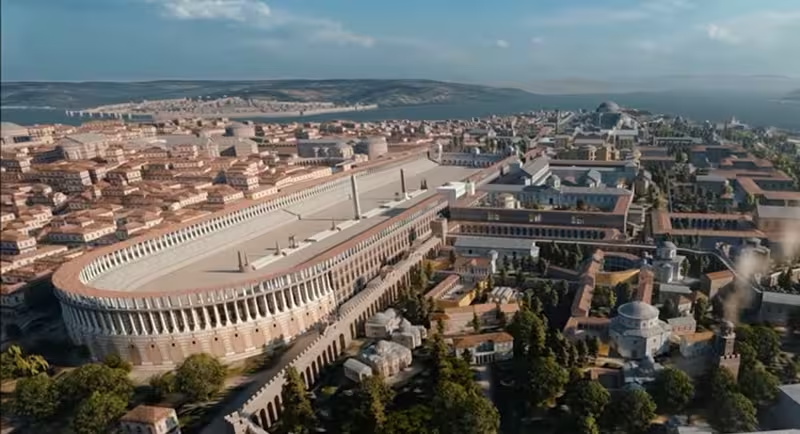
In late antique and early Byzantine cities the forum, the column and the hippodrome were the public stage. In Constantinople the stage was the Mese, the central avenue that started at the Milion, the milestone from which distances in the empire were measured, in front of Hagia Sophia, and ran through a chain of forums: that of Constantine, which was circular, then those of Theodosius (Tauri), Amastrianum, Bovis and Arkadios, all adorned with columns, arches and statues, many of them pagan. Churches, monasteries, baths, palaces and mansions stood along it; it was also the city’s main commercial street, and the road of imperial processions and triumphs, which entered by the Golden Gate and paraded to Hagia Sophia, with the guilds obliged to decorate the street and clean it.
Monumental arches and honorific columns continued Roman practice. The arch of Theodosius I in the Forum Tauri, built around 390, is the only freestanding Byzantine triumphal arch known; reconstructed as a triple arch about 43 metres wide, it was never fully excavated. A variant, the tetrapylon, with four arches around a square under a vault or dome, appears at the Arch of Galerius in Thessalonike, and the Milion was a domed tetrapylon; arches also served as city gates. Honorific columns were of two kinds: the monolithic shaft, as in the porphyry Column of Constantine and the Column of Marcian, which both still stand in Istanbul, and the spiral-relief column modelled on Trajan’s in Rome, as for Theodosius I and Arkadios, of which only fragments or drawings survive. The practice was abandoned after the 6th century and revived once, by Michael VIII, whose column near the Church of the Holy Apostles carried a bronze archangel Michael and the emperor offering him a model of the city. Other monuments stand in the Hippodrome, the Obelisk of Theodosius and the Serpent Column from Delphi; many are lost, such as the bronze equestrian statue of Justinian on a column in the Augustaion, described by Procopius.
Hippodromes were not a capital monopoly. They existed in many cities of the empire, but all went out of use after the 6th or 7th century – except in Constantinople, where it remained one of the beating heart of the empire. Evidence is mostly written: papyri, inscriptions and histories describe the circus factions, the Blues and the Greens, in Alexandria, Antioch, Ephesus and other cities, rather than the buildings.
An average hippodrome measured about 450 by 70 metres and took about five years to build. From the 4th century they were usually built inside the walls and next to the imperial residence, as a setting for court ceremonial and for the ruler’s appearance before his subjects; apsidal buildings next to the hippodromes of Sirmium, Milan and Thessalonike suggest an imperial loge, so that the hippodrome became in effect part of the palace.
Emperors also built to be seen as builders: Procopius’ Buildings praises Justinian’s churches, fortresses, aqueducts and bridges across the empire. See Byzantine imperial palaces.
Water: Aqueducts and cisterns
Byzantine cities did not invent their water systems; they inherited them from Rome. An aqueduct was an essential element of a large Roman city, bringing water for baths, fountains and public use from far away, mostly through underground pipes or open channels that fell gently from the source; the arches we see usually made up less than a tenth of the total length. Rome itself was supplied by 19 aqueducts, of which 14 still worked when the Goths cut them in 537. In the East, large provincial towns, such as those of Cilicia, were supplied by aqueducts too. Most of these provincial systems were destroyed during the troubles of the 7th century, after which cisterns became the main source of water for reduced populations.
Constantinople inherited the principle and scaled it up. It had no rivers, few springs and fast rainwater runoff, so it needed reservoirs to last through dry spells and long sieges, when aqueducts might be cut. Its original main supply came from Halkali, about 15 km north-west of the city, through a Roman aqueduct best known by the name of Valens, who restored or completed it in the late 4th century (older accounts attribute the original line to Hadrian). In the late 4th century the network was extended more than 100 km to the west to serve the growing population. Research by James Crow and colleagues has shown that, with its branches, the system was the longest known in the ancient world, around 592 kilometres by Crow’s calculation. Water was held in cisterns inside the city: open-air reservoirs such as those of Aetius and Aspar, and covered ones such as the Basilica Cistern. The most recent count attributes at least 211 cisterns to the Byzantine city, most of them built between the late 4th and early 7th centuries. The Avars cut the Valens Aqueduct during their siege of 626, which was long taken to mark urban decline; it was rebuilt in the 760s (dates of 758 and 765 are both given) and restored several times until the 12th century, and Crow and Richard Bayliss argue that only part of the system was abandoned. When the aqueducts failed, smaller cisterns that collected rainwater became more important.
Outside the capital, cisterns mattered just as much, above all where springs and rivers were scarce, and after the 7th century they often replaced the Roman aqueducts that had once served provincial towns. There they were often a village or monastery technology rather than an imperial one. On the rock of Monemvasia, a cistern survives near the church of Agia Sofia in the upper town. In Thessaloniki’s Upper Town, a Byzantine cistern stands near the bath described below. In southern Anatolia (Lycia, Pamphylia, Isauria and Cilicia), recent fieldwork shows that villages built cisterns in the settlement core, in streets, alleys and open spaces, and beside churches, houses and olive-oil and wine workshops; this is an area that has been little studied. Rainwater from monastery roofs may have fed some cisterns.
In focus: the Valens Aqueduct and the Basilica Cistern
The Valens Aqueduct still carries its arches, about 970 metres of them between the third and fourth hills of Istanbul, and they show much Byzantine repair work. The Basilica Cistern (Yerebatan Sarayı) is the best-known covered cistern: its 336 columns, 8 metres high and set in 12 rows of 28, support a chamber that held about 78,000 cubic metres. It is far from the largest: the open cistern of Aetius, built in 421, measured 244 by 85 metres and about 14 metres deep, and held between 250,000 and 300,000 cubic metres. The Binbirdirek cistern (Philoxenos) has 224 columns, set in 16 rows of 14, with superposed shafts reaching 12.4 metres. Using columns rather than the brick and cement piers of the Romans reduced maintenance costs, and the structures were lined with hydraulic cement. The major cisterns, usually placed on hills, supplied about 40 public baths as well as monasteries and churches.

Baths
Baths were an important part of late Roman urban culture, centres of leisure and social life. In the 5th century Constantinople had as many as nine public and 153 private baths, according to the Notitia urbis Constantinopolitanae, the most famous being the Baths of Zeuxippos. They had separate facilities for men and women, interiors decorated with marble and statues, and heating by hypocausts. Even clergy and monks used public baths, which were occasionally decorated with Christian subjects, although the church regarded them as centres of immorality, forbade mixed bathing and condemned frequent visits by clergy.
After the 6th century the picture changed. Most of the huge public baths fell into disuse, because of population decline or the cost of upkeep; some were destroyed and others were turned into churches or barracks, although some kept working in the major cities. Bathing was no longer a normal part of everyday life but a luxury or a hygienic necessity. Monastic rules of the 11th and 12th centuries prescribed bathing from twice a month to three times a year, with once a month the norm. In the early 11th century the town of Servia in Macedonia had only one bath, outside its walls, and a Byzantine writer describes a provincial bath as a smoky, draughty hut heated by an open hearth; the sumptuous bathhouse of Leo VI is the exception. Baths also became associated with healing: sick monks and patients in monastic hospitals were allowed more frequent or even unlimited bathing. Few baths of the period have been excavated, for example at Sparta and Trikkala, and they continued Roman planning, with a series of vaulted or domed rooms for dressing and for cold, warm and hot bathing. Monastic baths form a distinctive category and continued to be built throughout the Byzantine era, and many of the baths that survive are monastic for another reason too: monasteries kept their buildings in use.
In focus: the Byzantine Bath of Thessaloniki (13th century)
In the Upper Town of Thessaloniki, a bath dated to the 13th century (some accounts say late 12th or early 13th) has three rooms, cold, tepid and hot, the last under a dome. Byzantine sources do not mention it, and it was probably part of a monastery. In Ottoman times it became the “Paradise Baths”, which stayed in use until 1940 and explains why it survives. A second example, a 14th-century double bath, is known from Theotokopoulou Street in the same city.

In focus: monastic bathhouses at Kaisariani, Daphni and Dervenosalesi (11th century)
At Kaisariani, near Athens, the monastery’s bathhouse, originally a triconch building with a semicircular dome and an air-duct heating system, survives beside the 11th-century church; similar baths survive at Daphni and, in ruins, at the monastery of Zoodochos Pigi at Dervenosalesi on Mount Cithaeron. Under Ottoman rule the Kaisariani bath became an olive-oil press, a reminder of how civil buildings were reused. See our article on the monastery of Kaisariani. Beyond Greece, an excavated bathhouse in the lower city of Amorium in central Anatolia was reduced to its hot and warm rooms when the city was destroyed in 838.
Houses, neighbourhoods and streets
Houses are the least visible part of the Byzantine city: private, built of rubble and timber, and rebuilt again and again, they survive mostly as foundations. In the late Roman world they took two main forms: the insula, an apartment building, and the domus, a private house around a courtyard with a bath, kitchen, plumbing and storerooms. At Ephesus, two insula-type buildings, with vaulted shops on the ground floor and modest rooms above, were remodelled many times between the 1st and 7th centuries, and written sources mention ‘five-roofed’ houses (pentorophoi) in Constantinople and complaints about neighbours keeping pigs on upper floors. By the 7th century the focus of the house had shifted from the courtyard to a gallery on the upper floor, where guests were received. Building laws, preserved in the Code of Justinian, kept houses at least 12 Greek feet apart, protected neighbours’ daylight and views of the sea, and forbade balconies over streets narrower than 12 feet and staircases from the street to the balcony, as a fire hazard and an obstruction.
From about the year 1000, excavated town houses at Corinth, Athens, Pergamon, Thebes and Euripos (Chalkis) show two common plans: a rectangular building around a central open space without a colonnade, whose ground floor held storerooms with large storage jars, stables and workshops, with the living quarters upstairs; and a house with no courtyard or only a narrow one in front of the facade. Construction was poor, with frequent reuse of ancient material, and rooms were small and irregular, along narrow alleys with no obvious planning. In many older cities the main streets of late antiquity kept functioning while new patterns of growth appeared among the ruins, and houses tended to turn away from the street towards courtyards.
In focus: the Athenian Agora (7th to 13th century)
Since the 1930s, excavations in the Athenian Agora have uncovered a densely inhabited part of Byzantine and Frankish Athens, with hundreds of houses, workshops, roads and burials, much of it still unpublished. The area became residential at the end of the late Roman period, and study of Early Byzantine wells shows it was not deserted, as once thought. Habitation then expanded in the 10th to 12th centuries, with close-packed blocks of small houses and workshops, including dyeing and glass production, built over the ruins of the Classical Agora. North of the Agora, a settlement of the 10th and 11th centuries grew over the Stoa Poikile, with roads, houses and large storage jars; in the sections excavated, it was largely abandoned again at the start of the 13th century. The 11th-century Church of the Holy Apostles still stands at the south-east corner of the Agora. See Byzantine Athens.
In focus: Corinth, Pergamon and Mystras
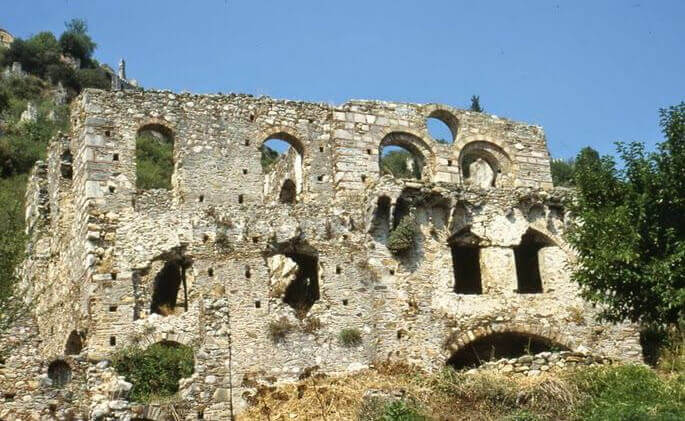
At Corinth, excavated medieval houses have courtyards with wells and ovens surrounded by rooms and storerooms. A reconstruction of a Byzantine neighbourhood at Pergamon in western Anatolia shows houses turned away from the street. At Mystras the upper and lower towns have streets that are often little more than footpaths, too steep for wheeled vehicles, houses needed heavy substructures, and the only large terrace was given to the Palace of the Despots; markets were probably outside the walls. See our Mystras guide.
In focus: mansions, village houses and what written sources add
Written sources fill some gaps. In 1077 Michael Attaleiates described his mansion in Constantinople in his foundation charter: several buildings around a common courtyard, each with a ground floor and an upper floor projecting over the courtyard, a chapel, and a three-storey dwelling with a donkey-driven mill on the ground floor.
A purchase deed of 1320 for a house in Thessalonike describes a stone and brick house covered with tiles beside a two-storey building with a thatched roof. Wealthy houses had separate quarters for women, usually in the inner part. In the countryside houses were modest, built of wood, unbaked brick or even reeds, with one or two rooms, earthen floors and an open hearth, and a Byzantine writer describes village houses of reeds plastered with mud and thatched. In sharp contrast, the mansions of wealthy landowners, like that of the epic hero Digenes Akrites, were surrounded by gardens and defended by walls and towers. Decoration was usually simple, but the grandest buildings could have polychrome facades, arcades and balconies, as at the Tekfur Sarayı in Constantinople, or niches and blind arcades, as at Mystras.
Hospitals, hostels and charity
Care for the sick and poor was a religious duty, so almost all Byzantine hospitals, hostels (xenones) and leprosaria were founded and run by churches, monasteries or pious individuals, rather than by cities or the state. Early charities were attached to churches or monasteries and run by monks. The Basileias, founded around 372 by Basil, bishop of Caesarea in Cappadocia, is often called the first hospital-like complex; it had doctors and a leprosarium. Early documentation is controversial and scholars define the term hospital differently: Timothy Miller argues for medical institutions as early as the 6th century, while a more cautious view holds that fully operational hospitals for the sick existed in the major cities only by the 9th or 10th century. Known examples include the hospital of the Great Lavra on Mount Athos (10th century), the Sampson Xenon and the Lips monastery (14th century) in Constantinople; victims of leprosy were treated in specialised hospitals. In the Middle Byzantine period, hospitals and orphanages were frequently controlled by monasteries.
In focus: the Pantokrator Xenon in Constantinople (1136)
The best-documented example is the hospital of the Pantokrator Monastery, founded by John II Komnenos in 1136; its founding charter, the typikon, survives and describes it in detail.
The hospital was part of the monastery and run through its administration. It had fifty beds in five wards divided by diagnosis, including one for wounds and fractures and one for women, which had a female physician (iatraina); each patient had a mattress, pillow and sheets. An outpatient clinic was staffed by two surgeons and two physicians, and the staff included five pharmacists who compounded drugs on the doctors’ orders, an ophthalmologist, a specialist surgeon for hernia repair, and an attendant who kept the surgical instruments sharp and clean. Its imperial funding set it apart from foundations that relied on church revenues and donations.
Read our article on the Pantokrator Monastery, and see Byzantine monasteries and the clergy.

Harbours, markets and bridges
Ports were among the most important civil structures, yet harbour building was often modest. Because Byzantine ships were small and their keels could be lifted, a natural harbour, such as a sheltered bay or a sandy bank on which to drag boats, was preferred to a complicated system of construction, and the jagged coasts of the Aegean, Cilicia, the western Balkans and the Black Sea offered plenty of them: even individual monasteries, as on Mount Athos, had their own. Larger ports had more equipment: piers and landing stages, shipyards, breakwaters, lighthouses and, in some cases, chains to close the bay, as at Constantinople and Thessalonike. Their walls ran down to the sea to prevent attack by hostile warships, and harbour dues regulated their use. Construction continued in late antiquity: Seleukeia Pieria, Alexandria, Patras, Methone, Aegina and Caesarea Maritima were cleared or rebuilt. After the 7th century there are few references to harbour building; in some places the threat of pirates moved the city centre from the shore to a hill, and when dredging stopped an estuary could turn into a swamp. The major seaports after the 7th century were Constantinople, Thessalonike, Corinth, Monemvasia, Patras, Abydos, Smyrna, Ephesus (though its port declined due to natural factors), Miletos, Attaleia, Dyrrachion, Herakleia in Pontos, Trebizond and Cherson; from the 11th century Venetian and Genoese colonies were founded in some of them.
The best-explored harbour is Constantinople’s Theodosian Harbour at Yenikapi, built in the late 4th century. Excavations during the Marmaray railway works, from 2004 to 2013, uncovered 37 shipwrecks of the 5th to 11th centuries, galleys and merchant ships among them. The harbour silted up because of the Lykos river and now lies about 300 metres from the shore. Read about recent finds in our archaeology news.
Markets
The Byzantine word for a market, agora, also meant the transaction itself, and markets could be permanent, occasional or periodic: the Book of the Eparch refers to established market days, and another term, pharos, could mean a market held on a single occasion. Cities had districts where commercial activity was concentrated. In Constantinople the main market ran along the Mese, with workshops of jewellers, candlemakers, fur-merchants and bakers, and the Makros Embolos linked the bakers’ quarter to the harbours of the Golden Horn. For much of Byzantine history the state regulated the prices of important goods; its role decreased in the Palaiologan period and probably already in the 11th and 12th centuries. At Mystras the markets were probably outside the walls. See our articles on the market and bridge of Saint Basil at Arta [add the two article URLs].
Bridges
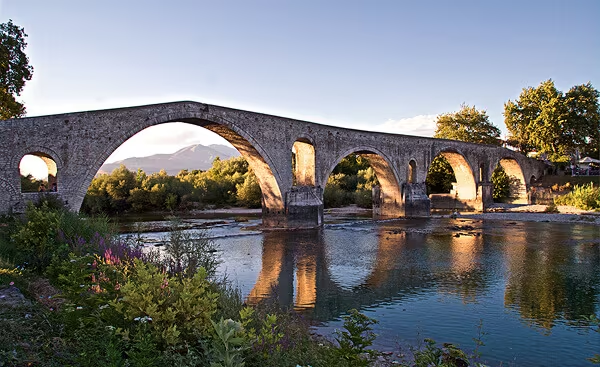
The Byzantines inherited the technique of bridge building from the Romans, using stone, brick or timber set in concrete, with arches resting on piers, the same technique as for aqueducts; the approaches were sometimes fortified with towers. Late Roman projects were grandiose: Constantine I’s bridge over the Danube between Oescus and Sucidava was 2,437 metres long, and Justinian’s bridge over the Sangarios, mentioned by Procopius, still stands. In emergencies, pontoon bridges of boats bound together were used. In the 11th century a special tax, the gephyrosis, was imposed for the maintenance and repair of bridges, and in the 12th century the monastery of Kosmosoteira was obliged to maintain two local stone bridges, a duty its typikon justified by noting that bridges are useful to many people. In late Byzantine times, the despot of Epirus commissioned the construction of the Bridge of Arta in his capital. Although it remains unclear to what extent the surviving structure is Byzantine, it was one of the largest bridge projects of this scale in the last centuries of Byzantium.
-
The Bridge of Arta: History, Legend and Architecture
The Bridge of Arta is Greece’s most famous stone bridge — celebrated for its Byzantine and Ottoman architecture and the haunting legend of the master builder’s wife.
Palaces and fortifications
Imperial and provincial palaces have their own guide: Byzantine imperial palaces, with articles on the Great Palace, Nymphaion and Ephesus. Walls and castles are covered in Byzantine fortifications and the Theodosian Walls.
Where to see it
See also our Istanbul, Mystras and Thessaloniki guides.
| Place | What to look for |
|---|---|
| Istanbul | Valens Aqueduct, Basilica Cistern, the Hippodrome monuments, the Columns of Constantine and Marcian, the Golden Gate, the Pantokrator Monastery (Zeyrek Camii) |
| Istanbul Archaeological Museums | Finds from the Yenikapi harbour excavations |
| Thessaloniki | The Byzantine Bath in the Upper Town, the Arch of Galerius |
| Kaisariani and Daphni, Attica | Monastic bathhouses |
| Athens | The Church of the Holy Apostles at the Agora; the excavated Agora |
| Monemvasia | Cisterns near Agia Sofia in the upper town |
| Mystras | The Palace of the Despots and the ruined hillside town |
| Amorium, Turkey | The excavated bathhouse (check access) |
Frequently asked questions
What is Byzantine civil architecture?
The buildings and infrastructure not built mainly for worship or war: palaces, public monuments, baths, houses, cisterns, aqueducts, hospitals, harbours, markets and bridges. The line with religious architecture was blurred.
Why do so few Byzantine houses and public buildings survive?
They were built of brick, rubble and timber, reused or rebuilt, and many lie under modern cities. Buildings tied to churches and monasteries survived best.
Did the Byzantines have public baths?
Yes, inherited from Rome, but the huge public baths mostly fell out of use after the 6th century. Later baths were smaller and bathing was less frequent, and many of those that survive were part of monasteries.
How did Byzantine cities get water?
Through aqueducts and cisterns. Where water was scarce, cisterns that collected rainwater were essential in villages and monasteries as well as in Constantinople.
Who ran Byzantine hospitals?
Mostly churches, monasteries and pious individuals. The Pantokrator Xenon was an imperial foundation but still part of a monastery.
Where can I see Byzantine civil architecture?
In Istanbul, Thessaloniki, Attica, Athens, Monemvasia and Mystras, among other places.
What was a Byzantine agora?
The agora, or forum, was the centre of public life in many cities: a square, usually rectangular, lined with porticoes and public buildings and decorated with statues, columns and arches. A decree of 383 forbade building inside forums, but most were gradually built over, although the word stayed in use.
Further reading
- Eastern Medieval Architecture: The Building Traditions of Byzantium and Neighboring Lands, Robert G. Ousterhout (Oxford University Press, 2019): chapters on secular architecture in each period.
- The Water Supply of Byzantine Constantinople, James Crow, Jonathan Bardill and Richard Bayliss (Society for the Promotion of Roman Studies, 2008): the definitive study of aqueducts and cisterns.
- The Birth of the Hospital in the Byzantine Empire, Timothy S. Miller (Johns Hopkins University Press, 1985; reprinted 1997): for hospitals and charity.
- Constantinople: Capital of Byzantium, Jonathan Harris (Bloomsbury; check the current edition): a readable history of the city.
- Robert Ousterhout’s free chapters, Middle Byzantine secular architecture and urban planning and Late Byzantine secular architecture and urban planning, on Smarthistory.
- The Oxford Dictionary of Byzantium, Alexander Kazhdan, ed. (Oxford University Press, 1991): the entries on aqueducts, baths, bridges, cisterns, hippodromes, hospitals, houses, markets, the Mese and ports are a concise starting point.