Empress Theodora: The actress who ruled Byzantium
No woman in Roman history travelled further than Theodora (c. 495–548). She was born to a bear-keeper of the Constantinople circus, worked the stage in an age when actresses ranked legally beside prostitutes, and died Augusta of the Roman Empire — co-ruler in practice, and in some matters more than that, beside Emperor Justinian I. Contemporaries could not decide whether she scandalised or awed them. Her enemies wrote the most venomous character assassination to survive from antiquity; her husband wrote her name into the laws of the empire. When she told a room full of panicking ministers that she would rather die an empress than live as a fugitive, she saved Justinian’s throne — and with it, arguably, the whole shape of the early Byzantine age.
About this Theodora: this article covers Theodora (c. 495–548), wife of Justinian I — the most famous of several Byzantine empresses who bore the name. The 9th-century Theodora who ended iconoclasm and the 11th-century Theodora Porphyrogenita, last of the Macedonian dynasty, will each be covered separately.
Theodora at a glance
Lived: c. 495 – 28 June 548
Reigned: Augusta from 527, alongside Emperor Justinian I
Origin: daughter of a bear-keeper of the Hippodrome; former actress
Defining moment: the Nika riots of 532, when her resolve kept Justinian on the throne
Impact: laws protecting women; refuge for the persecuted miaphysite church
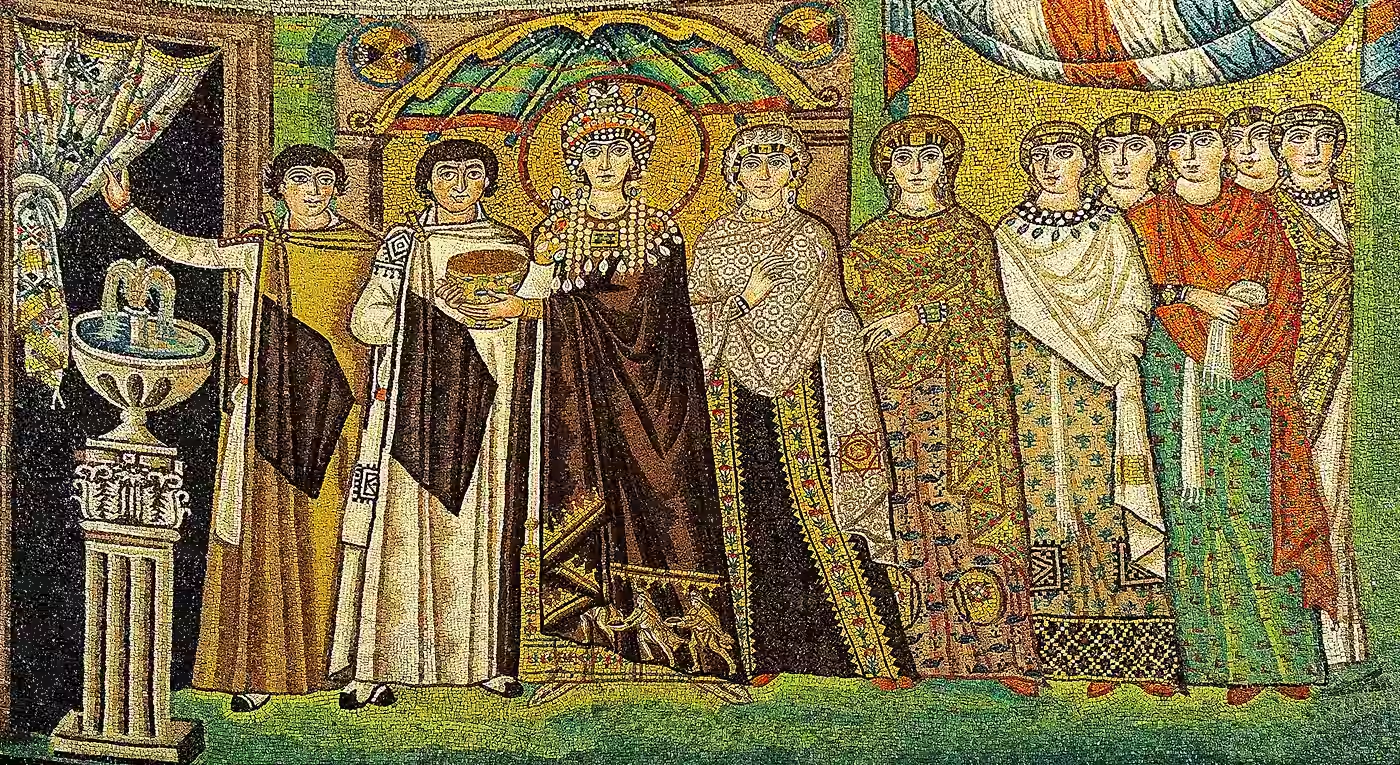
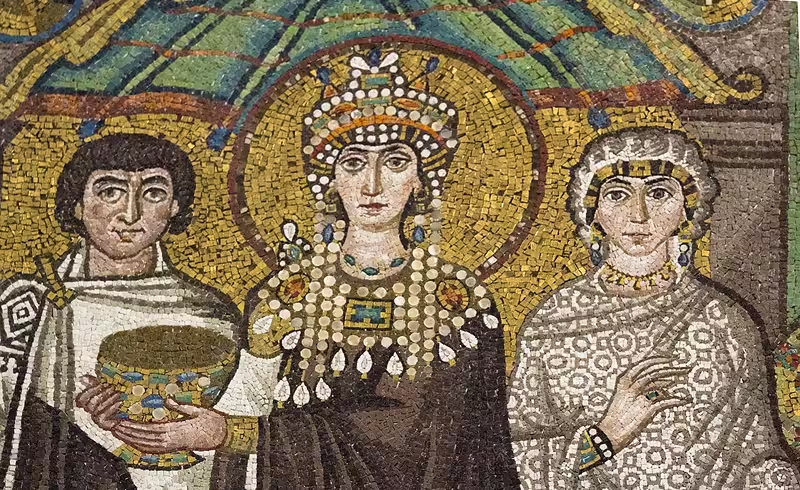
Portrait: the mosaic panel in San Vitale, Ravenna — completed c. 547
Main sources: Procopius (both his official histories and the hostile Secret History)
Credits Roger Culos, CC-by-SA 3.0
A childhood in the Hippodrome
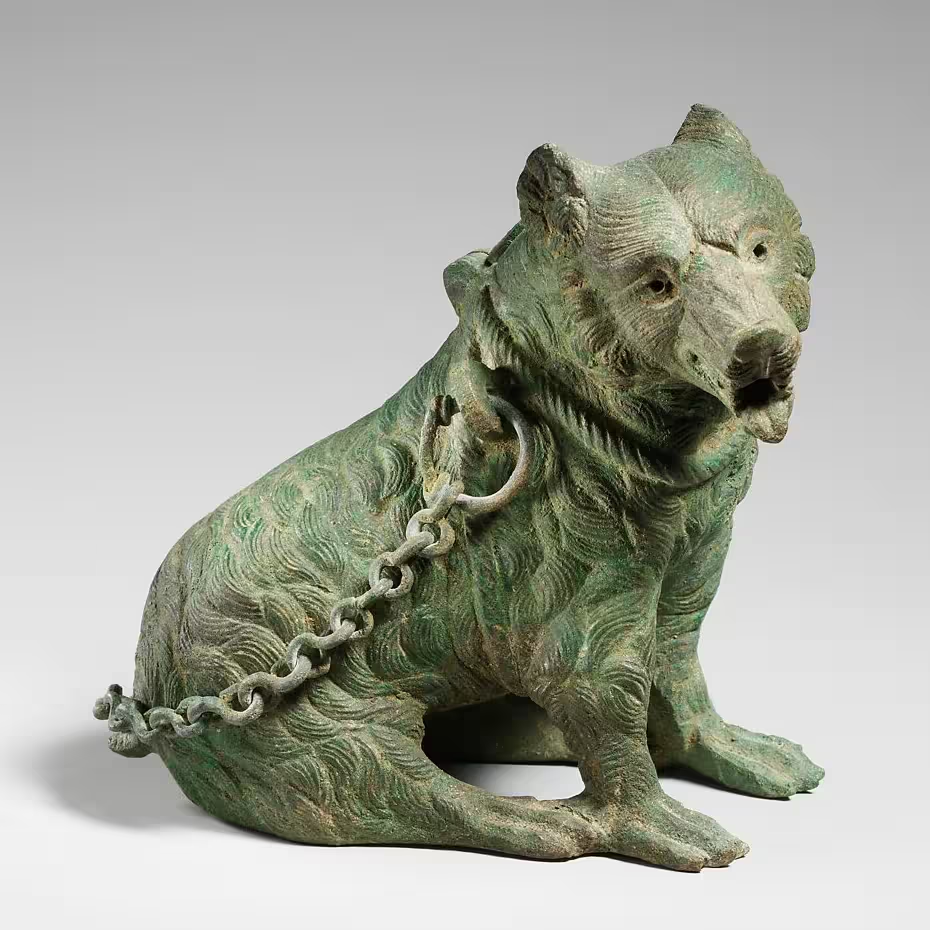
Theodora was born around 495, probably in Constantinople, into the underworld of the circus. Her father Acacius kept the bears for the Green faction — one of the two great sporting-political organisations, Blues and Greens, whose rivalry structured popular life in the capital.
When Acacius died, Theodora’s mother paraded her three small daughters, garlanded, before the crowds of the Hippodrome to beg that her new husband inherit the bear-keeper’s post. The Greens laughed them off. The Blues, sensing an opportunity for a gesture, took the family in.
Theodora never forgot either half of that day. Her lifelong loyalty to the Blues — and her lifelong instinct for the theatre of power — began in that arena. The little girl rejected by one faction would one day watch, from the imperial box of the same Hippodrome, as the factions who made and unmade her family’s fortunes were broken by her own resolve.
The stage, the scandal, and the journey back
Like her older sister before her, Theodora went onto the stage — which in sixth-century Byzantium meant burlesque, mime and pantomime, a profession so disreputable that Roman law barred actresses from marrying men of senatorial rank. Procopius’ Secret History goes much further, claiming she worked as a prostitute from childhood and recounting her alleged exploits in obscene, gleeful detail; how much is fact and how much is pornographic invective is impossible to untangle (see the Procopius problem below). What should be understood is that the distinction mattered less then than now: in Roman law and Roman eyes, the stage and the brothel stood side by side, and an actress was presumed sexually available by profession. What is certain is that she was famous, notorious, and determined to escape.
Still in her teens or early twenties, she left Constantinople as the companion of Hecebolus, newly appointed governor of the Libyan Pentapolis. He discarded her; stranded and penniless in North Africa, she made her way to Alexandria — then a stronghold of the miaphysites, the eastern Christians who rejected the Council of Chalcedon’s definition of Christ’s two natures and suffered periodic persecution for it. There, tradition holds, she came under the influence of the exiled patriarch Timothy and the great theologian Severus of Antioch. Whatever precisely happened in Alexandria, Theodora returned to Constantinople around 522 a changed woman: sober, devout, and permanently loyal to the persecuted church that had taken her in when the empire’s respectable society would not.
Meeting Justinian: a marriage against the law
Back in the capital, reportedly earning her living spinning wool in a house near the palace, Theodora met Justinian — nephew and heir-apparent of the reigning emperor Justin I, a Latin-speaking soldier’s son who had himself arrived in Constantinople as a peasant from the Balkans.
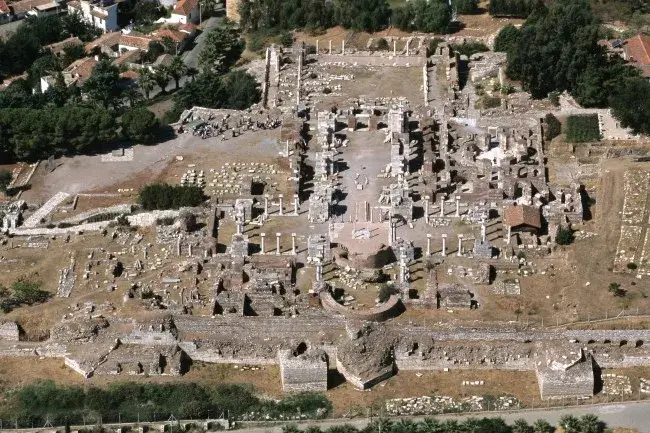
The attraction, by every account, was immediate and total. Justinian wanted to marry her; the law said he could not. An imperial edict of Justin, almost certainly procured by his nephew, created a path: a repentant former actress could petition to be restored to full legal honour. Around 525, in Hagia Sophia — the older basilica that preceded Justinian’s great church — the bear-keeper’s daughter married the future emperor.
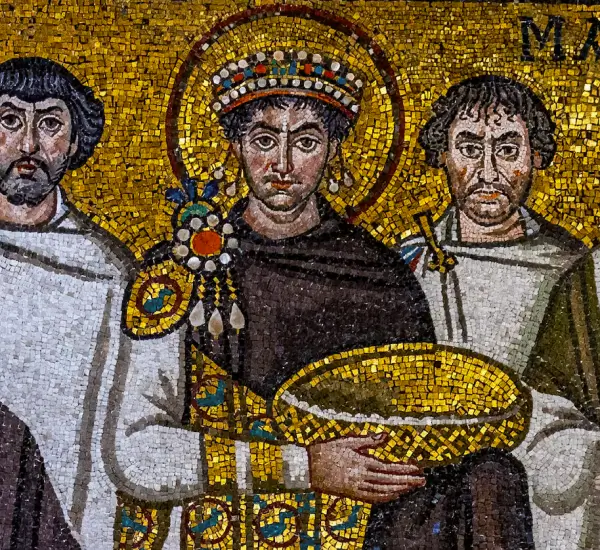
In April 527, Justin crowned Justinian co-emperor; Theodora was crowned Augusta beside him. Justinian did not treat her as a ceremonial consort. He called her, in his own legislation, his “partner in my deliberations” — a phrase without precedent in Roman law. Provincial officials swore their oath of office to both sovereigns by name. Foreign envoys learned to pay court to the empress as well as the emperor. Byzantium had known powerful imperial women before; it had never known an emperor who governed so openly in tandem with one.
The Nika riots: “royalty is a fine burial shroud”
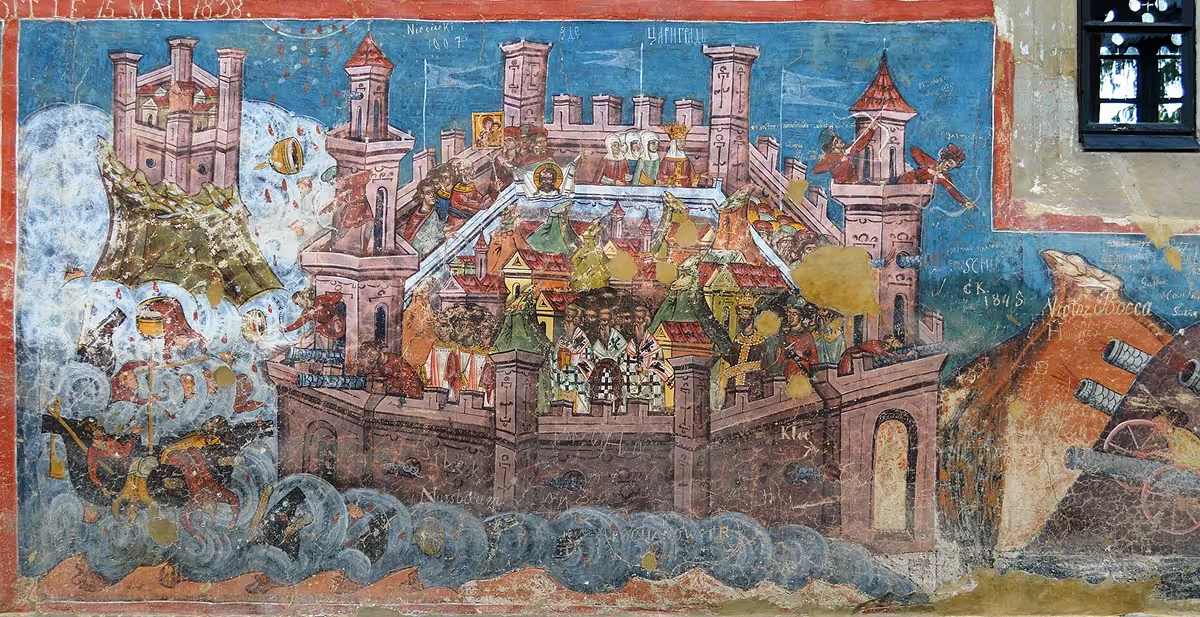
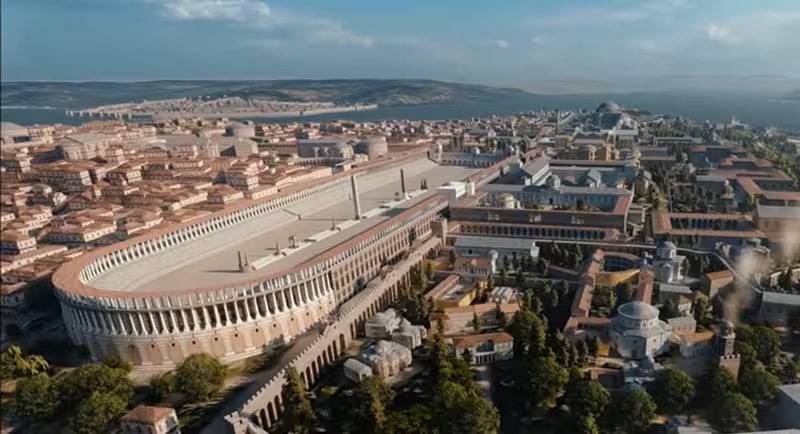
In January 532, the partnership faced annihilation. The Blues and Greens, briefly united against the government, turned a chariot-race protest into a full urban uprising — the Nika riots, from their chant of Nika, “conquer”. For days Constantinople burned, the first Hagia Sophia among the ruins. The mob crowned a rival emperor. Justinian’s ministers counselled flight; a ship stood ready at the palace harbour.
Procopius — no friend of Theodora — records what happened next. The empress rose in the council and refused to run. An old saying held that kingship makes a fine burial shroud; Theodora made it her own: “May I never be separated from this purple… If you wish safety, my Lord, that is easy. We are rich; there is the sea; there are the ships. But consider whether, once you have escaped, you would not gladly exchange that safety for death. As for me, I hold with the ancient saying: royalty is a fine burial shroud.”
The council held. Belisarius and Mundus led the troops into the Hippodrome, where the rioters had massed, and drowned the revolt in blood — the dead were reckoned in the tens of thousands, while the palace eunuch Narses split the factions with well-placed gold. It was the pivot of the reign. Everything that follows — the rebuilding of Hagia Sophia, the law codes, the reconquest of Africa and Italy that would fill Ravenna with mosaics — happened because the government did not board that ship. Whether the speech is verbatim or Procopius’ dramatisation, its substance was not doubted by contemporaries: it was the empress who refused to flee.
An empress at work
Theodora’s power was not a chronicler’s flourish; it left tracks in the empire’s laws and appointments for two decades.
Laws for women. The legislation of Justinian’s reign shows a sustained, unprecedented attention to the legal condition of women — and the emperor himself credited his consort’s counsel. Brothel-keepers were expelled from the capital and the buying of girls for prostitution attacked; a convent of “Repentance” (Metanoia) was endowed across the Bosphorus for women rescued from the trade — Procopius sneered at it, which is how we know it mattered. Divorce and property protections for wives were strengthened, the rights of daughters in inheritance improved, and rape was treated with new severity. Sixth-century Byzantium was no protofeminist state, but no Roman regime before it had legislated so consistently in women’s favour, and none would again for centuries.
Politics and patronage. Theodora made and unmade careers. She maintained her own network of informants, received foreign envoys, corresponded with courts abroad, and waged a long palace war against the finance minister John the Cappadocian — whose spectacular fall in 541 she engineered together with her closest ally, Antonina, the wife of Belisarius. Ambassadors, popes and generals alike understood that imperial power in Constantinople had two faces.
The enforcer. The other face of the partnership was darker, and it was usually hers. When Pope Silverius obstructed her plans to restore the deposed patriarch Anthimus, he was stripped of his office in occupied Rome, replaced with the more pliable Vigilius, and exiled to a barren island where he died of hunger — contemporaries had no doubt at whose instigation. The Secret History goes further, describing private cells beneath her quarters into which men who crossed her simply vanished: the general Buzes, it claims, spent more than two years in her dungeons without seeing daylight. Procopius’ details deserve the usual caution — but the pattern they dramatise is confirmed by the documented cases. Theodora was not only Justinian’s “partner in deliberations”; she was the regime’s enforcer, and the men of the court feared her for good reason. The same steel that saved the throne during Nika kept it safe, by uglier means, for twenty years.
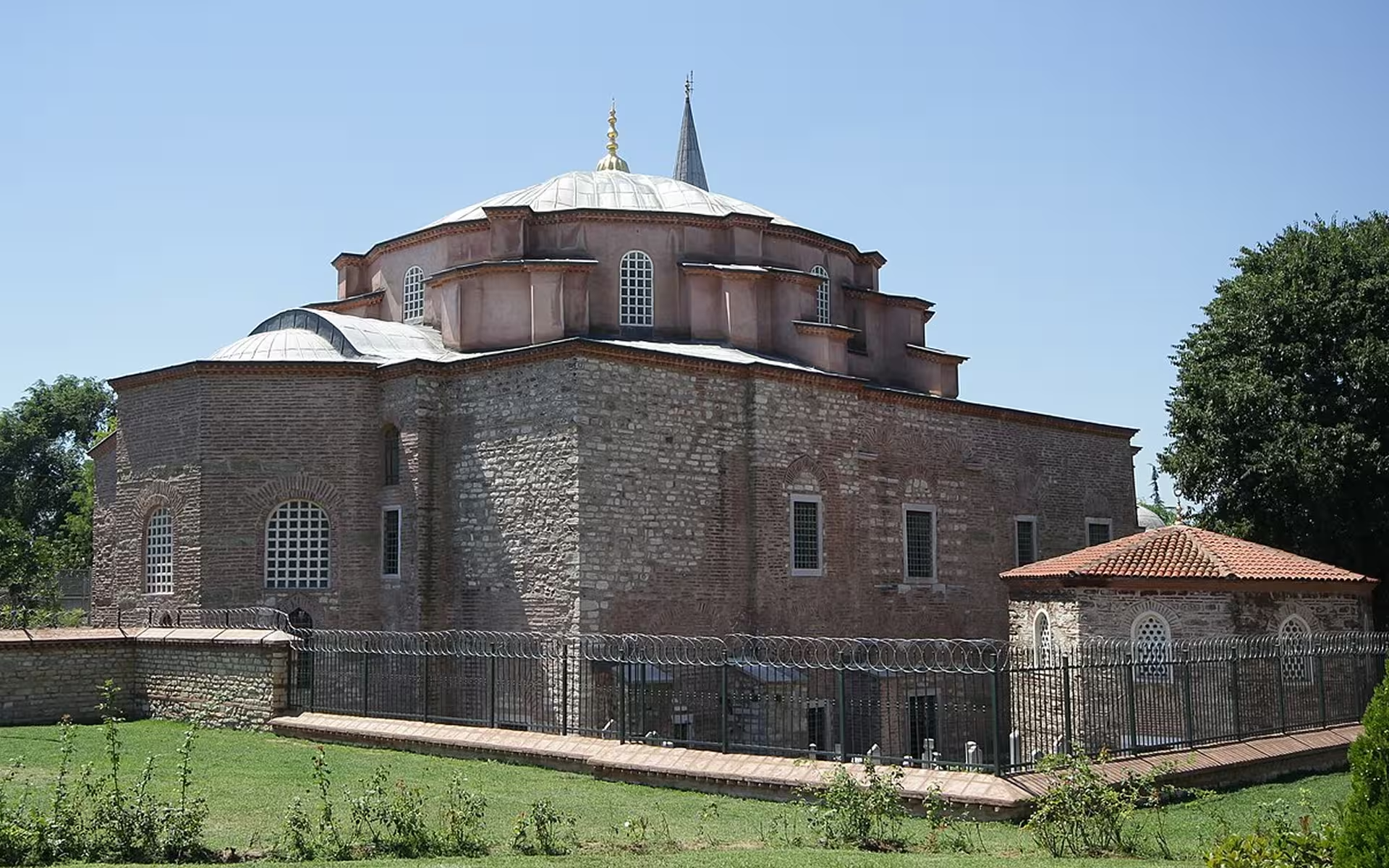
Building in her own name. That double sovereignty was written in stone across the empire. In Constantinople, she and Justinian jointly founded the church of Saints Sergius and Bacchus — today’s Little Hagia Sophia in Istanbul — where the carved marble frieze still praises “God-crowned Theodora, whose mind is adorned with piety, whose constant toil lies in unsparing efforts to nourish the destitute.” Inside Hagia Sophia itself, the great column capitals carry her monogram carved beside Justinian’s — visitors can still pick out the two interlaced ciphers today.
Her own foundations bore her stamp just as clearly: the Metanoia convent for women rescued from prostitution, churches raised at her expense in earthquake-ruined Antioch, and provincial cities in Africa and Syria renamed Theodorias in her honour. The capital answered in kind — Procopius records a porphyry column set up near the Arcadianae baths bearing her statue, which he judged beautiful “but inferior to the beauty of the empress.” For a Roman ruler, none of this was decoration: a name on a monument was a declaration of who reigned.
Protector of a persecuted church
Nothing reveals the strange duality of the reign better than religion. Justinian was a convinced Chalcedonian, committed to unity with Rome; Theodora never abandoned the miaphysites who had sheltered her in Alexandria. While imperial policy harried their clergy, the empress turned the Palace of Hormisdas — her and Justinian’s old residence, attached to the imperial palace — into a sanctuary where hundreds of miaphysite monks and bishops lived under her open protection. The deposed patriarch Anthimus, hunted by order of the emperor, simply vanished — for twelve years. He was found, after Theodora’s death, to have been living in her quarters all along.
Her masterstroke came around 542. At the request of the empire’s Ghassanid Arab allies, Theodora had a monk named Jacob Baradaeus consecrated bishop of Edessa — and then let him disappear. For over thirty years Jacob criss-crossed the East disguised as a ragged beggar (his nickname comes from the tattered horse-blanket he wore), ordaining priests and bishops by the hundred, always a step ahead of the imperial police who hunted him. The result was nothing less than a parallel church hierarchy, built clandestinely under the protection of the empress against the official policy of the emperor — a state-within-the-state run from the women’s quarters of the palace. The Syriac Orthodox Church, still called “Jacobite” after him, exists today because of it; with the missions she sponsored up the Nile, the Coptic and Ethiopian churches too trace their survival in part to her shelter. Historians still argue whether the imperial couple’s opposed religious policies were conviction, cynical good-cop-bad-cop statecraft, or a marriage honestly divided. The miaphysite churches themselves never doubted: they remember Theodora as a saint.
A family raised to the purple
Theodora did not climb out of the Hippodrome alone; she pulled her whole family up behind her, and the results reshaped the dynasty itself.
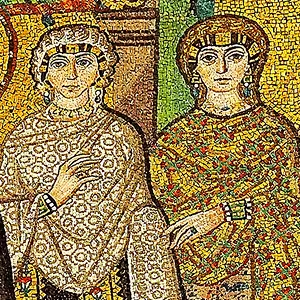
Her elder sister Komito, once an actress like her, was married in 532 to Sittas — one of the empire’s foremost generals, Belisarius’ equal in rank and reputation. Of the youngest sister, Anastasia, who stood garlanded beside them in the Hippodrome on the day the Greens turned the family away, the sources record almost nothing more — she presumably shared in the family’s rise, but history kept its eyes on the crowned heads.
Theodora’s only securely attested child, a daughter born before she met Justinian, was quietly folded into the highest aristocracy; the daughter predeceased her, but her sons — Theodora’s grandsons — completed the ascent. For Anastasius, the empress arranged in the last months of her life the most valuable match in the empire: Joannina, only child and sole heiress of Belisarius and Antonina. His brother Athanasius became a devout miaphysite monk and inherited a great part of Theodora’s private fortune — the illegitimate descendant of a legally infamous actress, openly professing the persecuted creed, living wealthy and untouchable at the heart of the orthodox court.
The crowning move came after her death. Her niece Sophia — in all likelihood Komito’s daughter — married Justinian’s nephew and heir Justin II. When the old emperor died in 565, the couple who took the throne were, quite literally, the nephew of Justinian and the niece of Theodora. Sophia proved her aunt’s truest heir: she abandoned the miaphysite creed of her family for the orthodoxy the crown required, took a visible hand in the treasury and in government, and became the first Byzantine empress to appear on the coinage beside her husband. In a single generation, the family of a Hippodrome bear-keeper had produced two reigning empresses. No dynasty in Roman history was rebuilt so fast, from so far down — and it was rebuilt through its women.
Death and afterlife
Theodora died on 28 June 548, probably of cancer, in her early fifties. Justinian wept openly at her funeral — and for the remaining seventeen years of his reign, he never remarried, and courtiers noted that he still swore oaths by her name. Her influence outlasted her: the miaphysite refugees remained unmolested in her palace, and the women’s legislation stood.
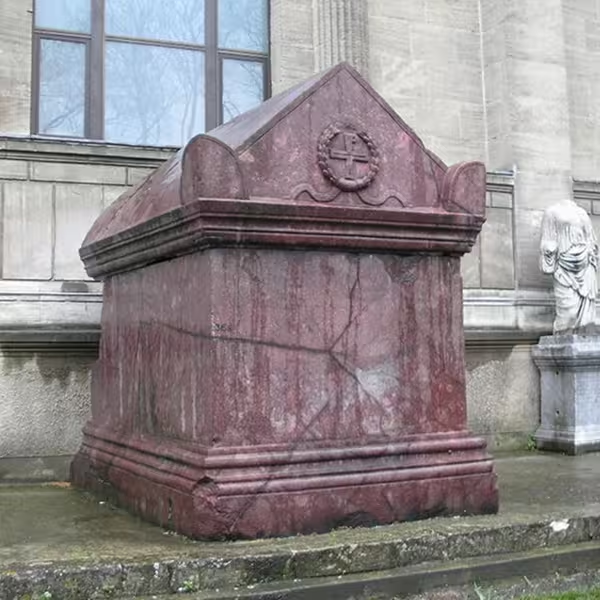
She was laid to rest in the Church of the Holy Apostles, in the mausoleum Justinian had built for their dynasty — the burial church of Byzantine emperors since Constantine. The old emperor did not treat it as a closed chapter: a court record from 559 shows Justinian interrupting a ceremonial procession through the city to enter the church and light candles at her sarcophagus, eleven years after her death. Theodora lay among the emperors for more than six centuries — until 1204, when the crusaders of the Fourth Crusade broke open the imperial tombs of the Holy Apostles and stripped them of their gold and ornament. The desecrated church decayed through the empire’s last centuries and was demolished in the 1460s, after the Ottoman conquest, to make way for the Fatih Mosque. Nothing of her tomb survives. The empress who buried the Roman Empire’s most magnificent funerary tradition with her has, in the end, only one monument left on earth — and it glows on a wall in Ravenna.
She left no children with Justinian, but no succession crisis either: as we have seen, her family already stood ready, and her niece would wear the crown within two decades. Her larger posterity was a model — the Byzantine empress as an actual sharer in rule — that Sophia claimed immediately, and that later empresses, including her 9th- and 11th-century namesakes, would inherit in turn.
The face in the mosaic
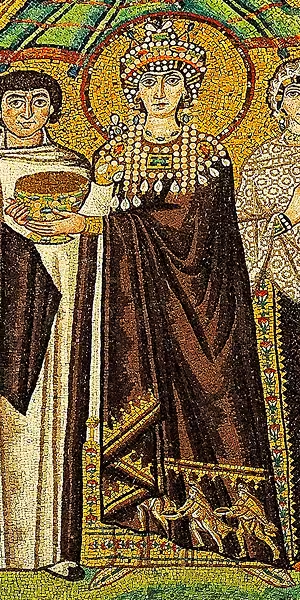
The famous Theodora mosaic — her only surviving contemporary portrait — stands not in Constantinople but in Ravenna, in the sanctuary of San Vitale, consecrated around 547, within a year of her death.
Facing her husband’s panel across the apse, the empress stands haloed under a shell canopy. She wears a great jeweled crown with ropes of pearls falling to her breast and a gem-studded collar over her chlamys of deep purple. On the hem of her robe are embroidered the Three Magi, bearers of gifts to a sovereign greater still. She presents a golden chalice for the eucharistic wine, while Justinian, across the apse, carries the paten for the bread.
She never saw the mosaic — neither she nor Justinian ever visited Ravenna. That is precisely what the panel means: the imperial presence made permanent in gold, in a province she would never enter, beside an emperor who would not share his image with any other human being. The bear-keeper’s daughter ended as close to sacred majesty as Byzantine art could carry a woman.
How do we know? The Procopius problem
Almost everything colourful about Theodora comes from one man — and he wrote in two opposite voices. Procopius of Caesarea, secretary to the general Belisarius, published official histories praising the regime; he also left the Anekdota or Secret History, unpublishable in his lifetime, in which Justinian is a demon in human form and Theodora is portrayed as an insatiable prostitute from her earliest years — allegations recounted with a venom and obscenity unique in ancient literature.
Modern historians read the Secret History neither as truth nor as pure fiction, but as invective — a recognised ancient genre with rules of its own, in which a target’s origins were blackened by convention. The stage career, the poverty, the Hippodrome childhood are almost certainly real — and her sexual reputation was evidently common knowledge, not Procopius’ invention: even John of Ephesus, the miaphysite bishop who knew and revered her, could refer to her matter-of-factly as “Theodora from the brothel.” What belongs to invective is the lurid detail — the specific anecdotes crafted to disgust senatorial readers who already despised an actress-empress, and which no other source corroborates. Strip the malice away and a consistent figure remains, visible even in Procopius’ public works and in John of Ephesus’ independent, admiring testimony: intelligent, theatrical, loyal to her own, unforgiving to her enemies, and indispensable to her husband. Few rulers of any age have been so lucky in their deeds and so unlucky in their biographer.
Frequently asked questions
Who was Empress Theodora?
Theodora (c. 495–548) was the wife of Emperor Justinian I and the Byzantine empress (Augusta) from 527. Born into the circus world of Constantinople and a former actress, she became the most powerful woman in Byzantine history, sharing openly in Justinian’s government.
What were Empress Theodora’s main accomplishments?
Above all her role in the Nika riots of 532, when her refusal to flee — “royalty is a fine burial shroud” — kept Justinian on the throne; for laws improving the position of women; for protecting the persecuted miaphysite church; and for her mosaic portrait in San Vitale, Ravenna.
Was Theodora really an actress — or a prostitute?
An actress, certainly: the career is beyond doubt, and the law had to be changed so Justinian could marry her. The claim that she was also a prostitute comes chiefly from Procopius’ hostile Secret History, whose graphic details are deliberate character assassination and cannot be verified. But in sixth-century Byzantium the two professions overlapped in law and in reputation — and even her admirer John of Ephesus called her “Theodora from the brothel” — so contemporaries clearly took her past for granted. What is invented is the detail, not the notoriety.
Did Justinian and Theodora have children?
No surviving children together. Theodora had a daughter before her marriage, who died young; her grandson later held high rank at court. Justinian never remarried after her death in 548.
Where can you see Empress Theodora’s portrait?
The Theodora mosaic is in the Basilica of San Vitale in Ravenna, Italy, where the panels of Theodora and Justinian face each other across the sanctuary — completed around 547, in the last year of her life.
Were there other Byzantine empresses named Theodora?
Yes — at least two of major importance: the 9th-century Theodora, wife of Theophilos, who ended iconoclasm and restored the icons in 843, and Theodora Porphyrogenita (d. 1056), last ruler of the Macedonian dynasty. This article covers Justinian’s wife, the most famous of the three.
Further reading and sources
- Procopius, The Secret History (Penguin Classics) — the notorious source itself; read with the caveats above.
- David Potter, Theodora: Actress, Empress, Saint (Oxford, 2015) — the best modern critical biography.
- James Allan Evans, The Empress Theodora: Partner of Justinian (University of Texas Press, 2002).
- Procopius, Wars I.24 (the Nika riots and Theodora’s speech); John of Ephesus, Lives of the Eastern Saints (her miaphysite protection).
All images of Theodora’s mosaic in Ravenna, unless indicated otherwise, are derived from a photograph by Petar Milošević (CC-by-SA 4.0). The original pictures have been cropped or resized with no further modifications.