Aegina, Saronic Gulf: Byzantine history, monuments and the tragic fate of Paliachora
Aegina sits closer to Constantinople’s political orbit than almost any island we cover here — half an hour by hydrofoil from Piraeus today, and for centuries the nearest inhabited island to Athens itself. That proximity did not protect it. From the 9th century onward, Aegina’s entire population abandoned its ancient, coastal city and rebuilt itself inland, on a defensible hill invisible from the sea. The result, a fortified hill-town called Paliachora, housed the island’s only real settlement for close to a thousand years. It is nearly empty today, but it never really left: roughly 38 churches still stand on its slopes, several of them genuinely Byzantine, and the whole abandoned town has earned a nickname familiar from the Cyclades — “the Mystras of Aegina.”
Aegina’s Byzantine story is not one of imperial building projects or famous sieges. It is the story of an island community that responded to a single, well-documented catastrophe — a raid so severe that it survives in the lives of two saints — by withdrawing, en masse, from the coast for nearly a millennium, and by producing, from that withdrawal, an abbess, a future Patriarch of Constantinople, and one of the most complete abandoned medieval townscapes anywhere in Greece.
Byzantine Aegina – in brief
Location:
Saronic Gulf, roughly 27 km from Athens and Piraeus — the closest inhabited island to the Byzantine mainland’s political center
Political situation:
End of Byzantine rule 1204, in the fallout of the Fourth Crusade — Aegina passed first to Venice, then to the Duchy of Athens and to the Turks in 1537
Main Byzantine-era settlement:
Kollona Hill and Paliachora (“Old Town”)
Main threat:
Arab raiding from the Emirate of Crete, most severely a raid recorded in the hagiographies of Sts. Athanasia and Theodora, datable to around 830
Ecclesiastical status:
Bishopric attested by name at the Councils of Constantinople of 869 and 879; originally a suffragan see of Corinth, later raised to an archdiocese
Notable Byzantine natives:
St. Athanasia of Aegina (9th-century abbess); Cosmas II Atticus, Patriarch of Constantinople (12th century)
Main surviving monuments:
38 Churches at Paliachora, though only few date before 1453; the ruins of the settlement of Kolona Hill, the Omorphi Ekklisia, the Church of the Taxiarchs on Mount Oros
Early Byzantine Aegina: from a refugee place to the 9th century raids
Aegina entered the Byzantine period as a modest but continuously inhabited island, its ancient acropolis at Kolona still standing above a harbor that had once rivaled Athens’ own. A Romaniote Jewish community, established by the 3rd century, worshipped near the ancient harbor in a synagogue whose mosaic floor survives today in the island’s Archaeological Museum; local Christian tradition claims a congregation reaching back to the 1st century. Aegina remained part of the Eastern Roman world after the empire’s division in 395, and when Slavic invasions overran much of the Greek mainland in the 6th and 7th centuries, the island served — according to the Chronicle of Monemvasia — as a place of refuge for Corinthians fleeing the chaos on the Peloponnesian coast opposite.
The 8th and 9th century looks, on the evidence of the settlement of Kollona hill, a rather prosperous moment for Aegina, at a time where the Byzantine empire was struggling for its survival. It did not last. The Emirate of Crete, the Arab state established after the Muslim conquest of Crete in the 820s, turned the southern Aegean into contested water for well over a century, and Aegina — a modest island with no serious fortifications — was an easy target. The lives of two Aeginetan saints record a devastating raid on the island, generally dated to around 830, severe enough to send much of the population fleeing to the Greek mainland: Athanasia of Aegina, and Theodora of Thessalonica, who was born on Aegina and fled as a child during the very raids her adopted city’s hagiography goes on to describe. Other scholarship places the decisive break slightly later, associating the final abandonment of the coast with a further raid around 896 that also struck Attica. Either way, the outcome was the same: Aegina’s inhabitants gave up their exposed coastal settlements and rebuilt their lives on a steep, landlocked hill in the island’s interior, later known as Paliachora.
The site they chose was not new ground. The hill has been identified with Oie, an ancient town mentioned by Herodotus and Pausanias, where the Aeginetans once kept two cult statues carried off from Epidaurus. Remains of ancient and Early Christian buildings have been found scattered across the site — Paliachora’s builders were not founding a town from nothing so much as reoccupying a defensible height their ancestors had already valued, this time for reasons of survival rather than religion.
Middle Byzantine Aegina: bishops, an abbess, and a future Patriarch
By the second half of the 9th century, Aegina’s church had enough institutional weight to send its own bishops to Constantinople. Two are named in the surviving record: Gabriel and Thomas, both attested as participants at the Councils of Constantinople of 869 and 879 — real, datable evidence of an island small enough to be raided at will, yet organized enough to hold its own episcopal seat. The see began as a suffragan of the metropolitan of Corinth and was later elevated to an archdiocese in its own right, a promotion that suggests the withdrawal to Paliachora had not diminished the island’s ecclesiastical standing.
Aegina’s most distinctive Byzantine legacy, though, is biographical rather than architectural. Athanasia of Aegina, a noblewoman who founded monasteries on the island before later serving as an advisor in Constantinople, is remembered in a hagiography that — alongside the life of Theodora of Thessalonica — is one of the two surviving textual witnesses to the raid that founded Paliachora in the first place. Three centuries later, Aegina produced a far more senior churchman: Cosmas II Atticus, a native of the island, served as Ecumenical Patriarch of Constantinople from 1146 to 1147 under Emperor Manuel I Komnenos, before being deposed amid political and theological conflict. Few small Aegean communities in this period can claim to have sent one of their own all the way to the patriarchal throne — even briefly.
By the late 12th century, the island’s fortunes had turned again. Michael Choniates, the metropolitan bishop of Athens and a contemporary observer, described Aegina in his own time as a base for pirates rather than a peaceful backwater. The English chronicler Benedict of Peterborough corroborates this from the outside: writing of Greece as it stood in 1191, he records that Aegina, along with Salamis and Makronisos, had become a pirate stronghold, and that fear of raiders had left many of the region’s islands effectively uninhabited. The very withdrawal that had protected Aegina’s population two centuries earlier had, by the eve of the Fourth Crusade, turned the whole southern Saronic Gulf into contested, lawless water.
The end of Byzantine rule: Venice, the Duchy of Athens, and Barbarossa
Byzantine institutional authority over Aegina ended in 1204, in the same collapse that reorganized so much of the Aegean after the sack of Constantinople. The island was formally assigned to the Republic of Venice, but in practice it fell under the control of the Frankish Duchy of Athens, the crusader state carved out of central Greece. Lordship of Aegina changed hands repeatedly over the following two centuries: given as a dowry to the Veronese knight Boniface of Verona in 1296, held by the Catalan Company after their seizure of Athens in 1317, and controlled from 1394 by the Caopena family, an Italian dynasty that ruled the island as effectively independent lords.
In 1451, Aegina passed formally to Venice, when its ruler Alioto Caopena placed the island under Venetian protection to escape the growing Ottoman threat. It was under Venetian rule, in the mid-15th century, that construction began on a proper castle at the summit of Paliachora — a fortification the Byzantine-era settlement itself had never possessed.
In 1462, the Venetians removed one of the island’s most prized relics, the skull of St. George, from the church of St. George the Catholic at Paliachora and transferred it to Venice, compensating the islanders with money toward their own defenses.
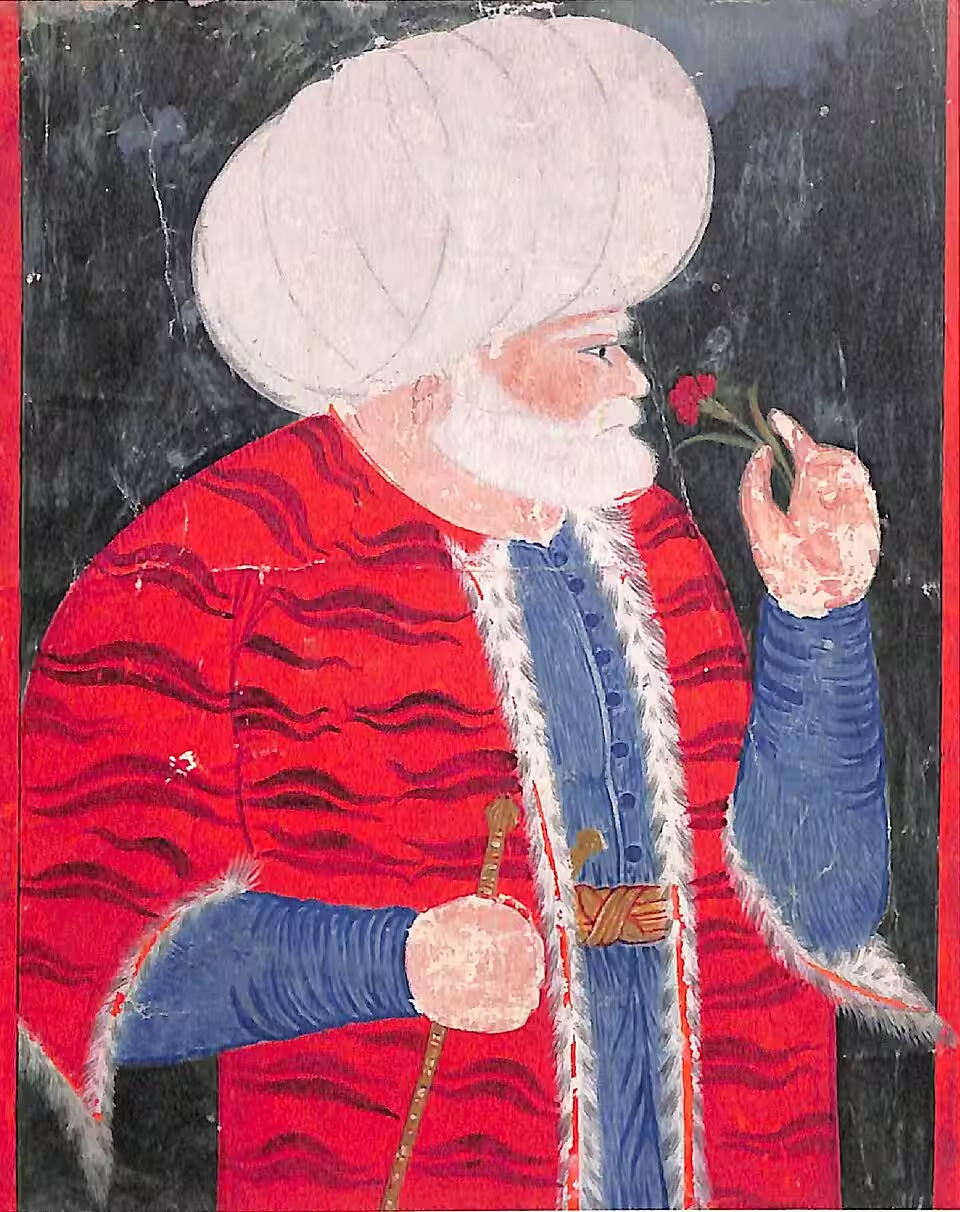
Those defenses did not hold. In 1537, the Ottoman admiral Hayreddin Barbarossa besieged Paliachora and captured it within four days, sparing only the Latin church of St. George. The adult male population was massacred and roughly 6,000 women and children were taken as slaves — a catastrophe from which the settlement never fully recovered, though it continued to be resettled and depopulated in cycles of Venetian and Ottoman control for another two and a half centuries. Piracy, the very threat that had built Paliachora in the first place, finally eased in the early 19th century, and the islanders at last abandoned the hill for good, resettling the coastal town of Aegina that remains the island’s capital today.
Byzantine and medieval monuments of Aegina
Unlike Naxos, where Byzantine churches are scattered across an entire farming landscape, or Leros, where a single well-documented castle anchors the story, Aegina’s Byzantine heritage clusters around a handful of sites: the abandoned town of Paliachora, the ancient acropolis at Kolona, and a scatter of rural churches, several with wall paintings of real quality.
Paliachora
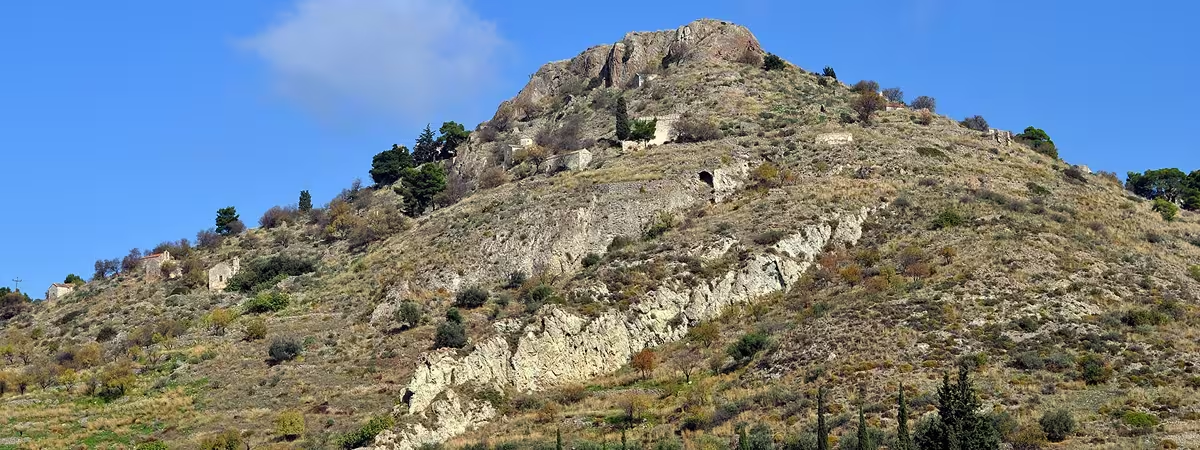
The abandoned medieval town that served as Aegina’s main settlement from the Middle Byzantine period until the early 19th century, built on a 355-meter peak in the island’s north, above the modern monastery of Agios Nektarios. Continuous pirate raids, culminating in the catastrophic Barbarossa siege of 1537, shaped the site’s entire layout: the settlement’s north side, facing the sea, was deliberately left unbuilt so that no part of the town could be seen from the water, and its two internal roads climb toward a summit castle whose walls survive in places to a height of nearly two meters.
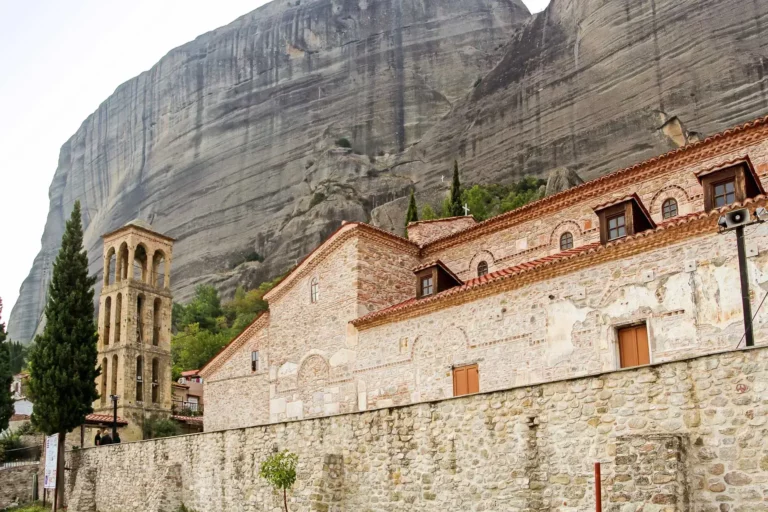
Of the roughly 38 churches still standing on the hillside, most belong to the 16th to 18th centuries — the long Venetian-Ottoman period of repeated resettlement after Barbarossa’s sack. A smaller, genuinely medieval core survives from before or close to the fall of Constantinople in 1453: the Church of the Taxiarch, the earliest identifiable building on the site, dated to the 13th century; St. George the Catholic (also known as St. George in the Forum, or Panagia Mesosporitissa), the 13th–14th-century cathedral that once held the skull relic of St. George before its removal to Venice in 1462; the cathedral church of St. Dionysios (the Episkopi), of the 14th–15th century; St. Euthymius, 14th century; and St. John the Theologian, dated to the very end of the 14th century. Many of the churches, medieval and later alike, retain their original interior wall paintings.
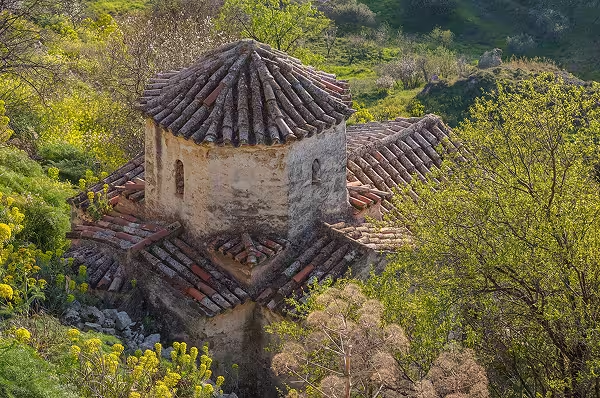
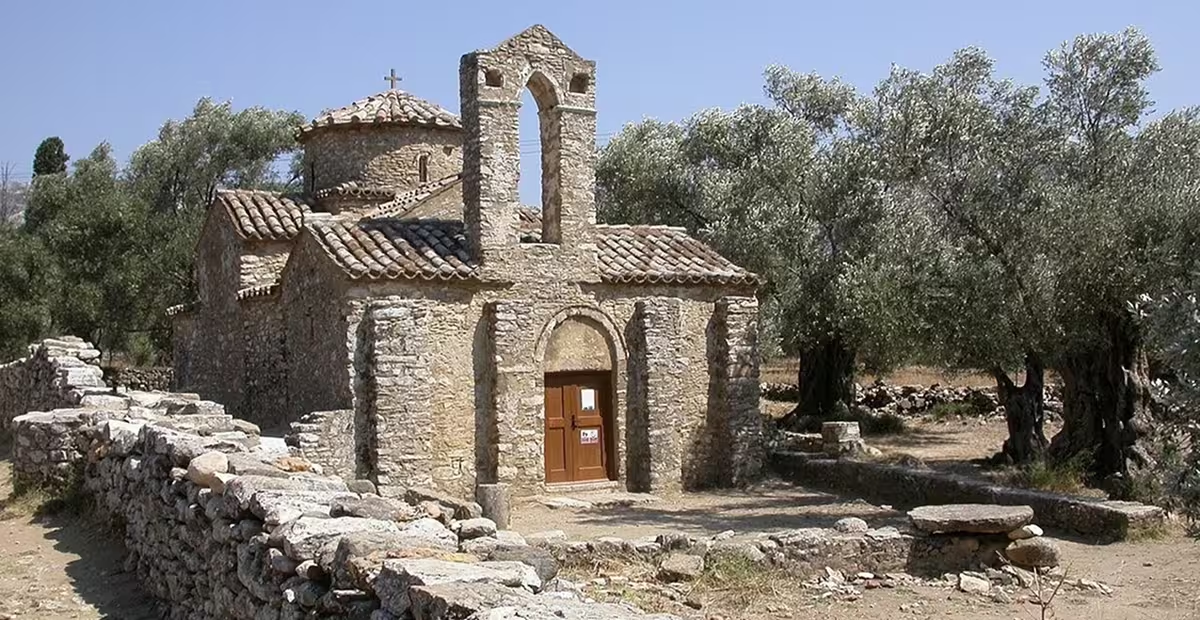
13th century Church of the Taxiarchs in Paliachora
@ C Messier, CC-by SA 4.0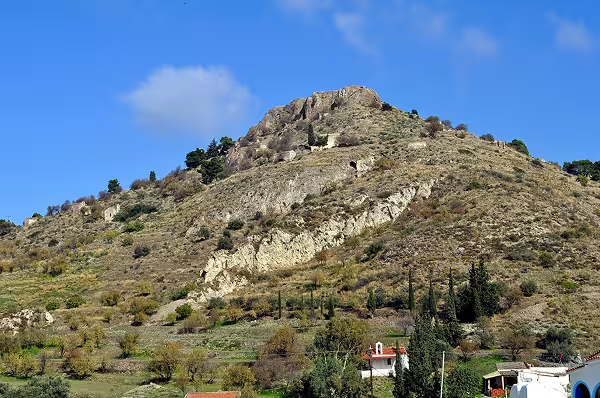
View of the ruins of Paliachora
@ Pawel pbm Szubert, CC-by SA 3.0
Kolona hill
On the headland immediately north of Aegina town, the ancient acropolis of Kolona — site of a Doric temple to Apollo whose surviving column gave the promontory its Venetian-era name — carried a Byzantine-period settlement layer directly above its Archaic and Hellenistic remains, itself resting on at least ten earlier building phases going back to prehistory.
The hill was first fortified in the 3rd century or shortly after, then abandoned from the 5th century until the end of the 6th. Its resettlement matches the Chronicle of Monemvasia‘s account of Corinthian refugees fleeing Slavic raids on the Peloponnese around that time, and the archaeology bears this out: the temple of Apollo was converted into a Christian church, and several of the settlement’s water cisterns from this phase still survive. Excavation on the hill’s south side has since revealed the remains of a settlement dating mainly to the 8th and 9th centuries, extending south toward the sea, where part of the Byzantine fortification wall — itself built over an earlier wall — is still preserved. Building activity in this later phase was modest: small-scale house repairs, a kiln, a small hypocaust room, a row of thresholds, and a sewage network of clay pipes. Clear signs of destruction date to the reign of Emperor Basil I (867–886): a small hoard of four of his bronze coins turned up in a burnt layer, with further coins of the same emperor found elsewhere on the site. The evidence points to the Byzantine settlement on Kolona hill being abandoned for good in the late 9th century, most likely after a pirate raid — the same wave of raiding, in other words, that pushed the rest of the island’s population up to Paliachora.
Karantina
The Karantina district, near Aegina’s ancient harbor, has produced a cluster of Late Roman and Early Christian remains, including the synagogue mentioned above. A 5th-century basilica once stood on the site of the modern church of Panagitsa; excavations in 2001 uncovered the remains of a font or baptistery, also floored in mosaic, along with a hoard of small bronze coins (minimi) dating to the turn of the 5th–6th century. Further west, the ruins of the so-called Vardias Basilica — known locally as the church of Agia Photeini — probably date to the 6th century. Its large semicircular apse, 6.5 meters across, survives along with the base of its ciborium, the lower parts of its templon and pulpit, its synthronon, and its triumphal arch. Vaulted tombs have been found outside the basilica’s north-east corner, and a pit grave was uncovered beneath the paved floor of its south aisle. Bronze coins of Emperor Heraclius (610–641), recovered during a rescue excavation, suggest the site remained in use into the early 7th century.
Mount Oros: Zeus Hellanios and the church of the Taxiarchs
Aegina’s rugged southern half, dominated by Mount Oros, holds two related but distinct Byzantine monuments. Near the village of Pachia Rachi, a 13th-century Byzantine church was raised directly on the ruins of the ancient summit temple of Zeus Hellanios, itself built in the 4th century BCE. The approach staircase, sections of the original ancient walls, and loose architectural fragments from the earlier temple survive around the later church.
On the mountain’s north slope, below this summit sanctuary, stands the church of the Taxiarchs (Archangel Michael), amid the ancient ruins known as Sphyrichtres and reached by a wide stone staircase between two terraced retaining walls. The upper terrace preserves a Hellenistic stoa, built of local dark trachyte in a Π-shaped plan; the church itself rises over the stoa’s north-west corner. It is a small, aisleless, domed cross-in-square church, its cross-arms compressed to fit a rectangular plan, with a narthex added later at the west end. Architectural details on the exterior of the sanctuary apse point to the 12th century, and the building’s overall massing suggests a date around the turn of the 12th to 13th century. Much of its masonry is spolia from the Hellenistic stoa, reused in a distinctly Byzantine technique: the base of the north wall uses carefully dressed stone with near-invisible joints, while the upper courses mix undressed stone and brick more freely. Nearby, the low remains of cells and a perimeter wall belong to a later monastery of Agios Nikolaos, otherwise undocumented.
Wall paintings survive inside the Taxiarchs, principally in the dome, with traces of an earlier layer visible in the sanctuary. Restoration in 2002 revealed four hierarchs, painted from the waist down in the lower apse in brown-red and ochre against a dark-blue ground — work of a quality unusual for a provincial church of the early 13th century. The dome itself centers on a bust of Christ Pantokrator, inscribed “the Philanthropist,” framed by a band of pseudo-kufic ornament paralleled in other 13th- and 14th-century monuments. Around the drum, four scenes tied to the Archangel Michael’s cult fill the corner panels: the Miracle at Chonae — a rare subject in monumental painting, showing the archangel splitting a rock to divert a river and save his shrine from flooding — alongside Joshua before Jericho, Jacob’s Ladder, and the Expulsion from Paradise. This dome cycle is attributed to a provincial workshop of the Palaiologan period, 14th century, added over the earlier sanctuary paintings. A further, later layer depicting the Archangel Michael and St. Anthony survives in the nave’s north-east corner.
Omorphi Ekklisia (Agioi Theodoroi)
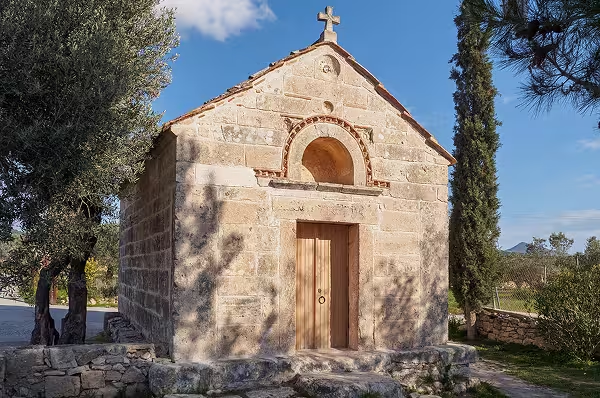
Inside Aegina town, toward the district of Kypseli, stands Omorphi Ekklisia (“Beautiful Church”), also known as Agioi Theodoroi — an aisleless, barrel-vaulted church built of large, dressed poros blocks. Its architecture shows no Western influence, and its style points to a date in the late 12th century, just before the Frankish conquest.
An inscription on the west façade records a renovation in 1289; remarkably, given that the island was by then under Frankish rule, the donor names Emperor Andronikos II Palaiologos and Patriarch Athanasios I of Constantinople — a small act of political allegiance suggesting the founder belonged to a prominent Byzantine family with ties to Constantinople, and perhaps hinting at a wider current of resistance among Aegina’s leading families to Frankish rule. A graffito by the entrance, and a now-lost painted inscription once inside, link the church to the Samalas or Zagomalas family.
The interior preserves an unusually complete Middle Byzantine fresco cycle: fourteen scenes from the life of Christ (notably without the Baptism or Pentecost), the Twelve Great Feasts, the Virgin Platytera flanked by archangels in the apse, the hierarchs Basil and John Chrysostom below her, and rows of full-length standing saints along the lower walls.
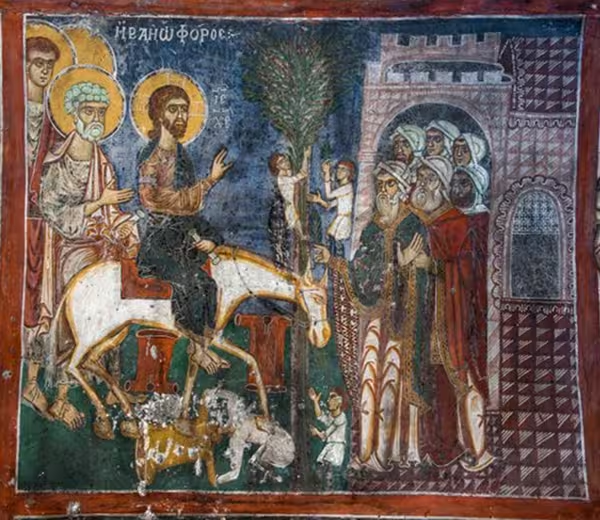
Specialists read the omission of the Baptism and Pentecost — otherwise near-universal in this kind of cycle — as a response to the era’s fraught debates over Church union with Rome and the Filioque, rather than a simple lack of wall space. The church also holds one of the very few Middle Byzantine depictions anywhere of the Virgin Galaktotrophousa (the nursing Virgin), a rare subject for the period. Stylistically, the paintings are conservative and strongly linear, in keeping with the broader character of wall painting in Frankish-ruled Greece at the time — art that, in the words of specialists who have studied it, seems to stand deliberately apart from contemporary currents elsewhere in the Byzantine world.
Smaller churches: Polles Elies, Agios Nikolaos Moulos, Agios Dimitrios
Above the sea on the road to Souvala, at Kavouropetra on the edge of Kypseli, stands the church of Agios Nikolaos Moulos: an elegant, four-columned domed cruciform church with slender proportions. Heavy later plastering has obscured its exterior, but it was built mainly of large dressed stone blocks with brick courses interspersed. The west and south entrances are framed in poros blocks under relieving arches, though later repairs have altered the doors and windows. Its eastern columns, absorbed into wall piers, carry composite Ionic capitals with imposts reused from earlier buildings — genuine Early Byzantine spolia. Almost none of the church’s original wall painting survives: a seated female figure of the post-Byzantine period, in poor condition, appears on the south-west pillar, alongside a stylized floral motif that may echo Middle Byzantine decoration.
In the area of Agioi Asomatoi stands the church of Agios Dimitrios, a domed cross-in-square church with contracted cross-arms and a later narthex added under a double-pitched roof at the west end. Beneath modern plaster, its masonry is built of poros courses with brick interspersed. Its one surviving wall painting, on the north-west pillar, shows the upper body of St. Demetrios, identified by inscription and probably originally mounted on horseback, spear in hand, with a shield decorated in kufic-style geometric motifs behind his shoulder — work of the 14th century. Recent renovation, unfortunately, has covered the rest of the interior in modern plaster and tile.
Not far from Aegina town, the ruins of a small Middle Byzantine church dedicated to St. Nicholas survive at Polles Elies.
Notable Byzantine Aeginetans
Paul of Aegina (c. 625 – c. 690), physician, surgeon, and medical encyclopedist, trained in Alexandria and wrote the Medical Compendium in Seven Books, a text that remained influential in both Western Europe and the Islamic world throughout the Middle Ages.
St. Athanasia of Aegina (c. 790–860), noblewoman, monastic founder, and abbess, established monasteries on the island before later serving as an advisor in Constantinople. Her hagiography is a key source for Saracen raiding in the Aegean during the Middle Byzantine period.
St. Theodora of Thessalonica (812–892) was born on Aegina and fled to Thessaloniki as a child during the Arab raids that emptied the island. Her surviving Life is one of the longest and most detailed hagiographies of the Middle Byzantine period.
Cosmas II Atticus (died after 1147), a native of Aegina, served as Ecumenical Patriarch of Constantinople from 1146 to 1147, under Emperor Manuel I Komnenos, before being deposed amid political and theological conflict.
Frequently Asked Questions
What was the Byzantine capital of Aegina?
Aegina had no formal Byzantine-era capital in the administrative sense, but Paliachora, a fortified hilltop settlement built in the island’s interior from the 9th century onward, functioned as its only real town for close to a thousand years, until the early 19th century.
How many Byzantine churches survive on Aegina?
Around 38 churches are documented at Paliachora alone, but most date from the 16th to 18th centuries, after the site was repeatedly resettled following the Ottoman sack of 1537. A smaller core of genuinely medieval churches — the Taxiarch, St. George the Catholic, the cathedral of St. Dionysios, St. Euthymius, and St. John the Theologian — dates to the 13th–15th century. Further Byzantine churches with substantial wall paintings survive elsewhere on the island, including Omorphi Ekklisia and the Taxiarchs on Mount Oros.
Why is Paliachora called the “Mystras of Aegina”?
The nickname refers to the density of churches and medieval structures packed onto a single defensible hill, evoking the far larger and more famous Byzantine hill-town of Mystras in the Peloponnese — a comparison of character and concentration, not of scale or imperial status.
When did Byzantine rule over Aegina end?
In 1204, after the Fourth Crusade fractured Byzantine authority across the Aegean. Aegina passed to Venice on paper, but was in practice controlled by the Frankish Duchy of Athens for most of the following two and a half centuries.
What threatened Byzantine Aegina most?
Arab raiding from the Emirate of Crete, and later generalized Aegean piracy. A raid recorded in the hagiographies of Sts. Athanasia and Theodora, usually dated to around 830, is the best-documented catastrophe behind the island’s retreat from the coast to Paliachora.
Sources
- Alexander Kazhdan (ed.), The Oxford Dictionary of Byzantium, Oxford University Press, 1991.
- Vassilios Christides, “The Raids of the Moslems of Crete in the Aegean Sea: Piracy and Conquest,” Byzantion, 51 (1981), pp. 76–111.
- Charalambos Pennas, The Byzantine Aegina, Athens, 2004.
- Nikolaos Moutsopoulos, Η Παλιαχώρα της Αιγίνης. Ιστορική και μορφολογική εξέτασις των μνημείων, Athens, 1962.
- Nikolaos Nikoloudis, “Η Αίγινα κατά τον Μεσαίωνα και την Τουρκοκρατία,” Βυζαντινός Δόμος, 7 (1993–94), pp. 13–21.
- Kastrologos (kastra.eu), “Παλιαχώρα Αίγινης.”