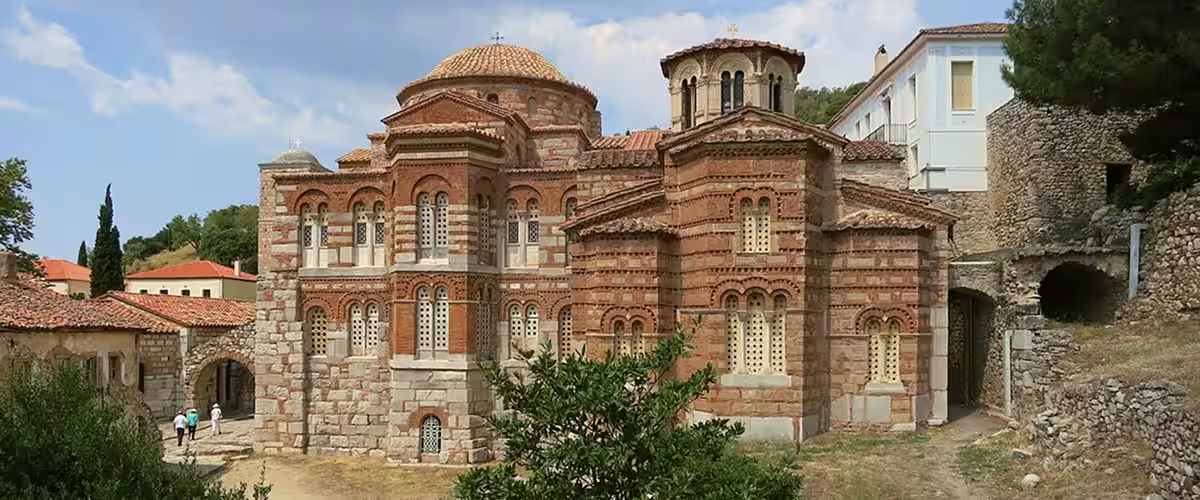
Hosios Loukas: A Byzantine Monastery built around a Saint’s tomb
On 7 February 953, a hermit named Luke died in his cell on the western slopes of Mount Helicon, near the ruins of ancient Steiris, and his disciples buried him under its floor. He was not the Evangelist but a local holy man, known in his lifetime as a healer and a prophet. Within sixty years his tomb had drawn so many pilgrims that the community built around it two churches side by side, a crypt, and one of the most lavish interiors of the Byzantine world: coloured marble on the walls and floors, and mosaics on gold ground in the vaults. The Monastery of Hosios Loukas, “the Blessed Luke”, is today the largest and best preserved monastic foundation of the 11th century in Greece, and the oldest of the three monasteries, with Daphni and Nea Moni, that UNESCO listed together in 1990. Almost everything in it, from the joined plan of its churches to the choice of saints on its walls, can be traced back to one purpose: to house and honour that tomb.
Quick facts
Location: Western slopes of Mount Helicon, near the villages of Steiri and Distomo, Boeotia, about 36 km by road from Delphi
Saint: Luke the Younger, or Luke of Steiris (896–953); feast on 7 February, translation of his relics on 3 May
Churches: The Panagia (second half of the 10th century) and the Katholikon (completed by 1011 or 1022), joined at one corner
Founder of the Katholikon: Abbot Philotheos, according to the monastery’s own liturgical texts
Famous for: The best preserved mosaic programme of the early 11th century, the frescoed crypt, and the marble interior of the Katholikon
Byzantine-era status: A major pilgrimage centre, with dependencies on Euboea by 1014 and close ties to the nobility of Thebes
UNESCO status: World Heritage Site since 1990, jointly with Daphni and Nea Moni of Chios
Today: An active Orthodox monastery and an archaeological site; the saint’s relics returned from Venice in 1986
Origins: a holy man and his tomb
Luke of Steiris
Almost everything known about the founder comes from his Life, written by an anonymous disciple a few years after his death. Luke’s family came from Aegina and settled at Kastorion in Phocis, the modern village of Kastri near Delphi, where he was born in 896. He took up the ascetic life young and moved from place to place across central Greece: the Pantanassa monastery in Athens, Mount Ioannitza, then the region of Corinth, where he sheltered near a stylite at Zemena from the Bulgarian raids of Tsar Symeon’s time. After twelve more years on Ioannitza he withdrew to the coast of the Gulf of Antikyra and to the islet of Ambelon. Around 946 he settled for good near Steiris, where a loose community of followers gathered round him. He died there in 953, aged 56.
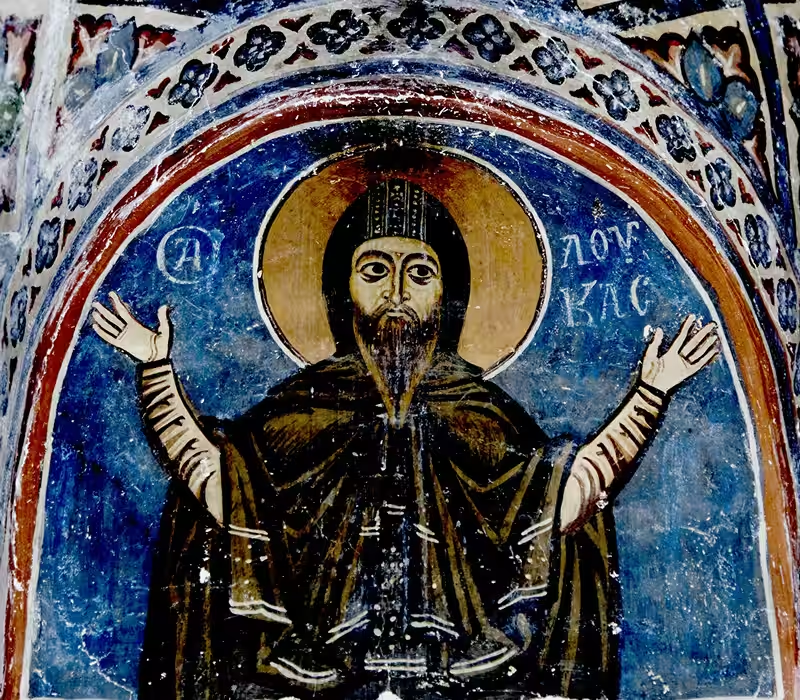
Luke owed his fame to two gifts. He was a healer, and he was a prophet. His best-known prophecy announced the reconquest of Crete from the Arabs about twenty years before Nikephoros Phokas achieved it in 961, in the reign of Romanos II. That prophecy would later tie the monastery, in local tradition, to the emperors themselves. His full story, including the miracles recorded in his Life, is told in our article on Saint Luke of Steiris.
From a cell to a pilgrimage centre
Luke’s reputation reached the governors of the theme of Hellas, whose seat was at Thebes. The Life names two military governors who honoured him, Pothos (perhaps of the Argyros family) and Krenites (perhaps Arotras). Krenites paid for a church dedicated to St Barbara, begun while Luke was still alive and completed by the monks a few years after his death – likely between 946 and 955.
The tomb soon became the centre of the community. Six months after the burial, a pilgrim monk, Kosmas from Paphlagonia, covered the grave with stone slabs and surrounded it with a barrier. By 955, according to the Life, the monks had turned the cell and its tomb into “a sacred oratory in the shape of a cross”. Healing miracles at the tomb drew pilgrims from all over Greece. They sought cures from the oil of the lamp above the grave, from the moisture it was said to exude, and from dreams received while sleeping beside it.
Where are the first buildings today?
The Life mentions two early buildings, the church of St Barbara and the cruciform oratory over the tomb, but none of the surviving structures can be matched to them with certainty. Eustathios Stikas identified the Panagia with St Barbara, which would date it around 955, and the present crypt with the oratory. Others reversed the pairing: the crypt, where St Barbara is still venerated, would be her church, and the Panagia would be the oratory, perhaps with a contribution from Romanos II (Laskarina Boura). Paul Mylonas placed the oratory in an earlier building under the nave of the Katholikon. Charalambos Bouras rejected both crypt and nave solutions, because the Katholikon and its crypt were built in one campaign to a single design. The question remains open.
Two churches and one tomb
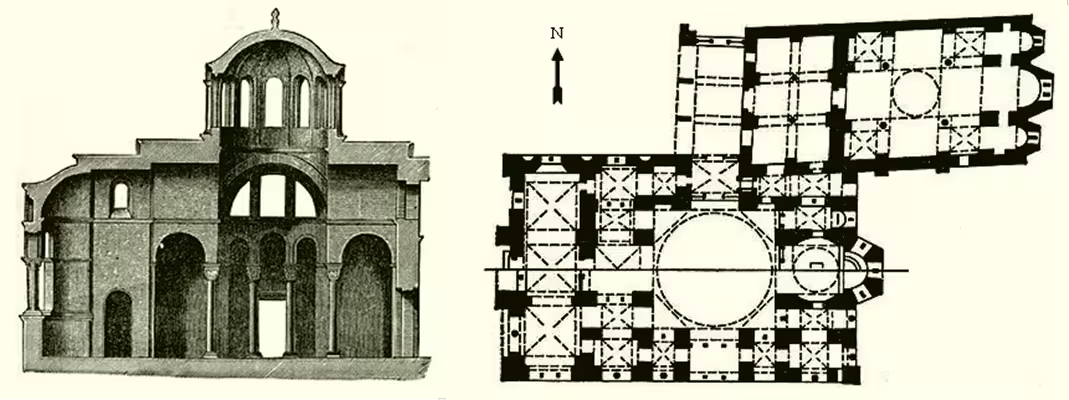
Right: Ground plan of the Katholicon (south) and Panagia church (north), after works by A. Rosengarten and M.F. Simpson.
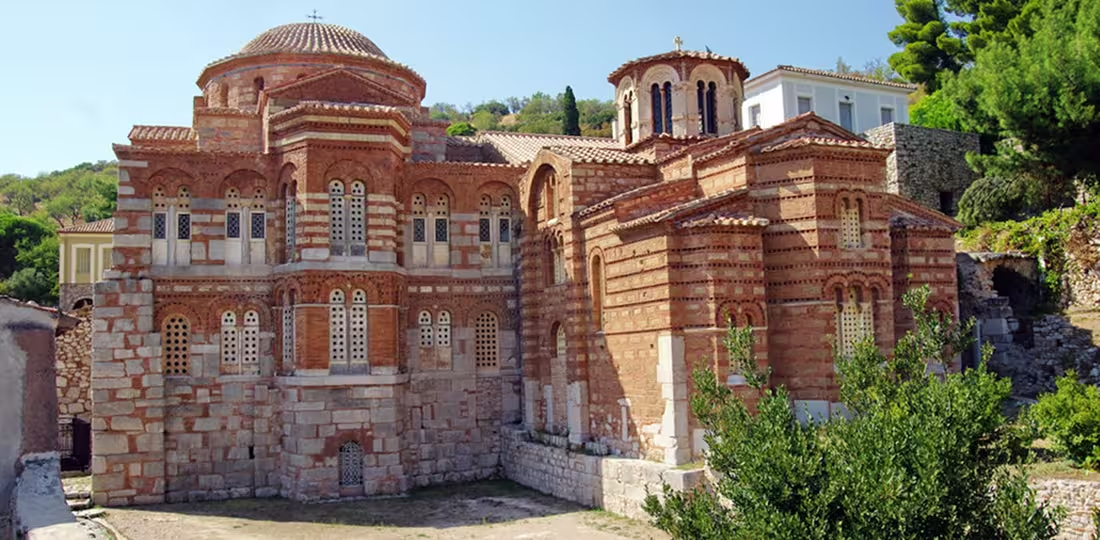
The Church of the Panagia
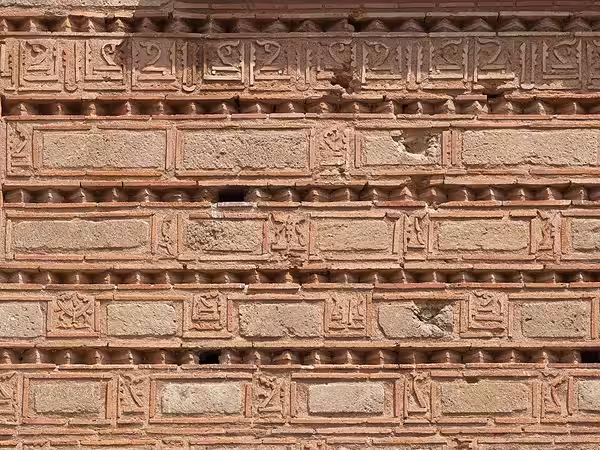
The smaller of the two churches, dedicated to the Virgin, dates from the second half of the 10th century. It is a four-column cross-in-square church built on Constantinopolitan models, and most of its carved marble motifs also come from the repertoire of the capital. Its plan is often compared with that of the Lips monastery in Constantinople. On the outside it shows two features that would spread across mainland Greece: cloisonné masonry, in which each stone block is framed by bricks, and friezes of cut brick in the shape of pseudo-Kufic, an imitation of angular Arabic script. The Holy Apostles in the Athenian Agora copies it so closely that the two must be the work of builders who knew each other.
A broad narthex, or lite, is attached to the west end, and beyond it stood an unusual outer narthex: an open portico with enclosed rooms, probably chapels, at both ends. The southern room was later absorbed into the Katholikon, where it became the north arm of the cross. Little of the church’s painted decoration survives. Five frontal hierarchs in the south arm and on the arch of the sanctuary date from the end of the 12th century, before the Latin conquest of 1204, and recall the painting of the chapel of the Virgin in the monastery of St John on Patmos.
Which church came first? A settled question
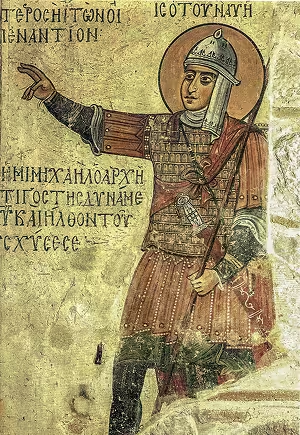
For a long time scholars debated the order of the two churches. Conservation work ended the debate. In 1964, a wall painting was discovered under the marble revetment of the Katholikon, on what had once been the east wall of the southern room of the Panagia’s outer narthex. It shows Joshua meeting the Archangel Michael before Jericho, with the biblical exchange in Greek. Since the Katholikon’s marble covered a painting belonging to the Panagia, the Panagia must be older. Stikas published the evidence in 1970, and the relative chronology has been accepted since.
The meaning of the Joshua painting is less certain. Andreas Xyngopoulos proposed that it belonged to a cycle of the Archangel Michael, to whom the chapel was probably dedicated. Others read it as an echo of the wars against the Arabs, and of Luke’s prophecy about Crete, since Joshua was the model of the warrior of faith. Nano Chatzidakis notes that its style is close to that of the Katholikon mosaics, which suggests that the two campaigns were not far apart.
The Katholikon, an octagon on squinches
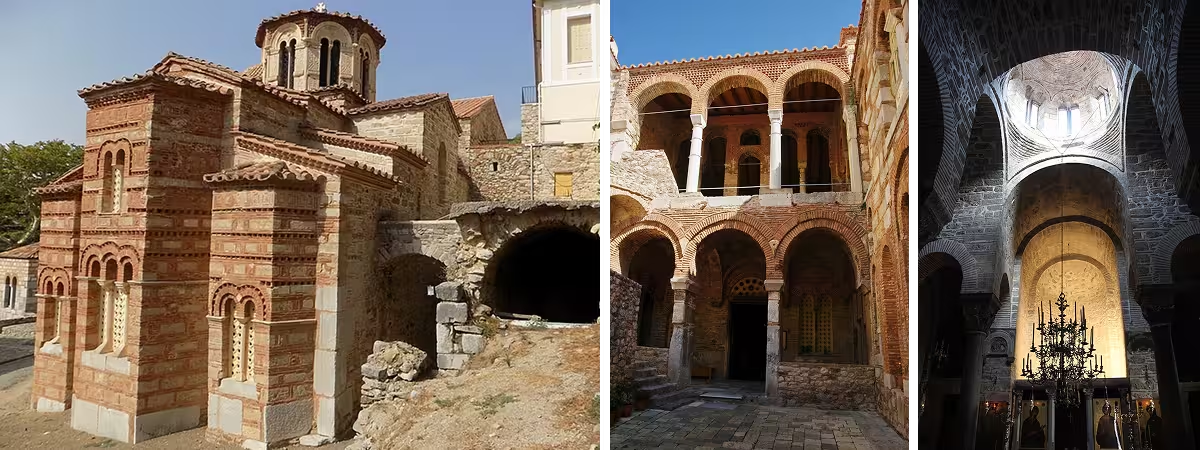
The main church was built in the first decades of the 11th century for a single purpose: to receive the saint’s relics. That function shaped both its plan, modelled on the martyria of early Christianity, and its decoration. Its ample square nave carries a gallery above and a crypt below. The dome, 8.98 m in diameter and about 5.22 m high, rests on a low sixteen-sided drum, carried by four large arches through four squinches, the corner niches that turn the square into an octagon. This plan, called the Greek-cross octagon, recurs in the most important 11th-century churches of Greece: the Soteira Lykodemou in Athens, Daphni, the church of Christianou in Triphylia, and in a modified form Nea Moni on Chios. Hosios Loukas is much larger than all of them and is generally seen as their model on the mainland.
Inside, side chapels, cross arms and nave open into one another through wide arches on marble columns and triple arcades. Coloured marble revetment covers the lower walls, mosaics on gold ground fill the vaults and conchs above, and an inscription names the monk Gregorios as the man responsible for the marble work. The effect is of a single space dissolving into light, in sharp contrast with the massive cube of the exterior.
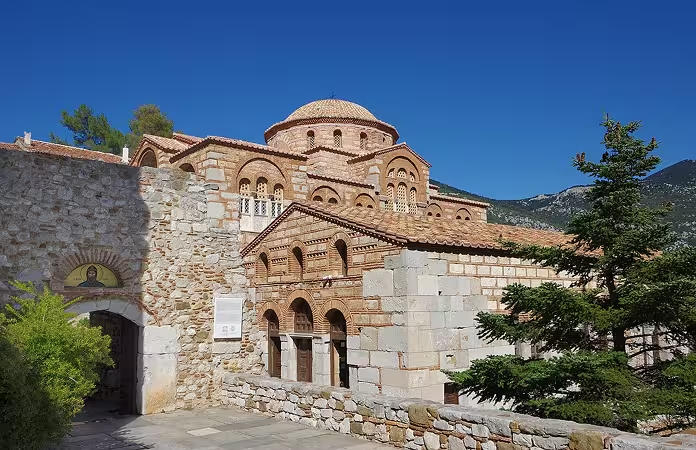
Katholicon seen from the exterior. @ Berthold Werner, CC BY-SA 3.0 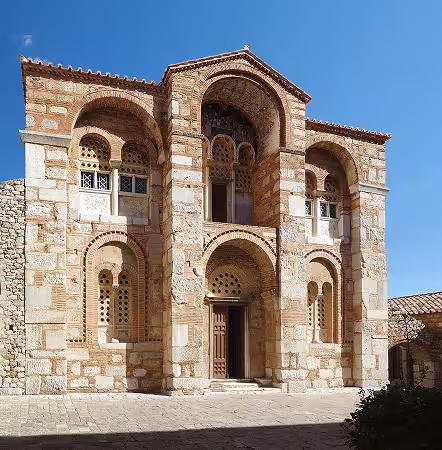
Facade. @ Berthold Werner, CC BY-SA 3.0 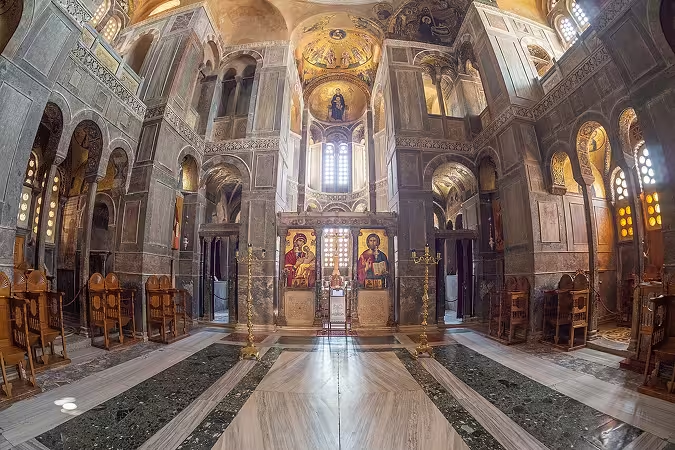
Interior facing the apse. @ C Messier, CC BY-SA 4.0 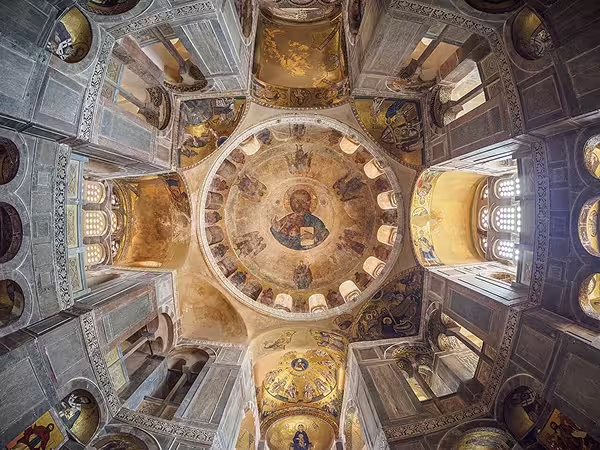
View of the dome. @ C Messier, CC BY-SA 4.0
The tomb, the shrine and the pilgrims
The architecture becomes clear once you follow the relics. The saint’s original tomb lies in the crypt, against the north wall. Directly above it, on the ground floor of the Katholikon, his marble shrine stands at the junction of the north arm of the cross and the north-east chamber, precisely where the Katholikon meets the older Panagia. Doors linked this chamber to the Panagia’s narthex, so that pilgrims could walk round the shrine and leave through the other church without crossing the nave. The small chapel beside it, now dedicated to St Charalambos, probably served for incubation, the practice of sleeping near the relics while waiting for a cure. The custom was still alive in the 1670s, when the travellers Jacob Spon and George Wheler described it.
Emperors or abbots? Who built the Katholikon
The monastery’s archives are lost, and no document from the time of the foundation survives. Into this gap stepped imperial legends. In 1436 Cyriac of Ancona recorded that Constantine IX Monomachos (1042–1055) had built the monastery. Two centuries later, the monks told Spon and Wheler that the founder was Romanos II, grateful for the Crete prophecy, and that he and his wife Theophano lay in the tombs of the crypt. Already in the 1870s the historian Georgios Kremos doubted these stories, which rest on no earlier source.
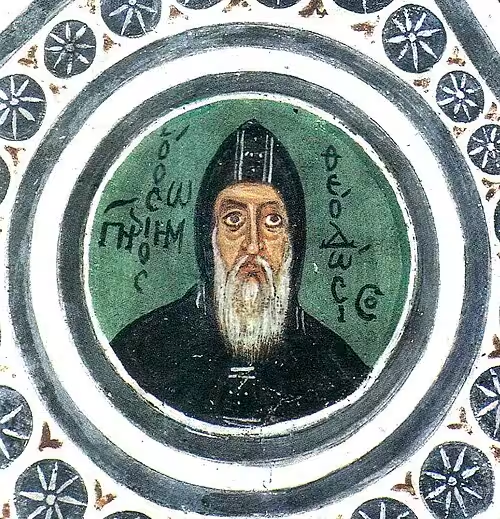
The texts of the monastery itself tell a different story. The liturgical service for the translation of the relics, still celebrated every 3 May, records that the relics were moved to the new church on 3 May of either 1011 or 1022, on the initiative of the abbot Philotheos. The Katholikon must have been finished by then. Philotheos is otherwise unknown, but his face appears several times on the walls. In the north-east chamber, next to the shrine, a fresco shows him offering a model of the church to the saint, and in the crypt the same elderly figure with a receding hairline and a forked white beard is named by inscription. Two further clues support the earlier date. A mosaic of St Nikon Metanoeite, who died in 997, gives a lower limit. And the carved marble closely resembles that of the monastery’s dependency at Aliveri on Euboea, dated by inscription to 1014, which led Bouras to favour a date around 1011.
A second figure shaped the decoration. Theodore Leobachos, from a great noble family of Thebes – city which was starting to bloom thanks to the silk industry, became abbot and took the name Theodosios, as Nicolas Oikonomides showed from an inscription in the monastery. He is portrayed among the abbots in the crypt, and the choice of certain themes in the Katholikon, notably the prominence of the two military saints named Theodore, suggests he helped fund the programme. He was also among the founders of the Confraternity of the Virgin of Naupaktos in Thebes, whose rule placed the abbot of Hosios Loukas immediately after the emperors, the patriarch and the metropolitan in its prayers. The same document, dated to 1048, mentions a priest of Daphni, one of the earliest written traces of that monastery.
What can be said, and what cannot
Most scholars now follow Manolis Chatzidakis in crediting the Katholikon to Abbot Philotheos, with abbots drawn from the Theban nobility funding the decoration over a generation. Some, including Stikas and Mylonas, still attribute the Katholikon to Constantine Monomachos. An imperial gift to an already flourishing monastery under Monomachos cannot be ruled out, nor can a role for Romanos II in the first church. What has no support is the tradition that Romanos and Theophano are buried in the crypt: its two tombs are now attributed to early abbots.
The decoration at a glance
The mosaics of the Katholikon
The mosaics are largely intact, except in the dome, which collapsed before 1593; the present painted Pantocrator probably repeats the lost composition. The programme follows the system developed in Constantinople after Iconoclasm, but bent to the needs of a martyrium. Feast scenes are few and placed where they count: the Nativity, the Presentation and the Baptism in three of the squinches (the Annunciation in the fourth is lost), the Crucifixion and the Anastasis flanking the door from the narthex, the Washing of the Feet and Doubting Thomas at its ends. Around them stand about 171 individual saints, a gallery of monks, bishops, martyrs and soldiers as rich as the illustrated menologia of the period. In the north arm, beside the shrine, Luke himself raises his hands in prayer, facing St Panteleimon, the healer saint who introduces the newcomer among the established saints. Chatzidakis places the mosaics between 1011 and about 1040, or slightly later if the translation took place in 1022. Their linear style, enormous eyes and stocky figures belong to artists trained in Constantinople, with the closest parallel in St Sophia in Kiev. They earned their place in the most beautiful surviving Byzantine mosaics and are the subject, scene by scene of our future guide to the mosaics of Hosios Loukas.
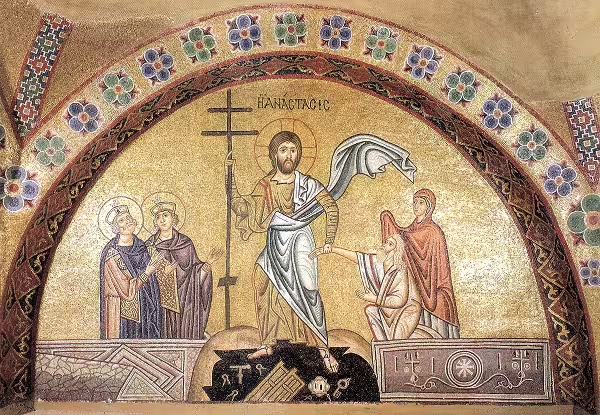
Resurrection (“Anastatis”). 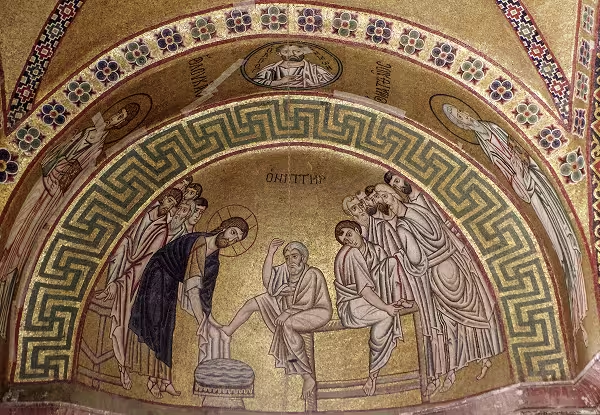
Washing of the feet (“Nipter”)
The crypt and its frescoes
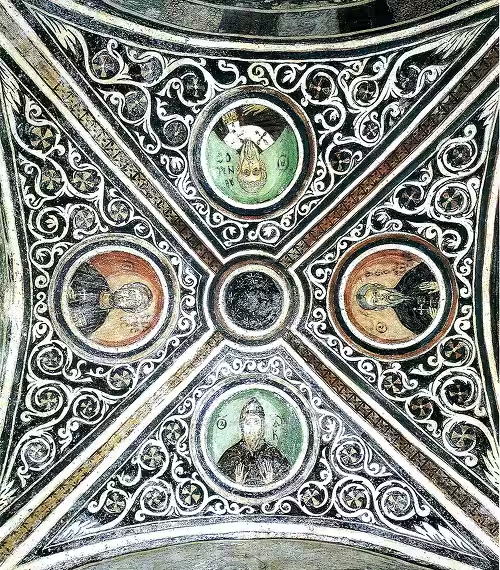
Beneath the Katholikon, and built with it, lies a crypt shaped like a small cross-in-square church, entered from the south. Against its north wall is Luke’s original tomb. Its walls carry a funerary programme painted in the same period as the church above: a Deesis in the apse, scenes of the Passion from the Entry into Jerusalem to the Entombment, Doubting Thomas, and the Dormition of the Virgin. The medallions of the vaults hold apostles, martyrs in civilian dress, desert fathers and, above the two tombs, a remarkable pairing. On one vault, St Luke appears with Sts Theodosios, Athanasios and Philotheos; on the opposite vault, four abbots of the monastery bearing the same names, among them Philotheos and Theodosios-Leobachos. The abbots are thus honoured beside their saintly namesakes, as the patriarchs are in Hagia Sophia. Cleaned by the Archaeological Service in the 1960s, they form, in Carolyn Connor’s assessment, the most complete programme of wall painting to survive from the Middle Byzantine period. Their technique is discussed in our hub on Byzantine monumental painting.
Chapels, galleries and later layers
Fresco, cheaper than mosaic, completed the decoration in the side chapels of the Katholikon. The north-west chapel, a funerary space with a tomb cut into its floor, holds a Transfiguration, a Crucifixion and the Ascension of Elijah in his fiery chariot. Later in the 11th century, paintings were added in the gallery and on the blind arcades of the façade, and some areas were repainted. Further work followed in the 12th century, and the Panagia received its frescoes at its end. Under Ottoman rule the monks repainted the rebuilt dome, probably in the 17th century, and added to the painted programme of the Katholikon as late as 1820. Reading the walls means separating these layers: the mosaics and the chapel and crypt frescoes belong to the first half of the 11th century, the dome painting does not.
The monastery beyond the churches
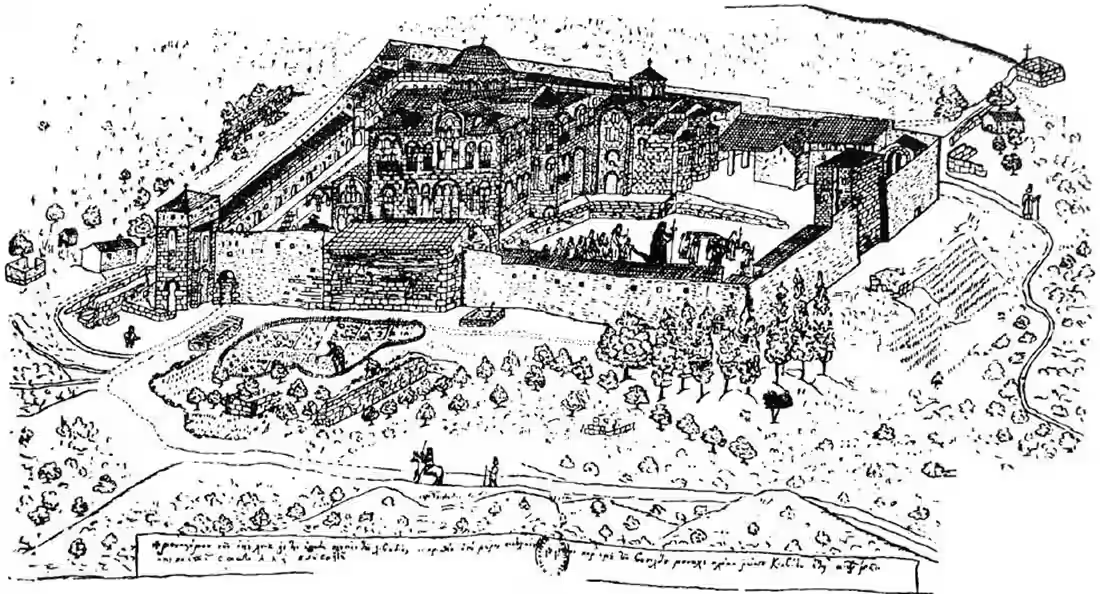
The churches stand at the centre of a larger complex. The monastery was originally fortified, though little of its enclosure wall survives. Its refectory dates from the 11th century; restored by the Archaeological Service, it has housed a collection of Byzantine sculpture since 1993. The bell tower contains a small domed octagon on two levels, built in the 11th century over an underground fountain fed by a cistern and once decorated with frescoes. Cells and service buildings surround the courtyard. In the 12th century an outer narthex was added to the Katholikon; the monks pulled it down during repairs in 1889–1890.
The monastery’s reach extended far beyond its walls. By 1014 it owned two dependencies on Euboea, at Aliveri and Politika, and it soon built another domed octagon for its dependency at Antikyra on the coast. In the 13th century, its dependency at Kambia in Boeotia received a small copy of the Katholikon, complete with a half-buried crypt. Luke’s portrait travelled even further: he appears in the Exultet Roll of Bari in the 11th century, and in 12th-century paintings in St Demetrios at Thessaloniki and at Koutsovendis in Cyprus.
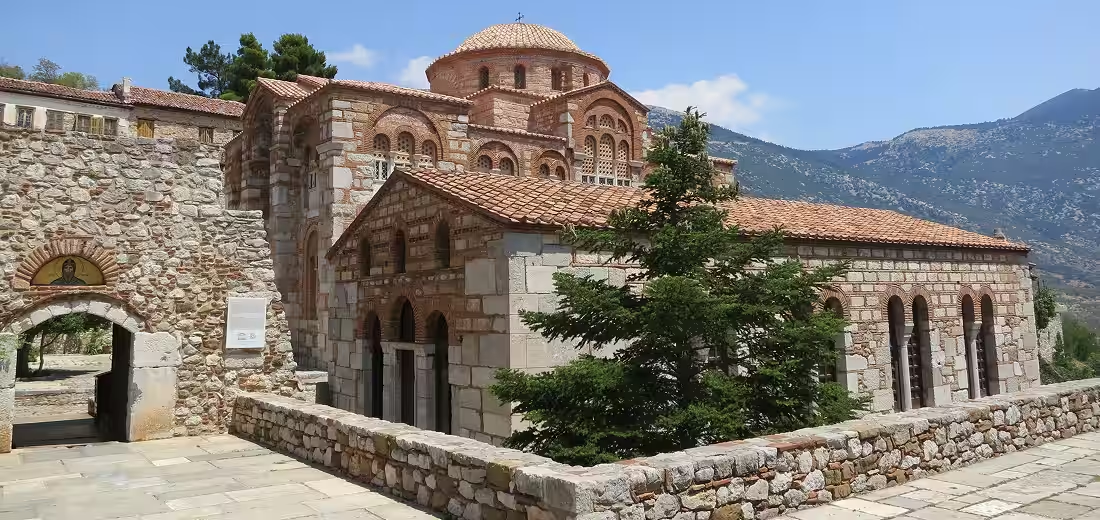
IMAGE PLACEHOLDERThe monastery courtyard with the refectory or bell tower (Wikimedia Commons — check licence).
After 1204: Latin canons, Ottoman rule and 1821
After the Fourth Crusade, central Greece fell under Latin rule. In 1206 the papal legate Benedict of Porto gave Hosios Loukas to the canons of the Holy Sepulchre, and Latin clergy occupied the monastery. When the Ottomans conquered the region, the monastery returned to Greek monks, who repaired and extended it over the following centuries. Their most important works were the rebuilding of the dome, which had collapsed before 1593, and the addition of a storey to the chapel that became the bell tower.
The saint’s body had its own history. According to the monastery, the relics stayed in the Katholikon until around 1460. From 1463 they were kept in the church of San Giobbe in Venice, venerated there as relics of Luke the Evangelist. They were identified as those of Luke of Steiris and returned to the monastery on 13 December 1986.
The monastery took part in the War of Independence, and Ottoman forces caused serious damage there in 1823. It was damaged again, and looted, during the Second World War, including bombing in 1943.
Restoration and recognition
Scholarly interest started early. The studies of Georgios Kremos (1874–1880), Charles Diehl (1889) and Robert Weir Schultz and Sidney Barnsley (1901) gave Hosios Loukas a central place in the study of Byzantine art. The Archaeological Service began a long programme of conservation in 1938. Anastasios Orlandos and Eustathios Stikas restored the refectory and other buildings, and Photis Zachariou cleaned and conserved the mosaics and frescoes. It was during this work that the Joshua painting came to light in 1964. In 1990, UNESCO inscribed the monastery on the World Heritage List together with Daphni and Nea Moni, as masterpieces of the same moment in Byzantine art.
The most recent threat came from wildfire. On 23 August 2023, a fire reached the monastery, burned part of its courtyard and badly damaged one of the buildings of the south-east wing; the churches were spared. In 2026 the Region of Central Greece announced €2.4 million for the restoration of that wing.
Visiting Hosios Loukas today
The monastery lies about two hours’ drive from Athens and can be combined with Delphi in a day. It is both a working monastery and an cultural site: the two churches, the crypt and the refectory are visited with one ticket. Shoulders and knees should be covered.
A sensible route follows the logic of the building. Start outside the east end of the Panagia, to see the cloisonné masonry and the pseudo-Kufic brick friezes. Enter the Katholikon through its narthex, where the Crucifixion and the Anastasis greet you on either side of the door, then stand under the dome to take in the squinches and the marble. Look for Luke and Panteleimon facing each other in the two arms of the cross, and the shrine at the north-east corner. Finish in the crypt, through its entrance on the south side, and in the refectory with its sculpture.
What you will not see needs to be known in advance. The dome mosaic is lost and the Pantocrator above you is a later painting. The Joshua fresco that settled the chronology lies in a part of the wall once covered by marble. And the two buildings that stood over the first tomb, the cruciform oratory and the church of St Barbara, cannot be pointed to on the ground at all.
Hosios Loukas belongs with the two other monasteries of the same UNESCO listing. Daphni, on the edge of Athens, has the more classical mosaics; our Byzantine Athens visitor guide places it on a route with the churches of the city.
Daphni impresses by its mosaics, Nea Moni by its imperial pedigree. Hosios Loukas tells a different story: a provincial holy man, a community that grew around his grave, and abbots from the Theban nobility who turned a tomb into one of the great interiors of Byzantium. It is the oldest and largest of the three, and the only one whose every wall still points back to the man buried below it.
Frequently asked questions
Who was Hosios Loukas?
Hosios Loukas, “the Blessed Luke”, was Luke of Steiris (896–953), a hermit of central Greece known as a healer and a prophet. He settled at the site around 946 and was buried there. The monastery grew around his tomb.
Is Hosios Loukas Saint Luke the Evangelist?
No. He is a 10th-century monk, also called Luke the Younger to distinguish him from the Evangelist. His relics were in fact venerated in Venice as those of the Evangelist until they were identified and returned to the monastery in 1986.
When was the monastery built?
The community dates from about 946. The Church of the Panagia was built in the second half of the 10th century, and the Katholikon was completed by 1011 or 1022, when the saint’s relics were moved into it. Its mosaics date from the first half of the 11th century.
Which church is older?
The Panagia. A wall painting of the Panagia found in 1964 under the marble of the Katholikon proved that the Katholikon was built against the older church.
Is Hosios Loukas still an active monastery?
Yes. It is home to an Orthodox monastic community and is also open to visitors as an archaeological site.
How far is Hosios Loukas from Delphi and Athens?
It is about 36 km by road from Delphi and roughly two hours’ drive from Athens, which makes it an easy stop on the way to or from Delphi.
Sources and further reading
- Chatzidakis, Nano. Hosios Loukas (Byzantine Art in Greece: Mosaics, Wall Paintings), Melissa, Athens, 1997.
- Oikonomides, Nicolas. “The First Century of the Monastery of Hosios Loukas”, Dumbarton Oaks Papers 46, 1992, pp. 245–255.
- Connor, Carolyn L. Art and Miracles in Medieval Byzantium: The Crypt at Hosios Loukas and Its Frescoes, Princeton University Press, 1991.
- Connor, Carolyn L., and W. Robert Connor. The Life and Miracles of Saint Luke of Steiris: Text, Translation and Commentary, Hellenic College Press, Brookline, 1994.
- Chatzidakis, Manolis. Studies on the dating of the Katholikon, 1969 and 1972. ⚠ CHECK full references
- Stikas, Eustathios. Το οικοδομικόν χρονικόν της Μονής Οσίου Λουκά Φωκίδος, Athens, 1970. ⚠ CHECK title
- Bouras, Charalambos. Study of the architecture of Hosios Loukas, 1994, and The Architecture of the Monastery of Hosios Loukas (posthumous). ⚠ CHECK both references
- Demus, Otto. Byzantine Mosaic Decoration: Aspects of Monumental Art in Byzantium, London, 1948.
- Van Tricht, Filip. The Latin Renovatio of Byzantium: The Empire of Constantinople (1204–1228), Brill, 2011, p. 450.
- UNESCO World Heritage Centre, “Monasteries of Daphni, Hosios Loukas and Nea Moni of Chios”, whc.unesco.org/en/list/537.
Cover image credits: @ bradhostetler, CC BY-SA 2.0


3 Comments