Constantine XI Palaiologos: The Despot of Mystras who became the last Roman Emperor
Constantine XI Palaiologos was the last emperor of the Romans, and spent most of his adult life not as an emperor but as a provincial prince in the Peloponnese. As Despot of the Morea from 1428 he took Patras, rebuilt the Hexamilion wall across the Isthmus of Corinth and pushed Byzantine rule into Attica and Boeotia — until an Ottoman army undid it all in a single campaign in 1446. Proclaimed emperor at Mystras in January 1449, he reached a capital of between 40,000 and 50,000 people, with no heir, a divided Church and no army worth the name. Four years later, on 29 May 1453, he died as Mehmed II’s troops broke through the land walls. His body was never securely identified, and that uncertainty turned a defeated ruler into the “marble emperor” of Greek legend.
Quick facts
Born
8 February 1405, Constantinople (the year 1404 is also given in recent literature)
Reign
1449–1453 · proclaimed at Mystras 6 January 1449, in Constantinople from 12 March 1449
Parents
Manuel II Palaiologos and Helena Dragaš
Dynasty
Palaiologan
Before the throne
Despot of the Morea, 1428–1449; twice regent in Constantinople (1423–24, 1437–40)
Wives
Theodora Tocco (m. 1428, d. 1429); Caterina Gattilusio (m. 1441, d. 1442) — no children
Died
29 May 1453, Constantinople, in the final Ottoman assault
Remembered for
the last emperor of an unbroken Roman line; the Morea campaigns and the Hexamilion; proclaiming the Union of Florence in Hagia Sophia (12 December 1452); the unresolved fate of his body
Place in the list
90th of 90 · before: John VIII · after: none · every emperor from Constantine to Constantine XI
A fourth son with little hope of the throne (1405–1427)
Constantine was born in Constantinople in February 1405, the fourth son of Emperor Manuel II and of Helena Dragaš, daughter of the Serbian lord Konstantin Dejanović. The date itself is unsettled: the Oxford Dictionary of Byzantium gives 8 February 1405, while Donald Nicol and Marios Philippides, the emperor’s two modern biographers, place his birth a year earlier. He would later add his mother’s family name to his own and sign himself Dragases — an unusual gesture for a Palaiologos, and one that historians usually read as a sign of how close he remained to her. Helena would outlive her husband by a quarter of a century and decide, in the end, which of her sons became emperor.
The family Constantine grew up in was the ruling house of a state that had almost run out of land to rule. By the early fifteenth century the empire consisted of the capital, a few Aegean islands, a stretch of the Thracian coast and the Peloponnese, and Manuel II governed it by sharing it among his sons as appanages: John, the eldest, as co-emperor and heir; Theodore as Despot of the Morea; Andronikos as Despot of Thessalonike from 1408. The three youngest — Constantine, Demetrios and Thomas — stayed in Constantinople because there was nothing left to give them.
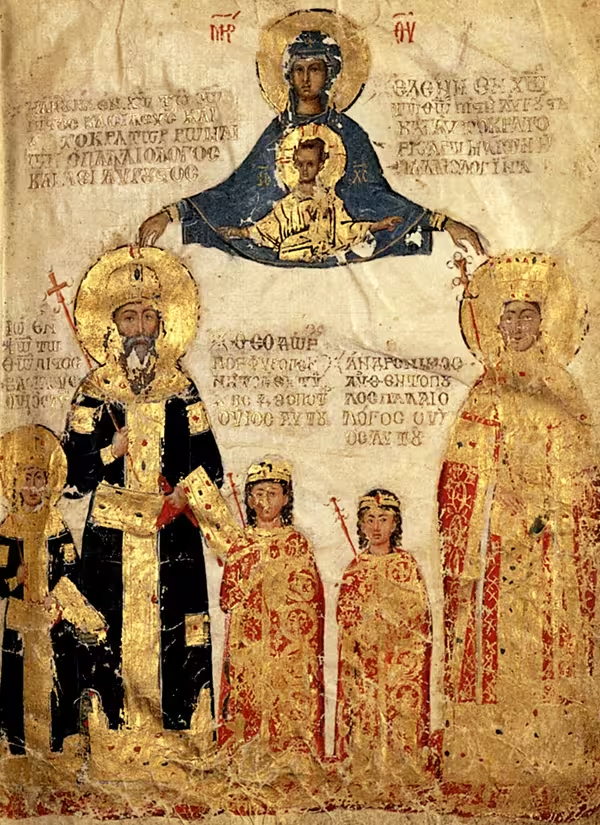
Little is known of Constantine’s youth, and most of what was later written about it was written by admirers after 1453. What is documented is that his eldest brother trusted him early. When John VIII left for Venice and Hungary in November 1423 to look for Western help, he left the twenty-year-old Constantine behind as regent; with their father, already paralysed by a stroke, Constantine negotiated a truce with Sultan Murad II before John returned empty-handed in November 1424. On Manuel’s death in 1425, Constantine received a strip of Black Sea coast north of the capital, from Mesembria down to Derkos, together with the port of Selymbria — small, but close to the city and strategically sensitive, which says something about the confidence placed in him.
The Palaiologan family, from Manuel II to the last heirs
The tree below follows the family through the last half-century of Byzantium. None of Constantine or his five brothers left a son who would rule, and the dynasty’s only continuation ran through Thomas’s children — one of whom married into the grand princes of Moscow.
Despot of the Morea: twenty years of reconquest (1428–1449)
The Peloponnese — the Morea, in the medieval name — was the one region where Byzantium was still gaining ground in the early fifteenth century. Its capital Mystras had become the liveliest Greek city of the age, and the peninsula’s remaining Latin lordships were weak enough to be picked off. Constantine spent the best part of twenty years there, first as one of three brother-despots and from 1443 as ruler of Mystras itself. For the wider story of the region, see our article on the Byzantine Peloponnese.
Glarentza, the Tocco bride and Patras (1428–1430)
Constantine came to the Morea at the end of 1427 with John VIII, on a campaign against Carlo I Tocco, the Italian ruler of Epirus who had occupied the northwest of the peninsula. After a Byzantine victory at sea off the Echinades islands, Tocco agreed to a settlement sealed by marriage: his niece — Creusa in recent scholarship, Maddalena in older works, renamed Theodora — was given to Constantine with Glarentza and the Tocco possessions in the Morea as her dowry. Glarentza was handed over on 1 May 1428 and the wedding took place on 1 July. On the Tocco family and their Epirote lands, see Byzantine Arta, jewel of the Despotate of Epirus.
His next target was Patras, the rich port held by its Latin archbishop, Pandolfo Malatesta. A first joint attempt by the three despots failed; Constantine then tried alone. He laid siege to the city on 20 March 1429, nearly died when his horse was killed under him, and was saved by his companion George Sphrantzes, who was taken prisoner in the process and released only in late April. The townspeople, largely Greek, accepted Constantine as their lord in the cathedral of St Andrew on 4 June 1429; the archbishop’s citadel held out until July 1430. The victory came at a price. A Catalan mercenary band hired by the dispossessed archbishop seized Glarentza instead, Constantine had to buy it back for 6,000 Venetian ducats, and he then had the town demolished rather than see it taken again. In November 1429, in the middle of these events, Theodora died; she was buried first at Glarentza and later moved to Mystras.
Three brothers, one peninsula
Constantine’s arrival made the despotate, created in 1349 for a single prince, into a shared condominium. Theodore II kept Mystras and refused to step aside; Constantine based himself at Glarentza and then, after an exchange with Thomas in 1432, at Kalavryta, while Thomas took Chlemoutsi and the lands of the old Principality of Achaea, which he acquired by marrying Catherine Zaccaria, heir of its last prince. By the early 1430s almost the entire Peloponnese was in Byzantine hands for the first time since 1204, with only a few Venetian ports outside it. It was largely, as Philippides has stressed, a conquest by marriage contracts as much as by arms.
The arrangement also bred rivalry. Since John VIII had no children, the next emperor would be one of his brothers, and it was well known that John preferred Constantine. Theodore, the elder, resented it: when Constantine was summoned to the capital in 1435, Theodore assumed he was about to be named co-emperor and hurried there to object. The quarrel threatened civil war until Gregory Mammas, the future patriarch, brokered a settlement at the end of 1436.
Regent during the Council of Florence (1437–1440)
Constantine reached Constantinople on 24 September 1437, and when John VIII sailed for Italy in November to negotiate the union of the Churches, he again left Constantine as regent — not proclaimed co-emperor, but clearly marked out as heir. Their mother Helena, George Sphrantzes and the statesman Loukas Notaras stayed to advise him, while the troublesome Demetrios was taken to Italy precisely so that he could not exploit the emperor’s absence. The regency passed quietly; Murad II was campaigning in Serbia. John returned on 1 February 1440 with the decree of Union signed at Florence, and the hostility it met in the city set the terms of everything that followed. Constantine, by every indication, accepted his brother’s logic: if the independence of the Church was the price of a Western crusade, it was worth paying.

In the summer of 1441 he married again, choosing Caterina Gattilusio, daughter of the Genoese lord of Lesbos. The marriage lasted barely a year. In 1442 Demetrios, now posing as champion of the anti-unionists and backed by Ottoman troops, marched on Constantinople; Constantine sailed to his brother’s aid with Caterina, but the couple were trapped on Lemnos by an Ottoman blockade, and there, in August 1442, Caterina fell ill and died. She was buried at Myrina. Constantine reached the capital only in November, after the danger had passed.
The Hexamilion, Athens and Thebes, and the disaster of 1446
In November 1443 Theodore gave up the Morea for Selymbria, and Constantine at last took Mystras, sharing the despotate with Thomas, who probably resided at Leontarion. Mystras under Theodore had become a centre of learning — the Platonist philosopher George Gemistos Plethon worked there, and served Constantine too — and the two brothers set out to make the peninsula defensible on its own. Their first project was the Hexamilion, the wall across the Isthmus of Corinth first built in the early fifth century, restored by Manuel II in 1415, breached by the Turks in 1423 and demolished on Murad II’s orders in 1431.
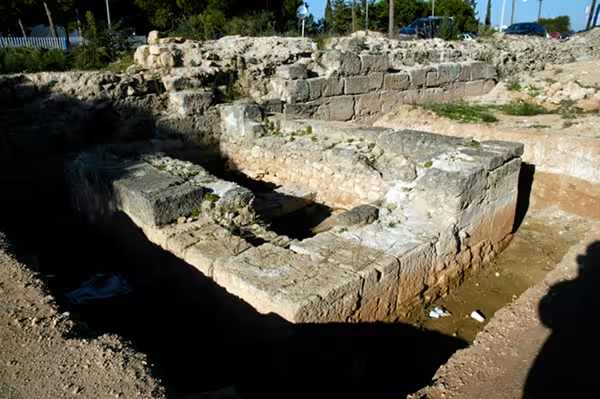
@ Nefasdicere, CC BY-SA 3.0
Constantine and Thomas rebuilt it in 1443–44, at a cost in money and labour that drove some Moreot landowners to flee to Venetian territory rather than pay. A prophecy circulating soon afterwards, possibly even inscribed on the wall, promised that it would shelter a revived empire.
In the summer of 1444, encouraged by news of the crusade setting out from Hungary under Władysław III and Cardinal Cesarini, Constantine went on the offensive. He took Athens and Thebes and forced Nerio II Acciaiuoli, the Florentine Duke of Athens, to pay tribute to him instead of the sultan (on the city in this period, see Byzantine Athens). The crusade was destroyed at Varna on 10 November 1444, but Constantine pressed on regardless: reinforced by 300 soldiers sent by Philip the Good of Burgundy, he raided as far north as the Pindus mountains in Thessaly.
The answer came in 1446. Murad II marched south with a large army — perhaps 60,000 men in Nicol’s estimate — and reached the Hexamilion on 27 November. This time he brought cannon. By 10 December the wall was rubble and most of its defenders were dead or captured; Constantine and Thomas barely escaped. Ottoman troops devastated the peninsula, though they failed to take Mystras, and the despots had to accept Murad as overlord, pay tribute and promise never to rebuild the wall. Within a few weeks, nearly everything Constantine had built since 1428 outside the Peloponnese was gone. You can still visit his former capital: see our guide to Byzantine Mystras.
Choosing the last emperor (1448–1449)
Theodore died in June 1448 and John VIII on 31 October of the same year, childless after three marriages. There was no law of succession in Byzantium — as our guide to imperial power explains, legitimacy came from acclamation, coronation and the ability to hold the throne — and in 1448 three brothers were available. Thomas, close to Constantine, made no claim. Demetrios did, and had the advantage of being in or near the capital and of being an open opponent of the Union, which made him the candidate of a large part of the population. The decision was made by their mother. Helena Dragaš invoked her right to act as regent until her eldest surviving son arrived, blocked Demetrios, and imposed Constantine, who had John’s known preference behind him. Because the Morea was an Ottoman tributary and the empire itself lived on sufferance, the choice was also communicated to Murad II, who accepted it.
Two envoys, Manuel Palaiologos Iagros and Alexios Philanthropenos Laskaris, were sent to the Morea to proclaim him. On 6 January 1449, at Mystras, Constantine was proclaimed Emperor of the Romans. He sailed for the capital on a Catalan ship and entered Constantinople on 12 March 1449.
Was Constantine XI ever crowned?
He was never crowned in Hagia Sophia, the traditional setting for an imperial coronation — that much is agreed. What happened at Mystras is less clear. The Oxford Dictionary of Byzantium states simply that he was crowned there on 6 January 1449, and a local tradition places the ceremony in the Metropolis of St Demetrios. Many historians read the event differently. Donald Nicol describes a small civil proclamation, without a crown and without a patriarch, in which Constantine may have placed an imperial headdress on his own head; Alexander Vasiliev, following Spyridon Lampros’s edition of the writings of John Eugenikos, concluded that no coronation was ever formally performed. The strongest contemporary witness supports them: in September 1452 the anti-unionist Theodore Agallianos described the emperor as still uncrowned, because the Church was leaderless and divided by the Union.
The obstacle was political. Patriarch Gregory III Mammas was a unionist, and a coronation at his hands risked a riot. Precedent offered a way out — Manuel I Komnenos and John VI Kantakouzenos had both been proclaimed far from the capital — but both had later been crowned in Constantinople, and Constantine never was. He seems to have considered his proclamation sufficient: his earliest known chrysobull, of February 1449, already styles him true emperor and autocrat of the Romans in Christ. Whether that amounts to a coronation is a question of definition as much as of evidence.
An emperor of one city (1449–1453)
The Constantinople Constantine came back to was no longer the city of the great emperors. It had never recovered from the sack of 1204, the civil wars of the fourteenth century and repeated plague; its population had shrunk to between 40,000 and 50,000, living in clusters of settlement separated by fields and ruins, and the emperors resided at the Blachernae palace near the land walls rather than the abandoned Great Palace. Everything beyond the walls — the Thracian countryside, the Bosphorus shores — was effectively Ottoman. The state Constantine governed was, for practical purposes, a city-state with a distant province in the Peloponnese. For the context of the period, see the late Byzantine period.
Brothers and a civil war in the Morea
Two weeks after his arrival, Constantine obtained a truce from Murad II that covered his brothers in the Morea as well. To keep Demetrios away from the capital he made him despot in his own place, with Mystras and the south and east of the peninsula, while Thomas held the northwest. It solved one problem by creating another. The two despots, one pro-Turkish and anti-unionist, the other a Latinophile, went to war with each other in 1449–50, and Constantine had to mediate a settlement — an arbitration recorded by the historian Laonikos Chalkokondyles.
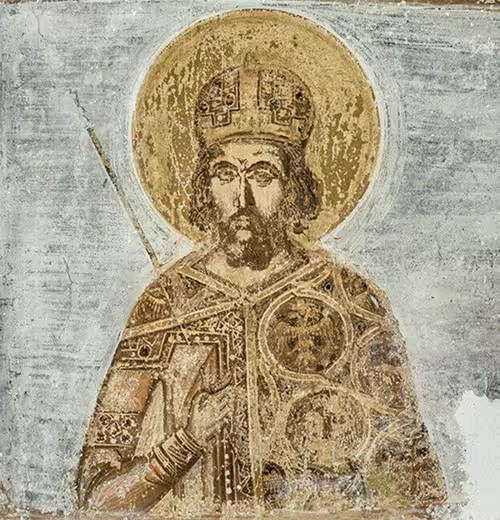
The brothers’ subsequent generosity to a monastery near Aigio is now linked to the portrait of Constantine discovered in its church in 2024, discussed further below.
On 23 March 1450 Helena Dragaš died as the nun Hypomone. Gemistos Plethon and Gennadios Scholarios, who agreed on almost nothing else, both wrote funeral orations for her. Her death removed the one adviser whom everyone at court deferred to, and left Constantine between rival counsellors: the megas doux Loukas Notaras, effectively first minister, who believed the walls would hold until the West arrived, and Sphrantzes, far more cautious about provoking the Turks. On the families who still dominated the court, see the Byzantine aristocracy.
The search for a third wife
Neither Constantine nor his brothers had a son, and the reign’s diplomacy was partly a search for an empress. In February 1449 an envoy went to Alfonso V of Aragon and Naples to seek both military aid and the hand of Beatrice of Coimbra; nothing came of it. In October Sphrantzes left for Trebizond and Georgia with a retinue of clergy, nobles and musicians, and was away for nearly two years. While at Trebizond he learned that Murad II had died, and proposed a bold alternative: marriage to Murad’s widow, the Serbian princess Mara Branković, which might have tied the new sultan’s hands. Constantine was willing; Mara was not, having vowed to live in chastity once freed from the Ottoman court. Sphrantzes came back in September 1451 with a Georgian ambassador and a plan for a Georgian match, but the crisis of 1452 meant he never returned to conclude it.
Money, Orhan and the throat-cutter
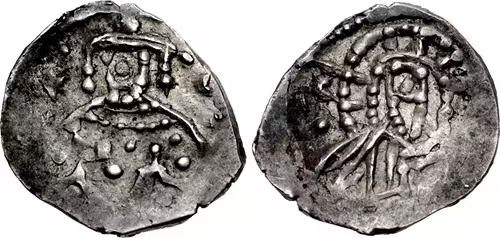
The treasury was almost empty. Constantine raised duties on Venetian imports, which led Venice to threaten in 1450 to move its trade elsewhere and to sign its own treaty with Mehmed II in 1451. He struck a new silver coinage early in the reign — the stavrata discussed below — and courted Ragusa to annoy the Venetians. His most serious misjudgement came in 1451, after the young Mehmed II succeeded Murad. Constantinople held Orhan Çelebi, a member of the Ottoman house and a potential rival claimant, for whose custody the sultan paid an annual sum; Constantine’s government complained that the payment was insufficient and hinted that Orhan might be released. The grand vizier Çandarlı Halil Pasha, long the Byzantines’ best friend at the Ottoman court, was appalled. Mehmed treated it as a breach of the truce. In the spring of 1452 he began building Rumeli Hisarı on the European shore of the Bosphorus, completed in August; when Constantine protested, he was told he owned nothing beyond his walls. In a moment of anger Constantine closed the gates and arrested the Turks in the city, then released them three days later. How the conflict escalated into war is told in our account of the fall of Constantinople.
Classical Numismatic Group, Inc., CC BY-SA 3.0
The Union proclaimed in Hagia Sophia (12 December 1452)
John VIII had signed the Union and never implemented it; Constantine inherited the problem and the bill. Pope Nicholas V made it clear in September 1451 that Western help depended on the Union being fully enforced, with the pope commemorated in the churches and the unionist patriarch Gregory III — who had left the city — reinstated. Constantine tried to buy time, forwarding to Rome the anti-unionist proposal for a new council, and resisted Leonard of Chios’s advice to arrest the opposition’s leaders. The papal legate, Cardinal Isidore of Kiev, arrived on 26 October 1452 with Leonard and 200 archers, and on 12 December 1452 the Union was solemnly proclaimed in a liturgy in Hagia Sophia. The Oxford Dictionary of Byzantium calls him a pragmatist who accepted the Union in the hope of military aid. Philippides is harsher: the gesture alienated much of the population and brought almost nothing in return. Both readings fit the outcome.
The emperor in the siege of 1453
The siege itself — Orban’s cannon, the chain across the Golden Horn, the ships dragged overland behind Galata — is told in full in our article on the fall of Constantinople in 1453. What concerns us here is what the emperor himself did. Through the winter of 1452–53 he had the land walls repaired, sent ships to the islands for supplies, and handed out commands, with Notaras on the Golden Horn and the Venetians guarding four of the land gates. In January 1453 the Genoese condottiere Giovanni Giustiniani Longo arrived with 700 men; Constantine made him protostrator, gave him command of the land walls and promised him Lemnos — which had already been promised to Alfonso of Naples.
Once the siege began on 6 April, money ran out quickly. On the emperor’s orders, silver vessels were taken from churches and private houses and melted down to pay soldiers and buy food, with a promise to repay the clergy fourfold after victory. Constantine offered tribute in exchange for a withdrawal; Mehmed replied by offering him the Peloponnese if he surrendered the city. Doukas reports that he answered “As to surrendering the city to you, it is not for me to decide or for anyone else of its citizens; for all of us have reached the mutual decision to die of our own free will…” He also refused when some of his own counsellors urged him to escape and carry on the war from the Morea. Other famous phrases attributed to him in these weeks reach us through later chroniclers, and should be read as such.
The same caution applies to his last speech to the commanders on 28 May. The most reliable version is the paraphrase sent to the pope by Leonard of Chios within weeks of the fall. The longer, more eloquent text long attributed to Sphrantzes comes from the Chronicon Maius, which is not Sphrantzes’ memoir but a sixteenth-century expansion of it by Makarios Melissenos, metropolitan of Monemvasia, written in Naples; it depends partly on Leonard’s text. Margaret Carroll argued that parts of the siege narrative in the Maius preserve genuine Sphrantzes material; Philippides rejects this. What is well attested is that on the evening of 28 May Constantine received communion in Hagia Sophia, asked forgiveness of those present, and went to inspect the walls. A later tradition holds that he also prayed that day in the church of St Theodosia, today’s Gül Camii.
How did Constantine XI die? What the sources actually say
Constantine was killed on 29 May 1453, during or shortly after the Ottoman breakthrough at the land walls. Beyond that, nothing is certain. No one from his entourage survived to give a credible account, and no reliable eyewitness of his death is known. Most writers, Christian and Muslim, agree that he died in the fighting; a few claimed he escaped; Ottoman sources say he was beheaded. The table sets out the principal witnesses, from the closest to the furthest from the event.
| Source | Who and where | What he reports |
|---|---|---|
| George Sphrantzes, Chronicon Minus | Constantine’s lifelong companion, in the city, captured | Only that his master was killed in the capture of the city. He was not present at the death. |
| Nicolò Barbaro | Venetian ship’s doctor, kept a diary of the siege | No one knew whether the emperor died or escaped; some said his body was seen among the dead, others that he hanged himself when the Turks broke in at the St Romanos gate. |
| Leonard of Chios | Latin archbishop of Mytilene, captured and escaped; wrote to the pope in summer 1453 | After Giustiniani’s departure the emperor begged his officers to kill him rather than let him be taken; no one would, and he fell in the press, rose, and was trampled. |
| Jacopo Tedaldi | Florentine merchant who fought in the last assault | Some said his head was cut off, others that he died in the crush at the gate — perhaps both were true. |
| Cardinal Isidore of Kiev | Papal legate, escaped disguised as a slave | Killed fighting at the St Romanos gate; heard that his head was taken to Mehmed, who mocked it and carried it to Adrianople. |
| Benvenuto, consul of Ancona | In the city | Heard from a soldier that the head was presented to the sultan on a lance. |
| Nicola Sagundino | Venetian, reported to Alfonso V in 1454 | Refused to flee, asked his officers to kill him, threw off his regalia so as not to be recognised, and vanished into the fighting sword in hand. Adds that the head was later sent to the Mamluk sultan of Egypt. |
| Tursun Beg | Ottoman official in Mehmed’s army | The emperor fled towards the harbour, ran into a band of marines, wounded one and was beheaded. |
| Kritoboulos of Imbros | Greek historian, later in Mehmed’s service | Died fighting. His heroic version became the accepted one in the Greek world. |
| Doukas; Laonikos Chalkokondyles | Greek historians writing in the following decades | Elaborate the story of the severed head and its presentation to the sultan. |
| Ibn Kemal | Ottoman historian, early 16th century | Like Tursun Beg: beheaded by a giant marine who did not know who he was. |
Read together, the sources suggest a probable core and a large halo. Nicol, who collected them most thoroughly, concluded that Constantine almost certainly died in the fighting near the St Romanos gate and that his body was probably found and decapitated afterwards. The rest — the cast-off insignia, the final charge, the dying words — belongs to a story that began to form within weeks. Gennadios Scholarios, soon to be the first patriarch under Ottoman rule, noted the symmetry that would dominate later memory: the city founded by a Constantine son of Helena had been lost under another Constantine son of Helena.
A body without a grave
No tomb of Constantine XI is known, and none is likely to be found. If his head was displayed and sent away as a trophy, the rest of the body was probably buried anonymously with the other dead. That did not stop the search. In the nineteenth century visitors to Istanbul were shown a humble, nameless grave in the Vefa quarter, lit by an oil lamp and venerated by local Greeks as the emperor’s; Vasiliev dismissed it as baseless, and the story that the Ottoman government paid for the lamp oil is equally unfounded. Another tradition placed the tomb in a pier chamber of Gül Camii, the former church of St Theodosia, where local Muslims honoured the same coffin as that of the holy man Gül Baba. Neither claim has any evidence behind it. The absence of a tomb became the foundation of a legend.
How we know his face
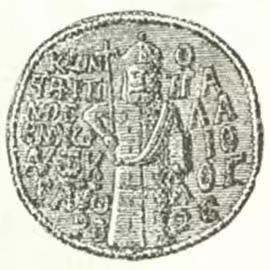
For most of the twentieth century, historians believed that no image of Constantine XI made in his lifetime survived. Three kinds of evidence have changed that picture. The first is coins. Contemporaries said that Constantine minted silver, including from melted church plate during the siege, but none of his coins was known until 1974, when the numismatist Simon Bendall identified two half-stavrata, one of them previously catalogued as a coin of John VIII. In 1991 Bendall published a hoard that brought the total to about ninety pieces: stavrata, half-stavrata and tiny eighth-stavrata, with the bust of Christ on one side and a crowned, very schematic emperor on the other.
Some were evidently struck early in the reign; the crudest are thought, though not proven, to be siege issues, which would make them the last coins of the Roman Empire. The second is a seal now in Vienna, of unknown provenance, probably detached from a chrysobull.
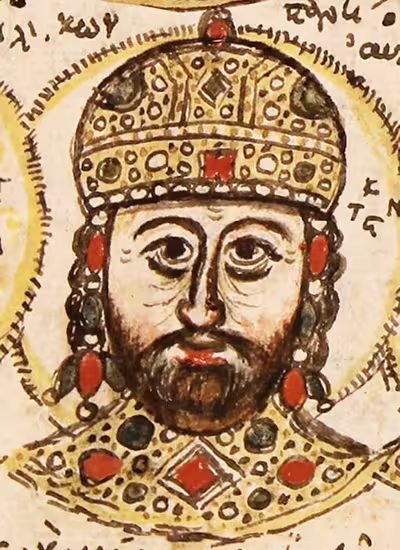
The third is painted. The emperor appears among the imperial portraits in a fifteenth-century manuscript of Zonaras’s history in the Biblioteca Estense at Modena, made after his death; he is shown there with a rounded beard, unlike his fork-bearded relatives, though no one can say whether that reflects his appearance.
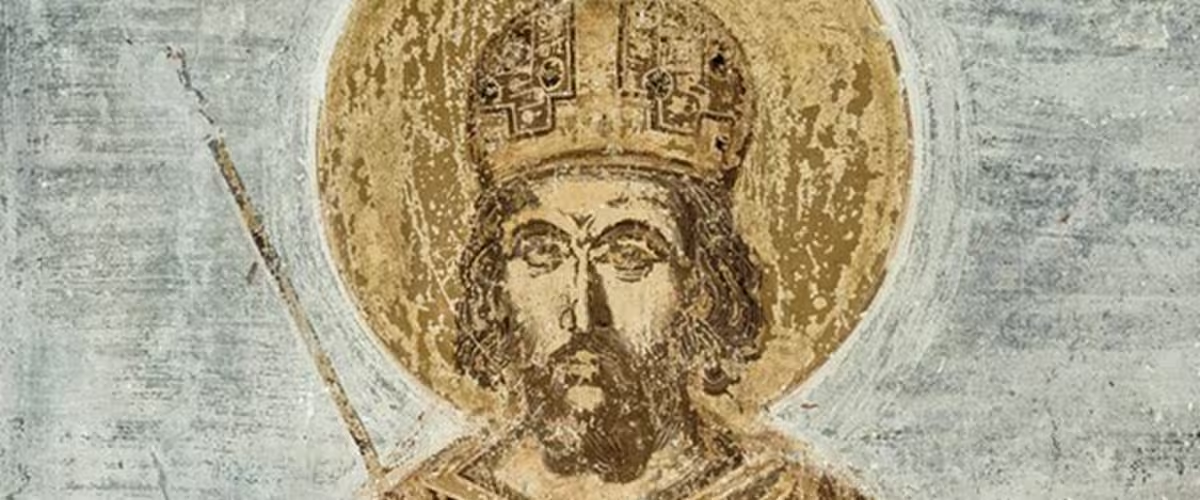
And in 2024, restorers working in the old monastery of the Taxiarches near Aigio found a mid-fifteenth-century portrait of an emperor in Palaiologan regalia that the Greek Ministry of Culture has identified as Constantine XI, painted in his lifetime and possibly from life. The full story of that discovery is told in our article on the fresco of Constantine XI found at Aigialeia.
From last emperor to marble emperor
The legend grew from the gap in the sources. A Greek lament of the 1450s, The Capture of the City, already asks the dead emperor whether he is alive or fell by his own sword, and wishes he were hidden under the hand of God. Chalkokondyles closed his history with the hope of a future Christian emperor of the Greeks. By the end of the fifteenth century the idea had taken a fixed shape: Constantine had not died but been rescued by an angel at the moment of death, turned to marble and hidden in a cave beneath the Golden Gate, where he waits for the call to wake, take back his sword and drive the Turks back to the Red Apple Tree, their legendary homeland. The Cretan painter Georgios Klontzas illustrated the whole cycle in seventeen miniatures in 1590, and in 1625 the English ambassador Thomas Roe found the Ottomans unwilling to let him take stones from the walled-up Golden Gate, out of an evident superstitious dread of the place.
The Marmaromenos Vasilias survived the Ottoman centuries and entered modern Greek politics. After independence, Constantine became an “ethnomartyr”, a national martyr whose stand on the walls prefigured the Greek state; when King George I named his heir Constantine in 1868, many Greeks hailed him in due course as Constantine XII, and his victories in the Balkan Wars seemed for a moment to bring the prophecy within reach. The dream ended with the defeat of 1922, the story of which is told in our article on 1453 and its echoes. Constantine has never been formally canonised. He died in communion with Rome after proclaiming the Union, and under Ottoman rule any official cult would have been an act of rebellion; popular veneration as a saint and martyr has nonetheless persisted, and the statue of him in Athens’ cathedral square stands with the blessing of the Church. His mother, by contrast, is venerated as Saint Hypomone. Athens has two statues of the last emperor — the other a colossal horseman on the Palaio Faliro seafront — and none of Basil II or Alexios I Komnenos, who were far more successful and died in their beds.
IMAGE — Codex Mutinensis portrait of Constantine XI (Biblioteca Estense, Modena; public domain). New alt text and caption: this image already appears on the fresco article.
Historians have been less unanimous than the statues. Čedomilj Mijatović’s 1892 biography, dedicated to the young Greek crown prince Constantine, read as open support for the Greek cause; Steven Runciman’s The Fall of Constantinople (1965) made Constantine a tragic hero while blaming him for the Orhan provocation; Apostolos Vacalopoulos saw in him the personification of the nation. Donald Nicol’s The Immortal Emperor (1992), the first full life, examined the Morea years seriously but kept the tragic frame. Marios Philippides’s 2019 biography is the counterweight: in his reading Constantine was neither a great statesman nor an exceptional soldier, his Moreot gains came mostly by marriage, and he failed to win over his own subjects or the West. Reviewers, including Jonathan Harris, have welcomed the rigour while finding parts of the indictment speculative. What remains beyond dispute is narrower and perhaps more interesting: an energetic provincial ruler who inherited an impossible position, made at least one serious diplomatic blunder, and chose not to leave.
The end of the line
The Morea outlived Constantinople by seven years. Demetrios and Thomas went on quarrelling, each seeking outside help — Demetrios from the sultan, Thomas from the papacy and the Italian states — until Mehmed II conquered the peninsula in 1460. Demetrios surrendered Mystras, gave his daughter Helena into Mehmed’s household, and ended his life as the monk David at Adrianople in 1470, living on revenues from Ainos and several Aegean islands granted by the sultan. Thomas fled to Corfu and then to Rome, where he died on 12 May 1465 on a pension from Pius II. His son Andreas, heir to a title without a state, signed his rights to the empires of Constantinople and Trebizond over to Charles VIII of France. His daughter Zoe, renamed Sophia, married Ivan III of Moscow in 1472 — the marriage behind Moscow’s later claim to be the Third Rome. Constantine himself left no child; the widow and daughters that Western writers gave him, starting with Aeneas Silvius in July 1453, never existed. The Roman line that had begun with Augustus ended with him. Whether the Byzantines would have called him Roman or Greek is a question we explore in Roman, Greek, or both?
Frequently asked questions
Who was Constantine XI Palaiologos?
Constantine XI Palaiologos (1405–1453) was the last Byzantine emperor. A son of Manuel II, he governed part of the Peloponnese as Despot of the Morea from 1428 to 1449, was proclaimed emperor at Mystras on 6 January 1449, and was killed when the Ottomans captured Constantinople on 29 May 1453.
Why is he called Constantine Dragases?
He took the family name of his mother, Helena Dragaš, daughter of the Serbian lord Konstantin Dejanović, and used it alongside Palaiologos.
Is he Constantine XI or Constantine XII?
Byzantine emperors never used regnal numbers; they are a modern convention. Most historians count him as the eleventh Constantine. He is occasionally called Constantine XII by those who count Constantine Laskaris, who may have been proclaimed emperor briefly in 1204 — an identification the Oxford Dictionary of Byzantium regards as mistaken. On the Laskarids, see our article on the Laskarid dynasty.
Was Constantine XI ever crowned?
He was proclaimed emperor at Mystras on 6 January 1449, probably in a civil ceremony, and was never crowned in Hagia Sophia. A contemporary described him as still uncrowned in 1452, because a coronation by the unionist patriarch risked unrest.
How did Constantine XI die?
He was killed during the final Ottoman assault on 29 May 1453, most probably near the St Romanos gate of the land walls. No reliable eyewitness saw his death, and the accounts disagree on the details; several report that his body was found and beheaded.
Where is Constantine XI buried?
His burial place is unknown. Graves shown to visitors in the Vefa quarter and at Gül Camii in Istanbul rest on later traditions with no supporting evidence.
Did Constantine XI have children?
No. His two marriages, to Theodora Tocco and Caterina Gattilusio, were childless, and attempts to arrange a third marriage failed before 1453. His nearest heirs were his brothers Demetrios and Thomas.
What did Constantine XI look like?
Apart from schematic images on his coins and a seal, the only portrait made in his lifetime is a fresco found in 2024 in a monastery near Aigio, which shows a mature man with a slender face. Read the full story of the discovery.
Is Constantine XI a saint?
He has never been formally canonised, but he is widely venerated in popular Orthodox piety as a martyr and “ethnomartyr”, and his statue in the cathedral square of Athens was erected with the Church’s blessing.
Sources & further reading
- A. Kazhdan (ed.), The Oxford Dictionary of Byzantium (Oxford University Press, 1991), entries “Constantine XI Palaiologos”, “Demetrios Palaiologos”, “Hexamilion”, “John VIII Palaiologos”, “Manuel II Palaiologos”, “Thomas Palaiologos”
- Donald M. Nicol, The Immortal Emperor: The Life and Legend of Constantine Palaiologos, Last Emperor of the Romans (Cambridge University Press, 1992)
- Marios Philippides, Constantine XI Dragaš Palaeologus (1404–1453): The Last Emperor of Byzantium (Routledge, 2019)
- Dionysios Zakythinos, Le Despotat grec de Morée, vol. 1 (1932; revised ed. 1975)
- Margaret Carroll, “Constantine XI Palaeologus: Some Problems of Image,” in Maistor (1984), 329–343
- Steven Runciman, The Fall of Constantinople 1453 (Cambridge University Press, 1965)
- Jonathan Harris, The End of Byzantium (Yale University Press, 2010)
- Simon Bendall, “The Coinage of Constantine XI,” Revue Numismatique 33 (1991), 134–142
- George Sphrantzes, Chronicon Minus, trans. Marios Philippides, The Fall of the Byzantine Empire (1980)
- Doukas, Decline and Fall of Byzantium to the Ottoman Turks, trans. H. Magoulias (1975); Kritoboulos, History of Mehmed the Conqueror, trans. C. Riggs (1954); Laonikos Chalkokondyles, The Histories, trans. A. Kaldellis (Dumbarton Oaks Medieval Library, 2014)
- Nicolò Barbaro, Diary of the Siege of Constantinople 1453, trans. J. R. Jones (1969)


2 Comments