Byzantine Iconoclasm: How an empire fought for a century over Holy Images
For about a century, the Byzantine Empire argued over one question: may Christians honour images of Christ, the Virgin and the saints? The quarrel ran from the 720s to 843, with a pause between 787 and 815. It cost a patriarch his throne, sent monks to prison and to death, widened the gap between Constantinople and Rome, and produced the theory of the icon that Orthodox Christians still use.
Historians speak of two periods. The first, c. 726–787, began under Emperor Leo III and ended at the Second Council of Nicaea. The second, 815–843, began under Leo V and ended with the Triumph of Orthodoxy. The Byzantines called the whole affair iconomachy, the struggle over images. The word “iconoclasm”, image-breaking, was a label applied by opponents.
Almost everything we know about it comes from the winners. No iconoclast writing of the period survives on its own. The arguments of the iconoclast council of 754 reach us only because their enemies quoted them in order to refute them. This article tells the story in order. At each stage it asks what the sources report, who wrote them and what the evidence supports.
It is also a story about who controls the sacred. The emperor, the bishops, the monks and the image itself were all in play. We follow the origins, the first iconoclasm, the restoration under Irene, the second iconoclasm and the final triumph. Then we turn to theology, art, the main characters and the legacy.
What was Byzantine iconoclasm?
An icon, in the broadest sense, is any image of a sacred person, in any medium and any size. In the narrowest sense it is a painted wooden panel used in devotion. The Byzantines were careful to contrast the icon with the idol, which was an image of pagan cult. They did not always keep the two apart, and the dispute turned on that line.
Key dates
691–692
Quinisext Council: Christ to be shown as a man, not as a lamb
717–718 : Leo III resists the Arab siege of Constantinople
726 : Eruption at Thera; start of imperial iconoclasm (or 730)
730: Assembly approves anti-icon edict; Germanos forced out
740 – Victory at Akroinon; earthquake damages Hagia Eirene
10 Feb.–Aug. 754 – Council of Hieria
c. 764 (?) – Martyrdom of Stephen the Younger
768–769 – Images removed from the audience halls of Hagia Sophia
Sept. 780 – Death of Leo IV; Irene becomes regent
24 Sept. 787 – Second Council of Nicaea opens
c. 787 – Chalke Christ restored
802 – Irene overthrown
813 – Defeat at Versinikia; Leo V takes the throne
815 – Synod renounces the restoration of icons
25 Dec. 820 – Leo V murdered
836 – The Graptoi tattooed
20 Jan. 842 – Death of Theophilos
11 Mar. 843 – Triumph of Orthodoxy
867 – Virgin and Child mosaic in the apse of Hagia Sophia dedicated
A history written by the winners
Two writers dominate the narrative. Theophanes the Confessor wrote a chronicle in the early 9th century. Patriarch Nikephoros wrote a short history of the years 602–769, and later he wrote refutations of iconoclast arguments. Both opposed iconoclasm. Lives of saints supply the stories of persecution. The Life of Stephen the Younger was written by Stephen the Deacon, who says he wrote it 42 years after the martyrdom. The date of that martyrdom, traditionally 764, is itself questioned.
On the other side little survives. Constantine V wrote theological treatises, the Peuseis or Questions, known only in fragments.
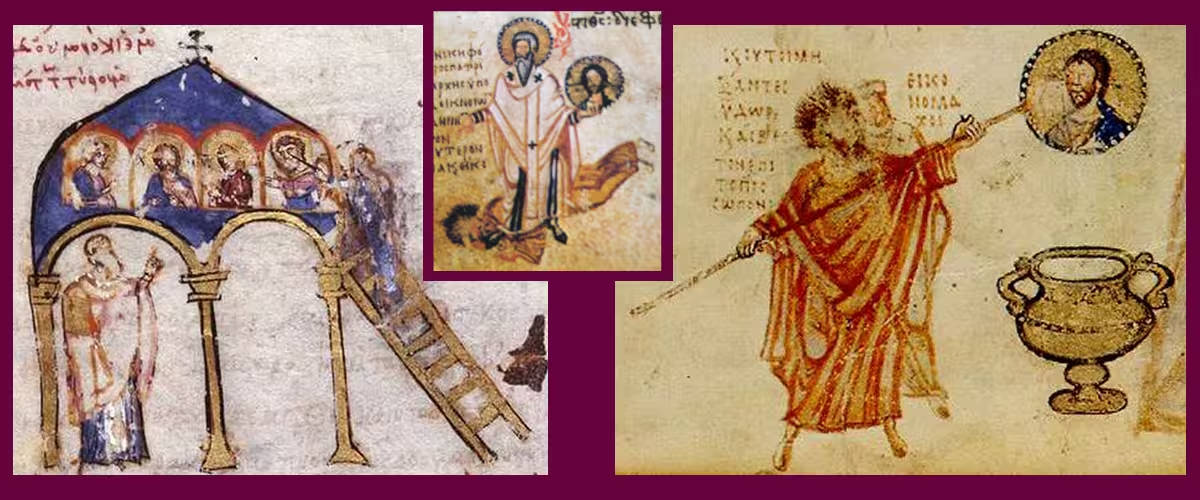
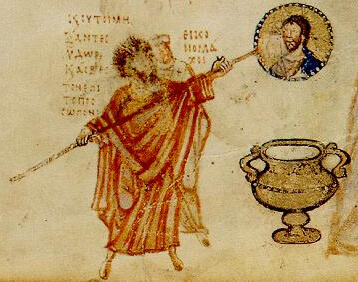
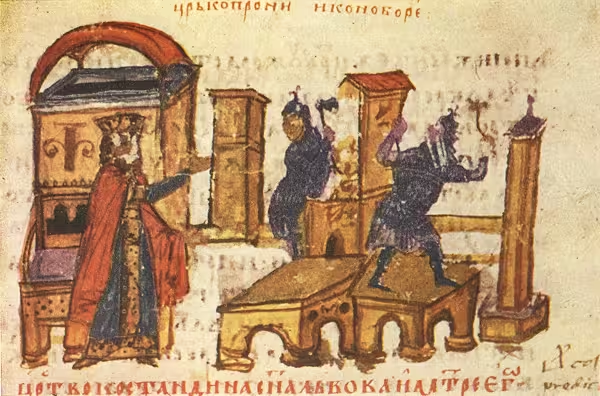
The definition of the council of 754 survives only in the acts of Nicaea II. The iconoclast patriarch John Grammatikos is known mainly through hostile portraits. A ninth-century psalter now in Moscow, the Khludov Psalter, shows iconoclasts whitewashing an image of Christ.
Iconoclastic figures are often depicted or described in derogatory terms. For instance, Emperor Constantine V was given the derogatory epithet Copronymus (‘dung-named’) by later hostile chroniclers who claimed that he had defecated in his baptismal font as an infant.
Open question: how much did the winners distort?
Several details look like victors’ rhetoric. Constantine V acquired the nickname Kopronymos, “dung-named”, from a story that he soiled the font at his baptism. In the 9th century his bones were dug up, burned and thrown into the sea. A mosaic of the Virgin installed in the apse of Hagia Sophia in 867 carries an inscription saying that images the iconoclasts had thrown down were set up again. Yet no trace shows that the apse held an earlier figural image. The mosaic may be the first figure there.
The story of the Chalke Gate, discussed below, is another case. Many historians now think the iconophiles exaggerated the offences of their opponents. Leslie Brubaker’s Inventing Byzantine Iconoclasm (2012) argues that much of the traditional picture was built after 843.
Before the quarrel: images in Christian life to 700
Christians inherited a suspicion of images from the Old Testament. The second commandment forbids making a graven image (Exodus 20:4), and early Christians had been made to sacrifice before imperial images in the persecutions. Writers such as Eusebios of Caesarea and Epiphanios of Cyprus disapproved of icons, especially of Christ, who should be worshipped as the image of the invisible God.
Yet Christians decorated their catacombs and, in time, their churches. By the 4th century Basil the Great could argue that honour offered to an image passes to its model. The cult of images grew, and so did stories of images that were “not made by human hand” and worked miracles.
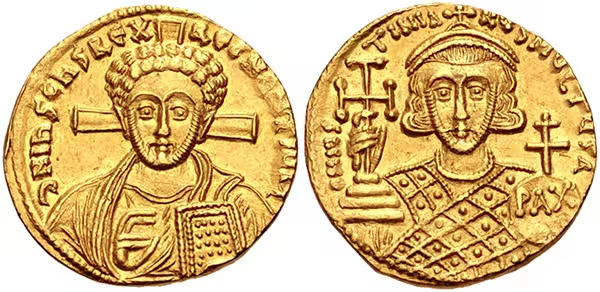
By the end of the 7th century the Church was legislating. The Quinisext Council of 691–692 banned crosses laid in floors, where they would be trodden on. It also ordered that Christ be shown as a man, not symbolically as a lamb, to affirm the Incarnation. Around the same time Justinian II put the image of Christ on his gold coins (692–695).
The signs point two ways. Images were becoming more important, and so was the worry about them.
The wider setting was a long run of disasters. Persian and Arab invasions in the 7th century cost the empire much of its land and wealth. In 717–718 Leo III, newly crowned, beat off the Arab siege of Constantinople. Many Byzantines read such events as signs of divine favour or anger.
Why did it happen? Hypotheses
The Byzantine writers offered their own explanation: Jewish magicians and the caliph Yazid II had corrupted Leo III. Modern historians do not accept it, and they have offered several others.
| Hypothesis | Proposed by, and evidence | Weakness |
|---|---|---|
| Divine anger | C. Mango. God was punishing Byzantium for idolatry through Arab attacks and natural disasters, such as the eruption at Thera in 726. | The link to icons is made by the sources, not shown by the events. |
| Revival of an old polemic | P. Alexander, E. Martin. Christians had long attacked religious art as a survival of paganism. Some bishops in Asia Minor held this view. | It does not explain why emperors adopted it. |
| Islamic or Jewish influence | Hostile Byzantine writers. A caliphal edict against images dates to about 721–723. | No firm evidence of influence. The Byzantine charge looks like polemic. |
| Imperial power | G. Ladner (caesaropapism), L. Barnard (the imperial cult), J. Haldon (emperors asserting authority in religion while under pressure to renew the state). | Why images, and not another issue? |
| Money | M. Sjuzjumov. Emperors confiscated monastic and church property. Constantine V did sell confiscated monastic land. | A result as much as a motive. |
| Clergy and the cult of saints | P. Brown. Holy men, icons, relics and monasteries spread holiness beyond the control of bishops in struggling cities. | Bishops were not united on the question. |
| Doctrine of salvation | Many specialists, following E. Kitzinger. Iconoclasts feared that devotion to icons blurred the line between image and prototype, and so between sacred and profane. | Hard to separate from the political and social motives. |
Open question: was there one cause?
Probably not. One influential synthesis holds that economic and political factors played a role, but that the central issue was how holiness reaches human beings. The iconoclasts accepted only the Eucharist, the church building and the sign of the cross as fully holy, because God or a priest had consecrated them. Icons and relics, in their view, were made holy from below, by popular devotion. That reading treats the iconoclasts as serious theologians, not as crude image-smashers. Other historians put more weight on emperors and their wars. The evidence allows several mixtures.
The first iconoclasm, c. 726–787
Leo III and the Chalke Gate
Leo III reigned from 717 to 741. He had been general of the Anatolikon theme, and once on the throne he held the empire together. He raised taxes to repair the walls of Constantinople, won a great victory over the Arabs at Akroinon in 740 and issued a new law code, the Ecloga. In 726, the tradition says, he began to support iconoclasm. In 730 he called a formal assembly, a silention, to approve an edict against icons.
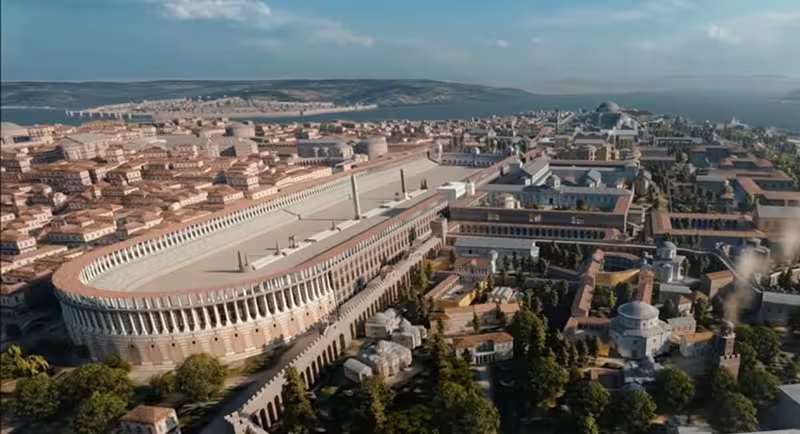
The first public act was the removal of a large image of Christ from the front of the Chalke, the vestibule of the Great Palace (see a restitution of this famous gate here). The Chalke Christ later became a barometer of policy. Irene restored it around 787. Leo V removed it again and put a cross in its place. After 843 the painter Lazaros set it up again in mosaic.
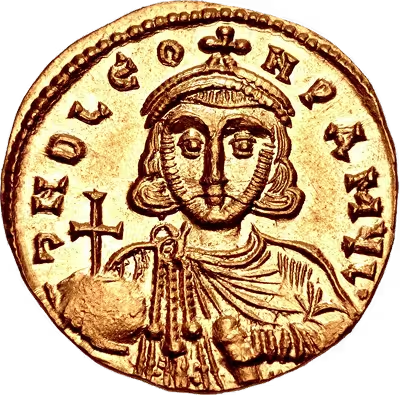
Patriarch Germanos I opposed the policy and was forced out in 730. Germanos had supported Leo and praised his victories. The reason for the break is unclear. The veneration of the Virgin, to whom Germanos wrote several sermons, may have been the main point of conflict. Leo also fell out with Popes Gregory II and Gregory III. In 732–733 he raised taxes in Sicily, Calabria and Illyricum, and he may have moved their churches from papal to Byzantine control. Many historians place that move under his son.
Open question: did Leo III really ban icons?
The traditional story fixes the start at the removal of the Chalke image in 726 or 730. Scholars now note the thin evidence for it. Stephen Gero’s study of Leo III’s reign and Marc Anastos’s work on the edict have shaped the debate. Part of the problem is chronology: the sources give 726 and 730, and the sources are all hostile. A good deal of what we call Leo’s iconoclasm may be the iconophiles’ later construction. His origins in the movement remain obscure. Some high clerics in Asia Minor supported him, but how much they influenced him is unknown.
Constantine V and the council of Hieria
Constantine V (741–775) was the real architect of imperial iconoclasm. He was an outstanding general who beat the Bulgars and the Arabs, and he wrote treatises against images. He called a council at the palace of Hieria, on the Asian shore opposite Constantinople. It opened on 10 February 754 and sat until August. Some 338 bishops attended.
The council called itself ecumenical. The church later rejected the claim, because no patriarch took part. Constantinople’s see was vacant, and the others stayed away. The bishops argued that an icon of Christ must fail in one of two ways. Either it shows his humanity alone, which divides him, or it shows both natures, which confuses them. The only true image of Christ, they said, was the Eucharist. The council also named John of Damascus an enemy.
The acts were not strongly enforced until the 760s. Then came persecution, especially of monks. Stephen the Younger, a hermit and the best-known martyr of the period, was brought to Constantinople, tortured and killed. Provincial generals such as Michael Lachanodrakon extended the campaign against monasteries. Constantine sold confiscated monastic property to pay for his wars. In the capital, according to Stephen’s Life, he replaced pictures in the church of the Virgin at Blachernai with trees, birds and beasts. Images of Christ and the saints stayed in the audience halls of Hagia Sophia until Patriarch Niketas had them removed in 768–769.
Open question: how violent was the persecution?
The monastic sources describe a reign of terror. The picture is more mixed. Outside the capital, iconoclasm was irregularly supported and was often limited to redecorating churches with secular art. The only surviving physical evidence of image removal in Constantinople is in Hagia Sophia. Constantine himself was an outstanding general. Some martyrdom stories, such as Stephen’s, were written decades later. The persecution was real, but its scale is hard to measure.
A fading policy
Iconoclasm lost force after Constantine died. His son Leo IV persecuted only a small group of officials in Constantinople in 780. When he died that year, his widow Irene became regent for their young son, and the way was open for a change.
What each side argued
The arguments were more sophisticated than the slogans suggest. Below the main lines.
| Issue | Iconoclast case | Iconophile reply |
|---|---|---|
| Scripture | The second commandment forbids images (Exodus 20:4–5). | God himself ordered the carved cherubim on the Ark (Exodus 25:18). |
| Christology | An image of Christ divides his natures or confuses them. Only the Eucharist is his true image. | The Incarnation made the invisible God visible and so paintable. To deny images of Christ is to deny his real humanity. |
| Idolatry | Candles, incense, bows and kisses before images turn matter into an object of worship. | Honour passes to the prototype. Veneration is not worship. |
| Tradition | Images are a recent corruption. | Images are ancient. Miracle-working icons made without hands prove it. |
| Saints and relics | Constantine V was hostile to relics, except those of the True Cross. His council still affirmed the saints’ intercession and rejected only their veneration through material images. | Icons and relics are channels of the holy and work miracles. |
John of Damascus laid the groundwork for the iconophile case. Born in Damascus around 675, he came from a family that ran the finances of the caliphate and became a monk at the monastery of St Sabas near Jerusalem. He lived outside the emperor’s reach, and the council of Hieria condemned him as a friend of the Saracens. He sorted images into six types, from the natural image that comes from its prototype to objects that recall the past. He also stressed the teaching role of icons for people who could not read.
In the second period, Theodore the Studite and Patriarch Nikephoros developed his theory. They distinguished three levels of image: Christ as the natural image of the Father, man as God’s image by adoption, and the icon as the artist’s image of Christ or a saint. They also separated the relative veneration of the icon from the true worship owed to the one it shows. Nikephoros, in his refutations, challenged the authenticity of texts from Eusebios and Epiphanios that iconoclasts had cited.
The iconoclasts were not simply against art. They accepted the Eucharist, the church and the cross as holy because these had been consecrated directly, by God or by a priest. They feared that devotion to icons was erasing the line between an image and what it showed. For the full theology, see the article on Orthodoxy.
Restoration: Irene and the Second Council of Nicaea
Irene needed a patriarch who shared her aim. In 784 she chose Tarasios, a layman and her chief secretary, who accepted on the condition that a council would restore icons. The first attempt at a council, in the summer of 786, was broken up by soldiers loyal to the old policy. Irene sent those units away and called the council again at Nicaea. It met from 24 September to 13 October 787, with about 350 participants, and it is counted as the seventh ecumenical council.
The council condemned the acts of 754 and defined the veneration due to icons. It also issued twenty-two canons on the discipline of the clergy. The restoration reached the streets: the Chalke Christ went back up. The Frankish court, which had not been consulted, rejected the council. The full story is told in the Irene of Athens article and in the article on the Second Council of Nicaea.
The interlude lasted nearly three decades. Irene fell in 802. Her successors, Nikephoros I and Michael I, did not revive iconoclasm. Then the army was beaten by the Bulgars, and a new emperor drew his own conclusion.
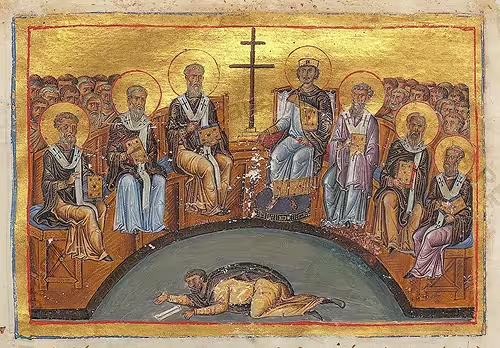
@ PHGCOM, CC-BY 3.5
The second iconoclasm, 815–843
Leo V and the new synod
Leo V, an Armenian general, was acclaimed emperor after the defeat at Versinikia in 813. He was an excellent soldier and had a name for fairness. He restored iconoclasm in several steps. He set up a commission under John Grammatikos to collect texts. He deposed Patriarch Nikephoros. In 815 he called a synod in Constantinople that renounced the restoration of icons and rehabilitated the council of Hieria.
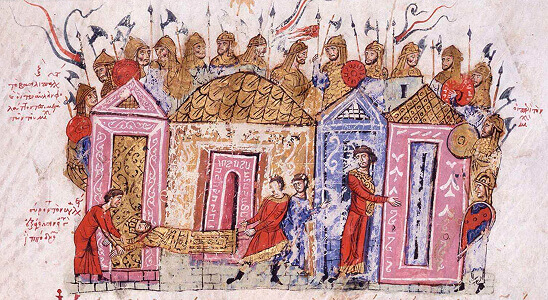
The military motive is plausible. Leo’s ban followed heavy defeats by the Bulgars, which he may have taken as a sign of God’s displeasure with icons. Hostile sources add that he stoned the Christ image at the Chalke, in imitation of Leo III. The second iconoclasm was milder than the first. Theodore the Studite was exiled more than once. Leo himself was murdered in church on Christmas Day 820 by supporters of Michael II. His body was exposed in the Hippodrome of Constantinople.
Michael II and Theophilos
Michael II was an iconoclast who did not press the matter. Theophilos (829–842), who had been tutored by John Grammatikos, was harsher. He forbade the production of icons and punished prominent iconophiles. They included Euthymios of Sardis, the painter Lazaros and the brothers Theodore and Theophanes. In 836 Theophilos had twelve verses tattooed on the brothers’ foreheads, which gave them their nickname, the Graptoi, “the inscribed”. Theodore described the ordeal in a letter. A later psalter shows the scene.
Theophilos was also a builder and a patron of learning. He added to the Great Palace, rebuilt walls and built a palace at Bryas. His reputation for justice lived on in legend. An iconoclast could be cultured, just and severe.
The Triumph of Orthodoxy

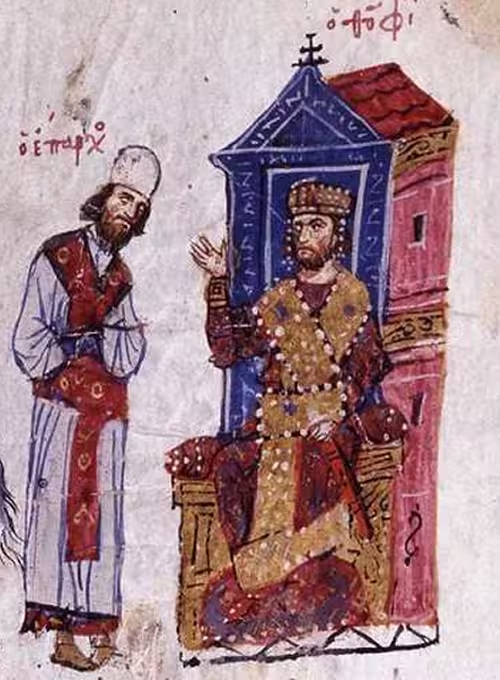
Theophilos died of dysentery on 20 January 842. His son Michael III was a child, so his widow Theodora governed, with the eunuch Theoktistos in effective control. They deposed the iconoclast patriarch John Grammatikos and installed Methodios, who had suffered under the iconoclasts. On 11 March 843, Theodora, Theoktistos and Methodios walked in procession from the church of the Virgin at Blachernai to Hagia Sophia, and there they celebrated a liturgy. The Orthodox Church marks the day each year on the first Sunday of Lent.
The restoration was a compromise. Theodora agreed only on condition that her husband was not condemned. She claimed he had repented on his deathbed. Methodios tried to be moderate toward former iconoclasts. The radical Studite monks demanded severe punishments and criticised him for defending the lenient patriarchs Tarasios and Nikephoros. Methodios excommunicated and confined some intransigent monks. Councils in the 860s and 870s condemned iconoclasm again, but it was no longer a live issue.
Open question: who restored the icons, and why?
The pious tradition makes Theodora a secret iconophile who venerated icons despite her husband. Some modern accounts say there is no evidence for it. The Oxford Dictionary of Byzantium gives Theoktistos the lead role. It says he overcame Theodora’s reluctance by arranging that Theophilos would not be condemned. The military defeats of the 830s, such as Dazimon and the sack of Amorion in 838, had might have contributed to weaken the case for iconoclasm. The deathbed story cannot be checked, and it conveniently served the settlement. The motives remain unclear.
Art and architecture under iconoclasm
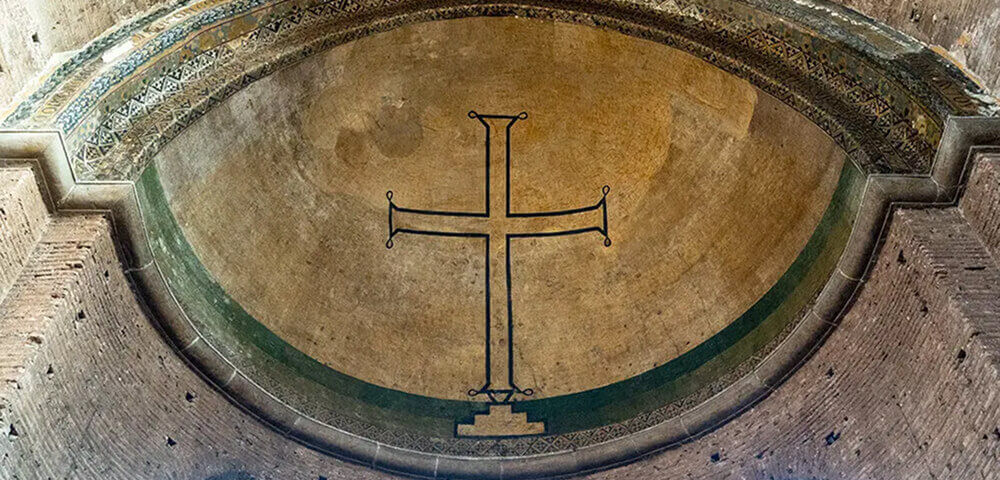
Iconoclasm did not end art. It changed what art showed. The iconoclasts accepted crosses, ornament and secular scenes. The best surviving example is the cross in the apse of Hagia Eirene in Constantinople. An earthquake damaged the church in 740, and Constantine V rebuilt it in the mid to late 750s. The cross is made of costly materials, and the builders bent its arms downward to follow the curve of the apse, so that the cross appears straight from below. Our article on the iconoclast mosaics of Hagia Irene, undoubtedly the most prominent surviving example of iconoclastic art, looks at it in more detail.
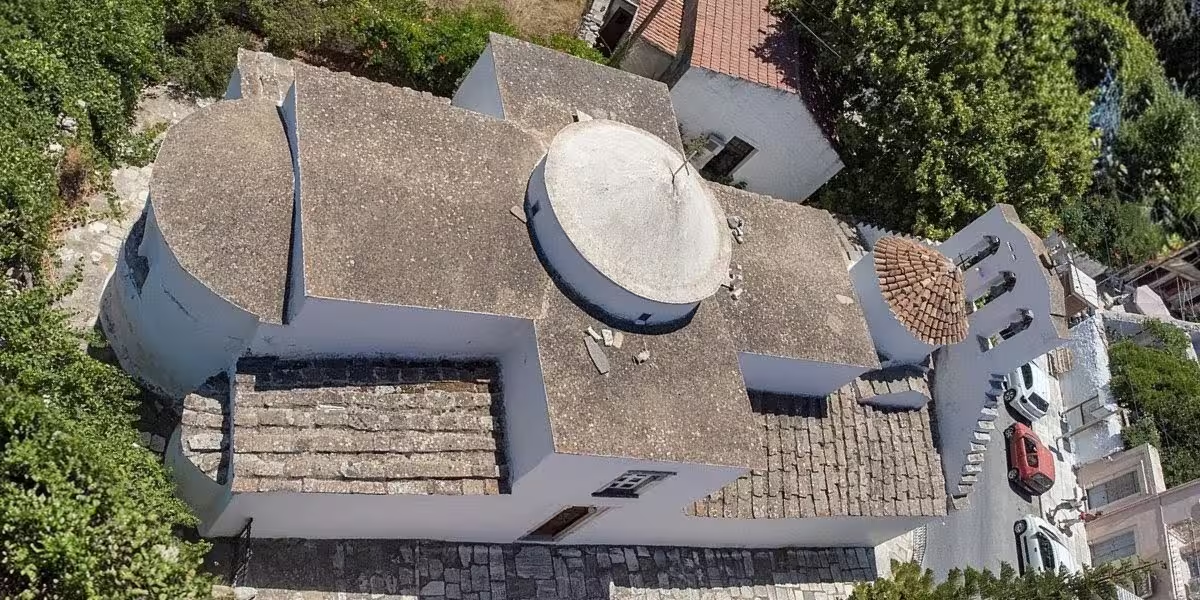
Other buildings show the change in layers. At the church of the Dormition in Nicaea, now destroyed, photographs from 1912 show three phases in the apse. A Virgin and Child came first. A plain cross replaced it in the iconoclast period. After 843 the cross gave way to a new Virgin and Child. From historical sources, we know that the same happened in other churches, like the Chalkoprateia in Constantinople. In the audience halls of Hagia Sophia, roundels with crosses survive where portraits of saints were once set. The ghosts of erased inscriptions lie beneath them. Iconoclast decorations survived in 8th or 9th century churches in Greece, in particular on the island of Naxos.
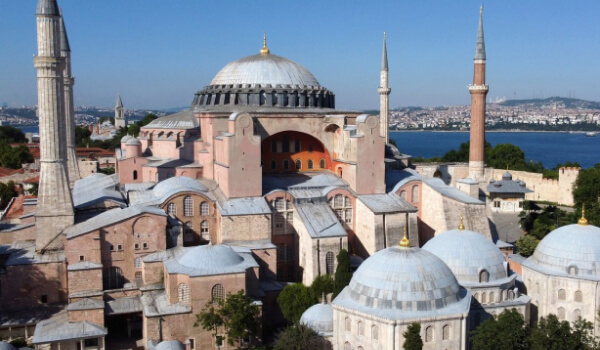
Not everything was cross and ornament. Constantine V decorated Blachernai with trees and birds. Theophilos added to the Great Palace, and the Chalke Christ was replaced by a cross on Leo V’s orders. After the restoration, the victors told their own story in art. The Khludov Psalter shows iconoclasts whitewashing an image of Christ. In 867, Patriarch Photios preached at the dedication of the Virgin and Child in the apse of Hagia Sophia. He framed the image as the restoration of the Church’s proper dress.
Open question: how much was lost, and how do we date what remains?
Old books call these years a dark age of Byzantine art. The evidence is mixed. Iconoclast emperors were serious patrons of building. The loss of figural art is hard to measure, because few early icons survive from anywhere in the empire. The best-known survivors are at the monastery of St Catherine on Sinai, which lay outside imperial control. The use of non-figural decoration also shaped the later cult of the cross. Dating a cross or an erased inscription to the iconoclast period is often a matter of judgment.
Who’s who: Supporters and adversaries of Iconoclasm
The iconoclasts
Emperor Leo III (717-741)
Started imperial iconoclasm and called the assembly of 730.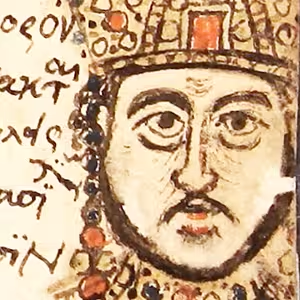
Emperor Constantine V (741–775)
Warrior and theologian, he called the Hieria Council and persecuted monks.
Michael Lachanodrakon (d. 792)
General who carried the campaign into the provinces and destroyed monasteries.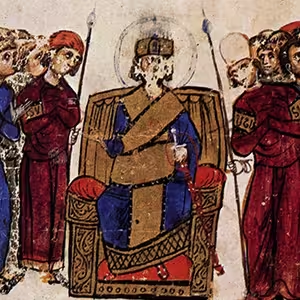
Emperor Leo V the Armenian (813-820)
Restored iconoclasm in 815.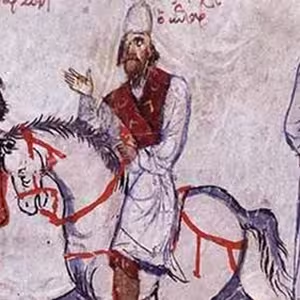
John VII Grammatikos
Scholar, tutor of Theophilos and iconoclast patriarch of Constantinople.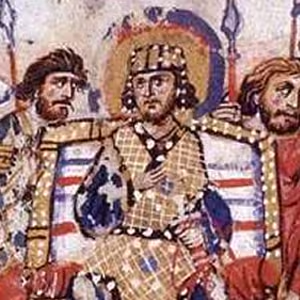
Emperor Theophilos (829-842)
Banned the making of icons and persecuted opponents.
The iconophiles (iconodules)
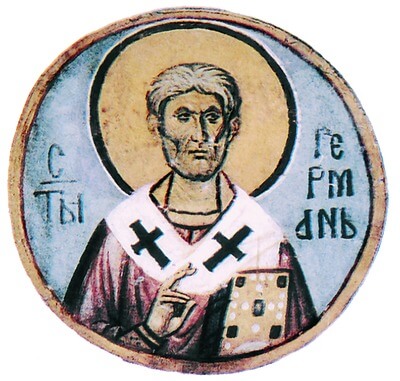
Patriarch Germanos I (715-730)
Forced out when he opposed the policy.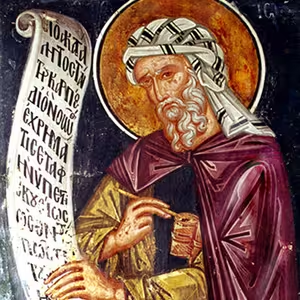
Saint John of Damascus
Monk and theologian under Muslim rule. Wrote the first great defence of icons.
Athonite fresco, 14th or 15th century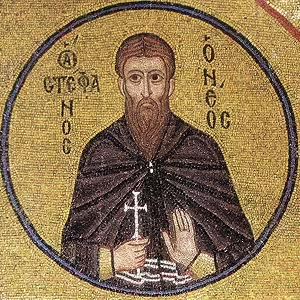
Saint Stephen the Younger
Hermit & martyr, killed under Constantine V.
Mosaic in Hosios Loukas, 11th century.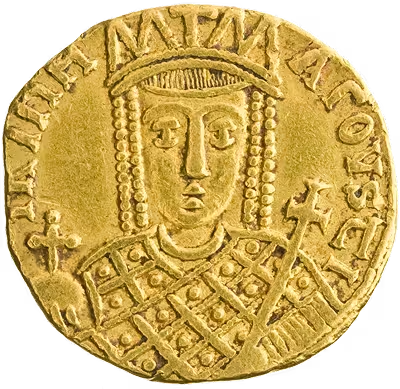
Empress Irene of Athens
Called the Second Council of Nicaea in 787 to restore icons.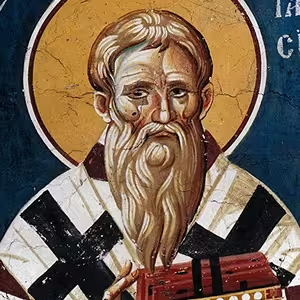
Patriarch Tarasios (784–806)
Led the council of 787.
Fresco in the Peribleptos Church in Ohrid, ca. 1350.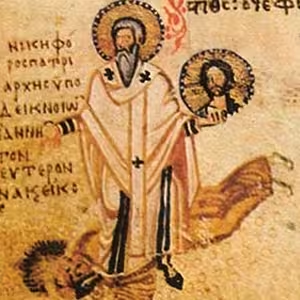
Patriarch Nikephoros I (806-815)
Historian and theologian. Deposed by Leo V.
Chludov Psalter Illumination, 9th century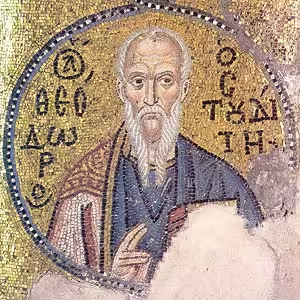
Saint Theodore Studion
Abbot of Stoudios, in Constantinople. Leader of the monastic resistance in the 2nd period.
Mosaic in the Nea Moni of Chios, 11th century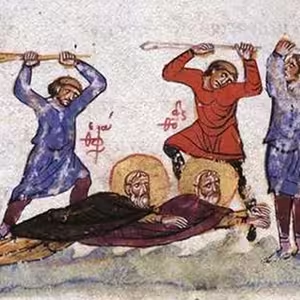
Saint Theodore & Theophanes Graptoi
Brothers tattooed with verses in 836.
Madrid Skylitzes manuscript, 12th century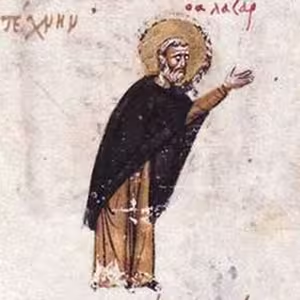
Saint Lazaros Zoographos
Painter persecuted by Theophilos; suppostely made the Chalke mosaic after 843.
Madrid Skylitzes manuscript, 12th century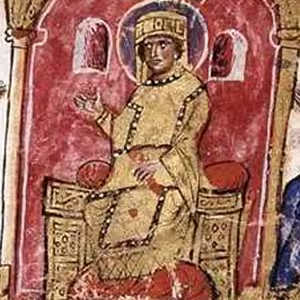
Empress Theodora
Regent for her son after the death of Theophilos. Restored icons in 843.
Skylitzes manuscript, 12th century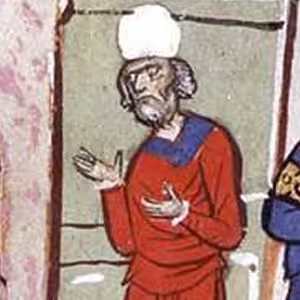
Eunuch Theoktistos
Logothetes tou dromou, assisting Theodora in the restoration of icons.
Skylitzes manuscript, 12th century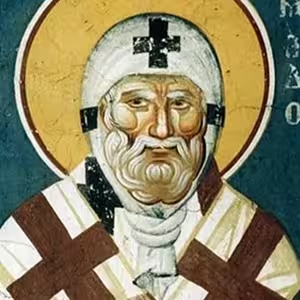
Saint & Patriarch Methodios (843-847)
Moderate toward former iconoclasts.
Peribleptos church fresco, Ohrid, ca. 1350.
Legacy: a partial victory for both sides
For theology. The iconophiles won the argument. The theory of the image became Orthodoxy, and the feast of 843 still carries it. Yet the iconoclasts’ concern, that devotion might drift into idolatry, did not vanish. Doubts about icon veneration lingered after the defeat.
For the Church and the emperor. The iconophiles owed their triumph to friendly rulers, Irene and Theodora, whose authority over church affairs grew as a result. One influential view holds that this brought monasteries under closer imperial control, and that strong centralised houses such as Stoudios gave way to smaller ones under state patronage. Religious dissidents failed in their appeals to Rome against imperial policy. Many active monastic iconophiles fled west, which left compromisers such as Photios free to hold the patriarchate. See the article on the Byzantine clergy for how patriarchs and monks fit into this story.
For Rome and the West. Popes Gregory II and Gregory III denounced imperial iconoclasm. Constantine V neglected northern Italy, and the Lombards took Ravenna. The papacy drifted toward the Franks. Charlemagne’s court then rejected the council of 787 in the Libri Carolini, a quarrel described in the Nicaea II article.
For art. The iconoclasts’ reliance on non-figural decoration helped raise the cult of the cross. After 843 the apse of Hagia Sophia received a figure of the Virgin, and the later decoration of Byzantine churches centred on images. For more on how the Church’s beliefs developed through these years, see From Byzantine Christianity to Orthodoxy.
Beyond Byzantium. The word “iconoclast” outlived the empire. Protestant reformers took up image-breaking in the 16th century, and John Calvin rejected the distinction between veneration and worship drawn at Nicaea. Today “iconoclast” means anyone who attacks cherished beliefs.
Open question: who really won?
The outcome can be read as a partial victory for both sides. The iconophiles won the theological battle and had their theory endorsed as Orthodoxy. The emperors won too, because their control of church affairs was confirmed. Historians who stress politics see the second point as the larger one. Those who stress belief put the first point first.
Frequently asked questions
What was Byzantine iconoclasm?
It was a long dispute in the Byzantine Empire over whether Christians could honour images of Christ, the Virgin and the saints. Emperors banned icons in two periods, c. 726–787 and 815–843.
When did Byzantine iconoclasm begin and end?
The first period began around 726 or 730 under Leo III and ended with the Second Council of Nicaea in 787. The second began in 815 under Leo V and ended on 11 March 843 with the Triumph of Orthodoxy.
Why did Leo III ban icons?
The sources do not say clearly. Hypotheses include a wish to purify worship after Arab victories and the Thera eruption of 726, an old Christian suspicion of images, and the emperor’s wish to assert authority over the Church. There is no firm evidence for the charge that Muslims or Jews influenced him.
What is the difference between an icon and an idol?
An icon is a sacred image whose honour passes to the person it shows. An idol, in Byzantine thought, is an image that receives worship as a god. Iconoclasts feared that icons were becoming idols. Their opponents said the difference lay in what the honour was aimed at.
What is the difference between iconoclasts and iconodules?
Iconoclasts, or image-breakers, opposed the veneration of icons. Iconodules, also called iconophiles, defended it. Both names were coined in the period, and each side used them against the other.
Who were the main iconoclast emperors?
Leo III, Constantine V, Leo V and Theophilos. Constantine V was the most committed. Michael II and Leo IV were iconoclasts who pressed the policy little.
Who defended icons?
Patriarchs Germanos I and Nikephoros I, the theologians John of Damascus and Theodore the Studite, the martyr Stephen the Younger, and the rulers Irene and Theodora, together with Patriarchs Tarasios and Methodios.
Did the iconoclasts destroy all icons?
No. Imperial support was uneven. Outside the capital, iconoclasm often meant redecorating churches with crosses or secular scenes. The only clear archaeological evidence of image removal in Constantinople comes from the audience halls of Hagia Sophia.
Did Islam cause Byzantine iconoclasm?
Byzantine writers blamed the caliph Yazid II and Jewish advisers. Modern historians find no firm evidence of this. Most favour a mix of religious, political and social causes.
How did Byzantine iconoclasm end?
Empress Irene ended the first period at the Second Council of Nicaea in 787. After Theophilos died in 842, the empress Theodora, the minister Theoktistos and the patriarch Methodios restored icons for good on 11 March 843.
What is the Triumph of Orthodoxy?
It is the feast marking the final restoration of icons in 843. The Orthodox Church celebrates it on the first Sunday of Lent.
Key dates
| Date | Event |
|---|---|
| 691–692 | Quinisext Council: Christ to be shown as a man, not as a lamb |
| 717–718 | Leo III resists the Arab siege of Constantinople |
| 726 | Eruption at Thera; start of imperial iconoclasm (or 730) |
| 730 | Assembly approves anti-icon edict; Germanos forced out |
| 740 | Victory at Akroinon; earthquake damages Hagia Eirene |
| 10 Feb.–Aug. 754 | Council of Hieria |
| c. 764 | Martyrdom of Stephen the Younger (date questioned) |
| 768–769 | Images removed from the audience halls of Hagia Sophia |
| Sept. 780 | Death of Leo IV; Irene becomes regent |
| 24 Sept. 787 | Second Council of Nicaea opens |
| c. 787 | Chalke Christ restored |
| 802 | Irene overthrown |
| 813 | Defeat at Versinikia; Leo V takes the throne |
| 815 | Synod renounces the restoration of icons |
| 25 Dec. 820 | Leo V murdered |
| 836 | The Graptoi tattooed |
| 20 Jan. 842 | Death of Theophilos |
| 11 Mar. 843 | Triumph of Orthodoxy |
| 867 | Virgin and Child mosaic in the apse of Hagia Sophia dedicated |
Sources and further reading
Start with the sources: Theophanes the Confessor’s Chronographia; Nikephoros’s Short History and Antirrhetics; the Life of Stephen the Younger; the writings of John of Damascus and Theodore the Studite; and the acts of Nicaea II, which preserve the council of 754’s definition.
- L. Brubaker, Inventing Byzantine Iconoclasm (London, 2012).
- L. Brubaker and J. Haldon, Byzantium in the Iconoclast Era, c. 680–850: A History (Cambridge, 2011).
- C. Barber, Figure and Likeness: On the Limits of Representation in Byzantine Iconoclasm (Princeton, 2002).
- S. Gero, Byzantine Iconoclasm during the Reign of Leo III (Louvain, 1973) and Byzantine Iconoclasm during the Reign of Constantine V (Louvain, 1977).
- P. J. Alexander, The Patriarch Nicephorus of Constantinople (Oxford, 1958).
- A. Bryer and J. Herrin (eds.), Iconoclasm (Birmingham, 1977).
- A. Grabar, L’iconoclasme byzantin: le dossier archéologique (Paris, 1984).
- P. Brown, “A Dark Age Crisis: Aspects of the Iconoclastic Controversy,” English Historical Review 88 (1973).
- E. Kitzinger, “The Cult of Images in the Age before Iconoclasm,” Dumbarton Oaks Papers 8 (1954).
- J. Haldon, “Some Remarks on the Background to the Iconoclast Controversy,” Byzantinoslavica 38 (1977).
- J. Moorhead, “Iconoclasm, the Cross and the Imperial Image,” Byzantion 55 (1985).
- P. Schreiner, “Der byzantinische Bilderstreit: kritische Analyse der zeitgenössischen Meinungen und das Urteil der Nachwelt bis heute,” Settimane di studio 34 (1988).
- C. Mango, The Brazen House (Copenhagen, 1959), on the Chalke.
- W. Treadgold, The Byzantine Revival, 780–842 (Stanford, 1988).
- R. Cormack and E. Hawkins, “The Mosaics of St. Sophia at Istanbul: The Rooms above the Southwest Vestibule and Ramp,” Dumbarton Oaks Papers 31 (1977).
Specific photographic credits.
Coin of Irene of Athens: @ ANS, CC0
5 Comments