The Byzantine and Christian Museum of Athens: Where Greece Reclaimed Byzantium
For most of the 19th century, the capital of the new Greek state looked straight past its medieval past. Byzantine churches were cleared to make room for a classical city, and the objects that survived had nowhere to go. The Byzantine and Christian Museum is the institution that changed that. Its history, from one collector’s improvised storerooms to a national museum opened before the world’s Byzantinists in 1930, is as revealing as the icons, mosaics and marbles it now holds.
Quick facts
Founded: 1914, by Law 401; roots in the Christian Archaeological Society (1884)
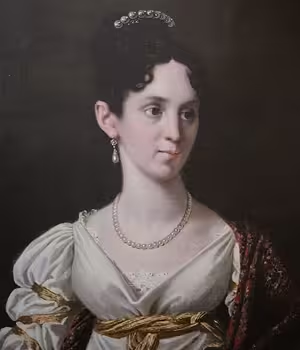
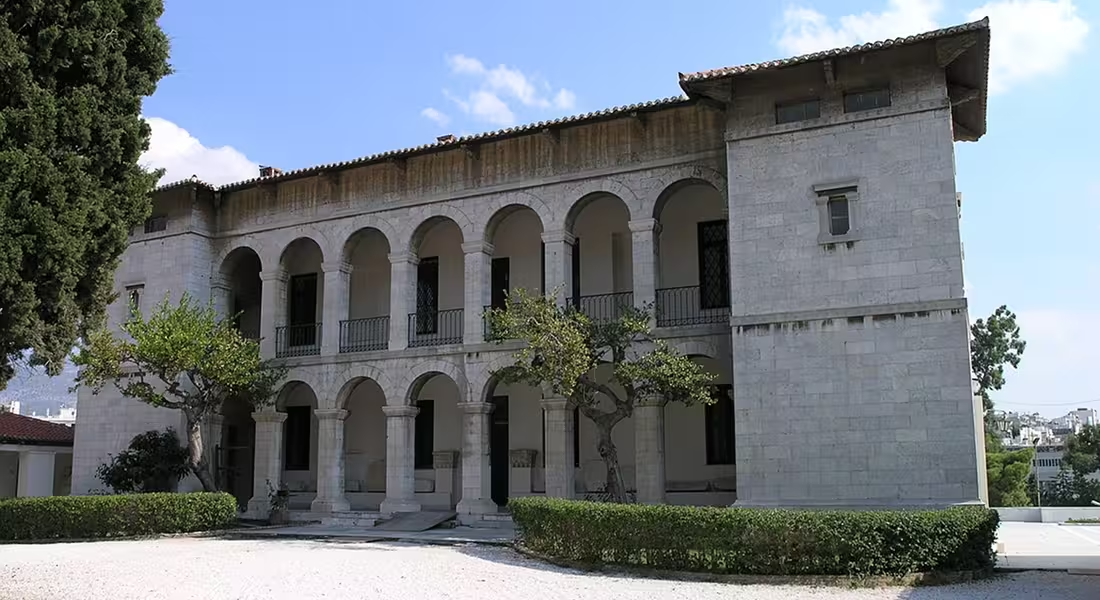
Building: Villa Ilissia, built by Stamatios Kleanthis for Sophie de Marbois-Lebrun, Duchess of Plaisance (completed 1848); museum since 1930
Collection: Around 25,000 objects, 3rd–20th century
On display: About 1,200 objects in the Byzantine section (4th–15th c.) and 1,500 in “From Byzantium to the Modern Era” (15th–20th c.)
Current galleries: Early Christian and Byzantine re-display completed 2004; post-Byzantine 2010
Address: Vassilissis Sofias 22, Athens · Metro: Evangelismos (Line 3)
Allow: 60–90 minutes for the highlights; half a day for everything
From rubble to national institution
A capital that wanted to be classical
When Athens became the capital of the Greek kingdom in the 1830s, it was a small town of Byzantine churches, Ottoman bazaars and ancient ruins. Its new planners and archaeologists had one model in mind: the city of Pericles. On the Acropolis, post-classical layers were stripped away over the following decades, a programme that culminated in the demolition of the medieval tower beside the Propylaia in the 1870s. In the lower town, medieval churches fell to the new street plan and to excavations. Even the Panagia Kapnikarea was slated for demolition before being spared. A survey of the field in Balkan Studies describes Byzantine and post-Byzantine monuments in Greece as almost wholly neglected until the mid-1880s.
Yet the intellectual climate was already shifting. In the middle decades of the century, Spyridon Zambelios and above all Konstantinos Paparrigopoulos, whose History of the Greek Nation appeared from 1860 to 1874, wrote Byzantium into a continuous story running from antiquity to the modern state. The museum would become the place where that argument was given material form.
Georgios Lambakis and the Christian collection
The first move came from outside the state. In December 1884 a group of Athenians founded the Christian Archaeological Society to study and protect Christian and Byzantine antiquities. Its driving force was Georgios Lambakis (1854–1914), secretary to Queen Olga, who had studied theology in Athens and Christian archaeology in Germany. Lambakis collected objects, documented monuments, and photographed churches that would later be altered or lost; his photographs are now an archive in their own right. His collection moved from the Holy Synod (1890) to a room in the National Archaeological Museum (1893), where it remained until 1923.
For Lambakis, Christian antiquity was the frame through which all earlier periods should be read. A recent study of his museum project notes that he went as far as calling classical archaeology “pre-Christian”.
The quarrel over the museum’s name
That devotional emphasis met resistance. In 1913, Adamantios Adamantiou (1875–1937), a university professor and former head of an ephorate of antiquities, criticised Lambakis’ focus on objects of worship. He argued that a state museum should preserve monuments of national history, not relics of the faith. The law of 1914 founded a “Byzantine and Christian” Museum, and the double name is generally read as a compromise between the two positions. Adamantiou became its first director, under a supervisory board chaired by Prince Nikolaos.
By 1923 the core collections were in place. Sculpture had been gathered from monuments across Attica and stored at the National Archaeological Museum and the Theseion. Icons, minor arts, manuscripts and textiles came through purchases and donations, and through heirlooms entrusted to the museum by monasteries and by communities uprooted from elsewhere in the Greek world following the first World War and subsequent conflicts.
Sotiriou, 1922 and the national museum
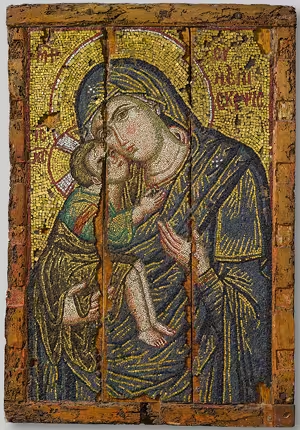
Georgios Sotiriou (1880–1965), commissioner of Byzantine antiquities since 1915, took over in 1923, in the immediate aftermath of the Asia Minor Catastrophe. One of his first acts was to fold the Christian Archaeological Society’s collection into the museum, and in 1924 he opened the first public display in five rooms of the Academy of Athens. The refugee crisis shaped the collection directly. Icons carried by displaced Orthodox communities entered the museum as a dedicated refugee heirlooms collection, among them the mosaic icon of the Virgin Episkepsis from Trigleia in Bithynia, received in 1925. Sotiriou had himself directed excavations around Smyrna during the Greek administration of 1919–1922, and his archive, kept at the museum, documents that period.
Sotiriou’s stated ambition, as the museum itself records it, was to make the institution one of Greece’s leading national museums and a model for the whole Orthodox East. He secured the Villa Ilissia, had it converted by the architect Aristotelis Zachos, and arranged a didactic, academically ordered display.
The official opening in September 1930 was timed to coincide with the 3rd International Congress of Byzantine Studies, held that year in Athens. The new national museum was presented first to the international community of Byzantinists.
How historians read it
Museologists such as Andromache Gazi and Iro Katsaridou read the early museum as an instrument of the national continuity thesis. On this reading, Byzantine objects were displayed to certify a Greek identity unbroken from antiquity to the present. Gazi cites Sotiriou describing the museum as Greece’s second national museum: the Archaeological Museum showed the civilisation of the “forefathers”, the Byzantine Museum that of the “fathers”.
This reading is now standard, but it should not flatten the story. The founders disagreed sharply among themselves about whether the museum served faith or nation. Sotiriou’s classification, conservation and publication work laid the scholarly foundations of Byzantine archaeology in Greece. Katsaridou also identifies a second shift in the 1980s, after Greece joined the European Community, when the Byzantine past began to be framed as part of a shared European heritage. That framing is arguably visible in today’s galleries. Its roots may lie earlier still: in 1964 the Zappeion hosted a Council of Europe exhibition entitled Byzantine Art, a European Art, whose executive committee Chatzidakis had served as general secretary since 1962.
From Sotiriou to the 21st century
The museum reopened after the Second World War in 1946, with a new exhibition space and a conservation workshop reorganised with Marshall Plan funds. Maria Sotiriou, often described as Greece’s first woman Byzantinist, worked alongside her husband throughout this period. Manolis Chatzidakis, director of the Benaki Museum since 1941, succeeded Sotiriou in 1960. His tenure was not continuous: he was dismissed in 1967, when the colonels’ junta came to power, which also confiscated his passport. He returned to the museum after the restoration of democracy in 1974 and retired the following year. Chatzidakis was also secretary of the Christian Archaeological Society for two decades, bringing Lambakis’ foundation and the state museum under the same scholarly leadership.
The most significant change since Sotiriou began in the late 1980s, with plans to extend the museum and redisplay its collections. The underground galleries designed by Manos Perrakis opened in June 2004, in time for the museum’s 90th anniversary and the Athens Olympics. The post-Byzantine galleries followed in 2010.
The Villa Ilissia
The museum’s home is itself a monument of the city it once ignored. Stamatios Kleanthis, one of the architects of the first plan for modern Athens, built the villa between 1840 and 1848 as the winter residence of Sophie de Marbois-Lebrun, Duchess of Plaisance. She was a Philadelphia-born, French-married philhellene and one of the most eccentric figures of Othonian Athens. Her years in Athens were overshadowed by grief as her only daugther died in Beirut in 1837, while her embalmed corpse was lost in a fire in Athens in 1847 before the duchess could bury it.
After her death in 1854 the property passed to the Greek state, which used it, among other things, for military purposes. It was assigned to the museum in 1926.
How the galleries are organised
The permanent exhibition lies mostly below ground, beneath the villa’s courtyard, and follows a chronological route in two halves. The first covers Byzantium from the 4th to the 15th century. It opens with “From the Ancient World to Byzantium”, where pagan and Christian imagery coexist, then moves into “The Byzantine World”: church sculpture, icons, mosaics, frescoes and minor arts, roughly in chronological order. A section on intellectual and artistic activity in the 15th century bridges to the second half, “From Byzantium to the Modern Era”. That half follows Orthodox art under Venetian and Ottoman rule, the Cretan and Ionian schools, and a final dialogue between Byzantium and modern art.
Two practical consequences follow. First, the Early Christian and Middle Byzantine material, the reason most readers of this site will come, is concentrated in the first part of the route, so budget your time accordingly. Second, a substantial share of the collection is post-Byzantine. That is not a detour: it shows how icon painting survived and transformed after 1453.
Highlights of the collection
A selection of works that justify the visit on their own – the most significant have their own article. The card marks it with they do.
-
Orpheus and the Good Shepherd
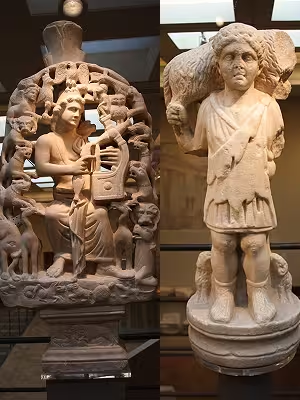
Photo credit: Giovanni Dall’Orto Orpheus charming the animals with his lyre and a shepherd carrying a lamb are displayed together, and read best that way. The two images were shared by pagan and Christian viewers, and they show how Christian art borrowed its first visual vocabulary.
Spoke: Early Christian sculpture — not yet written
Also see Byzantine Sculpture -
The Virgin Episkepsis
Photo credit: Giovanni Dall’Orto A portable mosaic icon over a metre high, in gold, glass and silver tesserae, showing the Virgin tenderly embracing the Child (Glykophilousa type). Refugees from Trigleia brought it to Greece, and it entered the refugee heirlooms collection in 1925. It has been linked to the Pantobasilissa church there.
Spoke: Episkepsis icon article — not yet written
Also see Byzantine ?Mosaics -
Archangel Michael
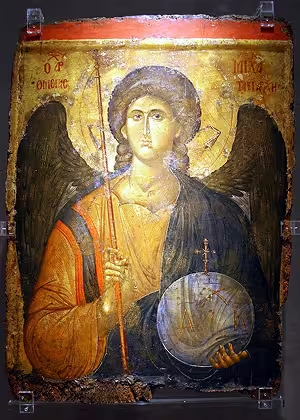
Photo credit: Giovanni Dall’Orto A half-length archangel, 110 × 80 cm, holding staff and orb, and a defining work of Palaiologan painting. It was given to the museum in 1958 by a Greek of Istanbul, and it travelled to the United States for the first time for the National Gallery of Art’s Heaven and Earth exhibition.
Spoke: Archangel Michael icon — not yet written
Also see Byzantine icons -
The oldest icon: the Crucifixion
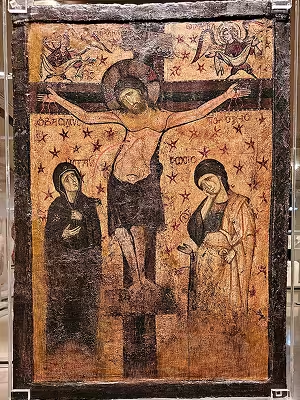
Photo credit: John Samuel, CC BY-SA 4.0 Usually described as the oldest icon in the collection, painted in the 9th century and repainted in later campaigns, with a Hodegetria added to the reverse much later. The layers make it a lesson in how icons were maintained in use.
We address this icon in our article about the Byzantine icons
-
The frescoes of Lefkada
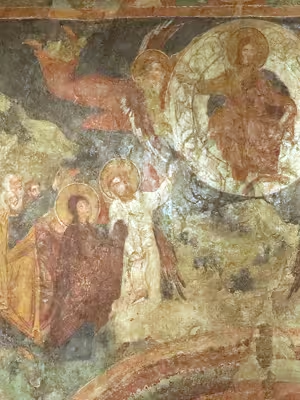
Photo credit: Francesco Bini, CC BY-SA 4.0 These frescoes were found under lime plaster in 1953, detached and brought to Athens in the late 1960s, and restored in the museum’s workshops. They are now remounted on a reconstructed wall at the church’s original dimensions, and show Orthodox painting absorbing late Gothic influence.
Links to Byzantine monumental painting
-
Cretan masters
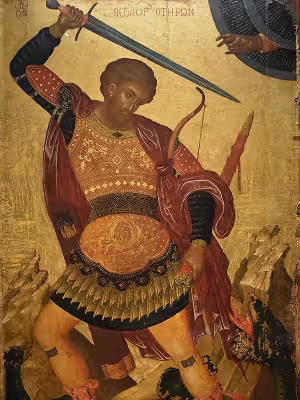
Photo credit: Nicola Quirico, CC BY-SA 4.0 The post-Byzantine galleries hold signed works by the leading painters of Venetian Crete, among them Angelos Akotantos and Michael Damaskinos. Together they trace how Constantinopolitan painting survived the fall of the city and met the Renaissance.
From church to vitrine: the museum and the monuments
Much of what the museum shows was removed from buildings: sculpture from demolished or rebuilt churches, frescoes detached to save them, liturgical furniture from monuments that no longer function as churches. The table below links objects to the monuments they came from.
| Object in the museum | Monument of origin | On Byzantine World |
|---|---|---|
| Marble slab from the pulpit of the Christian Parthenon | Parthenon as the church of the Theotokos, Acropolis | Christian Parthenon — planned |
| Fresco fragments from the cave chapels | Cave chapels of Mount Pentele, Attica | Byzantine Athens guide |
| Baptismal font | Holy Apostles, Ancient Agora | Holy Apostles Church |
| Sections of mosaic floor | Ilissos basilica, 5th c. | — |
| Sanctuary balustrade | St John Magoutis, Athens (lost) | — |
| Ten 15th-c. frescoes, remounted on a reconstructed wall | Virgin Hodegetria, Apolpena (Lefkada) | — |
| Mosaic icon of the Virgin Episkepsis | Trigleia, Bithynia (linked to the Pantobasilissa church) | — |
Visiting
The museum stands at Vassilissis Sofias 22, a short walk from Evangelismos metro station (Line 3) and about 15 minutes on foot from Syntagma. Standard admission is €8, reduced €4 ⚠ CHECK at publication. Opening hours change seasonally, so see the official schedule.
What you will see: the underground galleries, in chronological order, then the villa and its gardens. Temporary exhibitions are usually held in the villa.
What to know beforehand: the early galleries are dense with fragments that make sense only if you know where they came from. The table above and our Byzantine Athens guide give you the map.
Pair it with: the Benaki Museum and the War Museum on the same avenue, and the monastery of Kaisariani on the slopes of Hymettos for a Byzantine half-day beyond the centre.
How it compares
Among the world’s great Byzantine collections, surveyed in our guide to Byzantine art museums, Athens stands out for breadth and for its continuous run into the post-Byzantine centuries. On the ground in Greece, the comparison visitors actually make is with two other museums:
| Byzantine and Christian Museum | Benaki Museum | Museum of Byzantine Culture | |
|---|---|---|---|
| City | Athens | Athens (5 min walk) | Thessaloniki |
| Scope | Dedicated: Early Christian to modern | Encyclopedic Greek culture, strong Byzantine section | Dedicated, centred on Thessaloniki and Macedonia |
| Strengths | Icons, church sculpture, detached frescoes, post-Byzantine painting | Silver, gold jewellery, enamels, Cretan icons | Funerary painting, excavated finds, award-winning display |
| Choose it if… | You want the whole arc of Byzantine art in one route | You prefer precious objects and a broader Greek context | You are pairing it with the city’s churches |
Frequently asked questions
Is the Byzantine Museum in Athens worth visiting?
Yes, if Byzantium is why you are interested in Greece. It is the only museum in the city devoted entirely to Byzantine and post-Byzantine art, and it receives a fraction of the Acropolis Museum’s crowds.
Byzantine Museum or Benaki: which should I choose?
For the full sweep of Byzantine art, from Early Christian sculpture to Cretan icons, choose the Byzantine and Christian Museum. For precious metalwork and jewellery within a broader history of Greek culture, choose the Benaki. They are five minutes apart.
How long do you need?
About 60–90 minutes for the highlights, half a day to see everything, including the villa.
What are the must-see objects?
The Orpheus and Good Shepherd statuettes, the mosaic icon of the Virgin Episkepsis, the 14th-century Archangel Michael, and the remounted frescoes from Lefkada.
Why is it called the “Byzantine and Christian” Museum?
The name reflects a dispute at its foundation in 1914. One camp, led by Georgios Lambakis, saw the collection as Christian antiquities; the other, led by Adamantios Adamantiou, wanted a museum of Byzantine national history. The law kept both words.
Sources
- Byzantine and Christian Museum, official history and Villa Ilissia pages (byzantinemuseum.gr).
- Katsaridou, I., “Representing Byzantium: the Narratives of the Byzantine Past in Greek National Museums”, EuNaMus / Making National Museums, Linköping Electronic Conference Proceedings 22 (2007).
- Gazi, A., “National Museums in Greece: History, Ideology, Narratives”, in P. Aronsson & G. Elgenius (eds), Building National Museums in Europe 1750–2010, EuNaMus Report 1 (2011).
- “Museums and collections of Byzantine and Post-Byzantine art in Greece”, Balkan Studies ⚠ CHECK author/year.
- Study on Georgios Lampakis and the formation of the collection of the Museum of Christian Antiquities ⚠ CHECK full citation.
- Bouras, Ch., Byzantine Athens, 10th–12th Centuries — for the churches lost in the 19th century ⚠ add page refs.
- Acheimastou-Potamianou, M., Icons of the Byzantine Museum of Athens, Athens 1998.
- National Gallery of Art, Washington, Heaven and Earth: Art of Byzantium from Greek Collections (2013–14) ⚠ CHECK: exhibition title/date vs. Archangel Michael loan claim.
- Getty Museum, “Seeking Shelter: A Story of Greek Refugees and the Virgin Episkepsis”, The Iris.




One Comment