Agioi Theodoroi, Athens: The Byzantine Church That Signed Its Name
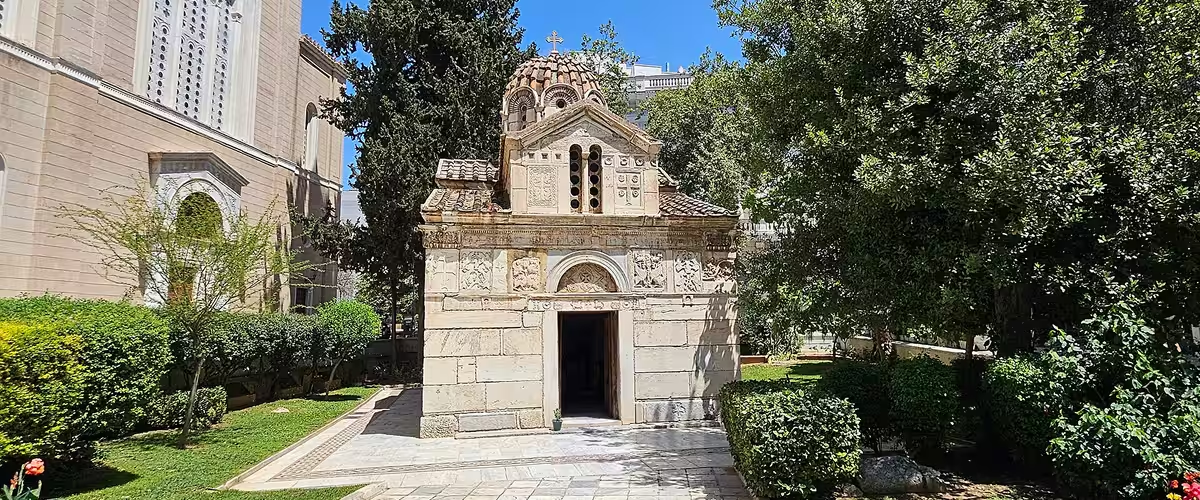
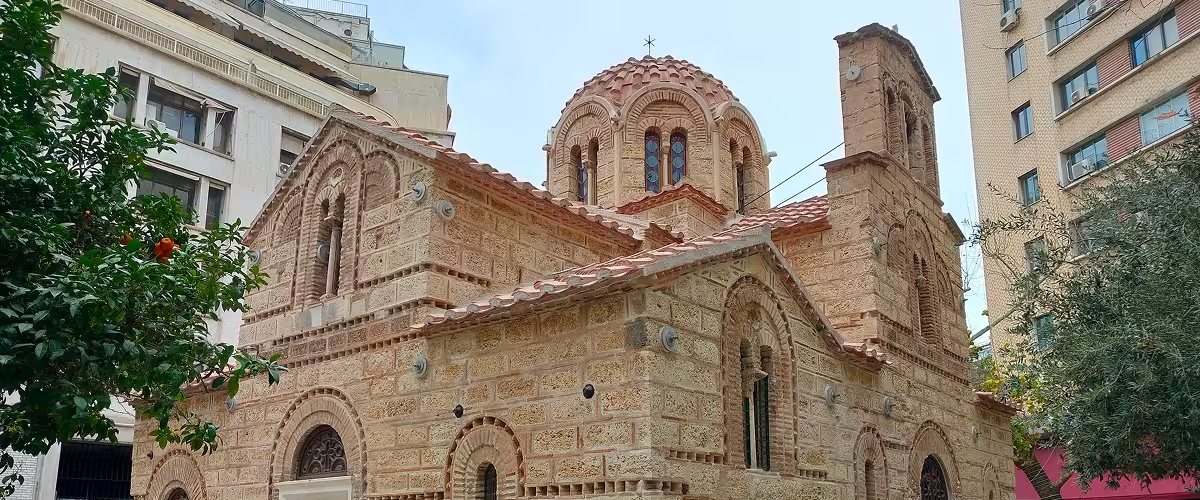
Between the office blocks of Evripidou Street and the gardens of Klafthmonos Square stands a small domed church of stone and brick that does something almost no other Byzantine church in Athens does: it tells us who built it and when. Above its west door, a verse inscription addresses the church’s martyr patron and names the man who rebuilt it, Nikolaos Kalomalos, holder of the court rank of spatharokandidatos. A second stone gives a date, read as 1049. For a city whose medieval monuments are otherwise dated by comparing masonry and window shapes, that is rare evidence, and it sparked one of the liveliest debates in the study of Byzantine Athens. Restored by the Ministry of Culture and reopened in March 2025, the church of the Saints Theodore is now one of the best places to see 11th-century Athenian building in the city centre.
Quick facts
Name: Agioi Theodoroi (Άγιοι Θεόδωροι), Church of Saints Theodore; also spelled Hagioi Theodoroi, Agii Theodori
Dedication: Saints Theodore Tyron and Theodore Stratelates
Location: Plateia Agion Theodoron, corner of Evripidou and Skouleniou streets, by Klafthmonos Square, central Athens
Built: 1049 according to its dated inscription (1065 and the 12th century were also proposed)
Founder: Nikolaos Kalomalos, spatharokandidatos
Type: Domed church, a rare variant of the “transitional” type, with an octagonal Athenian dome and a narthex
Decoration: Ceramic friezes, pseudo-Kufic brick ornament, imported glazed bowls; interior painted in the late 19th–early 20th century
Status: Active church of the Archdiocese of Athens, under the Ephorate of Antiquities of the City of Athens; reopened 7 March 2025
Nearest metro: Panepistimio
A founder, a poem and a date
The inscription of Nikolaos Kalomalos
Two inscribed slabs are set into the west façade, above the main door. The larger carries a poem in twelve-syllable verse, the standard metre of Byzantine dedicatory epigrams. It speaks directly to the saint:
Τὸν πρὶν παλαιὸν ὄντα σου ναόν, μάρτυς, / καὶ μικρὸν καὶ πήλινον καὶ σαθρὸν λίαν / ἀνήγειρε Νικόλαος ὁ σὸς οἰκέτης / ὁ Καλόμαλος σπαθαροκανδιδᾶτος / ὃς εὗρέ σε προστάτην παιδιόθεν μέγαν / βοηθὸν καὶ πρόμαχον πολλῶν κινδύνων· / ὃν πρέσβευε τοῦ ἄνω τυχεῖν κλήρου / λαβόντα τὴν ἄφεσιν τῶν ἐσφαλμένων.
“Your church, martyr, which was old, small, of clay and very decayed, was raised again by Nikolaos your servant, Kalomalos, spatharokandidatos, who found in you from childhood a great protector, helper and champion in many dangers. Intercede for him, that he may win his lot on high, having received forgiveness of his sins.”
Text as given by the Institute of Byzantine Research database Byzantine Monuments of Attica; translation Byzantine World.

The poem tells us three things. A church already stood on the spot, and it was poor: “of clay”, which Bouras takes to mean a building of mud brick. Kalomalos replaced it at his own expense. And his motive was personal devotion to a warrior saint who had protected him “in many dangers” since childhood, a phrase that suits a man with a military or official career.
Who was Kalomalos?
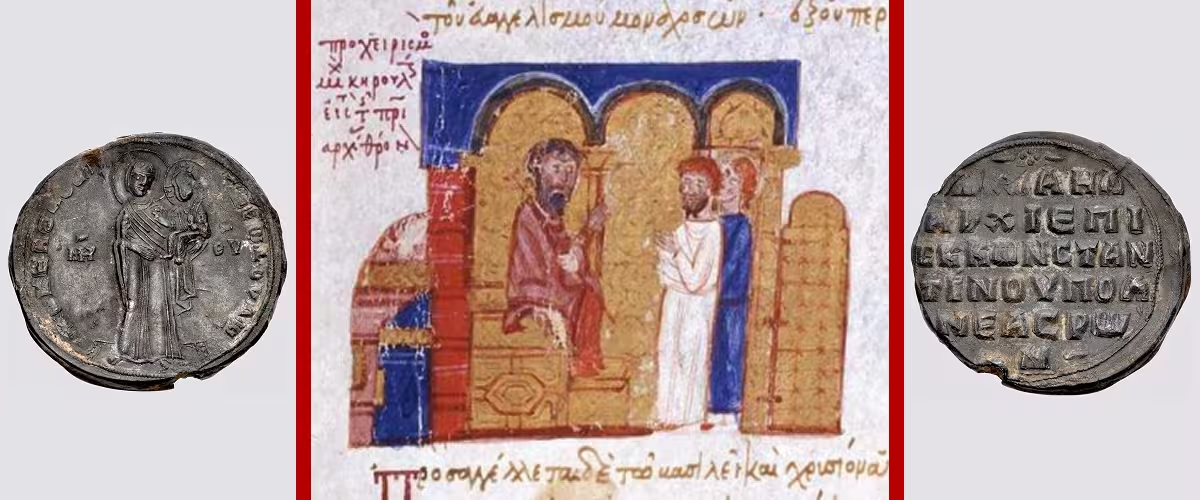
Spatharokandidatos was an honorary rank of the Byzantine court hierarchy, originally linked to the imperial guard. By the 11th century it was a middle-ranking dignity held by provincial officials and officers. Bouras describes Kalomalos as a state official with direct ties to Constantinople, and notes why that matters: a man connected with the capital chose to spend a large sum in a provincial city during a prosperous period for the empire. A lead seal of a Nikolaos Kalomalos was published by K. Konstantopoulos in 1899.
The date and the dispute
The smaller stone carries the year 6558 from the Creation (στφνη΄), which corresponds to 1049/50 AD, together with an indiction, the fifteen-year tax cycle Byzantines used alongside the year. In the 1930s the two stones started a debate involving A.H.S. Megaw, Andreas Xyngopoulos, V. Laurent and others. Xyngopoulos argued that the dated slab read 1065, did not belong to the church at all and was probably the start of an epitaph, and that the church itself was a 12th-century building. Megaw, whose chronology of Middle Byzantine churches was built on stylistic sequences, placed the Theodoroi around 1070. Laurent defended 1049 and the link between the two inscriptions.
Bouras, in Byzantine Athens, 10th–12th Centuries (2017), considers it “almost certain” that the church was built in 1049 and that the stonecutter simply miscalculated the indiction. He adds that several features point to a date around or even before 1049: the plan, which is close to churches built before 1000; the champlevé ceramic plaques, also found at the Soteira Lykodemou; the glazed bowls, dated to the first half of the 11th century; the pseudo-Kufic ornament; the dentil courses; and the carving of the templon.
The architecture
A rare plan
Most Middle Byzantine churches of Athens are cross-in-square buildings, with a dome carried on four columns. The Theodoroi is different. Bouras classes it as a variant of the so-called transitional type, without free-standing columns: west of the dome the supports are continuous walls, and the four corner bays are covered with barrel vaults.
The variant is rare, and Bouras reads it either as a sign of an early design or as a practical answer to a shortage of reusable ancient marble columns; another example in Athens is Profitis Ilias.
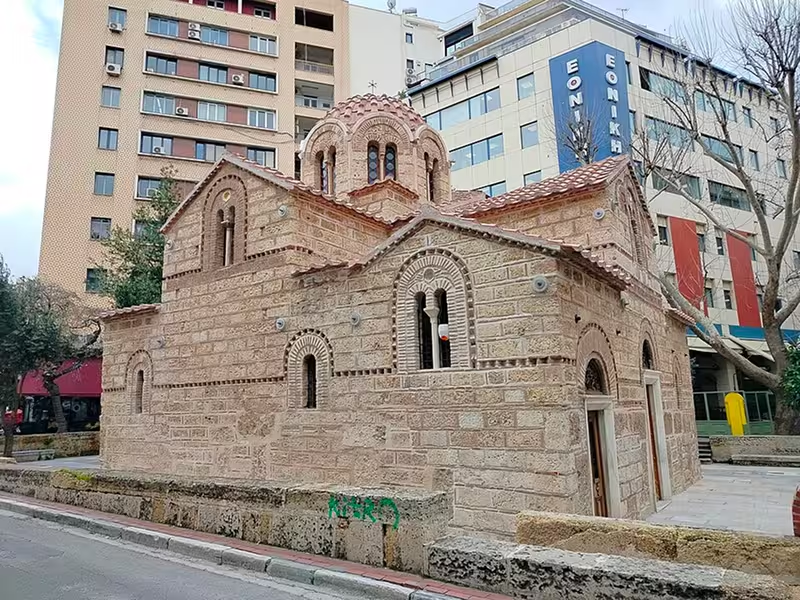
The building is noticeably irregular. The south arm of the cross is shorter than the north one, the diakonikon (the south side room of the sanctuary) is shorter than the prothesis, and the west façade is asymmetrical: a door and cloisonné masonry on the left, a tall single window and a wall of large upright stones on the right. Two blind arches in the east arm take the place of the side niches found in some sanctuaries. The arched openings above the side doors of the narthex led Gorham Stevens to believe the narthex was added later; Bouras rejects that view, though the question is not settled by excavation.
Masonry, friezes and Arabic-looking ornament
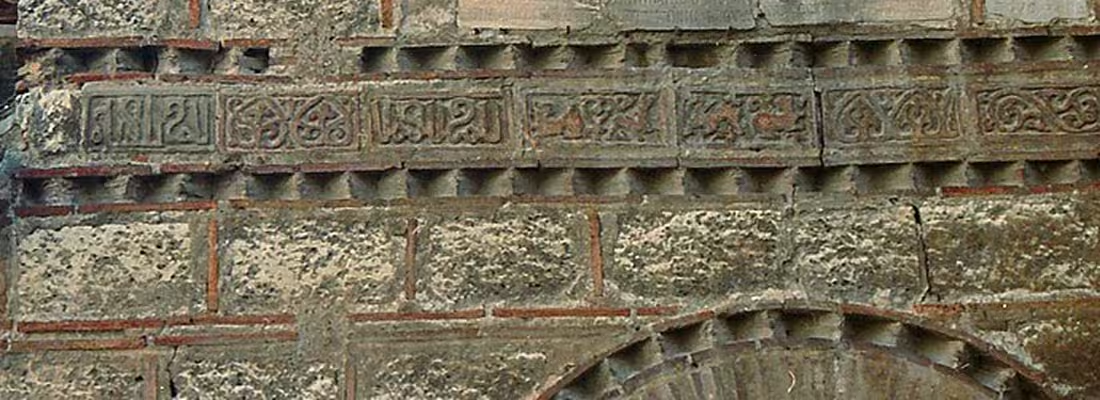
The walls are built in the Athenian cloisonné technique, with squared stones framed by bricks. The most striking ornament runs around the three arms of the cross: a frieze of terracotta plaques carved in champlevé, with the hollows once filled with white plaster, none of which survives. The west frieze has nine plaques in excellent condition, the north nine eroded ones, the south ten well-preserved ones. Brick ornament imitating Kufic script, the angular Arabic lettering, fills the spaces between the window arches of the apses and the dome. In the three windows of the main apse were set glazed ceramic bowls, believed to have been imported from Fatimid Egypt. The bowls are among the best Athenian examples of a fashion shared by churches of 11th-century Greece.
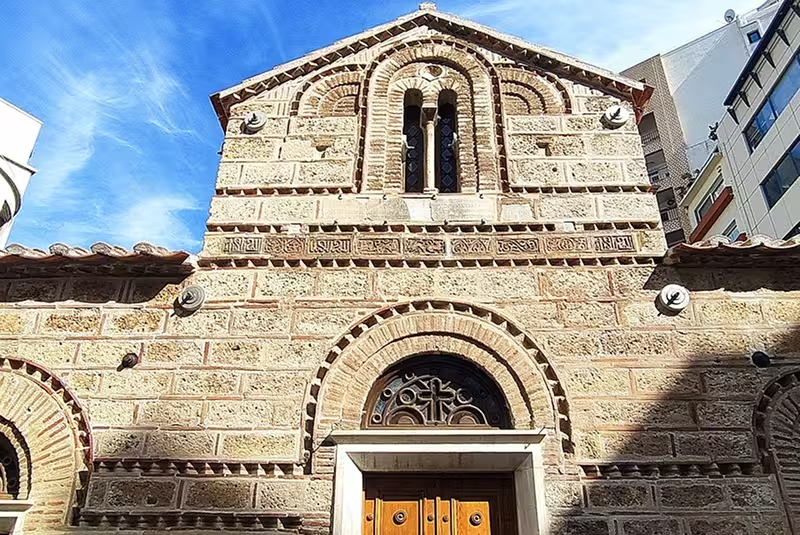
The friezes are not certainly original. George Miles suggested the façade frieze might be later than the building, while G. Nikolakopoulos dated the plaques, like the bowls, to the first half of the 11th century. Bouras notes that the friezes still deserve a detailed study.
The Hosios Loukas connection
Several details tie the church to the great monastery of Hosios Loukas in Boeotia. The double windows on all three sides of the main apse recall the katholikon there, and the string-course at the springing of the window arches has no known parallel outside the two churches of Hosios Loukas; at the Theodoroi it is plain and chamfered, while at Hosios Loukas it is carved. The double windows of the octagonal “Athenian” dome, with marble colonnettes at the corners and acanthus-carved imposts, compare with those of the Panagia at Hosios Loukas, the Holy Apostles in the Agora, the Taxiarchs at Charouda in the Mani and the demolished Panagia of Levadeia. The original marble door frame survives at the south entrance; the marble frame of the west door is modern.
The lost templon
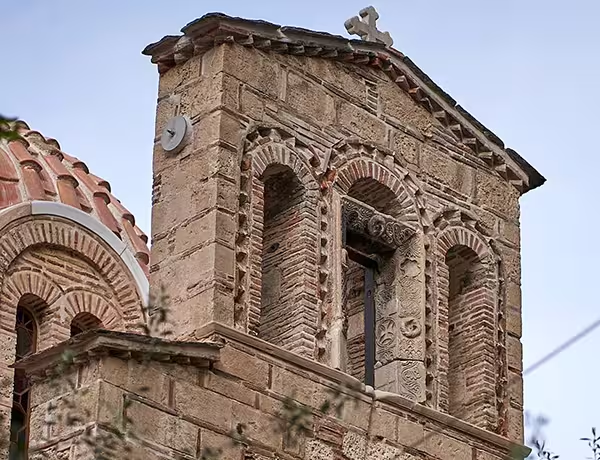
The church’s finest carving is not inside. Four marble pieces built into the modern belfry above the south arm come from the epistyle (the top beam) of the original templon, the marble screen in front of the sanctuary. Their decoration, unpublished before Bouras, is of exceptional quality: quatrefoils of pointed leaves set in squares, composite palmettes inside interlaced circles, and bosses of foliage separating the motifs. From the spacing of the surviving bosses (0.46 m) and the width of the sanctuary opening (3.70 m), Bouras reconstructs a beam with six bosses and a central figure, perhaps a cross, now lost. The palmette motif finds parallels at Hosios Loukas, in manuscripts and on the bronze doors of the Great Lavra on Mount Athos, all pointing to the late 10th or first half of the 11th century.
What lies beneath
Excavations by P. Lazaridis in 1967 showed that the church stands on the ruins of older buildings, possibly a Roman villa, and found sixteen graves older than the church. Graves had already been found under the floor. The site lay outside the Post-Herulian wall, the late Roman fortification that shrank Athens to a small area north of the Acropolis. Lazaridis reported no Middle Byzantine buildings around the church, which is one reason Bouras doubts that it was ever the main church of a monastery.
The church after Byzantium
Very little is known of the church between the 12th and the 19th centuries. A writer of 1876, Constantinides, claimed it was restored in 1558, a statement Megaw recorded without accepting. A photograph taken by Girault de Prangey in 1842 shows the dome windows blocked and the west door without its present marble frame.
Since Paul Durand, who recorded Athenian church paintings in 1842–1843, passed over the Theodoroi, Bouras concludes that whatever Byzantine or post-Byzantine wall paintings it had were already gone.
The church was stabilised after the War of Independence but, as Bouras notes with relief, not enlarged. The belfry was added around the mid-19th century. The Archdiocese of Athens credits King Otto and Queen Amalia with contributing to the repairs. In 1910 a new floor was laid and the interior plaster stripped, and the church received its present painted decoration in oils, in the taste of the time. Further excavation and conservation followed in 1967.
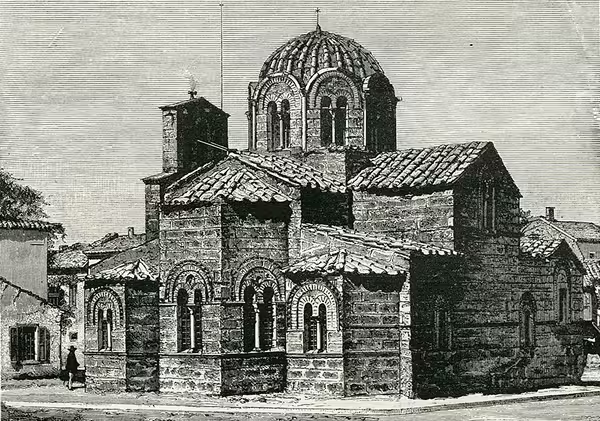
Drawing of the church in 1890 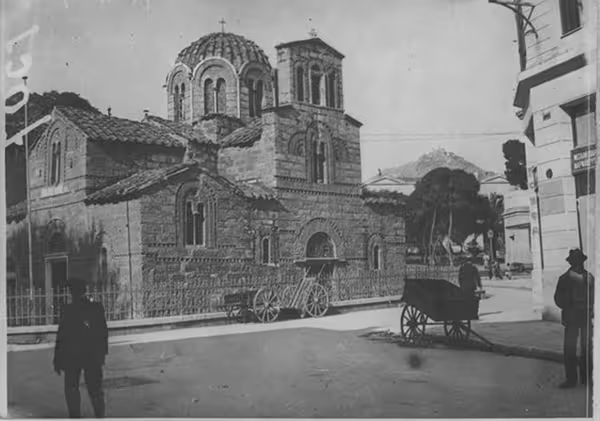
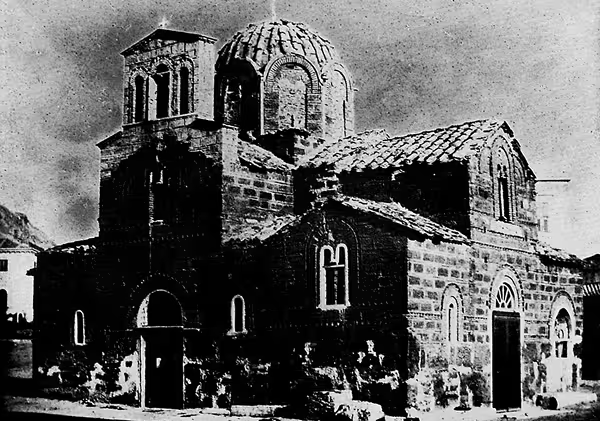
Picture of the church in 1917 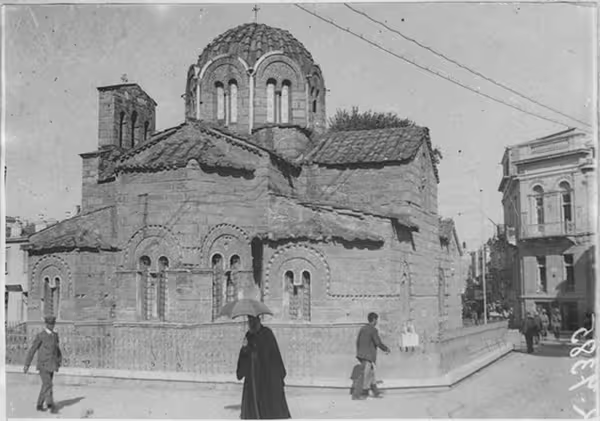
Picture of the church in 1917 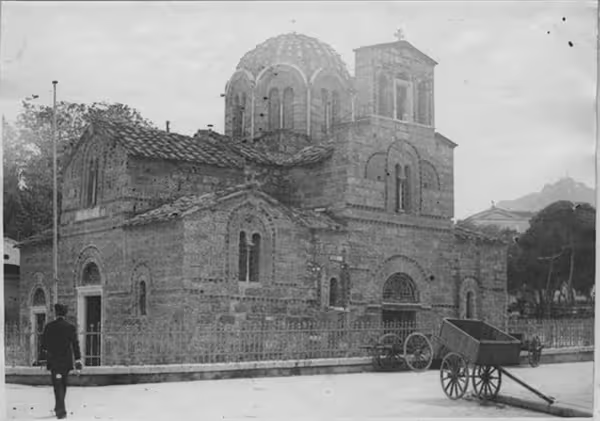
Picture of the church in 1917
A full restoration by the Ephorate of Antiquities of the City of Athens, funded through the regional programme “Attica 2014–2020”, ended in 2025. A crack had split the west wall from roof to foundation, most vaults were cracked, the roof tiles had decayed and the stone was black with soot. The team inserted steel reinforcements under the roofs, replaced the roofs and the lost marble parts of the dome, repointed the walls with mortar matching the original joints, cleaned the façades and the carved decoration, and took down, conserved and reset the inscription. The original glazed bowls, too fragile to leave in place, were replaced by copies. Inside, conservators removed a plastic covering from the marble floor and cleaned the paintings, the templon and the pulpit, revealing the interior as it looked in the late 19th century. The work was delayed by the pandemic and by repeated break-ins, one of which caused a fire. The church was reopened on 7 March 2025.
Open questions
1049, 1065 or later?
Current scholarship and the Ministry of Culture accept 1049. The alternatives are still repeated online: 1065, from Xyngopoulos’s reading of the dated stone, and a 12th-century rebuilding, from his view that the stone was unrelated to the present building. The debate turns on whether the dated slab belongs with the verse inscription, and on how the year and the indiction are read.
Parish church or monastery?
Some popular accounts present the Theodoroi as the katholikon of a monastery. Bouras thinks it probably was not, because the 1967 excavation found no Middle Byzantine buildings around it. The absence of evidence is not proof, since the excavation was limited.
One martyr or two?
The church is dedicated today to the two Saints Theodore, but Kalomalos’s poem addresses a single “martyr”. Some Greek sources identify him with Theodore Stratelates.
Are the ceramic friezes original?
Miles doubted it, Nikolakopoulos dated them to the first half of the 11th century. Bouras leaves the question open and calls for a dedicated study.
Unverified claims and traditions
Several statements about the church circulate without support in the specialist literature. A popular tradition holds that the earlier church was built by the empress Athenais-Eudokia; the same legend is attached to other Athenian churches, including Kapnikarea, and has no documentary basis. Greek popular articles describe the pseudo-Kufic ornament as “Arabic ideograms of the Koran”, but this is decorative lettering, not a legible text. Claims that the church was badly damaged in the battles of 1821 and that Roman mosaics were found under the floor in 1910 appear only in non-specialist sources. Finally, the description of the spatharokandidatos as an “imperial bodyguard” is anachronistic for the 11th century, when the title was an honorary court rank.
Other churches of the Saints Theodore in Athens
Theodore Tyron (“the recruit”), a soldier martyred at Amaseia in Pontus around 306, and Theodore Stratelates (“the general”), his hagiographic double, were among the most popular military saints of Byzantium. In the Greek Church they are celebrated together on the first Saturday of Lent, which commemorates the miracle of the kollyva: according to the story, the saint warned the bishop of Constantinople that Julian the Apostate had sprinkled the food in the markets with sacrificial blood, and told the faithful to eat boiled wheat instead. Athens had at least two other churches with this dedication.
The lost church of Nikis Street
In 1970, building work at 27 Nikis Street, a few minutes from Syntagma, uncovered the remains of a church with two phases. Only about a third of it could be studied, and the excavation was never completed. The later phase was a small single-aisled chapel with a semicircular apse, dedicated to the Saints Theodore, which survived until the War of Independence. The excavation report dates it to the 15th–16th century, and Bouras places it probably in the Ottoman period. It was built over the middle aisle of a larger three-aisled church, whose floor lay 1.10 m below street level and whose foundations partly rested on the outworks of the ancient city wall. The excavator dated this first church “before the 10th century”; it was well built, with reused ancient blocks taken from the wall. Bouras warns that the published reconstruction is uncertain, because the east wall shows no pilasters matching the division into aisles, and that nothing survives above foundation level to tell us its architectural type. A vaulted tomb reused as an ossuary was also found.
The church of the First Cemetery (1898–1902)
The third Athenian church of the Saints Theodore is modern, and its history shows how a city church was paid for and built in 19th-century Athens. In 1898 the old church of Saint Lazarus in the First Cemetery was judged too small and unsafe. A bequest from Penelope Chaldouvaki, a widow, of 21,116 drachmas in cash, 24 National Bank bonds and 200 silver five-drachma coins, was topped up by the city under mayor Lambros Kallifronas. The municipal engineer Armodios Vlachos reused the plans of the church of Saint George at the Rizarios School, built in 1878, for the new building. Construction by the contractor Georgios Ntavaris was troubled: the site proved too cramped, work was stopped, and councillors debated demolishing the half-built church. Completed in 1901 under mayor Spyridon Merkouris at a total cost of 54,196 drachmas against a budget of 36,118, it received a marble templon in 1902–1903, and its paintings are attributed to Polychronis Lembesis. The dedication to the Saints Theodore is first recorded in April 1901. Despoina Michalaga links it to the memorial service the municipality held for the dead each year on the last Saturday of the Souls since 1859, and to the feast of the kollyva, whose boiled wheat is the traditional offering for the dead.
Beyond Athens
The dedication to the Saints Theodore is relatively common and other Byzantine churches bear it in the area. The most famous church of the Saints Theodore near Athens is the Omorfi Ekklisia on Aegina, painted in 1289.
Visiting
The church stands in its own small square, Plateia Agion Theodoron, at the corner of Evripidou and Skouleniou streets, just west of Klafthmonos Square and a few minutes’ walk from Panepistimio metro station. Klafthmonos (“weeping”) Square owes its name to a joke by the chronicler Dimitrios Kambouroglou in 1878, about civil servants sacked after each change of government who gathered there to lament outside the ministry. The exterior, with its inscriptions, friezes and dome, can be seen at any time. The church is open for services and usually during the day on weekdays.
It fits easily into a walk with Kapnikarea on Ermou Street and the Soteira Lykodemou (Russian Church) on Filellinon Street. See our Byzantine Athens visitor guide.
FAQ
When was the church of Agioi Theodoroi in Athens built?
In 1049, according to an inscription on its west façade and the view of most scholars today. In the 1930s some read the date as 1065 or argued for a 12th-century building, but the 1049 date is now generally accepted.
Who built Agioi Theodoroi?
Nikolaos Kalomalos, a Byzantine dignitary with the court rank of spatharokandidatos. His verse inscription says he replaced an older church that was small, built of clay and in ruins, in thanks to the saint who had protected him since childhood.
Who are the Saints Theodore?
Theodore Tyron and Theodore Stratelates, two military martyrs of the early 4th century. The Greek Orthodox Church celebrates them together on the first Saturday of Lent.
Can you visit the church?
Yes. It is an active church near Klafthmonos Square, a short walk from Panepistimio metro, and reopened in March 2025 after a full restoration. The exterior can be seen at any time.
What is the Arabic-looking decoration on the walls?
It is pseudo-Kufic ornament, brickwork imitating the angular Arabic script called Kufic. It was a decorative fashion in 11th-century Greek churches and does not form a readable text.
Sources
- A.H.S. Megaw, “The Chronology of Some Middle-Byzantine Churches”, Annual of the British School at Athens 32 (1931–1932), pp. 90–130.
- A.H.S. Megaw, “The Date of H. Theodoroi at Athens”, Annual of the British School at Athens 33 (1932–1933), pp. 163–169.
- A. Xyngopoulos, “Αἱ ἐπιγραφαὶ τοῦ ναοῦ τῶν Ἁγίων Θεοδώρων ἐν Ἀθήναις”, ΕΕΒΣ 10 (1933), pp. 494–497.
- V. Laurent, “Nicolas Kalomalos et l’église des Saints-Théodore à Athènes”, Ἑλληνικά 7 (1934), pp. 72–82.
- K. Mentzou-Meimari, “Χρονολογημέναι βυζαντιναὶ ἐπιγραφαί”, ΔΧΑΕ 9 (1979), no. 88.
- P. Lazaridis, report on the 1967 works, Ἀρχαιολογικὸν Δελτίον 22 (1967), Chronika, pp. 154–156.
- “Ἐρείπια βυζαντινοῦ ναοῦ ἐπὶ τῆς ὁδοῦ Νίκης”, Ἀρχαιολογικὰ Ἀνάλεκτα ἐξ Ἀθηνῶν 3.1 (1970), pp. 29–34.
- D. Michalaga, “Ἱστορικὸ περίγραμμα τοῦ Ἱεροῦ Ναοῦ Ἁγίων Θεοδώρων τοῦ Α΄ Κοιμητηρίου Ἀθηνῶν”, Ἐπιστημονικὴ Ἐπετηρὶς τῆς Θεολογικῆς Σχολῆς τοῦ Πανεπιστημίου Ἀθηνῶν 35 (2000), pp. 685–698.
- Ch. Bouras, Byzantine Athens, 10th–12th Centuries, London and New York: Routledge / Athens: Benaki Museum, 2017, pp. 195–203 (Hagioi Theodoroi).
- Institute of Byzantine Research (NHRF), Byzantine Monuments of Attica, entry “Θεόδωροι, Άγιοι, Πλατεία Κλαυθμώνος”, online database.
- Hellenic Ministry of Culture, press release on the reopening of the church of the Agioi Theodoroi, 7 March 2025.