Theophano: From tavern to throne, the empress accused of killing three emperors
On the night of 10–11 December 969, a group of officers entered the imperial palace in Constantinople and killed Emperor Nikephoros II Phokas in his bedchamber. Could they have entered one of the most secluded part of the Great Palace without assistance? Several chroniclers say the empress helped them in. Her name was Theophano.
Several empresses bore that name. This one married Romanos II and then Nikephoros II Phokas, and she was the mother of Basil II. She is not Theophanu, the Byzantine princess who became empress in the West.
Theophano saw three emperors die around her within ten years: her father-in-law Constantine VII in 959, her first husband in 963 and her second husband in 969. Byzantine writers blame her, to varying degrees, for all three. She was also a commoner who reached the throne, a regent at twenty-two, and an exile who lived to see her sons rule.
Her story is well known in outline and thinly documented in detail. Most of it comes from authors who disliked her. This article follows her life through the men who shaped it, and it tests five accusations against the sources, one by one.
Three Theophanos, one name
Do not confuse her with two other famous empresses. The first Theophano was the wife of Leo VI and is venerated as a saint. Theophanu was the niece of John Tzimiskes. She married Otto II in 972 and became an empress in the west.
Key dates
c. 941
Theophano (Anastaso) born
Sept. 944
Romanos marries Bertha (Eudokia)
6 Apr. 945
Romanos crowned co-emperor
949
Death of Bertha
c. 956
Marriage of Romanos and Anastaso, renamed Theophano
958
Birth of Basil II
9 Nov. 959
Death of Constantine VII; Romanos II sole ruler
960
Birth of Constantine VIII
960–961
Nikephoros Phokas reconquers Crete
13 Mar. 963
Birth of Anna
15 Mar. 963
Death of Romanos II; Theophano regent
14 Aug. 963
Nikephoros Phokas enters Constantinople
16 Aug. 963
Nikephoros crowned
Sept. 963
Marriage of Theophano and Nikephoros
10–11 Dec. 969
Nikephoros murdered; Tzimiskes takes the throne
970 or Nov. 971
Tzimiskes marries Theodora
10 Jan. 976
Death of Tzimiskes; Theophano recalled
978
Last record of Theophano
Who tells her story? Sources and their limits
Five kinds of source shape what we know.
Leo the Deacon. His History covers the years 959 to 976. He wrote probably in the 990s, within living memory of the events. He gives the fullest narrative of the murder of Nikephoros II.
John Skylitzes. His Synopsis of Histories is the main source for the accusations against Theophano. He wrote in the late 11th century, about a century after her death, and he plainly disliked her as an upstart.
Theophanes Continuatus. This chronicle ends around 961. It covers the early years of Romanos II and records what happened to his sisters.
Later compilers. George Kedrenos (Cedrenus) relied on earlier writers. He preserves, for example, a remark about Romanos II’s first wife.
Other evidence. Seals and coins show her titles but say little about her actions. A tradition drawn from Georgian sources may place her at court in 978.
Open question: how far can we trust a hostile record?
Skylitzes and others wrote for readers who valued dynastic order and who looked down on a commoner empress. Many of the charges are rumours. For each one, ask three questions: who reports it first, how long after the event, and who gains from the story.
Origins and name (c. 941–956)
Theophano was born around 941. She was baptised Anastasia, and everyone called her Anastaso. Her father, Krateros, kept a tavern, according to the chronicles that disliked her. A kinder tradition makes him a wine merchant. One court panegyrist went further and gave her illustrious parents. That claim shows how much her origins embarrassed the court.
She received the name Theophano only when she married. Renaming a bride was usual. Romanos II’s first wife, Bertha, became Eudokia in the same way. The new name recalled Theophano, the first wife of Leo VI, who was venerated as a saint. It gave the newcomer a sacred and dynastic past.
Open question: where was she from, and what was her real social background?
Leo the Deacon, the earliest source, calls her a Laconian, that is, from the region around Sparta in the Peloponnese. Some modern accounts follow him and suggest the city itself. Others place her in a Constantinople tavern. The two versions can be reconciled. She may have been born in Laconia and come to the capital young, as many provincials did. No source says so.
The father’s trade is also contested. A tavern keeper and a wine merchant are not the same rank, though both are far below the court.
Wife of Romanos II, 956–963
An almost unreal love story
Romanos was born in 938 and crowned co-emperor on 6 April 945. In his case, marriage had already been a matter of state. His grandfather, Romanos I Lekapenos, wanted to marry him to Euphrosyne, a daughter of the general John Kourkouas, to bind the army to the dynasty. His Lekapenos uncles blocked the plan. In September 944 he married Bertha, a daughter of Hugh of Provence, king of Italy. She took the name Eudokia and died in 949. Kedrenos says she died a virgin.
Romanos fell in love with Anastaso around 956 and married her. He was then heir to the throne and a widower, and she had no rank, no family at court and no dowry.
How was such a marriage possible?
The Byzantines did not treat the empress’s birth as a legal matter. A woman became empress by coronation and by the patriarch’s blessing, not by blood. Several points explain why Romanos could do what he did.
No law forbade it. Roman law did forbid men of senatorial rank to marry actresses, but that rule was narrow and it had bent before. Nothing reserved the imperial bed for the aristocracy.
The dynasty had humble roots. Basil I, who founded the Macedonian dynasty in 867, began as a peasant and a stable hand. Romanos I Lekapenos, the grandfather who had once ruled for the boy Constantine VII, was a soldier of modest family. By 956 the court knew that the throne could change hands between social worlds.
Romanos was the heir. He had been co-emperor for eleven years, and his father, a scholar who left governing to others, had no easy way to undo a marriage once the patriarch and the ceremony had made it. Sources disagree on Constantine VII’s attitude. Some say he objected strongly. Others say he approved and celebrated the wedding in Hagia Sophia. Either way, the marriage stood.
Beauty counted. All sources agree on her looks. That was the only quality in her favour that her enemies could not deny.
Parallels: other outsiders who became empresses
Theodora, 6th century.
Justinian wanted to marry an actress. Roman law barred senators from doing so. His uncle, Justin I, changed the law after his own wife, Euphemia, who opposed the match, died in 524. Justinian married Theodora in 525, and she was crowned Augusta in 527. Our main source for her past, Procopius, wrote a hostile Secret History alongside his official praise. It is the same problem we face with Theophano: a scandalous tale from a writer with a grudge.
-> Read more about Theodora and her background in the Hippodrome of Constantinople.
The bride shows.
In 788 the empress Irene of Athens held the first recorded bride show to find a wife for her son Constantine VI. Imperial envoys toured the provinces, thirteen candidates gathered, and the winner was Maria of Amnia, a granddaughter of a provincial magnate. Another show is reported for Theophilos around 830, and one for Staurakios in 807, in which Theophano of Athens, a relative of Irene, was chosen. Historians disagree on whether these shows were real. Warren Treadgold defends them. Lennart Rydén argues they are literary inventions. Whatever the truth, the tradition shows that Byzantines thought a girl from a modest provincial family could become empress. What made Theophano shocking was the manner: she was chosen by a prince’s desire, outside any official process.
Mistresses made empresses.
Basil I married Eudokia Ingerina, the lover of his master Michael III. Leo VI made his mistress Zoe Karbonopsina his fourth wife, against the Church. Theophano’s rise was unusual, but the throne had seen it before.
The death of Constantine VII, 959 : the first accusation
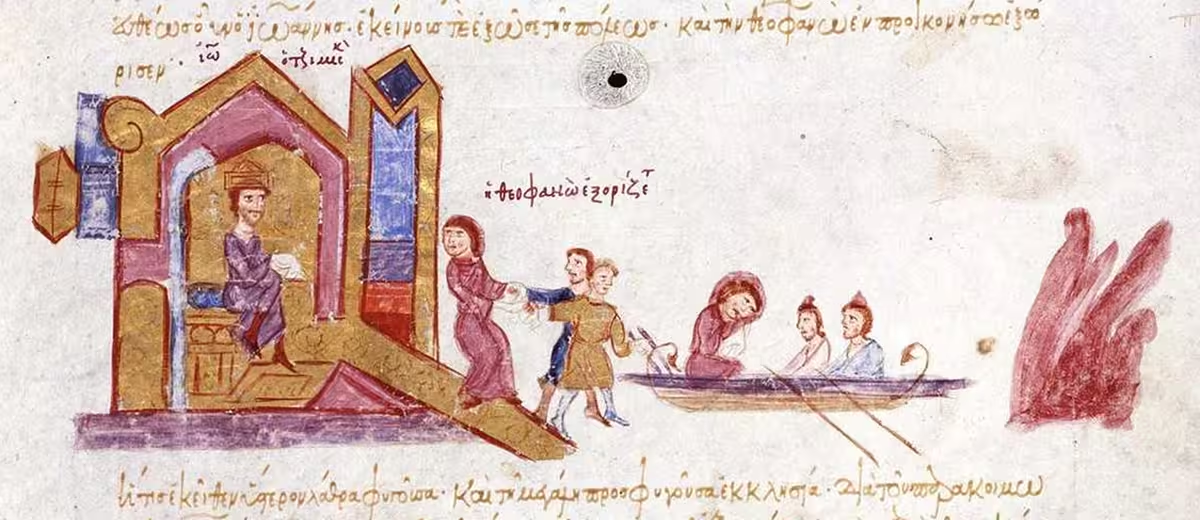
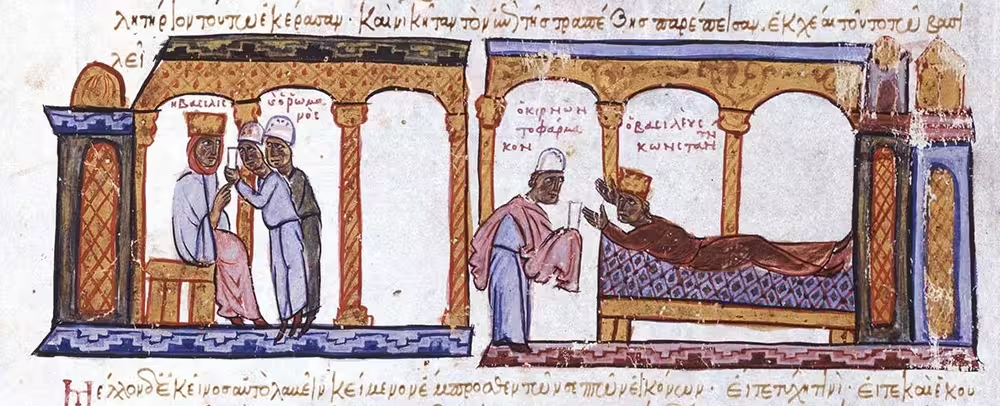
Constantine VII died on 9 November 959, and Romanos succeeded him. Rumour said Constantine had been poisoned, by his son or by his daughter-in-law. Skylitzes says Theophano tried to poison him, or took part in an attempt. Other accounts say he died after a fever that lasted several months. That does not look like poison, but was the first charge against her.
Emperor Romanos II, 959–963
Romanos kept some of his father’s closest men, such as Theodore of Dekapolis and Nikephoros Phokas. He gave the administration to the eunuch Joseph Bringas. Under Romanos, Nikephoros Phokas reconquered Crete in 960–961 and defeated the emir Sayf al-Dawla. He also recaptured Germanikeia and besieged Aleppo. Bringas ran a capable government, but the military aristocracy resented him.
Theophano’s two sons were born in these years: Basil in 958 and Constantine in 960. Her influence on her husband was great, and the chroniclers link her to two palace conflicts.
Conflicts with the in-laws
The first conflict was with Romanos’s mother, Helena Lekapene. Helena was no ordinary dowager. She was the daughter of Romanos I and the wife of Constantine VII, and she had acted as his adviser and co-regent. In 945 she had urged her husband to turn on her own brothers, Stephen and Constantine Lekapenos, and so had helped him regain the throne. She knew how palace coups worked.
Skylitzes says Romanos did not dare drive his mother out of the palace because he feared her curse. I have not read the passage itself. The curse in question is Helena’s. A parent’s curse was a serious matter in Byzantine religious culture, and an emperor who sent away his mother invited it. The sources disagree on the rest. Some say she left court. Others suggest she stayed. She died on 19 September 961.
The second conflict concerned Romanos’s five sisters: Zoe, Agatha, Theophano, Anna and Theodora. Romanos sent all five to the Kanikleion convent. Many chroniclers put the idea on Theophano. A probable reason lies in the politics of legitimacy, which we meet again below. Born in the purple, the princesses could give a husband a claim on the throne. Romanos I had used that very device when he married his daughter to Constantine VII. Locking the sisters away shut off that route for ambitious generals. It did not work for ever: Theodora would later marry John Tzimiskes.
The death of Romanos II, 963
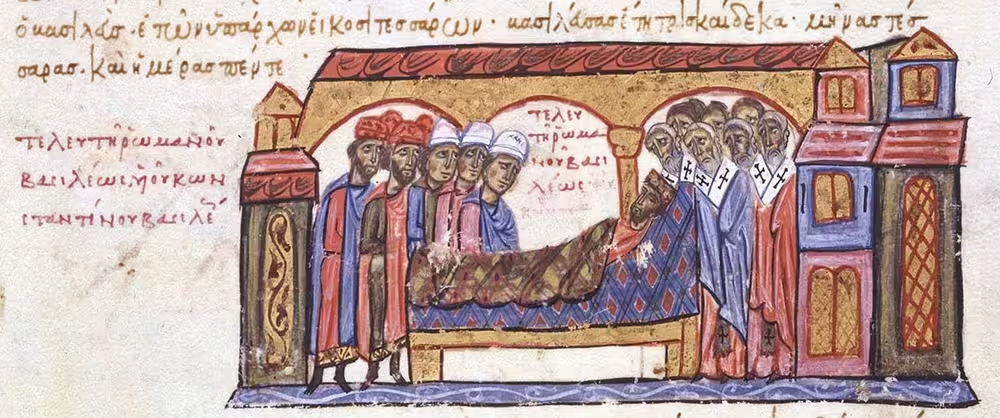
Romanos II fell ill after a long hunting trip and died on 15 March 963, in his mid-twenties. Two days earlier, on 13 March, Theophano had given birth to a daughter, Anna. Anna would later marry Vladimir I of Kiev.
Some chroniclers say Theophano poisoned him. Leo the Deacon and Skylitzes imply it. Others blamed his drinking and his way of life.
Open question: did Theophano poison her husband?
No source offers proof. The strongest argument against the charge is practical. As crowned Augusta, Theophano held a secure position. As a widow with infant sons, she faced rivals. On the day he died she was still recovering from childbirth. Poison would have cost her more than it gained. This is a reasoned doubt, not a proof. It still weighs against the story.
Widow and regent, March–August 963
Theophano became regent for Basil and Constantine, who were about five and three. Joseph Bringas controlled the government. Nikephoros Phokas, the general of the east, held the army. The two men were rivals.
The army proclaimed Nikephoros emperor at Caesarea. He entered Constantinople on 14 August after street fighting with Bringas’s supporters, and he was crowned in Hagia Sophia on 16 August. Theophano had backed him against Bringas.
He first sent Theophano to the Petrion palace. Soon afterwards, in September, he married her. He promised in return to protect her sons’ interests. The marriage also strengthened his claim to rule, since Theophano was the mother of the legitimate emperors.
Why Theophano could not rule alone, and why every pretender had to mary her?
Theodora was in no position to rule on her own right.
Basil was about five and Constantine about three. Both were crowned co-emperors, so the dynasty’s claim was secure. The question was who would govern for them. A regency by the empress mother had precedents: Zoe Karbonopsina had governed for Constantine VII from 914, and Theodora for Michael III from 842. Irene of Athens had ruled even without that excuse. But each of those regencies relied on strong allies, and Theophano’s position was weaker for several reasons :
– Succession was custom, not law. No rule guaranteed that two small boys would keep the throne. A strong adult could set them aside, and many had tried.
– The army. The empire was at war on several fronts. Phokas had just won Crete and beaten the Arabs in Cilicia, and the eastern troops were his. A woman could not lead an army in the field, and Bringas, a eunuch, could not be emperor and had no soldiers behind him.
– Her background and the court. Theophano was a commoner with no family in the palace and no network. The ministers who had resented her influence were now free to act. The patriarch, Polyeuktos, disliked her.
Marrying the empress was almost a necessity for every pretender.
Marriage to the widow gave a soldier something he could not win by arms: a place in the Macedonian house. The dynasty had ruled since 867, and its sons were the lawful emperors. A general who simply took the throne was a usurper. A general who married the empress mother became the stepfather and protector of the legitimate emperors.
The device was old. In 919 Romanos Lekapenos, an admiral, pushed Zoe Karbonopsina aside, married his daughter Helena to the boy Constantine VII, and rose in a year from regent to co-emperor. Nikephoros followed the same logic. He gave a sacred pledge to protect Theophano’s sons. He had no child of his own to set against them. Tzimiskes did the same after his coup. When the patriarch barred him from marrying Theophano, he married Theodora, a Macedonian princess by blood. That choice shows what he needed: not Theophano herself, but a link to the dynasty.
The pattern lasted. In the 11th century the porphyrogenita Zoe gave the throne to a succession of husbands in the same way. Theophano was an early case of a woman whose real value was her sons.
The murder of Stephen Lekapenos, Easter 963
The most puzzling of the accusations belongs to these weeks. Stephen Lekapenos was a son of Romanos I and co-emperor from 924 to 945. In December 944 he and his brother Constantine had arrested their father and shipped him to a monastery on the island of Prote. A few weeks later, on 27 January 945, Helena and Constantine VII turned the tables and sent the two brothers into exile.
Stephen lived out his life in exile, moving from Prote to Prokonnesos, to Rhodes and finally to Methymna on Lesbos. A plot to restore him was uncovered in December 947, and its members were mutilated. He died at Methymna on Easter Sunday, 18 April 963, a month after Romanos II.
Skylitzes says Theophano had him poisoned, to protect her sons by removing a possible claimant. The motive is credible. A former emperor was exactly the kind of figure whom plotters would raise during a minority. But the case has weak points. The source is single and hostile. Stephen was in his fifties and had been confined for almost twenty years. And in April 963 the real power lay with Bringas, who may have had as much reason as Theophano to want him gone. That last point is a hypothesis, not something the sources say. Hostile writers attributed several deaths in the imperial family to her, usually by poison, and the accusation fits a pattern.
Empress of Nikephoros II, 963–969
The Church objects
Patriarch Polyeuktos opposed the marriage. The charge was that Nikephoros had been godfather to one or more of Theophano’s children. That created a spiritual kinship, which barred marriage. The patriarch banned Nikephoros from the altar. Nikephoros’s father, Bardas Phokas, and another witness then testified that he had not been godfather to any of the children. Polyeuktos gave way.
Open question: was the godfather charge true?
Sources don’t allow us to tell. The testimony came from the Phokas family, which had every reason to give it. The charge may also have served as a pretext for a patriarch who disliked the marriage for other reasons. The sources do not settle the question.
A weakened influence
Theophano’s formal standing under Nikephoros was higher than under Romanos, but her real influence was likely smaller. Nikephoros was an austere soldier. He is said to have taken a vow of chastity after the death of his first wife. The Oxford Dictionary says he was ascetic, and that the marriage did not satisfy Theophano.
Nikephoros’s reign brought victories. His armies took Cilicia and Antioch, which fell in October 969, weeks before his death. They also brought unpopularity in the capital. His blunt manner hurt him at court and in diplomacy.
Theophano and John Tzimiskes
John Tzimiskes was Nikephoros’s nephew and a leading general. Theophano is said to have taken him as a lover. The chroniclers add that Tzimiskes was dismissed from his command and later recalled with her help. She then plotted with him against her husband.
Open question: were John and Theophano having an affair?
Once again, there is no conclusive evidence. Only hostile sources report it, and none is an eyewitness. The story is useful to a chronicler because it explains the plot with a simple motive. It may be true. It may equally be a literary device. The safest statement is that Theophano and Tzimiskes conspired, and that a love affair is possible but unproven.
The night of 10–11 December 969 and Phokas’ murder
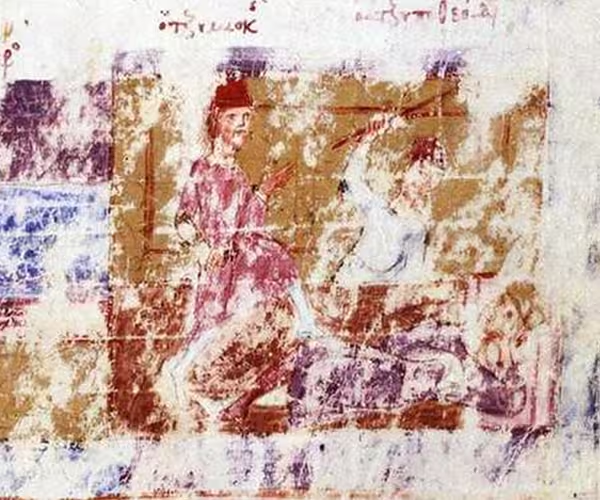
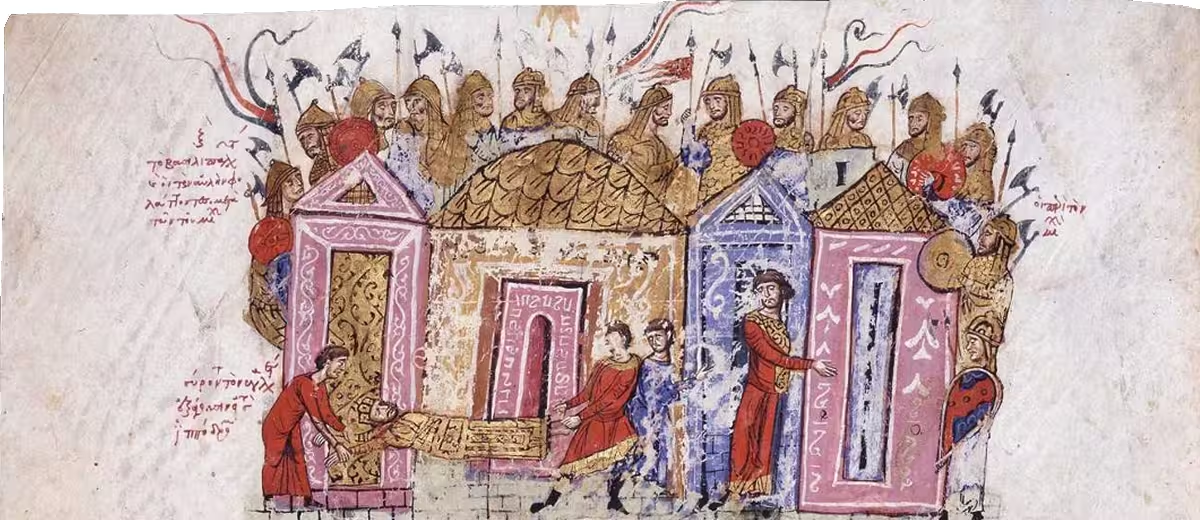
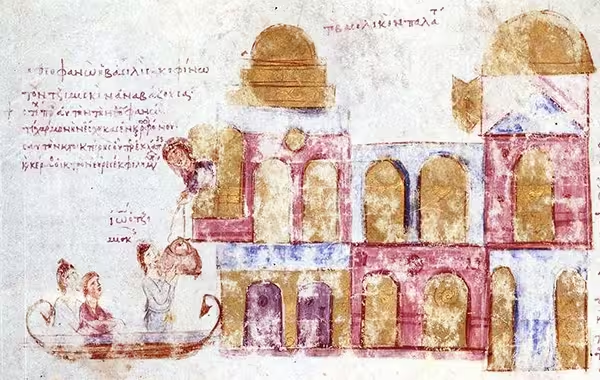
Tzimiskes crossed the Bosphorus in a storm. He entered the palace with help from inside and killed Nikephoros in his bedchamber with his fellow conspirators. Some sources state that Theophano helped Tzimiskes’s supporters to enter the emperor’s bedchamber, letting the doors opened behind hers. Later narratives add details, such as conspirators being hauled up in a basket by women of the household.
Open question: what was Theophano’s role in the assassination?
The murder of Nikephoros Phokas is the best-attested of the charges. Leo the Deacon and Skylitzes both give her a part. The patriarch’s reaction supports them, because he demanded her removal. But the sources do not say whether she planned the murder, joined it, or only made it possible. The extent of her role stays open.
Exile, 969–978
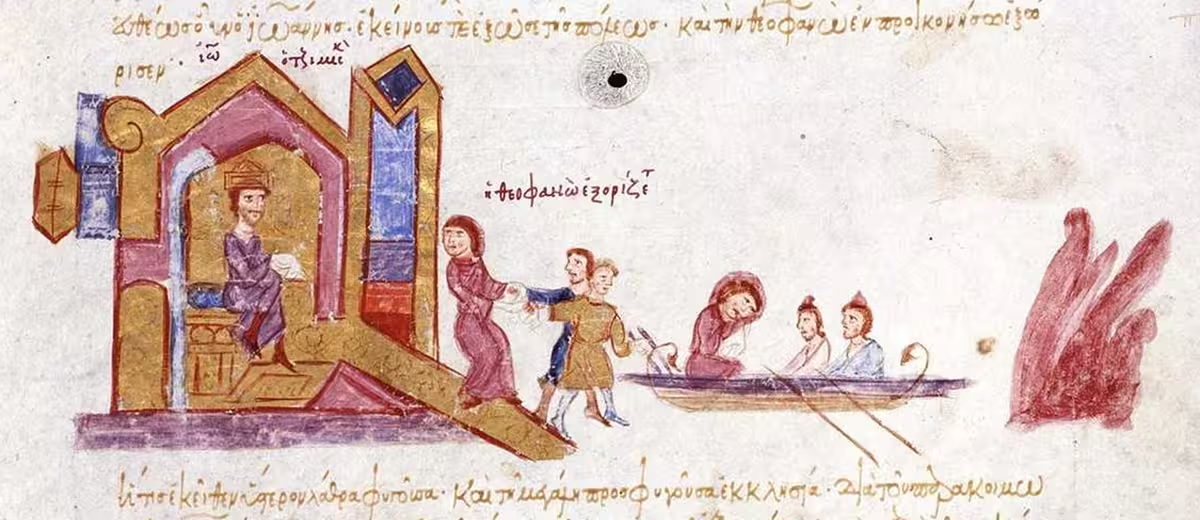
Tzimiskes expected to be crowned and to marry Theophano. Patriarch Polyeuktos set conditions. Tzimiskes had to do penance, punish the killers, remove Theophano from court and cancel Nikephoros’s church decrees. The official reason for removing her was that she had already married twice.
Tzimiskes banished her before his coronation, maybe to the island of Prokonnesos, likely in a convent as was the custom. Polyeuktos died about two months later. However, Tzimiskes never recalled Theophano.
Instead, he married Theodora, a sister of Romanos II, who belonged to the Macedonian dynasty and could also strengthen his claim to the throne. The mariage occured in 970 or in November 971. A satirical song describes Theophano’s failure in becoming the new empress. A few years later, Tzimiskes died on 10 January 976, triggering the last twist in Theophano’s life.
Return to court.
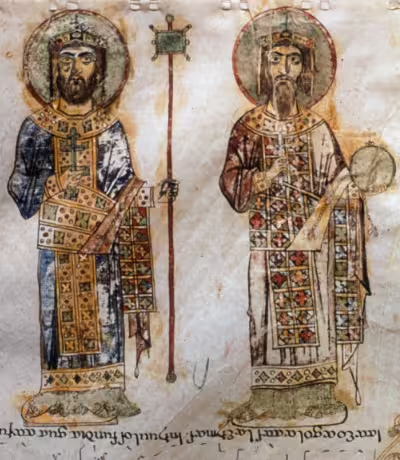
After his death, her sons Basil and Constantine took power, and one of their first acts was to recall their mother. We don’t know much about her later fate. She may have died in the same year, 976. Maybe she was still alive in 978, when a source claims she asked a retired Georgian general, T’ornik of Tao, to broker an alliance in support of her sons against the first revolt of Bardas Skleros. Her exact death date is unknown.
Her son Basil II ruled until 1025 Her son Basil II ruled until 1025 and became the dominant emperor of the age, as well as one of the greatest in Byzantine history. Constantine VIII ruled alone after the death of his brother. His daughters Zoe and Theodora were the last rulers of the Macedonian dynasty. Her daughter Anna Porphyrogenita married Vladimir of Kiev, triggering the Christianization of Kievan Rus.
The evidence table
Five accusations, and what the sources offer for each. The last column is my reading, for you to validate.
| Accusation | Source | Assessment |
|---|---|---|
| She tried to poison Constantine VII (959) | Skylitzes, a century later | Single hostile source. Unproven. |
| She took part in the murder of Stephen Lekapenos | Skylitzes (per the Oxford Dictionary) | Single source. Not enough to judge. |
| She turned Romanos II against his mother and sisters | Chroniclers of the period | Plausible for the sisters. The mother’s removal is disputed. |
| She poisoned Romanos II (963) | Leo the Deacon and Skylitzes imply it | Rumour. Weak motive. Unlikely. |
| She helped the conspirators kill Nikephoros II (969) | Leo the Deacon, Skylitzes, the patriarch’s demand | Best attested. Extent of role unclear. |
How historians judge her
Modern readers often repeat the chroniclers’ picture of a calculating woman who moved from one powerful man to the next. A second reading starts from her situation. She was a commoner, a widow at twenty-two or so, with two infant sons and no kin at court. She needed a military protector. Her alliance with Nikephoros fits that logic.
Our personal take: she was a woman of low birth who reached the highest position in the empire. Through her influence over her first husband, she succeeded in carving out a place for herself at court, making herself enemies in the process. After the death of Romanos, she became a widow at twenty-two or so, with two infant sons and no kin at court. She needed a military protector, and her alliance with Nikephoros fits that logic. Why exactly she decided to participate in the violent end of Phokas’ rule is uncertain, but she undoubtedly tried to navigate events to her advantage, to survive and secure her sons on the throne. She ultimately succeeded – but she also paid for it with exile and a reputation smeared by male historians who disdained her birth and certainly attributed to her more wrongs than she actually committed. But she remains in history as a fascinating character, and a striking figure among powerful Byzantine women.
Further reading
- Leo the Deacon, The History of Leo the Deacon, translated by A.-M. Talbot and D. Sullivan (Washington, 2005).
- John Skylitzes, A Synopsis of Byzantine History, 811–1057, translated by J. Wortley (Cambridge, 2010).
- L. Garland, Byzantine Empresses (London, 1999).
- J. Herrin, Women in Purple: Rulers of Medieval Byzantium (London, 2001).
- G. Schlumberger, Un empereur byzantin au dixième siècle: Nicéphore Phocas (Paris, 1890).
- G. Morgan, article in Byzantinische Zeitschrift 47 (1954), 292–97.
- Prosopographie der mittelbyzantinischen Zeit, entries on Romanos II and Anna (online).